
You arrive in Spain, you settle into a home or a hotel with a double bed, and you notice something strange about the pillows. Or rather, about the pillow, singular, because instead of the two separate pillows you expected, one for each person, there is a single enormous one stretching the entire width of the bed. It looks less like two pillows and more like one very long bolster, and it is meant to be shared by both people sleeping there, their two heads resting side by side on the same continuous cushion. This is the almohada matrimonial, the matrimonial pillow, and it is one of those small, endearing details of Spanish domestic life that nobody thinks to mention to a newcomer, right up until the moment you find yourself sharing a pillow with your partner and wondering, gently, how on earth this is supposed to work.
The almohada matrimonial is a delightfully charming quirk of Spanish beds, and once you know about it you start noticing it everywhere, in homes, in hotels, in the bedding aisles of Spanish shops where the long pillowcases sit alongside the ordinary ones. It is a small thing, easy to overlook, and yet it says something rather sweet about how Spanish couples think about sleep and closeness. It is also, if we are honest, a source of a certain amount of gentle nightly negotiation, which is part of what makes it so charming to discover. There is something disarming about a custom whose main drawback is that it forces two people to be considerate of each other in the dark. Most cultural quirks a traveler encounters are matters of food or manners or timing. This one reaches all the way into the most private and unguarded hours of the day, and asks, quietly, that a couple learn to move as one even in their sleep.
Here is what the almohada matrimonial actually is, why Spanish couples sleep this way, the small comedy of coordination it produces, and what it quietly reveals about a certain idea of togetherness. This is a light look at a lovely cultural custom rather than anything more, and every couple and household differs, but the single long pillow of the Spanish double bed is one of those small discoveries that makes living in or visiting another country such a delight.
The Pillow That Surprises Everyone
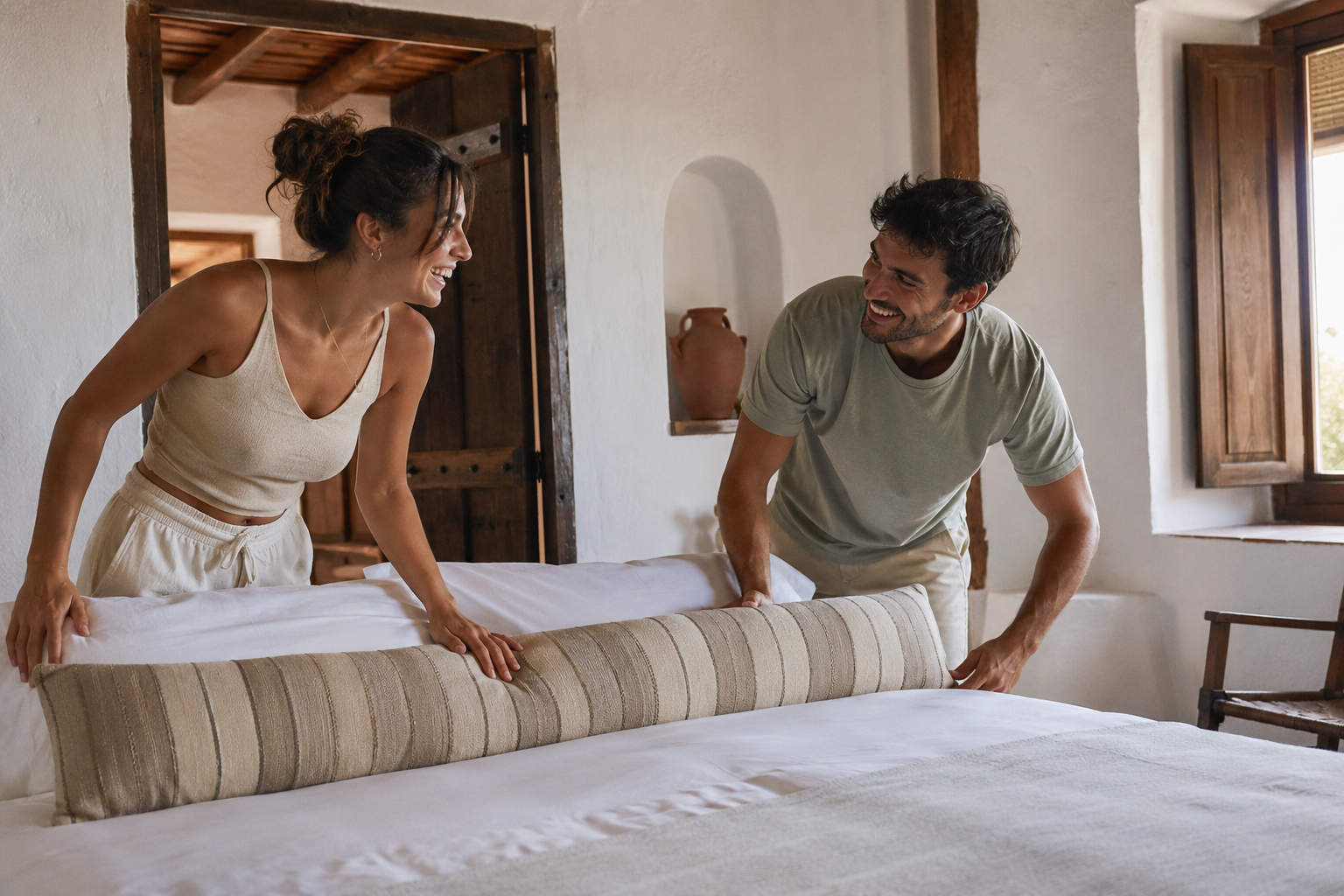
The first thing to understand is just how universal and how unexpected this custom is, because it is not a rare eccentricity but a standard feature of Spanish beds that nonetheless catches nearly every foreigner off guard. The surprise is part of the charm.
The setup is consistent across Spain. On a Spanish double bed, the default is very often not two individual pillows but a single long one running the full width, a shared cushion designed for two people to rest their heads on together, so what a newcomer expects to be a pair turns out to be one continuous whole. It is simply how a great many Spanish beds are made up, in homes and hotels alike.
And it reliably astonishes visitors. Foreigners arriving in Spain are frequently baffled by the single long pillow, having grown up in cultures where each sleeper gets their own, so the discovery of the shared pillow is a small but memorable moment of cultural surprise, the kind of thing people remember and mention for years. There is even a whole genre of bemused expat storytelling devoted to it, the newcomer marveling that a bed for two could come with a pillow for one. The reactions tend to follow a familiar arc, from initial confusion, through a phase of mild irritation at the logistics, to a grudging and then genuine fondness for the thing. Many who arrive convinced they will replace it at the first opportunity find, months later, that they have quietly made their peace with it, and some even come to prefer it, which is perhaps the surest sign that there is more to the custom than mere inertia.
What the Almohada Matrimonial Actually Is
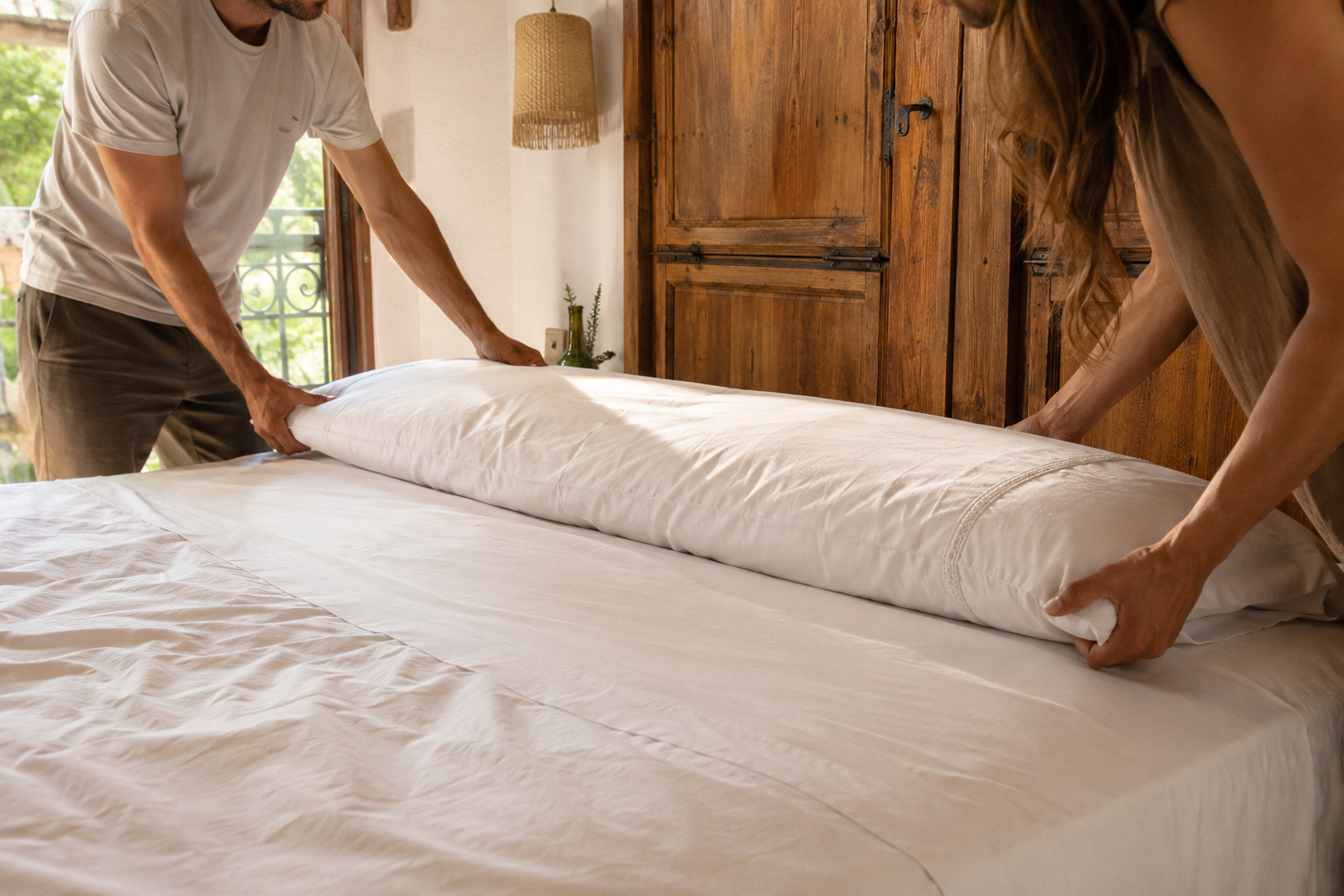
To picture it properly, it helps to understand exactly what this pillow is and how it differs from what most foreigners are used to, because it is a genuinely distinct object rather than just a big pillow. Its shape and purpose are specific.
It is essentially a long bolster. The almohada matrimonial is a single elongated pillow, much longer than a standard one, made to span the width of a double bed so that two people can lie on it side by side, so it functions rather like a body pillow, only positioned horizontally at the head of the bed. Its whole design assumes two heads sharing one surface.
The name itself tells the story. It is called the almohada matrimonial, the matrimonial pillow, to match the cama matrimonial, the Spanish double bed meant for a couple, so the pillow and the bed share a name rooted in the idea of two people sleeping together. That word, matrimonial, threads through the whole vocabulary of the Spanish couple’s bed, quietly framing it as a space of shared life rather than two separate sleeping stations pushed together. It is a small linguistic detail, but a telling one, because the language a culture uses for its beds reveals something about how it imagines the people in them. Where some traditions think first of individual comfort and personal space, the Spanish vocabulary of the bed keeps returning, gently, to the couple as a unit, to the marriage as the thing the bed is built around.
Why Spanish Couples Sleep This Way

The natural question a foreigner asks is simply why, why share one pillow when two would seem so much more practical, and the answer lies partly in habit and partly in a particular idea of closeness. It is a custom people grow up inside.
For most Spaniards, it is simply normal. The single long pillow is what many Spaniards have slept on their whole lives, the way beds have always been made in their homes and their parents’ homes, so it is not a deliberate choice so much as an inherited default that feels entirely natural to those raised with it. Most people do not question the way their own beds were always made, and for many Spaniards two separate pillows on a double bed would look slightly odd.
There is also a quiet symbolism to it. Sharing a single pillow places two people literally on the same surface through the night, their heads close together on one continuous cushion, which carries a gentle sense of togetherness that two separate pillows, however practical, simply do not, so the custom can be read as a small daily emblem of a shared life. Whether or not Spanish couples think of it that way consciously, there is something companionable in the design, two people meeting in the middle of the same soft expanse. You do not have to be sentimental to feel it. There is a simple, physical fact of intimacy in resting your head where your partner’s head also rests, night after night for years, on the same worn and familiar surface. Objects that a couple shares so completely and so continuously tend to gather meaning quietly over time, and the shared pillow, humble as it is, gathers a good deal.
The Small Comedy of Coordination
Now for the part that every newcomer discovers within about one night, which is that sharing a single pillow with another person involves a certain amount of delicate, half-comic negotiation. This is the almohada matrimonial’s great practical challenge, and its most endearing feature.
The trouble is that the pillow moves as one. Because both people are resting on the same continuous cushion, any adjustment one person makes affects the other, so flipping it to the cool side or folding a corner up to read becomes a joint operation that ideally require a bit of coordination between the two sleepers. You cannot simply plump your own pillow when it is also your partner’s pillow.
This leads to gentle nightly comedy. Anyone who has shared one knows the particular sensation of having the pillow subtly tugged out from under your head as your partner rearranges their side, or of lying very still so as not to disturb a sleeping partner’s half of the cushion, so the shared pillow becomes a small ongoing exercise in consideration and compromise. It is the kind of minor domestic friction that couples end up laughing about, a nightly negotiation conducted mostly in the dark and mostly without words. Over time, couples who share one develop a whole unspoken choreography around it, an instinct for when the other is settling in or turning over, a reflexive stillness that keeps the shared surface steady. It becomes, without anyone deciding it should, one of the small physical languages of a relationship, learned so gradually that neither person quite notices they have learned it.
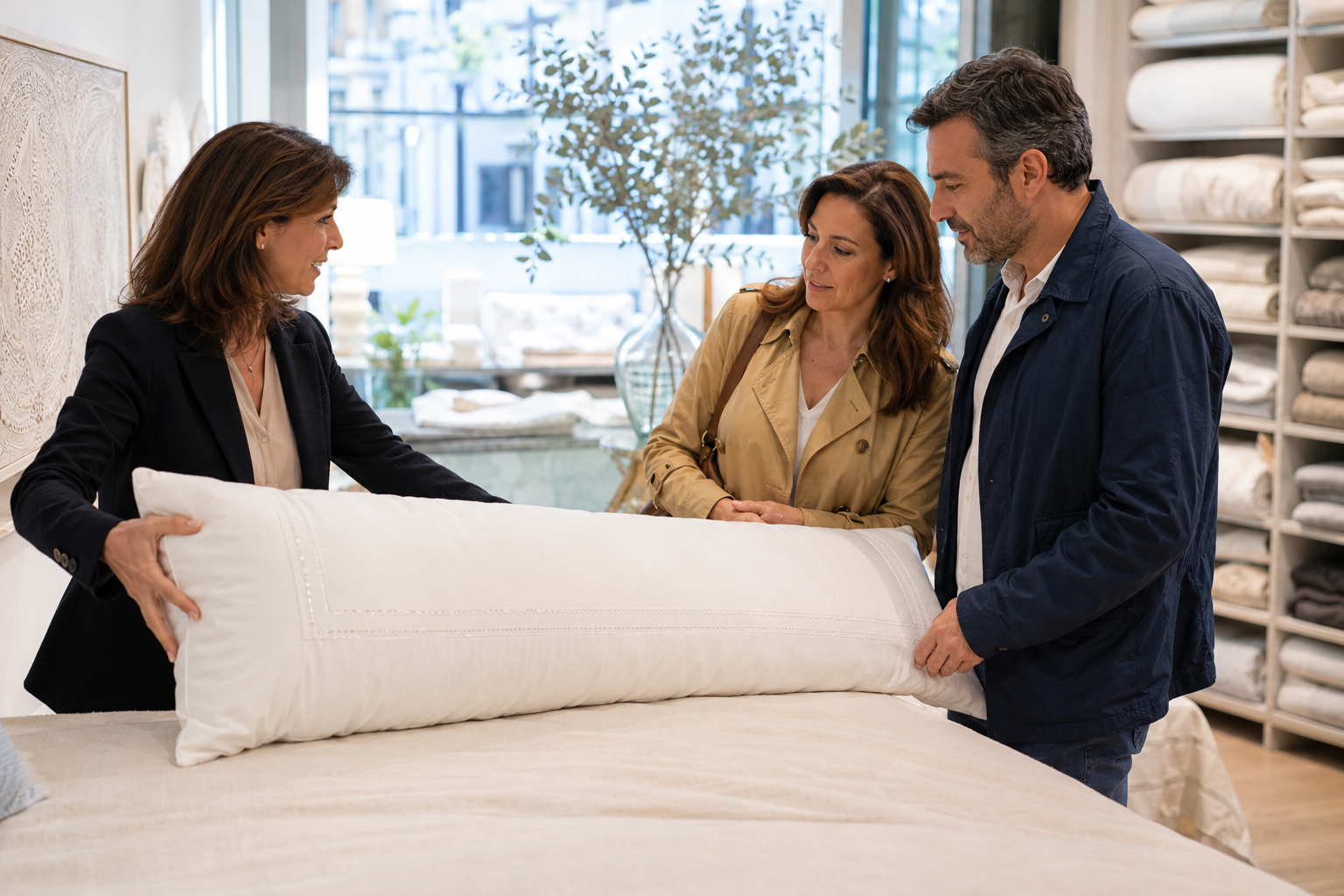
The Togetherness Built Into the Bed
Look a little deeper and the almohada matrimonial starts to seem like more than a bedding choice, hinting at a whole gentle philosophy of closeness that runs through the Spanish idea of the couple’s bed. It is togetherness quietly built into the furniture.
The shared pillow resists separation by design. Where two separate pillows allow two people to carve out their own distinct territories on a bed, a single shared one keeps them, quite literally, on common ground, so the custom subtly encourages closeness and shared space rather than individual zones. It is hard to retreat entirely to your own side when your head rests on the same pillow as your partner’s. Two separate pillows quietly permit a kind of separateness, a small nightly declaration that this half is mine and that half is yours. The single long pillow refuses that division. It insists, in its gentle way, that the bed is one shared thing rather than two adjoining territories, and that whatever the day has held, at night the couple returns to common ground.
This fits a broader warmth in Spanish domestic life. Spanish culture tends to prize closeness, family and shared physical space, and the single pillow of the marriage bed sits comfortably within that, a small furnishing expression of a larger disposition toward togetherness, so the almohada matrimonial can be seen as of a piece with a whole affectionate way of living. It is a tiny thing, but it points in the same direction as much else in Spanish home life, toward warmth and shared presence over separateness.
When Practicality Pushes Back

It is worth acknowledging that the almohada matrimonial is not universally beloved, and that a fair number of people, Spaniards included, find its practical drawbacks reason enough to abandon it. The custom is charming but not without its critics.
Plenty of couples opt out. Some sleepers, foreign and Spanish alike, find the coordination too much of a nuisance and switch to two pillows on their double bed, prizing the freedom to flip and fold their own without disturbing anyone, so the custom is a strong default rather than an unbreakable rule. No one is obliged to share a pillow, and many happily do not.
Modern beds are gently loosening the grip of the custom, too. As Spanish beds have grown larger over the years, with wider mattresses becoming more common, the practical case for two pillows strengthens, so the single long pillow, while still very much alive, shares the bedroom increasingly with the two-pillow arrangement familiar elsewhere. Like many old customs, it persists most strongly out of affection and habit rather than necessity, which is arguably the nicest reason for a custom to survive. A tradition kept alive by practicality alone tends to vanish the moment something more convenient comes along, but one kept alive by affection can outlast every practical objection, precisely because the people who love it are not really weighing its convenience at all. The almohada matrimonial belongs firmly to that second, hardier category, which is why, for all the wider beds and the easy availability of ordinary pillows, it shows no real sign of disappearing from Spanish bedrooms.
A Small, Sweet Discovery

The lasting charm of the almohada matrimonial is that it is exactly the sort of tiny, unexpected detail that makes encountering another culture such a pleasure, a small domestic custom that reveals, in the space of a single pillow, a whole gentle attitude toward closeness and shared life. It is the kind of thing no guidebook warns you about and no one thinks to explain, discovered only by living it.
What makes it worth knowing, beyond the simple surprise, is how much warmth is folded into so ordinary an object. The single long pillow of the Spanish double bed turns the most basic act of sleep into a small nightly gesture of togetherness, two people sharing one surface, coordinating in the dark, meeting quite literally in the middle, which is a rather lovely thing to build into the furniture. Even its little frustrations are the frustrations of closeness, of two lives pressed companionably together. That, in the end, is what makes it worth writing about at all. A pillow is about the most ordinary object imaginable, and yet the Spanish way with it manages to say something about how a whole culture pictures the shared life of a couple, quietly and without any fuss. The best cultural details are often exactly like this, small and domestic and easy to miss, and all the more charming for being so.
So the next time you find yourself in Spain facing a double bed dressed with a single impossibly long pillow, do not go hunting for its missing partner. Recognize it for what it is, the almohada matrimonial, a small emblem of the Spanish idea of shared sleep, and give it a try. You may find the coordination a comedy at first, but you may also come to feel the quiet companionship built into it, the sense of two heads resting on common ground, and understand why so many Spanish couples would not dream of sleeping any other way.

About the Author: Ruben, co-founder of Gamintraveler.com since 2014, is a seasoned traveler from Spain who has explored over 100 countries since 2009. Known for his extensive travel adventures across South America, Europe, the US, Australia, New Zealand, Asia, and Africa, Ruben combines his passion for adventurous yet sustainable living with his love for cycling, highlighted by his remarkable 5-month bicycle journey from Spain to Norway. He currently resides in Spain, where he continues sharing his travel experiences with his partner, Rachel, and their son, Han.