
Watch a Spanish cook deal with a tomato and you will witness something quietly ingenious. Instead of blanching it in boiling water to loosen the skin, shocking it in ice, slipping off the peel, and chopping the flesh the way so many American recipes instruct, they simply cut the tomato in half and grate the cut face against the coarse holes of a box grater over a bowl. In seconds, the soft flesh and juice fall through as a smooth pulp while the skin flattens harmlessly in their palm, ready to be tossed aside. That is the whole method, and it produces perfect skinless tomato pulp with none of the fuss, which is exactly why Spaniards reach for it constantly and American recipes so often overlook it.
The grated-tomato technique, tomate rallado, is one of those brilliant everyday shortcuts that makes you wonder why you ever did it any other way. It gives you fresh tomato pulp with no blanching, no ice bath, no peeling, no chopping, in a fraction of the time the traditional method demands. It is the secret behind Spain’s beloved pan con tomate and the quiet workhorse behind countless Spanish sauces and sofritos, and once you learn it, you will find yourself grating tomatoes for everything.
Here is how the grated-tomato technique works, why it is so much better than peeling, what Spaniards use it for, and a classic recipe that shows it off perfectly. This is a simple piece of practical kitchen wisdom rather than anything difficult, and the whole technique takes seconds to learn, but it is exactly the kind of small, clever method that quietly transforms how you cook with tomatoes.
How the Technique Works
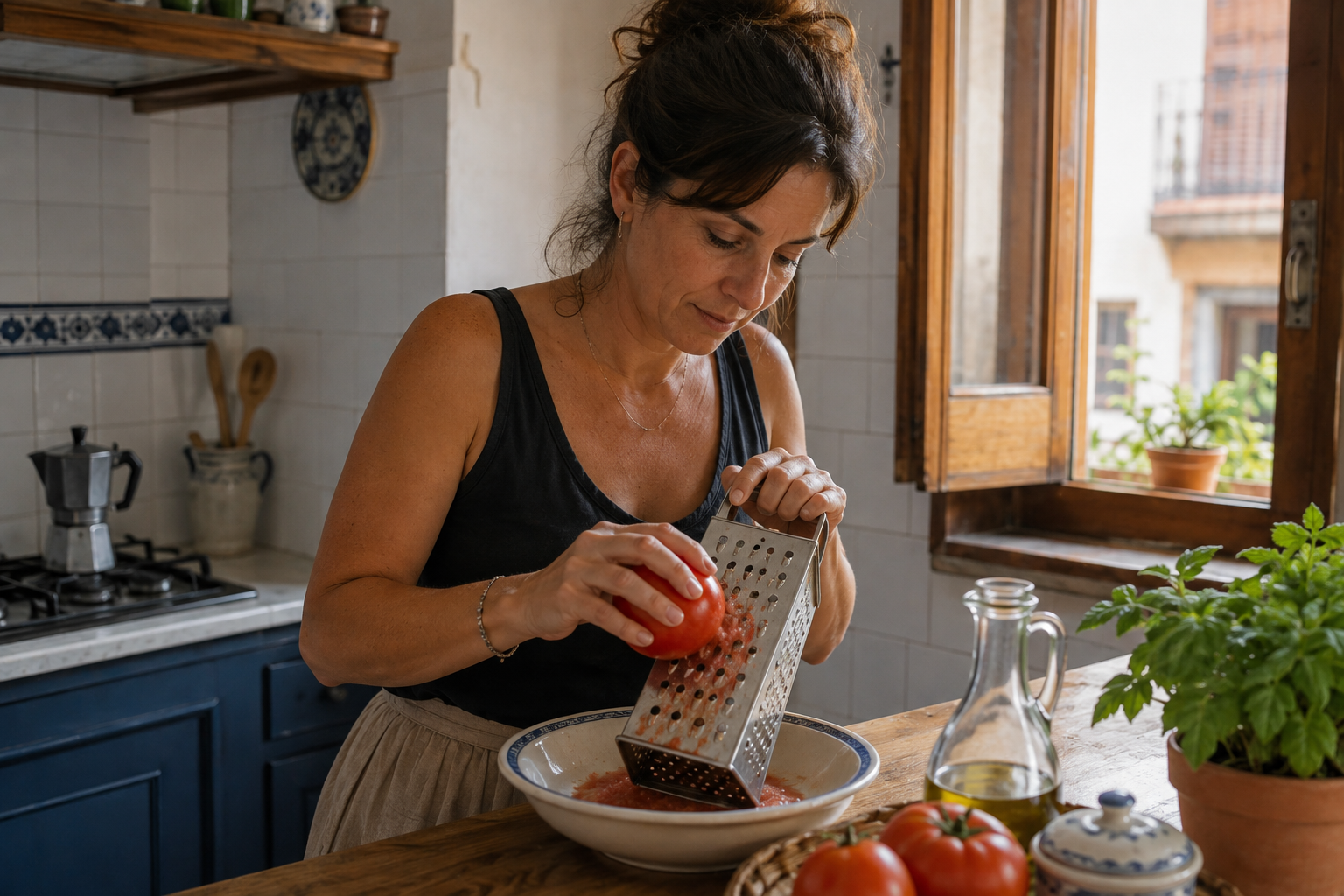
The grated-tomato method is beautifully simple, and the whole thing rests on a single clever action, grating the cut face against the grater so the flesh passes through while the skin stays behind. You cut a ripe tomato in half across its middle, hold a half in your palm with the cut side facing the grater, and rub it up and down over the large holes with the tomato held against them, letting the pulp fall into a bowl below.
What happens next is the small piece of magic. As you grate, the soft juicy flesh of the tomato is shredded and pushed through the holes into the bowl as a smooth pulp, while the skin, too tough and flat to pass through, simply flattens out against the grater and remains in your hand, so that when the flesh is gone you are left holding nothing but the empty peel. You discard that skin, and the bowl below holds perfect, fresh, skinless tomato pulp. The first time you do it, the effect is almost startling, because it seems too easy to be right. You brace for the fiddliness of peeling and instead the whole thing is over in a few passes of the grater, the skin peeled away into your hand as if by sleight of hand. Cooks who have spent years blanching and slipping skins tend to feel a small pang of regret at all the effort they need never have spent.
The result is exactly what many recipes go to great lengths to produce. In one quick motion you have separated the tomato flesh from its skin and reduced it to a smooth pulp, achieving in seconds what blanching and peeling and chopping achieve in many minutes, with less mess and less waste. The grater does the peeling for you, effortlessly, which is the whole genius of the method.
Why It Beats Peeling
The traditional way to skin a tomato is a genuine chore, and understanding just how much work the grating method saves shows why Spaniards never bothered with the alternative. To peel a tomato the classic way, you score it, plunge it into boiling water, shock it in ice water, slip off the loosened skin, then core and chop it, a multi-step process involving a pot of boiling water, a bowl of ice, and several minutes of fiddly work.
The grating method sweeps all of that away. There is no pot to boil, no ice bath to prepare, no scoring or blanching or shocking, and no chopping, just a tomato, a grater, and a bowl, with the entire job done in the time it takes to grate one tomato half. For a cook who wants fresh tomato pulp, the time and effort saved over the traditional peeling method is considerable, and the result is arguably better.
There is a quality argument too, not just a convenience one. The grating method captures all the tomato’s juice along with its flesh, losing nothing to a pot of water, and it yields a fresh, raw pulp with a bright flavor that blanching can dull, so the shortcut is not a compromise but often an improvement. You get more of the tomato, more of its flavor, and more of its fresh character, in less time and with less mess, which is a rare combination. It is worth appreciating that convenience and quality usually pull in opposite directions in the kitchen, the faster method giving the poorer result. The grated tomato is one of the uncommon cases where the shortcut is also the better technique, saving effort while capturing more of the raw tomato’s brightness than the laborious blanch-and-peel ever could. That is why it endures as a genuine cook’s method rather than a lazy compromise.
Why the Skin Comes Off So Easily

The reason the technique works so cleanly comes down to the different textures of the tomato’s flesh and its skin, which respond very differently to the grater. The soft, juicy inner flesh of a ripe tomato is easily shredded and pushed through the holes of the grater, while the skin is tough, thin and flexible, unable to be forced through and instead sliding flat against the surface, so the grater neatly divides the one from the other.
This is why ripeness matters so much to the method. A properly ripe tomato has soft, yielding flesh that grates effortlessly into pulp, so the riper and juicier the tomato, the better it works, while an underripe, firm tomato is harder to grate and gives a poorer result. The technique is at its best in high summer, when tomatoes are at their ripest, which is not coincidentally when Spaniards use it most.
The physics of it also explains why you hold the tomato the way you do. Because the flesh grates away and the skin remains, you naturally end up gripping the flattened skin as a kind of handle by the end, which conveniently keeps your fingers away from the grater as the flesh disappears, though a little care is always wise near those sharp holes. The method works with the tomato’s own structure rather than against it, which is why it feels so effortless.
What Spaniards Use It For

The most famous use of grated tomato is the beloved Spanish dish pan con tomate, where the technique is essential rather than optional. In this simple, iconic dish, grated fresh tomato is spread over toasted, garlic-rubbed bread and finished with olive oil and salt, and the grated pulp is exactly what makes it work, giving a fresh, juicy tomato topping that a chopped tomato could never provide.
But grated tomato reaches far beyond that one dish. Spanish cooks use grated tomato as the base for a huge range of sauces and sofritos, the foundational cooked tomato-and-onion base that begins so many Spanish dishes, because the grated pulp gives a smooth, skinless tomato base with no extra work, ready to cook down into a sauce. Rice dishes, stews, braises and countless everyday recipes begin with grated tomato in Spanish kitchens. The paella that starts with a sofrito, the stew that needs a tomato base, the quick pasta sauce on a weeknight, all of them lean on the same effortless grate rather than a can or a laborious peel.
This versatility is what makes the technique so worth having. Any time a recipe calls for peeled tomatoes, chopped tomatoes for a sauce, or fresh tomato pulp of any kind, grated tomato does the job faster and often better, so the single simple skill unlocks a whole category of cooking. Once you can grate a tomato, you have a fast, fresh, skinless tomato base ready for toast, sauce, rice, stew, or anything else, which is why it is such a staple of the Spanish kitchen. This is the deeper reason the technique is worth learning, that it is not a trick for one dish but a foundation for many. The grated tomato is a starting point, a versatile fresh base that flows into an enormous range of cooking, so mastering the single motion quietly upgrades your whole repertoire of tomato-based dishes at once. Few kitchen skills return so much for so little effort to acquire.
The Little Details That Help
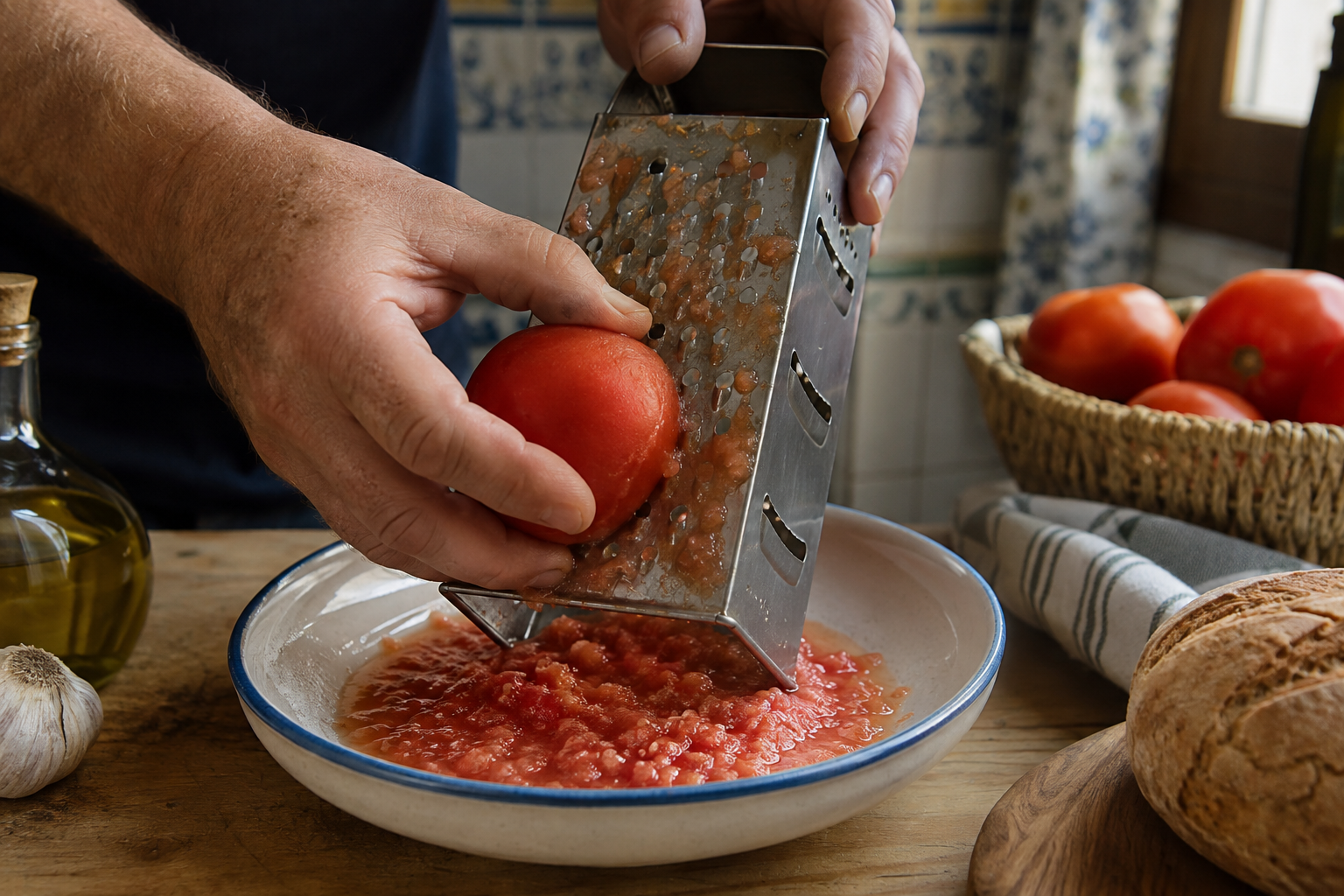
A few small refinements make the technique work even better, and the first concerns how watery your pulp turns out. Depending on the tomato, the grated pulp can be quite juicy, and for uses like pan con tomate you can let it drain briefly in a sieve, without pressing on it, to shed some excess liquid, while for a sauce that extra juice is welcome and needs no draining.
The choice of tomato and grater matters too. A ripe, flavorful tomato is essential, since the whole dish or sauce depends on it, and the large or coarse holes of a standard box grater are the right ones to use, giving a proper pulp rather than a fine purée. Set the grater in or over a bowl to catch everything, and you are ready to go with the simplest possible equipment.
A little safety awareness rounds it out. Because you are grating a shrinking piece of tomato against sharp holes, it is worth keeping an eye on your fingers as the flesh disappears and you are left with just the skin, stopping before you grate your palm, which is the one small hazard of an otherwise foolproof method. With that minor care taken, the technique is about as easy and reliable as any in the kitchen.
A Recipe That Shows It Off
There is no better way to appreciate grated tomato than to make pan con tomate, the Catalan classic that turns four humble ingredients into one of the great simple pleasures of the Spanish table. It is essentially toasted bread rubbed with garlic and good olive oil, topped with grated fresh tomato and a little salt, and it depends entirely on the grated tomato for its fresh, juicy character.
The beauty of the dish is its utter simplicity, which means every ingredient has to be good. Use ripe tomatoes, good crusty bread, fresh garlic and a fine extra virgin olive oil, and the humble combination becomes something quietly special, a taste of the Spanish summer on a piece of toast. It works as a breakfast, a tapa, a snack or a light meal, and it comes together in minutes. In Catalonia it is a daily ritual, in Andalusia a morning staple, and everywhere in Spain the simplest possible proof that a few good ingredients need almost nothing done to them.
Here, then, is pan con tomate, the perfect showcase for the grated-tomato technique, simple enough to make any morning and good enough to serve to guests.
Pan con Tomate serves 4

Ingredients:
- 2 large very ripe tomatoes
- 4 thick slices of crusty bread
- 1 to 2 cloves garlic, peeled
- good extra virgin olive oil
- flaky sea salt
Method:
- Cut each tomato in half across the middle.
- Holding a tomato half cut-side down against the coarse holes of a box grater set over a bowl, grate the flesh into the bowl until only the skin remains in your hand, then discard the skin.
- Repeat with the remaining tomato halves, then stir a pinch of salt into the grated pulp.
- If the pulp seems very watery, let it drain briefly in a sieve without pressing.
- Toast the bread slices until golden and crisp, in a toaster, under a grill, or in a hot dry pan.
- Rub one side of each hot toast with the cut face of a peeled garlic clove.
- Spoon the grated tomato generously over the garlic-rubbed toast and spread it gently.
- Drizzle with good olive oil, sprinkle with flaky sea salt, and serve at once.
The Shortcut Worth Learning
The lasting appeal of the grated-tomato technique is that it is one of those rare kitchen tricks that is faster, easier and better than the method it replaces, with essentially no downside. Where peeling a tomato the traditional way is a fussy multi-step chore, grating it is a single quick motion that delivers fresh, skinless pulp in seconds, which is exactly the kind of clever efficiency that generations of Spanish cooks have built into their everyday cooking.
What makes it so worth adopting is how much it simplifies cooking with fresh tomatoes across the board. Once grating a tomato is second nature, you stop dreading the peeling step in recipes, you make pan con tomate on a whim, and you start countless sauces with a quick grate rather than a laborious peel, opening up fresh tomato cooking in a way the old method quietly discouraged. The single small skill pays off again and again.
So the next time a recipe tells you to peel and chop a tomato, or the next time you crave something fresh and simple on toast, reach for a box grater instead. Halve a ripe tomato, grate away the flesh, discard the skin left in your hand, and you will have in seconds what once took minutes of fuss, a bowl of bright, fresh, skinless tomato pulp ready for whatever you please. It is the shortcut American recipes so often skip, the one Spaniards have always known, and once it becomes a habit, you will never go back to blanching and peeling again. The pot of boiling water can stay in the cupboard where it belongs.

About the Author: Ruben, co-founder of Gamintraveler.com since 2014, is a seasoned traveler from Spain who has explored over 100 countries since 2009. Known for his extensive travel adventures across South America, Europe, the US, Australia, New Zealand, Asia, and Africa, Ruben combines his passion for adventurous yet sustainable living with his love for cycling, highlighted by his remarkable 5-month bicycle journey from Spain to Norway. He currently resides in Spain, where he continues sharing his travel experiences with his partner, Rachel, and their son, Han.