
On an American beach, the flags are advice. A red flag means the lifeguards would rather you stayed out of the water, and a certain kind of swimmer treats it as a personal challenge, wading in anyway with a shrug. On a Spanish beach, that same shrug can cost you thousands of euros and, far worse, your life. Here the flags are not suggestions but law, and the red one in particular is enforced with a seriousness that catches foreigners completely off guard.
Spain guards its coastline with a color-coded flag system that every beachgoer is legally bound to obey, and the penalties for ignoring it are real. Swim when the red flag is flying and you are not merely being reckless in the eyes of the lifeguards. You are committing a serious legal offense, one that can bring a fine running well into four figures, on top of the genuine danger that put the flag up in the first place.
Here is how the Spanish beach flag system works, what each color means, and why swimming under the red one can cost you both a fortune and your safety. This is a general overview rather than legal advice, and the exact rules and fines vary by municipality, but the system and its seriousness are consistent across the country.
The Three Colors That Rule the Beach

The heart of the system is beautifully simple, three flags in three colors, flown from the lifeguard posts and towers along the beach. A green flag means the water is safe and swimming is permitted, the all-clear that lets you enjoy the sea without concern. It is the flag every beachgoer hopes to see, and on a calm summer day it flies over most of the Spanish coast.
A yellow flag signals caution, telling you that conditions are not dangerous enough to close the water but are risky enough to demand real care. Under a yellow flag you may swim, but you should stay close to shore, keep well within your depth, and be alert to currents and waves, since the sea is in a mood that has to be respected. It is the flag that says the water is open but watching you.
Then there is the red flag, and the red flag means one thing only, which is that swimming is completely forbidden. When the red flag flies, the sea is judged too dangerous for anyone to enter, whether from powerful currents, high waves, or other hazards, and the beach is closed to bathing for as long as it stays up. There is no discretion in it and no room for the confident swimmer’s exception. Red means out of the water, full stop. Some beaches add further flags to this core three, such as one warning of jellyfish or one showing that no lifeguard is on duty, and a few use extra markers for water quality. But the three colors are the heart of it everywhere, and understanding them is all most visitors will ever need. When in doubt, the rule is to read the flag and believe it, because it is telling you the plain truth about the sea in front of you.
Red Is the Law, Not a Suggestion
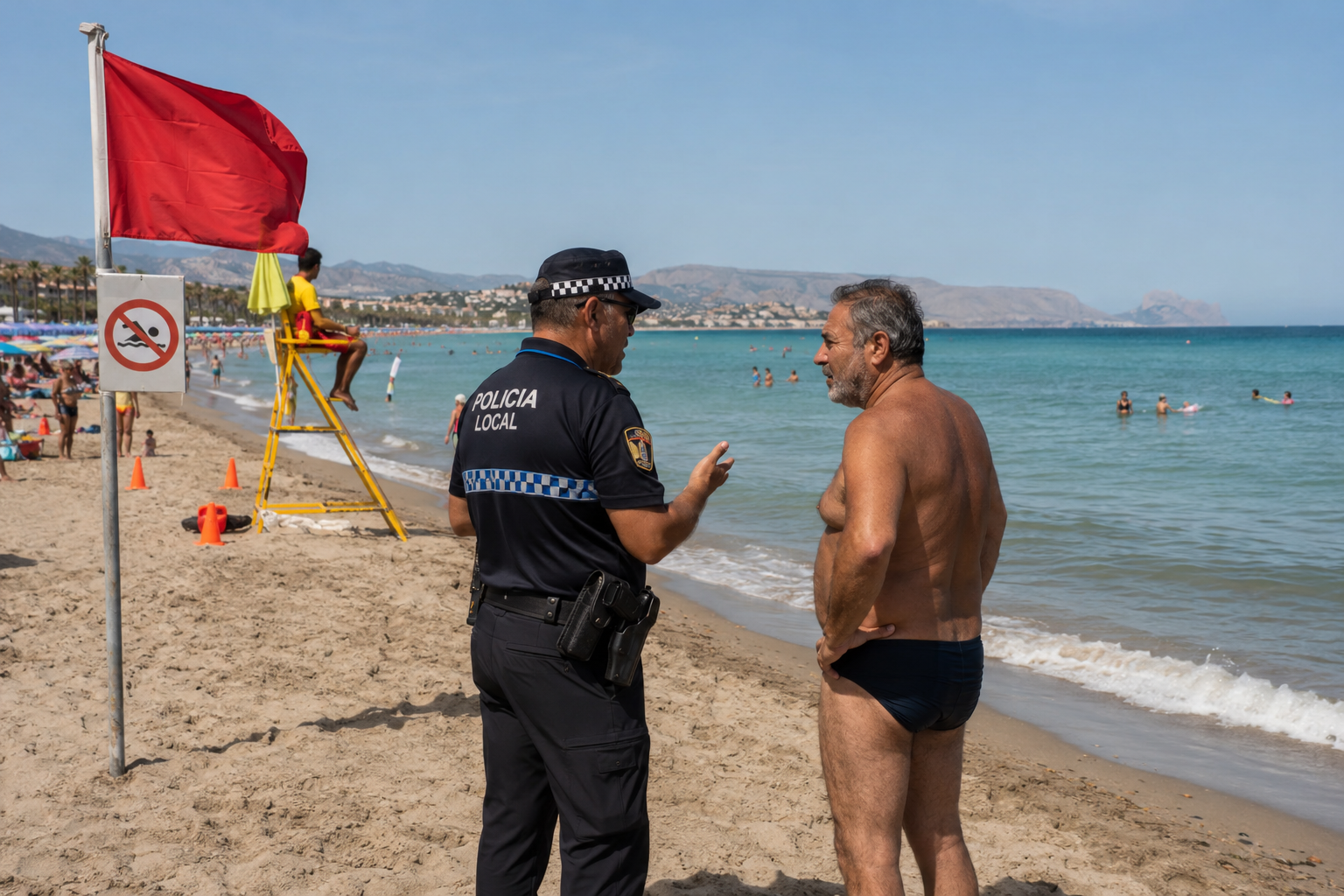
The crucial thing for a foreigner to understand is that the red flag carries the force of law. Bathing when the red flag is flying is not a matter of ignoring friendly advice but of breaking a real rule, one grounded in Spain’s national coastal law and the local ordinances that every coastal town enforces. Entering the water under a red flag is formally classified as a serious offense, with the penalties to match.
This is where visitors so often come unstuck, because the American instinct treats the flag as guidance to be weighed against one’s own judgment of the sea. In Spain that instinct is simply wrong, since the judgment has already been made by the authorities and expressed in the flag, and your own assessment does not enter into it. The red flag removes the decision from you entirely, and choosing to swim anyway is choosing to break the law.
The reasoning behind the firmness is sound. A red flag goes up because trained people have judged the sea genuinely dangerous, often in conditions whose peril is not obvious from the shore, and a calm-looking surface can hide currents that will overwhelm even a strong swimmer. The law does not trust the individual bather to make that call against the experts, and given how often overconfidence turns fatal at the coast, that lack of trust is well placed. This is the hardest part for confident swimmers to accept, since a lifetime of handling ordinary surf can breed a dangerous faith in one’s own judgment. But the currents that put up a red flag, the rip currents in particular, are exactly the kind of hazard that does not announce itself and that strength and experience do little to counter. The flag knows something the swimmer cannot see, and the law sides with the flag for good reason.
The Fine That Reaches Four Figures
The penalty for swimming under a red flag is what truly startles people, because it is no token slap on the wrist. Ignoring the red flag is treated as a serious breach of beach safety rules, and the fine for it commonly runs up to around fifteen hundred euros, a painful sum for a moment of poor judgment. For repeat offenders, or in the strictest municipalities, the penalty can climb as high as three thousand euros.
This puts the cost of a red-flag swim squarely in four-figure territory, which is a shock to anyone expecting a gentle warning. A single decision to wade in when the flag says no can end with an official identifying you on the sand and beginning the process of a fine larger than many people’s monthly rent. The pleasant dip you imagined becomes one of the most expensive swims of your life, assuming it does not become something far worse.
Because the rules are set and enforced at the municipal level, the exact figures vary from town to town, and it is always worth knowing that local ordinances differ along the coast. But the pattern holds everywhere, which is that red-flag bathing is a serious, finable offense, and that the sums involved are large enough to take seriously. Nowhere in Spain is swimming under the red flag treated as the trivial matter that many foreigners assume it to be. It is worth carrying this knowledge onto the beach, because the moment of temptation is real. On a hot day, with the water looking merely lively rather than lethal and other people perhaps already in it, the pull to ignore the flag can be strong. Knowing in advance that doing so risks a fine of well over a thousand euros, quite apart from the danger, is often enough to keep a tempted swimmer safely on the sand.
Why Spain Enforces It So Hard

The severity makes complete sense once you understand what these rules are trying to prevent, which is drowning. Spain has thousands of kilometers of coastline drawing enormous crowds every summer, and every year people die in its waters, often precisely because they entered the sea in dangerous conditions against the warnings. The red flag and its fine exist to keep that number down, and they save lives.
The danger extends beyond the reckless swimmer, which is part of why the law is so unforgiving. When someone ignores a red flag and gets into difficulty, the lifeguards must go in after them, risking their own lives in the very conditions that were judged too dangerous for anyone to enter. A single act of stubbornness can put a whole rescue team in mortal peril, turning one person’s bad decision into a threat to several.
Real cases make the point vividly. Rescues of red-flag swimmers regularly leave lifeguards injured or worse, hauled to hospital after dragging some overconfident bather from currents that nearly took them both, and the beachgoer who caused it faces a heavy fine on top of the near-tragedy. When you see it that way, the four-figure penalty stops looking harsh and starts looking like a reasonable price for endangering yourself and the people who must come to save you. There is a moral weight to this that the fine only partly captures. The person who swims under a red flag is not simply taking a private risk with their own life, which might be their business, but imposing that risk on strangers who are obligated to try to save them. The lifeguard does not get to decline the rescue, and so the reckless swimmer effectively conscripts others into their danger, which is why the law and the public treat it so severely.
Who Enforces the Flags

The flags are not merely decorative, because there are people whose job is to uphold them. The socorristas, the lifeguards who watch the beaches, are the front line, raising and lowering the flags according to the conditions and warning bathers who stray toward danger, and their instructions carry real authority rather than being friendly suggestions to be waved away.
Behind the lifeguards stands the local police and the machinery of the municipal authorities, who can identify offenders and issue the actual fines. When a swimmer ignores the flags and the lifeguards’ warnings, especially if a rescue results, the authorities can and do step in to process a penalty, taking the offender’s details on the beach itself. The enforcement is not theoretical but a working system that produces real fines every summer.
For a visitor, the practical meaning is that the lifeguard’s word should be treated as law, because in effect it is. Ignoring a socorrista who tells you to leave the water is not standing up for your rights but courting both danger and a fine, and the sensible traveler treats their instructions with exactly the respect they would give a police officer. On a Spanish beach, the person in the red and yellow is not there for decoration. This can require a small adjustment for visitors from places where lifeguards mainly watch and rarely intervene. In Spain the socorrista is an active authority on the beach, empowered to order people out of the water and to summon the police if ignored, and their calls about the flags are final. Treating them as the professionals they are, rather than as decorative figures in bright shirts, is both safer and far cheaper than the alternative.
The Wider World of Spanish Beach Fines
The red flag is only the most dramatic of a whole set of beach rules that surprise foreigners, because Spain regulates its beaches far more tightly than most visitors expect. Under national coastal law and a dense layer of municipal ordinances, a long list of seemingly harmless beach activities can carry fines, and the sums are often just as steep as the one for red-flag swimming.
The examples are many and varied. Depending on the town, you can be fined for reserving a spot with an unattended umbrella at dawn, for using soap or shampoo at the beach showers, for playing bat-and-ball games in crowded areas, for smoking on a growing number of smoke-free beaches, for barbecuing, for camping overnight, and for drinking alcohol on the sand. Some of these penalties reach into the thousands of euros, in the same serious range as the red-flag fine.
The unifying lesson is that Spanish beaches run on rules, and that the relaxed, anything-goes attitude of some other coasts does not apply. The rules exist to protect safety, cleanliness and the shared enjoyment of the coast, and they are enforced by councils that take them seriously. A little awareness of the local ordinances, usually posted at the beach entrance, saves a visitor from an expensive and avoidable mistake. The variety can be dizzying, since what is fine on one beach may be forbidden on the next town’s, and rules that seem absurd to an outsider, like a ban on urinating in the sea or on using soap at the showers, are enforced in earnest where they apply. The safe assumption is that a Spanish beach has rules, that those rules are posted, and that ignorance of them is no defense against the fine that follows breaking them.
How to Enjoy the Beach Without a Fine

Staying on the right side of all this is easy once you know the system, and it costs you nothing but a moment’s attention. The single most important habit is simply to look for the flag before you swim and to obey it without exception, treating green as go, yellow as go carefully, and red as an absolute no matter how inviting the water looks. That one rule keeps you both safe and unfined.
Beyond the flags, a quick glance at the posted rules when you arrive at a beach tells you what the local council permits and forbids, from smoking to drinking to ball games, so you can enjoy the day without stumbling into a penalty. The rules are rarely onerous and mostly amount to common courtesy, and knowing them turns the whole apparatus of fines into a non-issue. Respect the beach, and it will never cost you a cent in penalties.
Above all, take the red flag seriously, because it is the one that matters most in every sense. It is there because the sea that day can kill, and it is backed by a fine large enough to make even the reckless think twice, and heeding it protects your wallet, your safety, and the lives of the lifeguards who would otherwise have to come for you. On a Spanish beach the flags are not decoration and not advice. They are the law, and the red one is a line you cross at real peril, in every way that counts. For the visitor, none of this need spoil the pleasure of a Spanish beach, which remains one of the great joys of the country. The rules ask very little, mostly just attention and common sense, and in return they keep the coast safe, clean and welcoming for everyone on it. Learn the three flags, respect the red one absolutely, glance at the posted rules, and the Spanish beach gives back everything you came for, with none of the expensive surprises.

About the Author: Ruben, co-founder of Gamintraveler.com since 2014, is a seasoned traveler from Spain who has explored over 100 countries since 2009. Known for his extensive travel adventures across South America, Europe, the US, Australia, New Zealand, Asia, and Africa, Ruben combines his passion for adventurous yet sustainable living with his love for cycling, highlighted by his remarkable 5-month bicycle journey from Spain to Norway. He currently resides in Spain, where he continues sharing his travel experiences with his partner, Rachel, and their son, Han.