
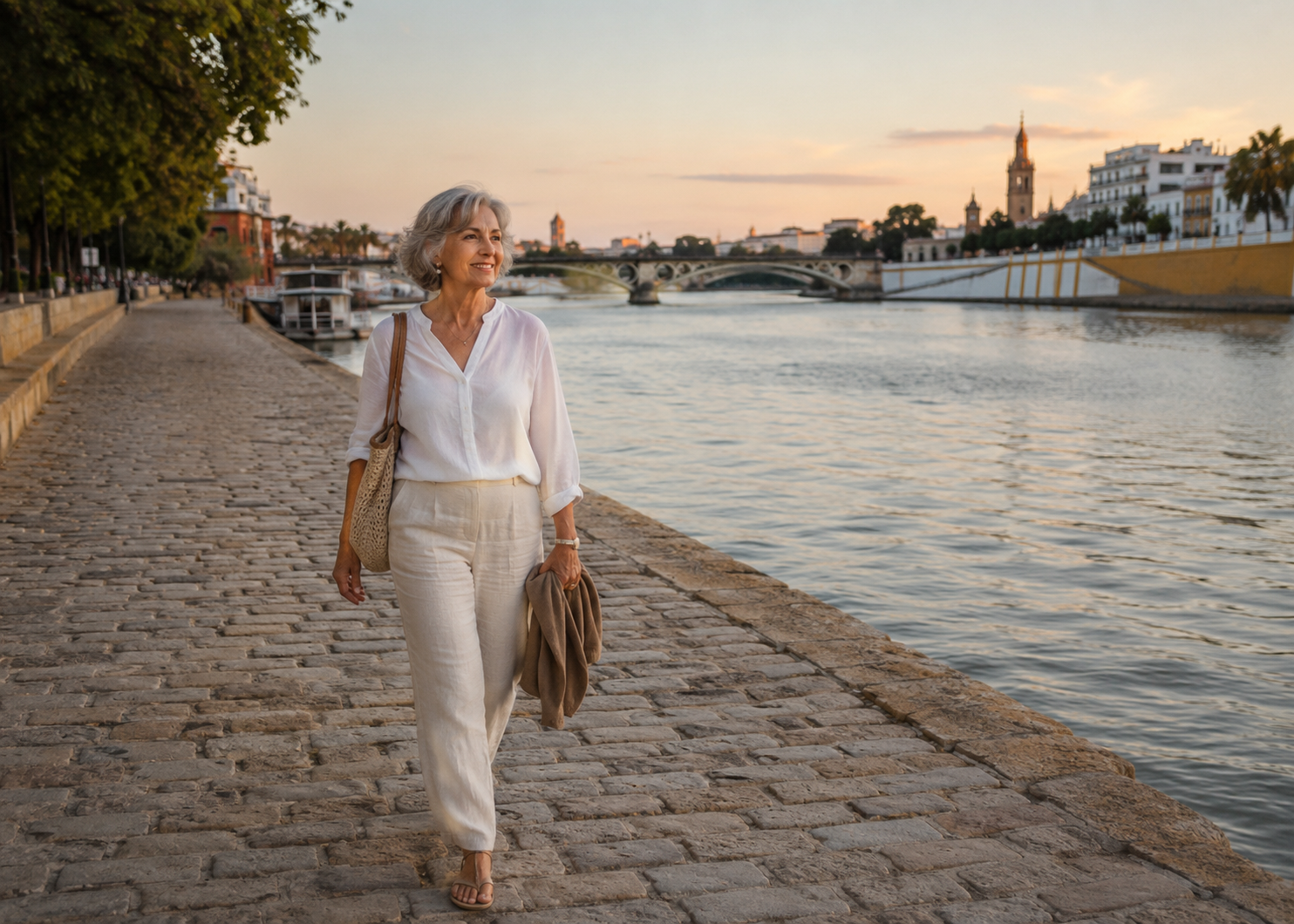
Picture a woman who, at sixty-seven and on her own, did something a lot of people only daydream about. She left the United States and moved by herself to Seville, in the south of Spain, to spend her retirement in a city she barely knew, without a partner to share the adventure or split the costs. It sounds daunting, even reckless. In practice, it turned out to be easier than growing old alone would have been back home.
That is the quiet truth behind a growing trend of solo American retirees, many of them women, choosing Europe. It is not that these women are braver than everyone else, though many are. It is that Europe, and cities like Seville in particular, are structured in ways that make a single person’s later years more affordable, more sociable, and more independent than the car-dependent American suburb allows. Solo retirement is genuinely easier there, and it is worth understanding exactly why.
The American Problem With Aging Alone
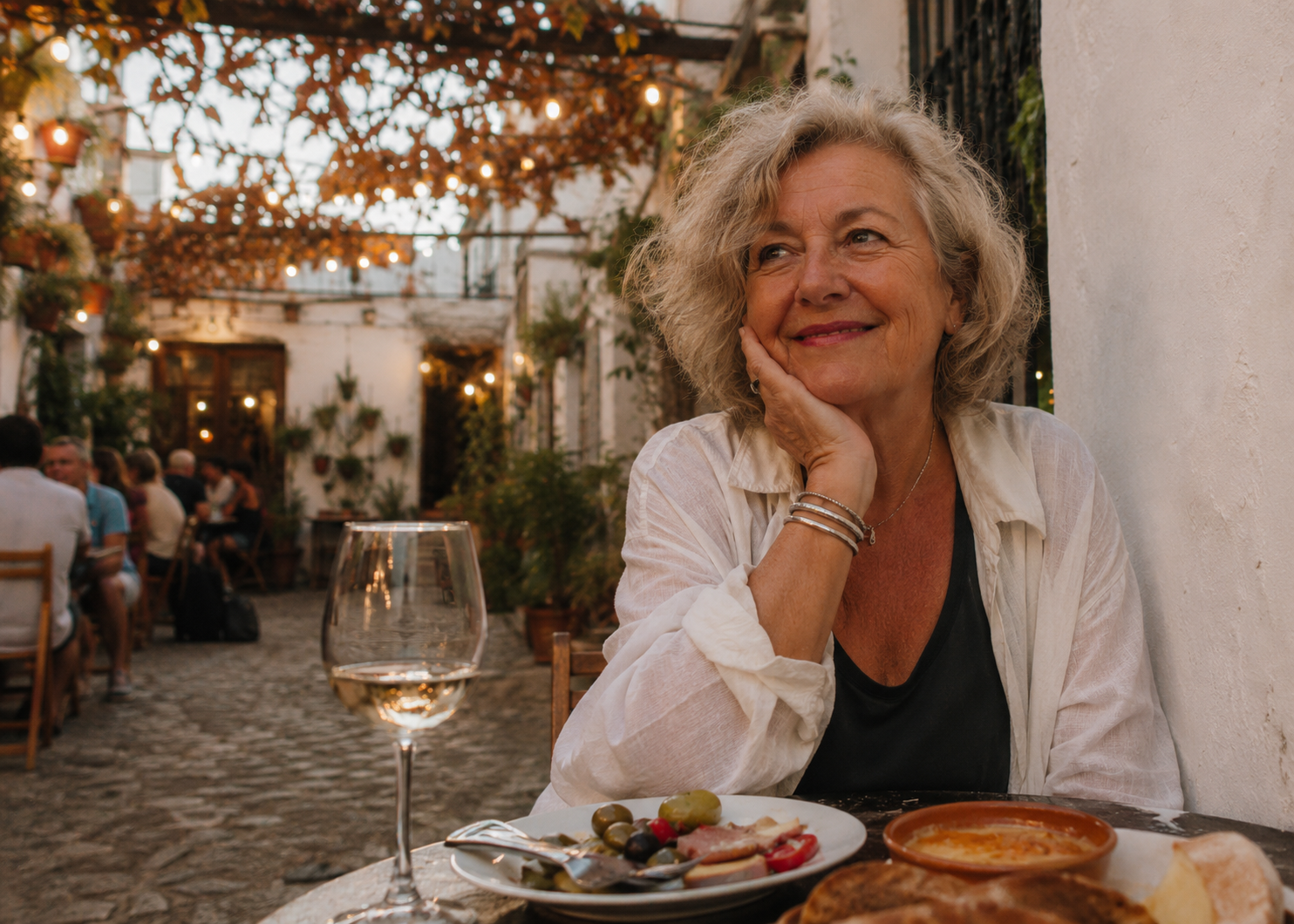
To see why Europe helps, you have to start with how hard aging alone can be in much of America. The typical American suburb is built around the car and the couple, and both of those facts quietly punish the older person who lives by themselves.
The car is the first trap. So much of American life requires driving that the day a person can no longer safely drive, whether through failing eyesight, reflexes, or confidence, their independence can collapse almost overnight. Groceries, doctors, friends, and errands all sit a drive away, and without the car they become inaccessible, leaving the non-driver stranded at home and dependent on others. For a solo older person with no partner to share the driving, that risk is especially acute. The second trap is social. American social life outside big cities often revolves around private homes and couples, which can leave a single older person on the outside, isolated behind their own front door in a neighbourhood where nothing is within walking distance and no one is out on the street.
The result, for too many solo American retirees, is loneliness and a shrinking world. It is not inevitable, and plenty of people find ways around it, but the physical and social design of much of the country works against the person aging alone rather than for them. This is the backdrop against which the European alternative looks so appealing, because it inverts almost every one of these problems.
Why Seville Costs Less for One
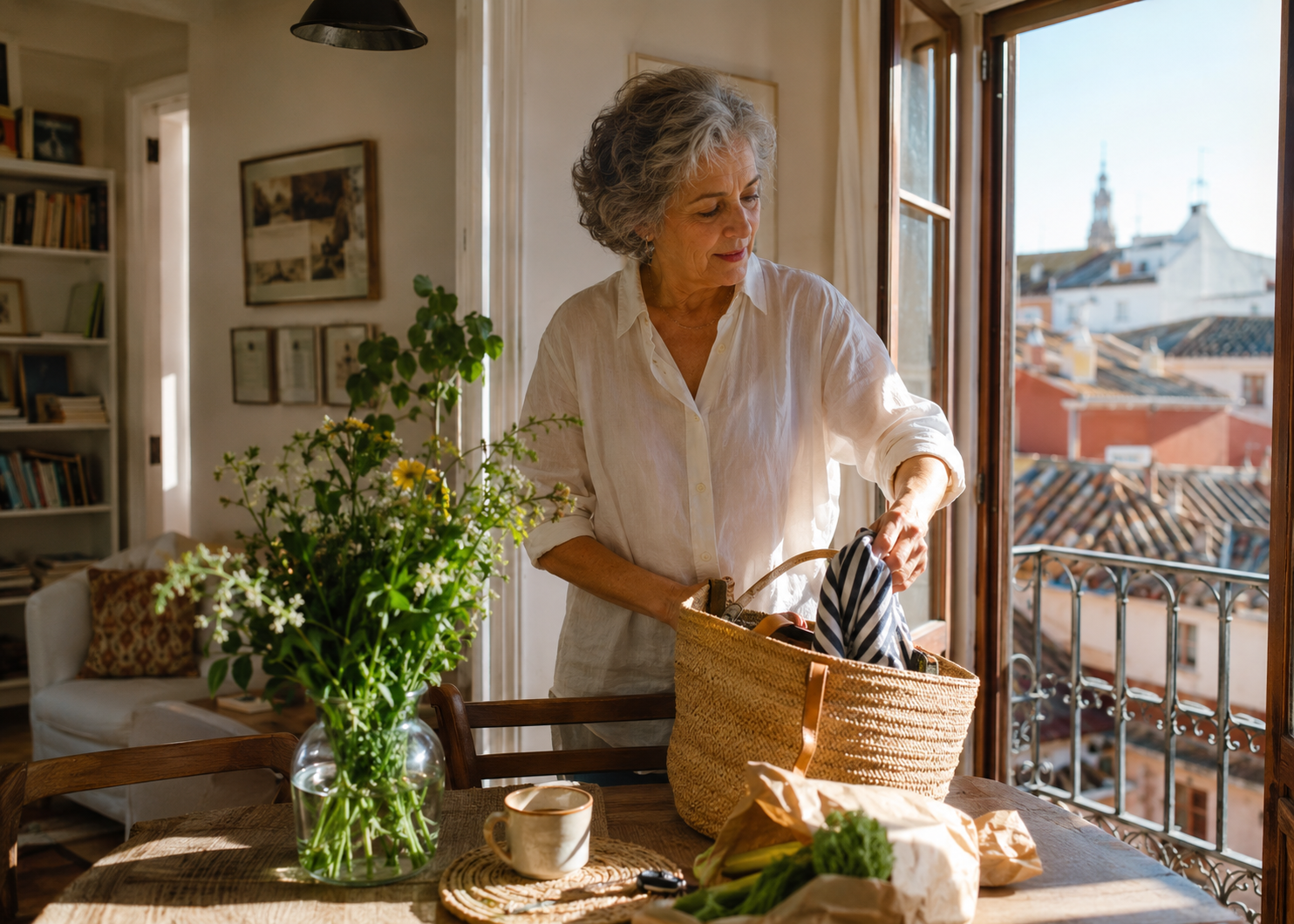
Before the lifestyle, the money, because affordability is what makes the whole thing possible on a single income. A solo person cannot split the rent or the bills with anyone, so cost matters even more than it does for a couple, and here Seville is quietly generous.
Seville is one of the more affordable big cities in Western Europe, with a comfortable single-person monthly budget, rent included, landing somewhere between about twelve hundred and eighteen hundred euros in 2026, depending on the neighbourhood and lifestyle. That range sits within reach of a typical American retirement income; the average Social Security benefit of around nineteen hundred dollars converts to roughly seventeen hundred and fifty euros, enough for a comfortable solo life in Seville with care. Andalusia, the region Seville anchors, has some of the lowest costs of any major part of Spain.
For the solo retiree, this affordability is not a luxury but the very thing that unlocks the move. It means a single income can cover a full, dignified life, including a decent flat, good food, healthcare, and leisure, without the constant anxiety that a fixed pension will not stretch. Where the same income might mean a pinched, worried existence in a costly American city, in Seville it funds a genuinely comfortable one. The affordability is the foundation; everything else about the easier solo life is built on top of it.
The City That Does Not Need a Car
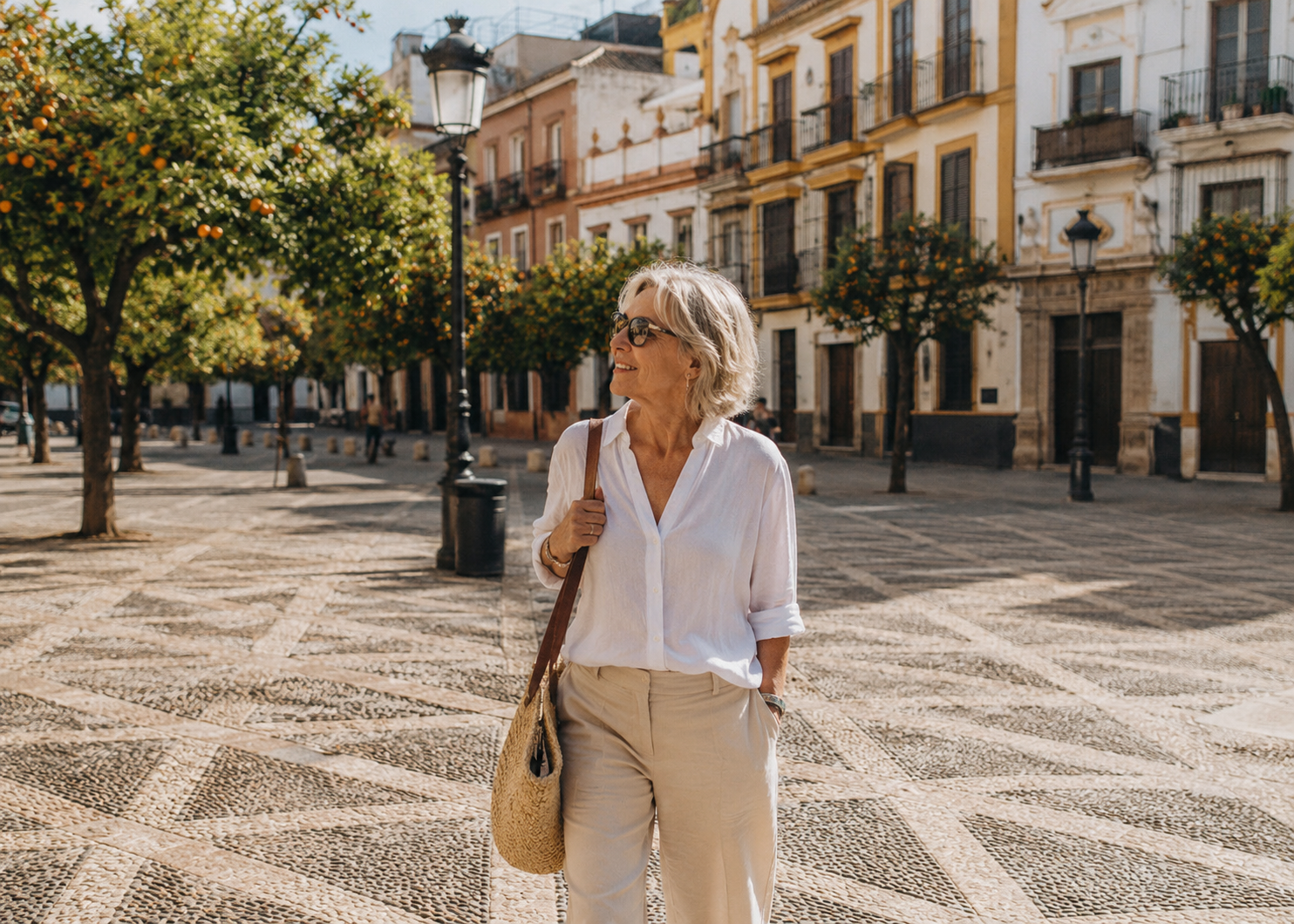
The single most important structural gift Seville gives a solo older person is that it does not require a car. The historic centre is famously flat, an unusual blessing for a city of its age and scale, and it is genuinely walkable, with most daily needs reachable on foot. On top of that, the city has buses, a tram, a metro line, and over a hundred and eighty kilometres of bike lanes.
This changes everything for someone aging alone. Because life does not depend on driving, the terrifying American prospect of losing independence along with a driver’s licence simply does not apply. A resident can reach the market, the doctor, the café, and their friends on foot or by cheap public transport, indefinitely, long past the age when driving would have become difficult. Most people living in the centre do not own a car at all, and they do not need one. Independence is decoupled from the ability to drive, which for a solo older person is close to priceless.
The knock-on effects are profound. A walkable life is a more active life, keeping a person moving and out in the world rather than stranded at home. It is also a more social life, because walking through a lively city means constantly encountering other people, exchanging greetings, and being part of the street rather than sealed in a car. For the person who feared that age would gradually shrink their world, a city like Seville does the opposite, keeping that world open and reachable on their own two feet.
Where Being Alone Is Normal
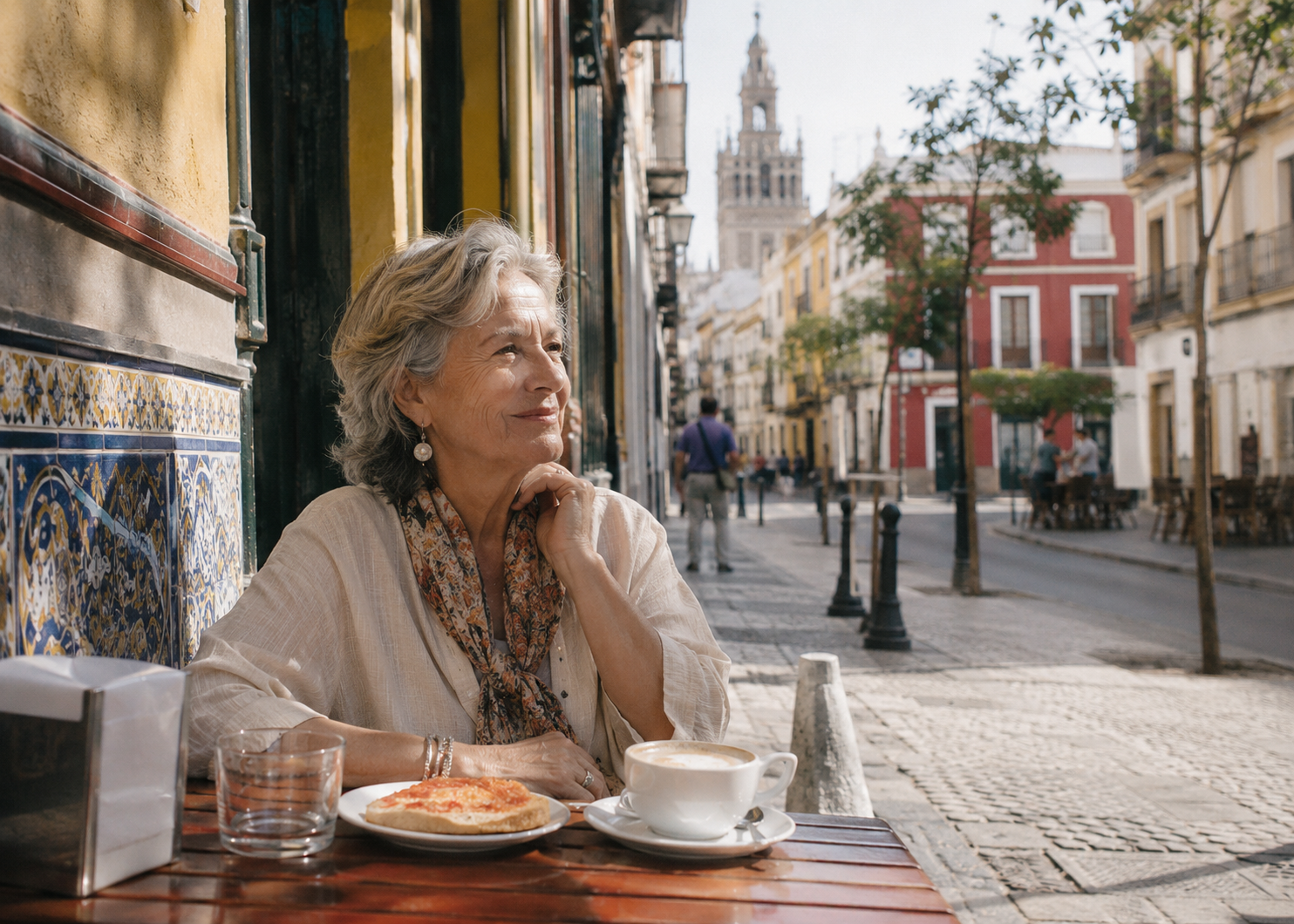
Beyond the practical, there is a cultural gift that matters just as much: in Seville, being out alone is completely normal and comfortable, in a way it often is not in America. This is subtle but powerful, and it goes to the heart of whether a solo person feels included or exiled.
Spanish life happens in public, in plazas, on café terraces, and along the evening paseo, the stroll that fills the streets at dusk. And crucially, the deep tapas and café culture makes a person sitting alone over a coffee or a small plate for an hour entirely unremarkable. Nobody stares, nobody pities, nobody treats a solo diner as a problem to be seated in the corner. A woman can eat dinner by herself, linger over a glass of wine, and feel like a natural part of the scene rather than an object of sympathy. That comfort, the ordinariness of being alone in public, is worth as much as any low crime statistic to someone building a life on their own.
This stands in sharp contrast to the couple-centric social world many solo Americans describe, where dining out alone can feel conspicuous and social gatherings are organised around pairs. In Seville, the public, sociable, come-as-you-are rhythm of the city means a single person is simply another face in a crowd that is always out and about. They are neither hidden away nor singled out, but folded naturally into the daily life of the place. For someone who dreaded feeling like the odd one out, that easy belonging is a quiet revelation.
Built-In Community
Affordability and walkability get a solo retiree to Seville and keep them independent, but community is what keeps them happy, and here too the city offers more structure than the American suburb. The opportunities to meet people and build a social life are woven into ordinary daily existence rather than requiring a car and a calendar full of arrangements.
The raw materials of connection are everywhere. The same plazas and café terraces that make solo life comfortable also make it social, providing endless low-pressure venues to become a regular, chat with neighbours, and slowly build familiarity. Beyond that, Spanish cities run inexpensive municipal activity programmes for older residents, from classes to outings, and Seville has an established international community and language exchanges that give newcomers a ready-made way in. The long, unhurried meals and the tradition of lingering at the table, the sobremesa, are practically engineered for conversation and connection.
For a solo retiree willing to show up and participate, this adds up to a real defence against the loneliness that can shadow a single person’s later years. Community does not have to be manufactured from scratch through sheer effort; much of it is simply available, out in the streets and squares, waiting to be joined. The person who feared isolation finds instead a city that keeps offering, gently and repeatedly, chances to be among others. That structural sociability is one of the deepest reasons solo retirement works so well there.
The Healthcare Safety Net for One
A particular anxiety for anyone retiring alone is healthcare, because a solo person has no partner to lean on, no second income, and no one else’s plan to fall back on. Here Spain’s system offers exactly the kind of security a single retiree needs, at a cost that does not threaten their independence.
The healthcare a solo retiree can access in Spain does not depend on a spouse or an employer, which removes a vulnerability that haunts many single people in the American system. Legal residents can eventually buy into the public health system through the convenio especial for a modest flat monthly fee, and in the meantime private health insurance for an older person runs roughly one hundred to two hundred euros a month, far less than American coverage, with comprehensive care and short waits. Either way, the solo retiree has real, affordable, reliable medical security in their own name.
Just as importantly, there is no looming threat of the catastrophic, bankrupting medical bill that shadows American retirement, a threat that is especially frightening for someone with no partner to help absorb a financial shock. Knowing that a health crisis will be handled by a good public or affordable private system, without wiping out one’s savings, is a profound source of peace for a person facing later life alone. It means the solo retiree can relax into their independence rather than living in quiet fear of the one event that could undo it.
Real Women Are Already Doing This
None of this is theoretical, and it is worth grounding it in reality, because solo women really are making these moves and thriving. The travel writer Marsha Scarbrough, for instance, has written about moving to Madrid alone at seventy, having concluded she could not afford to retire in the United States, and finding that Spain fell comfortably within her budget.
Her account captures the pattern exactly. She has described arriving to find developed infrastructure, clean and affordable public transport, and, most strikingly, streets that were safe and full of friendly people at all hours. What she found, in other words, was precisely the combination this piece has been describing: affordability that made a solo retirement possible, walkability and safety that made it independent, and a public, sociable street life that made it far from lonely. Her experience is not a lucky exception but an illustration of how the pieces fit together for a woman on her own.
Stories like hers matter because they turn an appealing idea into a demonstrated reality. It is one thing to argue that Europe should be easier for solo retirees; it is another to see women in their late sixties and seventies actually doing it, alone, and reporting that it works. For anyone hesitating at the threshold, wondering whether such a move is really feasible on their own, the growing number of solo retirees who have gone before is the most reassuring evidence there is. They are not braver than everyone else. They simply found a place that made the solo path easier to walk.
One Honest Caveat

None of this means a solo move abroad is effortless or right for everyone, and honesty requires naming the harder parts. Retiring alone in a foreign country asks things of a person that staying home does not, and the same independence that makes it rewarding also makes it demanding.
There is the language: while Seville has English speakers, daily life, officialdom, and deeper friendships all go better with Spanish, and learning it takes real effort, especially later in life. There is distance from family, which for a solo retiree can mean long flights to see children or grandchildren and the ache of missing ordinary milestones. There is the reality that community, however available, still has to be reached for; the plazas and classes are there, but a shy or passive newcomer can still end up lonely if they do not step out and take part. And Seville’s summer heat is genuinely punishing, a practical factor for an older person to weigh. The move suits the adaptable, the reasonably outgoing, and the willing-to-try more than it suits everyone.
These caveats do not overturn the case; they refine it. Solo retirement in Europe is easier than in America in structural ways, but easier is not the same as automatic. The women who thrive are the ones who lean into the opportunities the city offers rather than waiting for life to come to them, and who go in clear-eyed about the trade-offs. Named honestly, the difficulties make the successes more credible, and they point any prospective solo retiree toward the single wisest first step: to try the life on for a season before committing to it for good.
Easier, Not Just Cheaper
In the end, the case for solo retirement in a city like Seville is not merely that it is cheaper, though it is. It is that the whole shape of life there suits a person aging on their own, in ways the American default does not. Affordability lets one income stretch, walkability preserves independence, public life dissolves the isolation of being single, and a humane healthcare system removes the deepest fear.
That combination is what the phrase easier than America is really pointing at. It is not a knock on the United States so much as an observation about design: a walkable, sociable, affordable city with a safety net simply serves a solo older person better than a car-dependent, couple-centric, expensive one with catastrophic medical risk. For the person retiring alone, those structural differences are not abstractions. They are the difference between a shrinking life and an expanding one.
So the woman who moved to Seville alone at sixty-seven was not gambling as much as it appeared. She was choosing an environment that would work with her circumstances instead of against them. For solo retirees weighing their options, that is the real lesson: aging alone is hard everywhere, but some places make it far easier than others, and much of Europe, quietly, is built to help rather than hinder the person walking into later life on their own.

About the Author: Ruben, co-founder of Gamintraveler.com since 2014, is a seasoned traveler from Spain who has explored over 100 countries since 2009. Known for his extensive travel adventures across South America, Europe, the US, Australia, New Zealand, Asia, and Africa, Ruben combines his passion for adventurous yet sustainable living with his love for cycling, highlighted by his remarkable 5-month bicycle journey from Spain to Norway. He currently resides in Spain, where he continues sharing his travel experiences with his partner, Rachel, and their son, Han.