
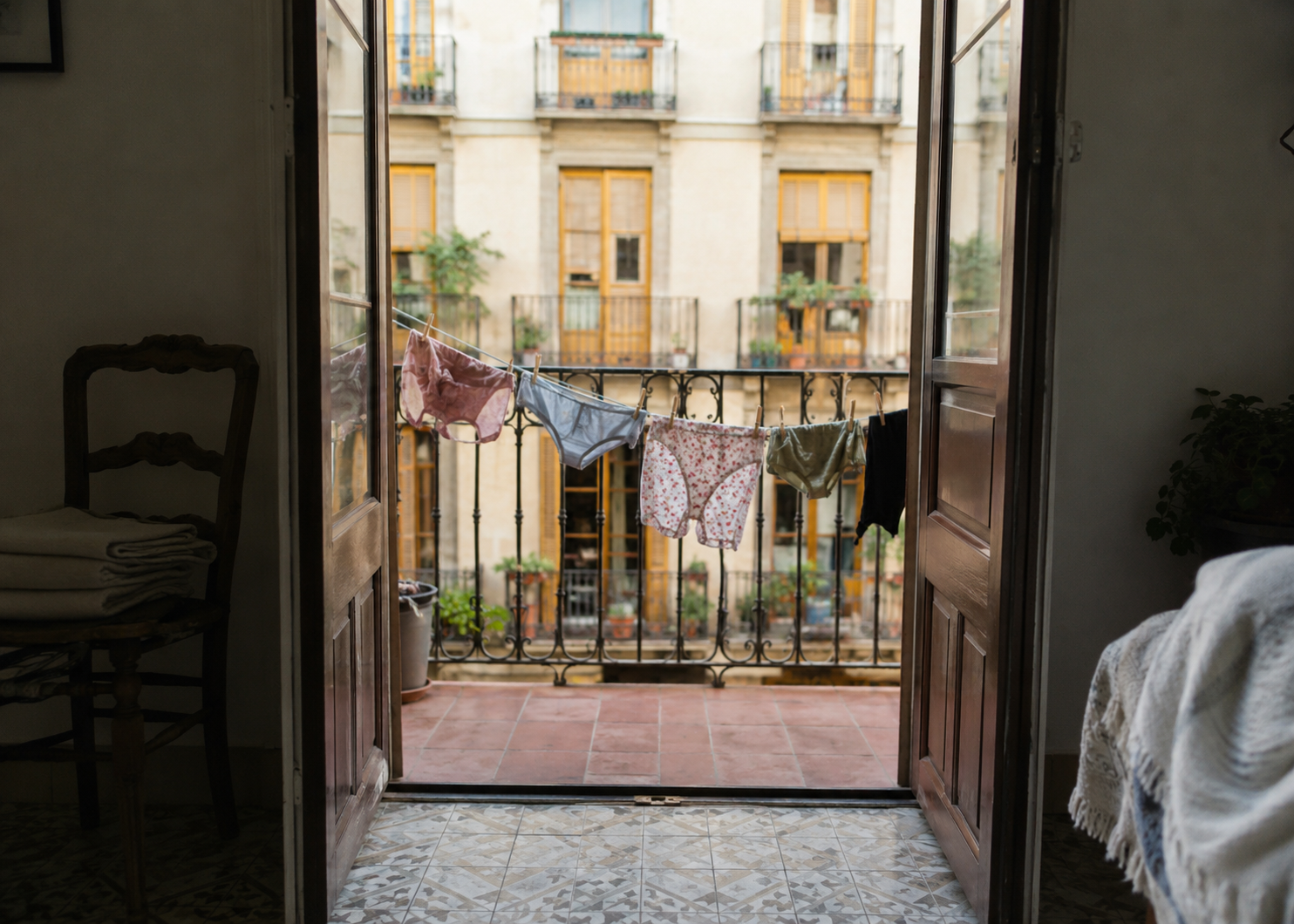
Look up in any Spanish city and the whole street is doing its washing in public. Shirts and sheets, socks and underwear, hang from lines strung across balconies and between buildings, flapping over the traffic in full view of anyone who cares to look. Nobody cares to look. The laundry is simply there, the way windows and shutters are there, an ordinary part of the face a building shows the street. The balcony two floors down from where this is written has a row of school socks and somebody’s underthings on it this morning, and will again tomorrow.
To an American arriving for the first time, the underwear is the part that lands. Back home, laundry is something you do behind a closed door and a spinning drum, and a line of your intimate things strung across the front of the house would read as a small scandal, or at least a lapse. In Spain it reads as Tuesday.
The reason is not that Spaniards are less private. It is that Europe never built the habit of hiding laundry, because it never fully built the habit of machine-drying it in the first place.
The Numbers Behind the Balconies
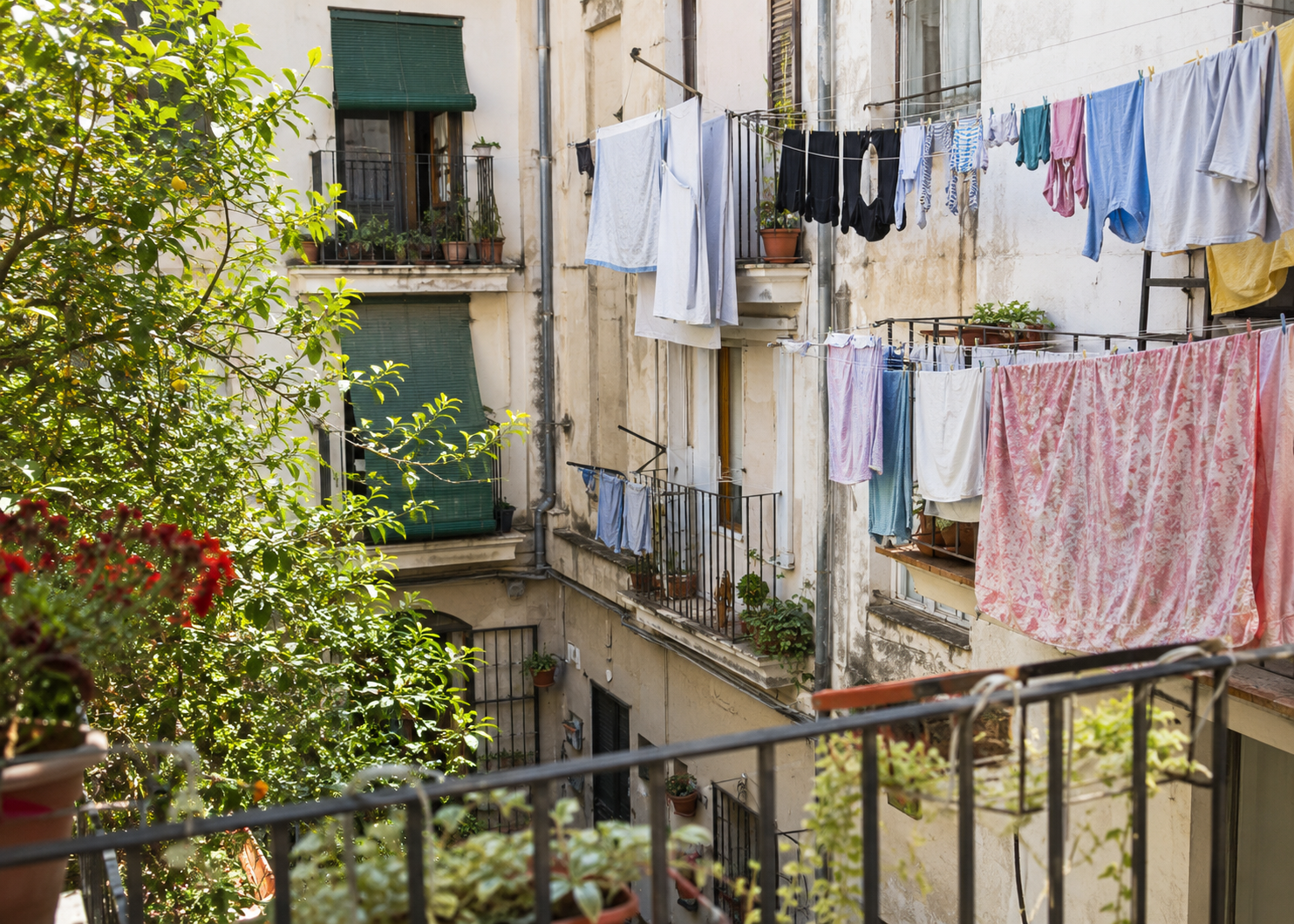
The gap in appliances is wider than most visitors guess. Somewhere around 75 to 80 percent of American homes own a clothes dryer. In Europe the figure lands between a third and a half, depending on the country and who is counting, and in Italy it drops to about 20 percent. The dryer, standard equipment in an American laundry room, is in much of Europe an optional extra that plenty of households simply never buy.
The American numbers underneath that are striking on their own. There are roughly 87 million residential dryers in the United States, and together they eat about 6 percent of the country’s residential electricity, a share of the grid comparable to the entire annual consumption of a mid-sized state. Running them costs Americans on the order of $9 billion a year, which in euros is a little over €8 billion spent turning warm air into slightly warmer, drier laundry.
The subject even had its viral moment. In 2022 the American commentator Josh Barro posted a jab about all these high-income European countries where nobody seems to own a machine that dries clothes, and the reply threads filled with photographs of sunlit balconies and pointed reminders about the price of healthcare. El País covered the skirmish with some amusement. It was a small culture clash, but it caught something real, which is that the dryer is one of those appliances an American assumes is universal and simply is not.
None of this is about wealth. The countries hanging their washing on the line are prosperous places with modern grids. They looked at the dryer, weighed it, and largely declined.
Why the Dryer Never Took Over
Three ordinary facts explain most of it, and none of them is culture. The first is the price of power. Electricity has long cost more across much of Europe than in the United States, and a machine that runs hot for an hour lands differently on a bill when every kilowatt is dear. When the sun is free and the socket is expensive, the arithmetic bends hard toward the balcony.
The 2022 energy crunch only deepened the instinct. When gas prices spiked across the continent and electricity bills followed, a machine that had always looked expensive to run looked worse the winter everyone’s bill jumped, and the line outside looked better than ever.
The price gap underneath it is not small. Households across much of Europe have long paid two or three times what Americans pay per kilowatt-hour, so an appliance that barely registers on a cheap American bill is a visible line item on a European one. The dryer was priced out of the default here before anyone made it a matter of taste. For a family the difference compounds, since a household running several loads a week is choosing, every week, between an hour of paid machine time and a free morning of sun.
The second fact is the size of the home. City flats in Madrid, Rome, or Paris come with kitchens and utility spaces an American would find impossibly small, and there is often nowhere to put a second large appliance even if you wanted one. A washing machine tucked under the counter is one thing. A dryer beside it is a luxury of square meters most flats do not have.
The third is the weather, at least for the southern half of the continent. Madrid averages around three hundred days of sunshine a year, and much of the south runs higher still. A load pinned out on a summer morning is dry by lunch, stiff and sun-warmed and smelling of nothing in particular, which is to say clean. The sun does in a few hours, for free, what the machine does in one hour for money. In that climate the machine is not competing against a chore so much as against a pleasant one.
Even where Europeans do own dryers, the machines are a different animal. The common European type is a heat-pump dryer, which uses roughly half the energy of a conventional American vented dryer but takes about twice as long to finish a load. The technology is gentler, cheaper to run, and in no particular hurry, which suits a household that never treated same-day dry laundry as a right.
The Tendedero Is a Fixture, Not an Afterthought
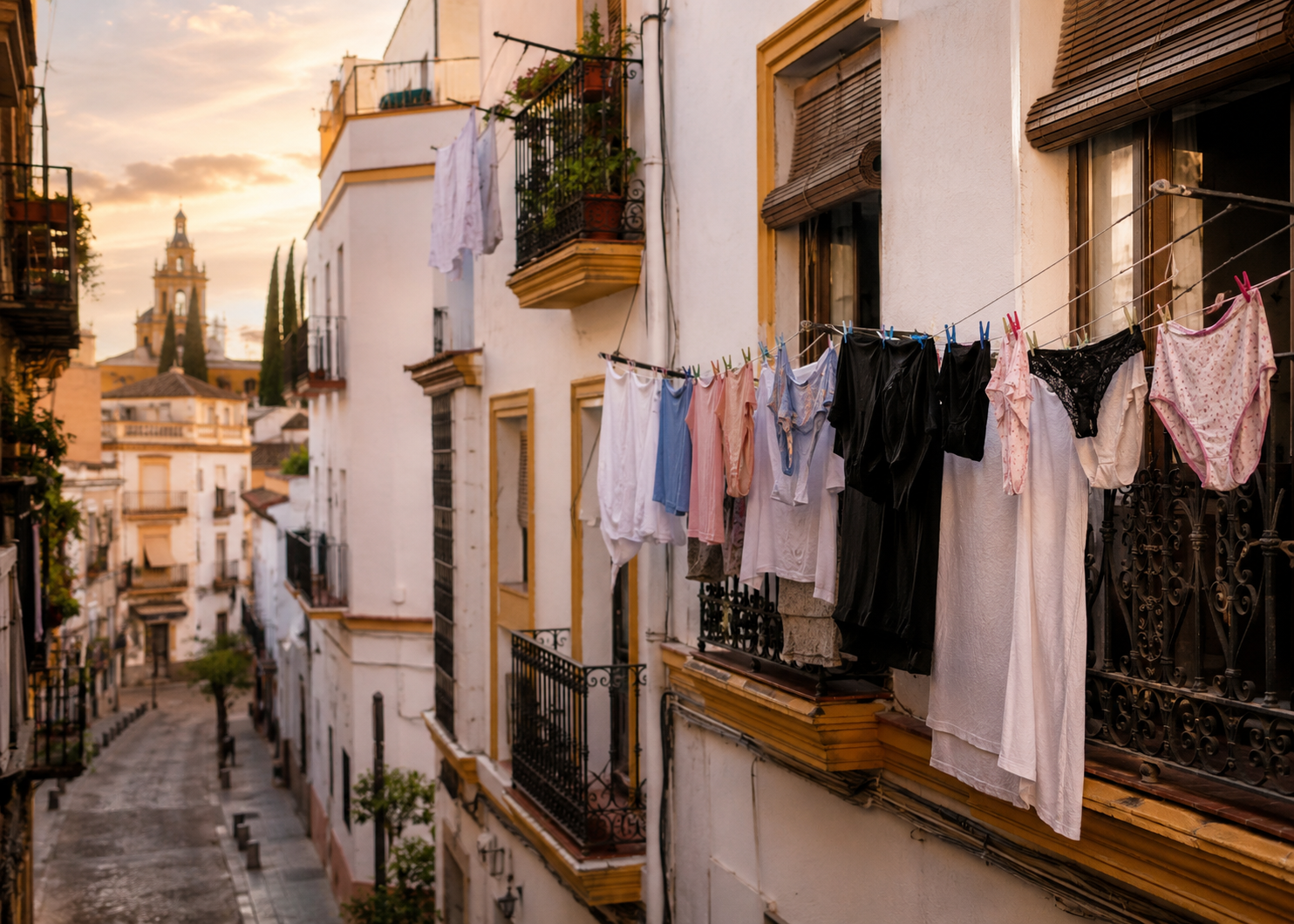
Every Spanish home comes equipped for the line, and the equipment has a name. The tendedero is the drying rack or the run of lines out on the balcony or the roof terrace, and it is as standard a fitting as the taps. New flats are built with the fixtures already in place, a little galvanized frame bolted to the wall or a set of retractable cords that pull out across the light well.
In older neighborhoods the lines run building to building, strung on pulleys so a person can reel the wet clothes out over the courtyard and reel them back dry without leaning far from the window. The shared light wells at the center of many blocks become vertical laundries, a hundred households’ washing hanging in the same column of air. It is one of the sounds of a Spanish morning, the squeak of a laundry pulley and the snap of a sheet in the breeze.
On the flat rooftops, the azotea of a southern town, whole terraces are given over to lines, and the image of washing strung across a bright wall in a place like Jerez de la Frontera is postcard shorthand for Andalusia itself. Before private machines, the wash was even more communal. It was done at the public lavadero, the stone washing basin at the edge of many old villages, where the laundry and the gossip of the town got done in the same hour.
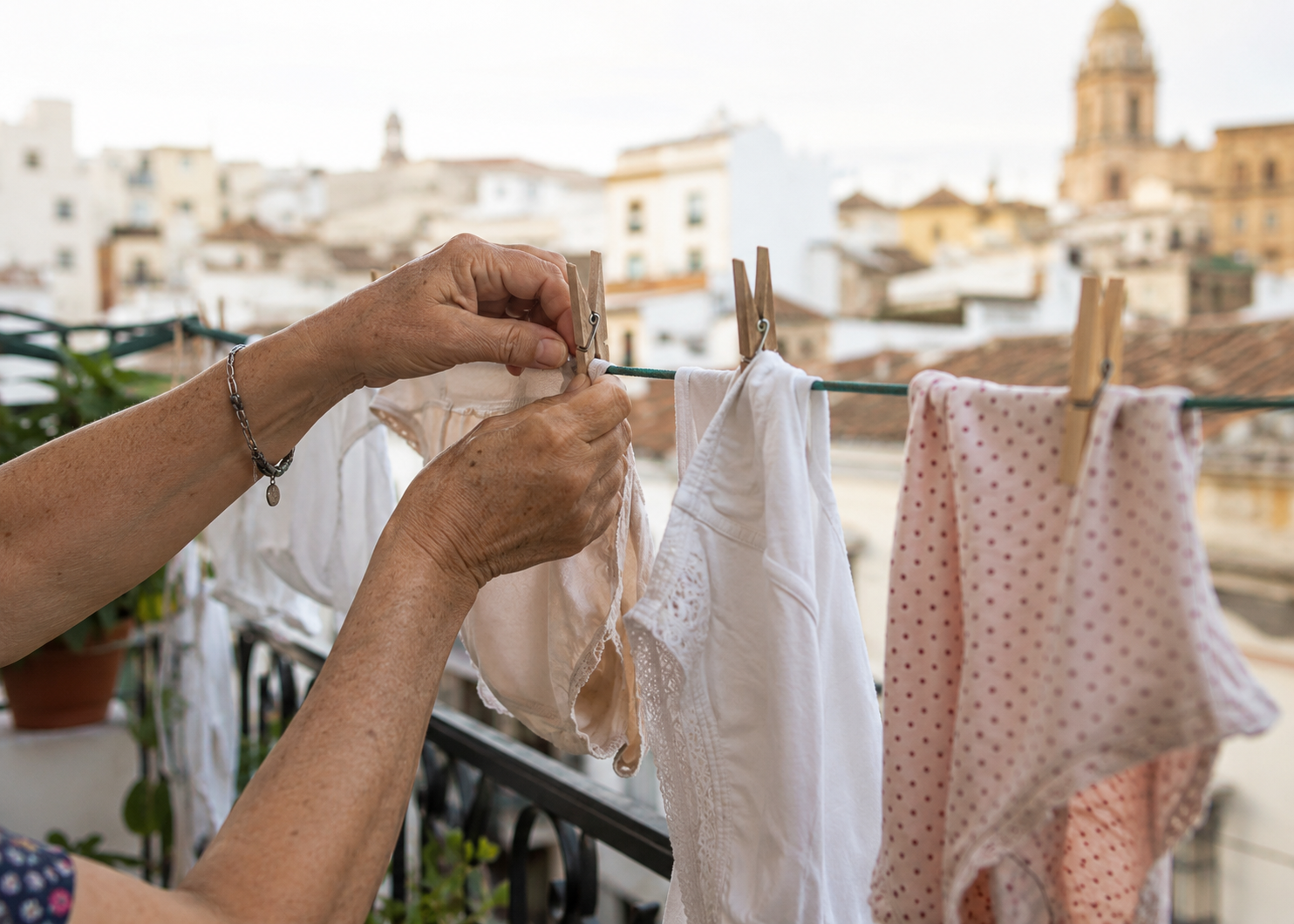
The tools are humble and universal. A bag of pinzas, the clothespins, lives on every balcony. There is an order people learn without being taught, pegging by the seams so the marks do not show, hanging shirts by the tail, turning dark clothes inside out so a long afternoon of sun does not fade them. None of it is difficult, and all of it is second nature by the time a Spanish child is old enough to be handed the basket.
Winter has its own gear. When the balcony will not do, a folding rack, the tendedero de pie, goes up in the spare room or over the bathtub, and the flat spends a day smelling faintly of damp cotton. It is less pleasant than the summer version, and everyone accepts it as the ordinary price of the season.
What there is not, anywhere in the arrangement, is embarrassment. The underwear goes up with everything else, in plain sight, because there was never a reason to treat it as a secret. A body wears clothes, the clothes get washed, and the drying of them was never a private act that leaked into public. It is just a public act, and always has been.
America Learned to Hide It
The American instinct runs the opposite way, and it is worth seeing how far it goes. In much of the United States, hanging laundry outdoors is not merely unfashionable, it is often flatly forbidden. Thousands of homeowners’ associations across the country ban clotheslines outright, treating a line of drying shirts as an eyesore that lowers the tone, and by extension the property values, of the street.
The fight has been serious enough to produce laws. Roughly twenty states have passed some form of right to dry statute specifically to override those bans and protect a homeowner’s ability to hang washing in the sun. Florida and California were early to it; others followed as energy and environmental arguments gained ground, often over the objection of the associations the laws were written to overrule. A continent away, the notion of needing legal permission to use a clothesline sounds close to a joke.
Underneath the rules is an aesthetic, and underneath the aesthetic is the dryer itself. Once the machine made hidden, same-day drying the default, visible laundry stopped signaling thrift or sunshine and started signaling that something had gone wrong, that a household could not afford or could not manage the normal way of doing things. The line became a mark of not quite keeping up. Europe, which never made the machine the default, never attached the shame, and so the washing stayed cheerfully where it always was, out front.
The associations tend to defend the bans on the grounds of uniformity, the same logic that regulates lawn height and mailbox color. A clothesline, in that worldview, is visual noise. From the balcony side of the Atlantic the noise is rather the point, the ordinary evidence that a building is full of people getting on with their lives.
What the Line Does to Your Clothes
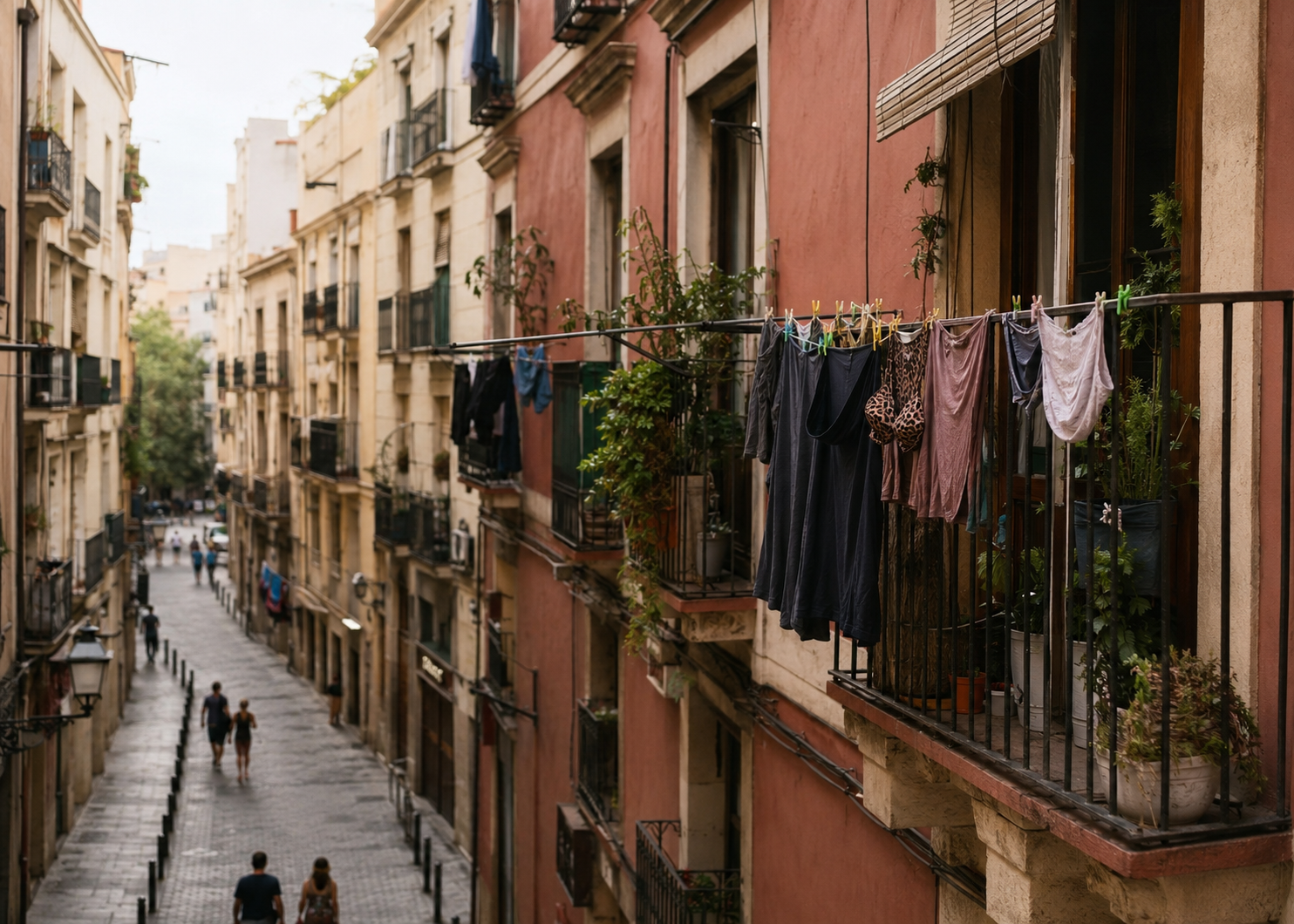
There is a practical case for the balcony that has nothing to do with cost or culture, and anyone who has done it both ways tends to notice. Line-drying is gentler on fabric. The heat and tumbling of a dryer are what fill the lint trap, and that lint is your clothes, worn away a little with every cycle. Hang them instead and they keep their shape and color far longer, which quietly saves the money the dryer was supposed to save. Wool and delicate knits especially prefer the line, since the tumble and heat are exactly what shrink and pill them, and half the care labels warning against machine drying are just describing what a balcony does gently by default. The single-load comparison is lopsided in the other direction too. A line costs nothing to run, while a conventional dryer is one of the hungriest machines in the house, which is why it looms so large in that share of the grid, and skipping it most weeks shows up plainly on the monthly bill.
The line has its costs too, and honesty about them is the fair thing. Air-dried towels come out stiff rather than fluffy, a texture some people love and others cannot stand. A run of grey winter days can leave a flat draped in slow-drying laundry for two days at a stretch, and clothes left too long in hard sun will fade. There are mornings when a machine would plainly be easier, and nobody hanging a third load in the rain is pretending otherwise.
For most of the year in most of Spain, though, the trade lands in the balcony’s favor. Longer-lasting clothes and a smaller bill, plus the particular smell of sun-dried cotton, add up to a habit people keep by choice as much as by thrift. The dryer, where it exists, gets saved for the sheets in February and the towels nobody wants stiff.
The Dryers Are Coming Anyway
The picture is shifting, though, and worth watching rather than freezing. Dryer ownership has been climbing across Western Europe for years, pushed by busier households, wetter northern climates, and flats too small to drape with racks for two days running. The combined washer-dryer, a single machine that washes and then dries the same load in one drum, has become a common answer for a home with room for only one appliance, slow and imperfect but small.
The newer machines make the choice easier to justify. Heat-pump models have come down in price and sip far less power than the old vented kind, which softens the two objections, cost and conscience, that kept the dryer out for so long. In the colder, damper parts of the continent, where the sun cannot be relied on for months at a time, the machine was always going to win eventually.
Even so, the balcony is not going anywhere in the south. A device that costs money and time to do a job the sky does for free has a hard sell to make in a place with three hundred days of sun, and the tendedero has a few centuries of habit on its side. The likely future is both, the machine for the grim weeks and the line for everything else.
What the Balcony Teaches
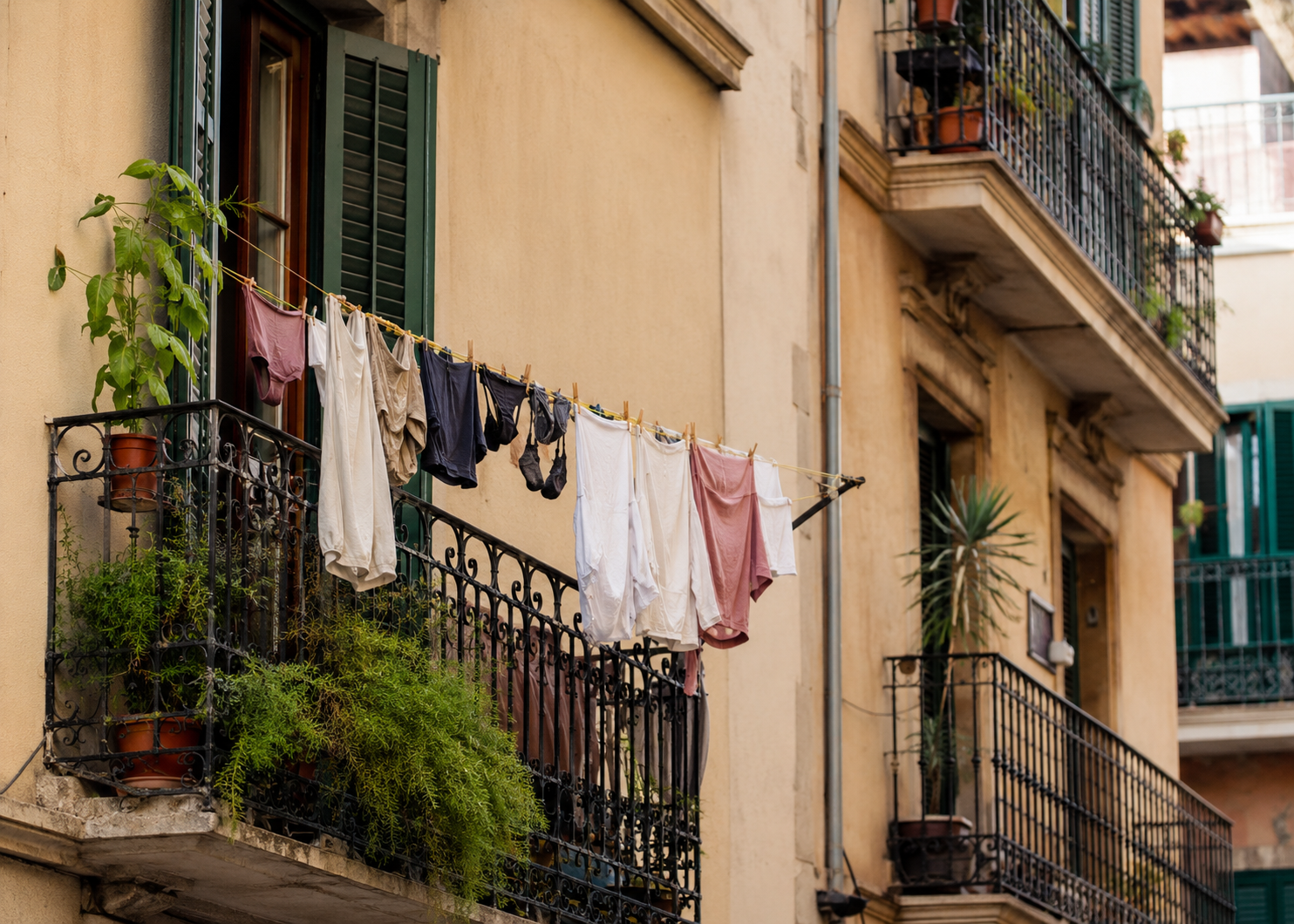
Hang your washing outside for a season and something shifts in how you see the appliance you left behind. The dryer starts to look less like a necessity and more like a convenience that quietly costs a fair amount, in money, in the life of your clothes, and in the small daily contact with weather and light that pinning out a load happens to give you.
The underwear on the line stops looking like exposure and starts looking like ease, a neighborhood that has simply never bothered to be ashamed of an ordinary thing. There is a kind of privacy that is really just anxiety about being seen, and the Spanish balcony has quietly opted out of it. The washing goes up, the sun does its work, and the street looks exactly like a place where people live.
If you move here, buy the pinzas and give it a summer before you shop for a dryer. You may find, as many do, that the machine you assumed you could not live without turns out to be the one thing you never quite get around to buying.

About the Author: Ruben, co-founder of Gamintraveler.com since 2014, is a seasoned traveler from Spain who has explored over 100 countries since 2009. Known for his extensive travel adventures across South America, Europe, the US, Australia, New Zealand, Asia, and Africa, Ruben combines his passion for adventurous yet sustainable living with his love for cycling, highlighted by his remarkable 5-month bicycle journey from Spain to Norway. He currently resides in Spain, where he continues sharing his travel experiences with his partner, Rachel, and their son, Han.