
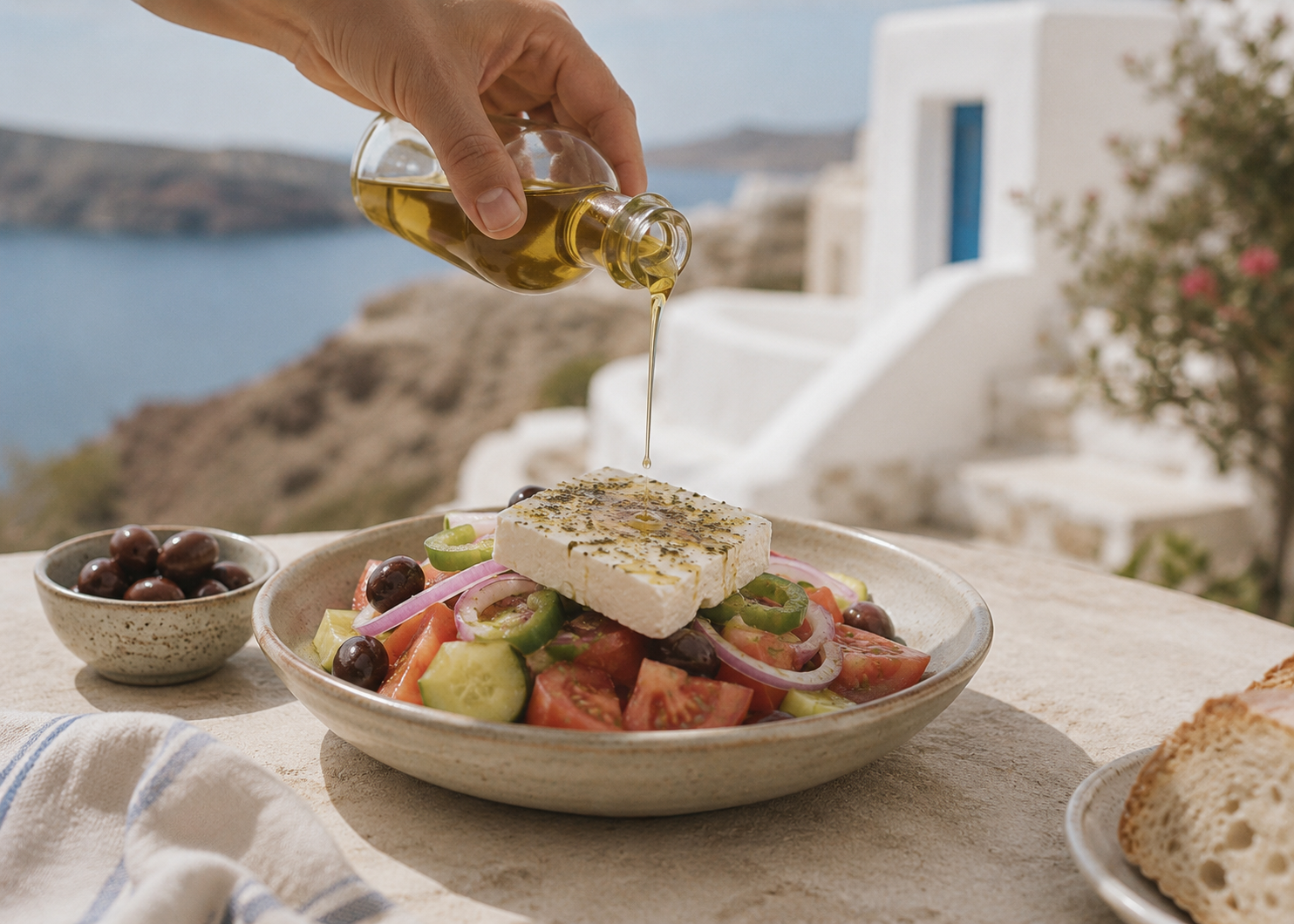
The salad arrives at a taverna table on a Greek island and it looks almost too simple to be a recipe. Big rough chunks of tomato, slabs of cucumber, rings of raw onion, green pepper, a few olives, the whole thing crowned with a thick slab of feta and showered with oregano and olive oil, no lettuce anywhere in sight. This is horiatiki, the Greek village salad, and it is one of the great dishes of the Mediterranean precisely because it asks for so little and delivers so much, provided you understand what it actually is.
From a kitchen in Spain, where the same respect for a few perfect ingredients runs through the cooking, the American version of Greek salad is a familiar disappointment. The American Greek salad is a bowl of chopped lettuce with some vegetables, crumbled feta, and a creamy or vinegary dressing, a different dish entirely, and even the better American attempts at the real thing stumble on one specific point. They use the wrong tomatoes. Horiatiki lives or dies on its tomatoes, and the American habit of reaching for the firm, uniform, flavorless Roma or the pale supermarket slicer is the single biggest reason the home version never tastes like the one on the island.
The Tomato Is The Whole Point
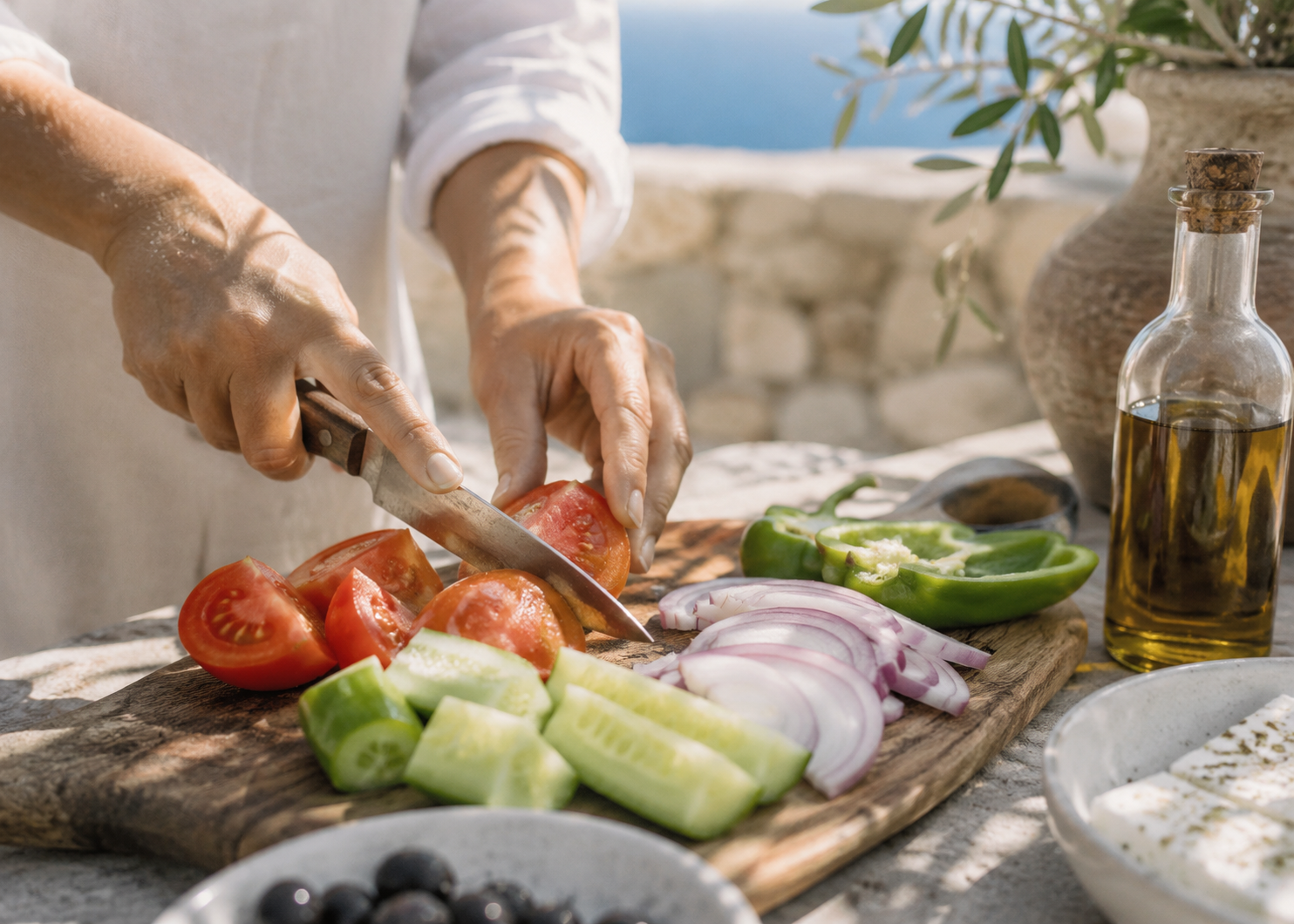
Here is the heart of the matter, the thing American recipes get wrong before anything else. The tomatoes must be ripe, flavorful, summer tomatoes, and the choice of tomato matters more than any other decision in the dish.
Horiatiki is, at its core, a celebration of the tomato at its peak, and the salad cannot be better than the tomatoes in it. In Greece the salad is made with big, ripe, intensely flavorful summer tomatoes, often slightly irregular, deeply red, fragrant, the kind that taste of sunshine and acidity and sweetness all at once, cut into rough generous chunks. These tomatoes are the foundation, the main event, and everything else in the salad, the cucumber, the onion, the feta, the oil, is in service to them. The dish exists to show off perfect tomatoes, and when the tomatoes are right it is sublime.
The American mistake is to substitute the wrong tomato, most often the Roma, which is firm, meaty, uniform, and bred for sauce and shipping rather than for flavor, or the pale out-of-season slicer that has no taste at all. A Roma tomato in horiatiki is a small tragedy, because it brings the right red color but none of the juicy, sweet-acid flavor the dish depends on, leaving a salad that looks right and tastes of nothing. The dish then seems boring, and the cook concludes that horiatiki is overrated, when the real problem is simply the tomato. Use a ripe, flavorful, in-season tomato, a good heirloom, a real vine tomato at its peak, and the same recipe transforms into the thing you remember from Greece, which proves that the tomato was the whole point all along.
What Horiatiki Actually Is, And Is Not
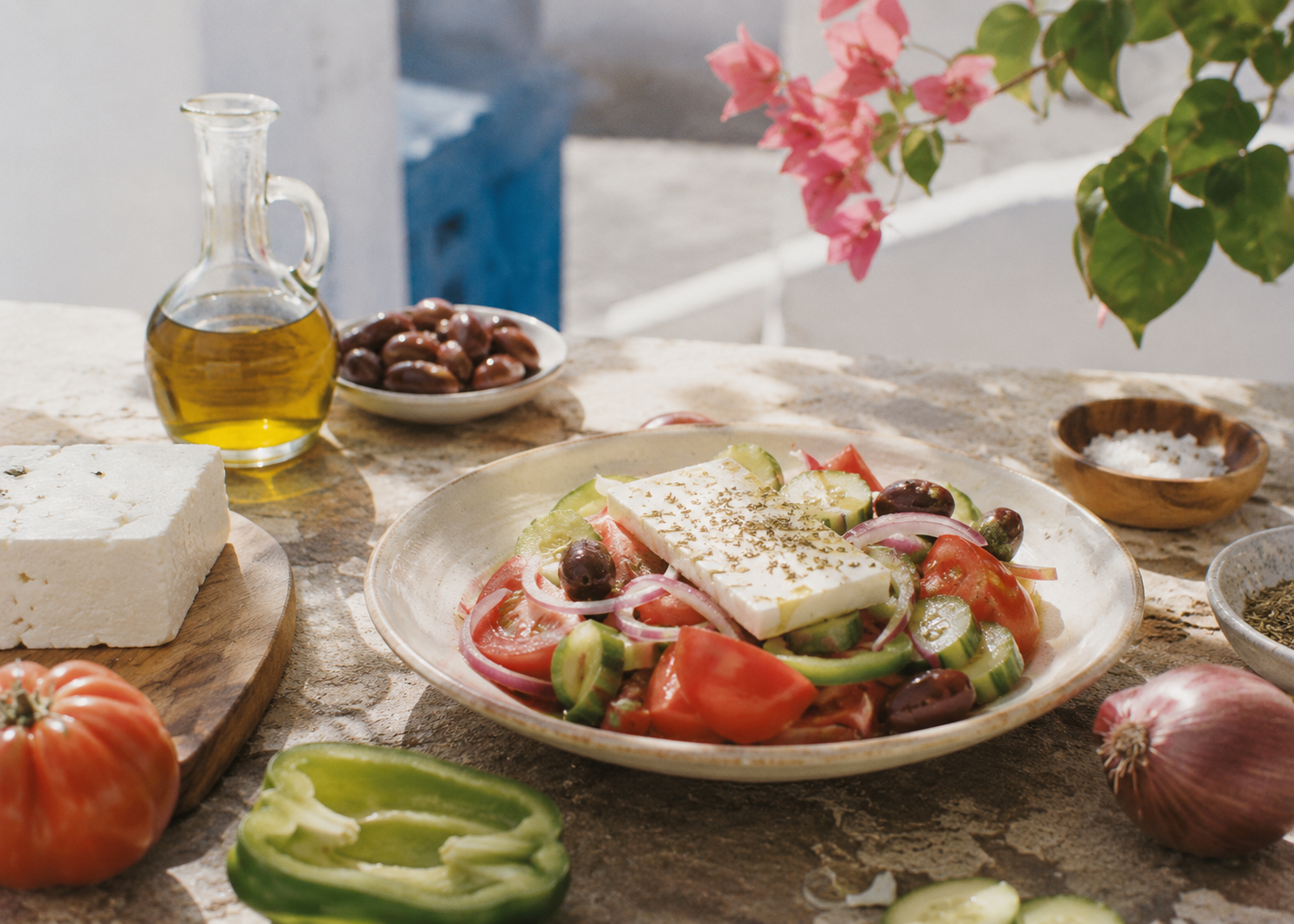
To make it right, you first have to understand what the dish is, because the American Greek salad has drifted so far that many people do not know the original.
Horiatiki, the name means village salad, contains no lettuce at all, which surprises Americans who think of Greek salad as a lettuce salad with Greek toppings. It is a salad of vegetables and feta, built on tomato and cucumber, with raw onion, green pepper, olives, and the feta, dressed with nothing but good olive oil, oregano, and salt, sometimes a splash of red wine vinegar. There is no lettuce, no creamy dressing, no bottled Greek dressing, none of the elaboration the American version adds. It is austere and generous at once, a few excellent ingredients in big rough pieces, and its beauty is in that simplicity.
The feta is the other defining element, and it too is handled differently than Americans expect. In a proper horiatiki the feta is not crumbled into small bits scattered through the salad but laid on top as a single thick slab or large pieces, often sprinkled with oregano, sitting on the vegetables like a crown. This is partly presentation and partly function, the slab of feta to be broken up and shared at the table, soaking up the oil and tomato juices, rather than dispersed into crumbs. And the feta should be real Greek feta, made from sheep’s milk or a sheep-and-goat blend, briny and tangy and creamy, not the dry, sour, cow’s-milk crumbles often sold as feta elsewhere. Real feta on top, ripe tomatoes beneath, and you are already most of the way to the real dish.
Here is how it comes together. This makes a generous salad for four as part of a meal, in the rough, abundant Greek style.
Ingredients

- 4 large ripe summer tomatoes, the best you can find, in rough chunks
- 1 cucumber, in thick half-moons
- 1 small red onion, in thin rings
- 1 green pepper, in rings
- 150 g Greek olives, Kalamata, ideally with pits
- 200 g block of real Greek feta, sheep’s milk
- 4 tbsp extra virgin olive oil, plus more to finish
- 1 tsp dried Greek oregano
- salt, to taste
- red wine vinegar, optional, a small splash
Method
- Choose and cut the tomatoes. Use the ripest, most flavorful summer tomatoes you can find, never firm Roma or pale out-of-season ones. Cut them into rough, generous chunks and put them in a wide bowl. They are the foundation of the dish.
- Add the vegetables. Add the cucumber in thick half-moons, the onion in thin rings, and the green pepper in rings. Cut everything in substantial pieces, not thin slices, to keep the crunch and the rough character. Scatter in the olives.
- Season and dress. Sprinkle with salt, pour over the olive oil generously, and add the optional splash of red wine vinegar if using. Toss gently, just enough to combine, so the tomatoes begin to release their juice into the oil.
- Crown with feta. Lay the block of feta on top of the salad as a single slab or in large pieces, rather than crumbling it through. Sprinkle the oregano over the feta and the salad, and finish with a little more olive oil over the cheese.
- Rest and serve at room temperature. Let the salad sit a few minutes so the tomatoes release their juice and the flavors meld. Serve at room temperature, never cold, with plenty of good bread to soak up the pool of tomato-and-oil juice at the bottom of the bowl, which is one of the best parts.
A note on the tomatoes and feta. The dish has nowhere to hide, so the two ingredients that carry it must be genuinely good: ripe, flavorful, in-season tomatoes, and real Greek sheep’s-milk feta. Everything else is supporting.
The Other Ingredients, Done Right
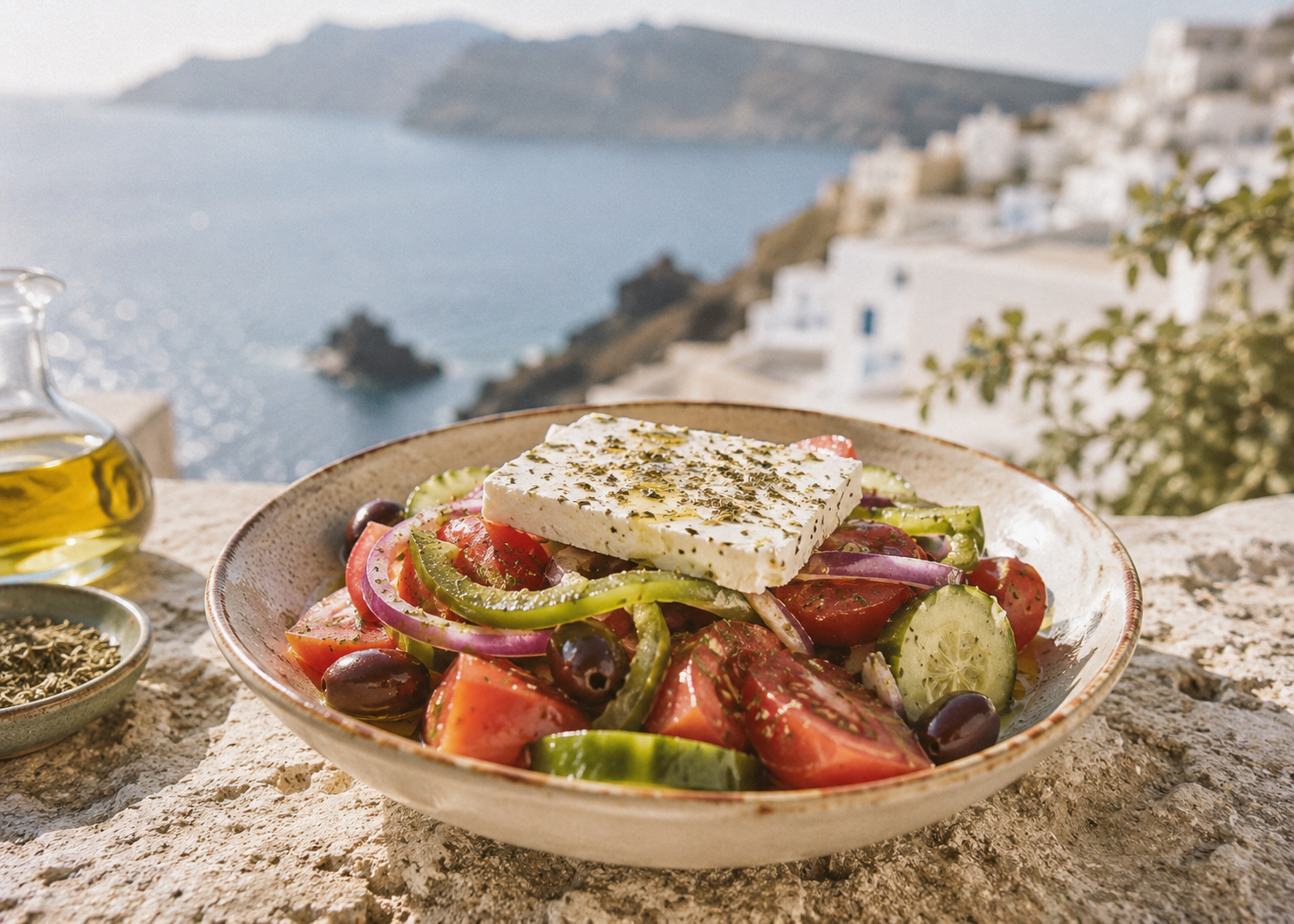
Beyond the tomato and the feta, each of the remaining ingredients has a correct form that the American version often gets slightly wrong, and the details add up.
The cucumber should be cut into substantial pieces, thick half-moons or chunks, not thin slices, so it keeps its crunch and stands up to the tomato, and in Greece it is often left unpeeled or only partly peeled. The onion should be raw, cut into thin rings or half-rings, and it should be a real presence in the dish, since the sharp bite of raw onion against the sweet tomato and salty feta is part of the balance, though those who find it too strong can soak the rings briefly in cold water to soften the edge. The green pepper, a regular green bell or the long Mediterranean type, is cut into rings and adds a fresh, slightly bitter crunch that rounds out the vegetables. None of these is exotic, but each should be cut generously and left raw and crisp, in keeping with the rough, substantial character of the dish.
The olives should be good Greek olives, Kalamata or a similar real cured olive, ideally with the pits in for the most flavor, scattered over the salad. The oil must be good extra virgin olive oil, used generously, because it is not a token dressing but a main flavor, pooling at the bottom of the bowl where the bread will later soak it up. The oregano, dried Greek oregano for preference, is sprinkled over the top, especially over the feta, and its piney, aromatic note is essential to the Greek character of the dish. Salt brings it all together, and a splash of red wine vinegar is optional, used by some and not others. What you do not add is anything else, no lettuce, no creamy dressing, no long list of extras, because the dish is complete as it is and additions only dilute it.
The Bread At The Bottom Of The Bowl
There is a final element of horiatiki that is not an ingredient in the salad but is inseparable from how it is eaten, and understanding it completes the dish.
As the salad sits, the tomatoes release their juice, and that juice mixes with the generous olive oil and the brine from the feta and olives to form a pool of intensely flavorful liquid at the bottom of the bowl, and this liquid is not waste but one of the best parts of the whole thing. In Greece, good bread is always on the table, and the ritual is to tear off pieces and dip them into that pool of tomato-oil-feta juice, soaking up every drop, so that the bread becomes a second course of the salad. This is why the dish is made with so much olive oil and why the tomatoes must be juicy, because the juice they create is half the point, and a salad made with dry Roma tomatoes and a stingy hand with the oil produces no juice and so loses this entire dimension.
The bread-and-juice ritual is the clearest sign that horiatiki is peasant food in the best sense, designed to make a satisfying meal from a few cheap ingredients by wasting nothing, the bread extending the salad and capturing its essence. It also explains why the salad is best eaten at room temperature rather than cold, since the cold of the refrigerator mutes the tomatoes and firms the oil, while at room temperature the flavors are full and the juices run freely. A horiatiki served at room temperature, with good bread to dip, is a complete and deeply satisfying thing, a light meal in itself on a hot day, and it is a world away from the cold, lettuce-heavy, over-dressed American salad that borrowed its name.
Why The Simplicity Is The Skill
The lesson of horiatiki is the lesson of so much Mediterranean cooking, and it is worth stating plainly because it runs against the American instinct.
The dish is hard to make well not because it is complicated but because it is so simple that there is nowhere to hide, and every ingredient has to be genuinely good. There is no dressing to mask a poor tomato, no clever technique to rescue mediocre feta, no long ingredient list to distract from a weak component. The whole dish is a handful of raw ingredients and good oil, which means the quality of each one shows completely, and the skill is not in the cooking, of which there is none, but in the sourcing and the restraint. This is the opposite of the American instinct to improve a dish by adding to it, the lettuce, the dressing, the extra ingredients, all of which actually move it away from the excellent simple thing it is meant to be.
The Greek village cook understood that the way to make a great salad was to start with great ingredients and then do as little as possible to them, and that adding things was usually a way of compensating for ingredients that were not good enough in the first place. Horiatiki at its best is proof that a few perfect tomatoes, real feta, good oil, and a little oregano need nothing else, and that the confidence to leave a dish simple is itself a kind of culinary skill, perhaps the hardest one for a cook trained to add and elaborate. Get the tomatoes right, treat the rest with the same respect, dress it only with oil and oregano, and serve it with bread at room temperature, and you have one of the simplest and finest dishes the Mediterranean has to offer, exactly as it is made in a village taverna on a Greek island in the height of summer.
How The American Greek Salad Drifted
It is worth tracing how the dish on the American table grew so far from the one in the Greek village, because the drift followed the same predictable pressures that reshaped so many imported dishes.
The biggest change was the addition of lettuce, which has no place in horiatiki at all, and it happened because the American idea of a salad is fundamentally a bowl of leaves, so a salad without lettuce did not register as a salad to American diners and restaurateurs. Lettuce was added to make the dish legible as a salad in the American sense, and once the lettuce was in, the character shifted entirely, the tomato demoted from star to topping, the whole thing diluted into a leafy base with Greek accents. The second change was the dressing, since a bowl of lettuce needs a dressing to bind it, and so the simple oil and oregano gave way to a creamy or heavily vinegary bottled Greek dressing, another layer of distance from the original, which needs no dressing because the oil and the tomato juice are the dressing.
The third pressure was the industrial tomato itself, the firm, flavorless, shippable supermarket tomato that came to dominate the American produce aisle, which made the original tomato-centric dish impossible to reproduce even by those who wanted to, since the tomatoes simply were not good enough to carry a salad built around them. Faced with weak tomatoes, the American version leaned harder on the lettuce and the dressing precisely because the tomatoes could not do the work, a vicious circle in which poor ingredients pushed the dish further from a form that depended on great ones. The result, over decades, was a dish that kept the name Greek salad while losing almost everything that made horiatiki what it is, and most Americans have only ever met the descendant, not the original.
The encouraging news is that the original is entirely recoverable in an American kitchen, and requires no special skill, only the right ingredients and the discipline to leave things out. Buy ripe summer tomatoes from a farmers market or grow them, find real Greek sheep’s-milk feta, use good olive oil generously, add the cucumber and onion and pepper and olives and oregano, and leave out the lettuce and the bottled dressing entirely. The dish that results will taste like Greece, not like the American compromise, and it will cost less and take less effort than the elaborated version, since doing less with better ingredients is both cheaper and easier than doing more with worse ones. The horiatiki on the island is not a sophisticated dish beyond the reach of a home cook. It is the simplest possible thing done with good ingredients and left alone, which any cook can manage the moment they understand that the tomato, not the lettuce, was always the point.

About the Author: Ruben, co-founder of Gamintraveler.com since 2014, is a seasoned traveler from Spain who has explored over 100 countries since 2009. Known for his extensive travel adventures across South America, Europe, the US, Australia, New Zealand, Asia, and Africa, Ruben combines his passion for adventurous yet sustainable living with his love for cycling, highlighted by his remarkable 5-month bicycle journey from Spain to Norway. He currently resides in Spain, where he continues sharing his travel experiences with his partner, Rachel, and their son, Han.