
An American books a massage at a lovely spa somewhere in Europe, arrives relaxed and looking forward to it, and is shown into the treatment room with a quiet instruction to undress and lie down. So they do the thing they have always done at home, they undress to their comfort level, climb onto the table, and reach for the sheet to pull over themselves, the way every American massage has always worked.
And there is no sheet. There is a towel, perhaps, maybe laid under them rather than over them, and in a moment the therapist will return and simply begin, with none of the elaborate covering and uncovering an American takes for granted. The rule nobody mentioned, the one you discover flat on the table, is that a great deal of European massage is done with little or no draping, and the first time it happens it can be a genuine surprise.
There is no fine here and nothing has gone wrong, but it is one of those small cultural gaps that can leave a visitor flustered at exactly the moment they were supposed to be relaxing, and it is worth knowing about before you book rather than discovering it in the room. The difference comes down to two different traditions of how massage handles the body, the careful American choreography of the sheet and the more matter-of-fact European approach that often does without it. Here is what the rule actually is, why Europe does it this way, where you are most likely to meet it, and how to handle it so that the massage is the pleasure it was meant to be rather than an awkward ambush. This is general cultural information, and practices vary a great deal by country, by spa, and by therapist.
The American Sheet Ritual
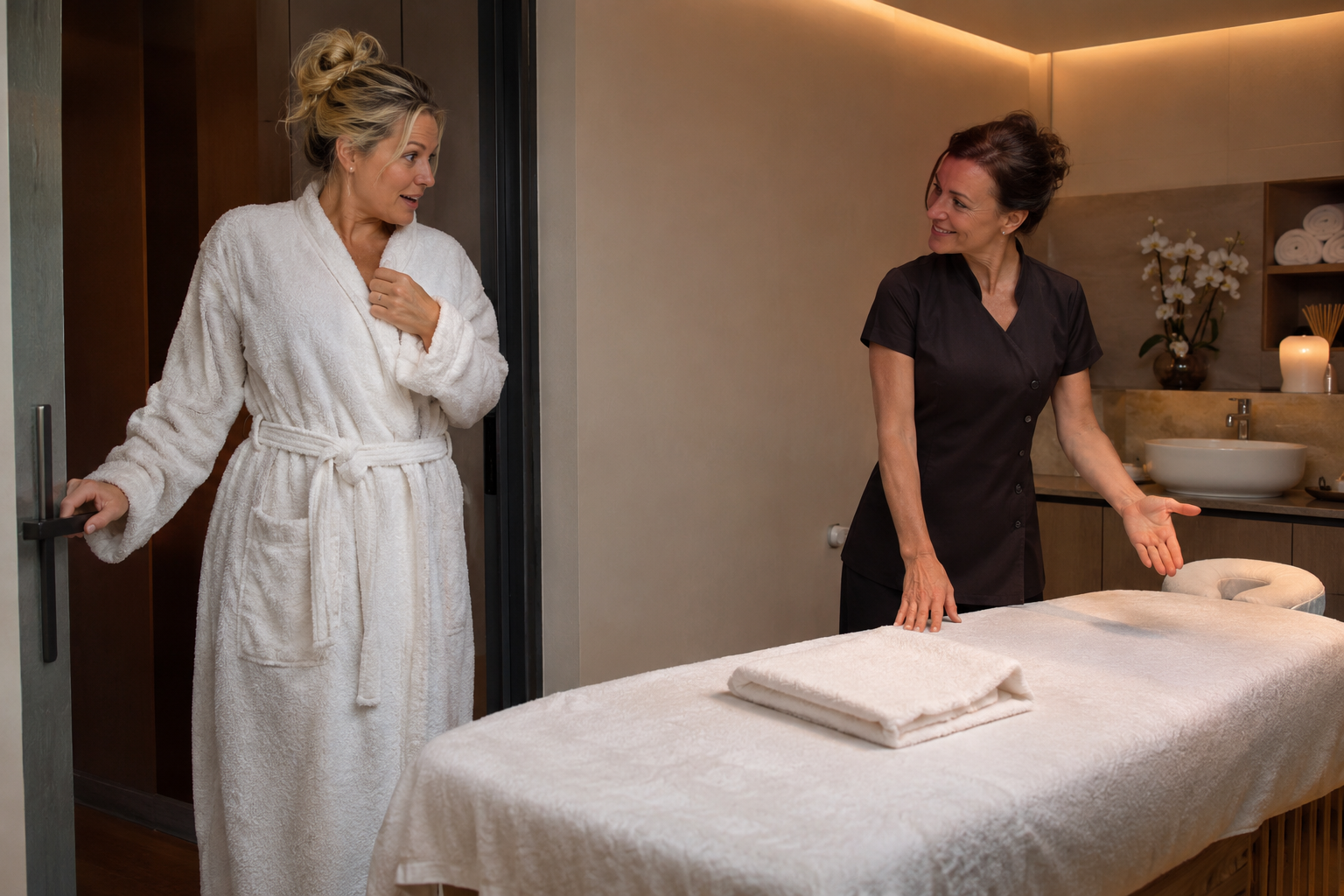
To understand the surprise you have to see how thoroughly the American massage is built around the sheet, because it is so standard at home that most Americans do not even think of it as a choice. In the American model, you undress in private to whatever level you are comfortable with, you get onto the table and under a sheet or blanket, and you are covered the entire time. When the therapist works on a particular area, a leg, say, or the back, they fold back the covering to expose only that one part, work it, and then re-cover it before moving on, so that at no point is more of you uncovered than the small area being worked. This careful, continuous draping is the invisible rulebook of the American massage.
The whole system is designed around privacy and modesty, treating exposure of the body as something to be minimized and managed, and it is backed in the United States by professional standards and expectations that therapists are trained to follow closely. An American who has had a dozen massages has had the sheet every single time, has never once had to think about it, and has absorbed the deep assumption that being covered is simply how massage works, a fixed feature of the experience rather than one cultural approach among several. The draping is so automatic that its absence does not even register as a possibility.
This is exactly why the European table comes as a shock, because the American arrives carrying that assumption like luggage and expects the sheet to be there, reaches for it on reflex, and finds the rules are different. It is not that the American is unusually modest or the European unusually bold, it is that two cultures have settled on two different defaults, and the American default is so ingrained that meeting the other one without warning feels less like a different custom and more like something having gone wrong. The sheet ritual is invisible until the moment it is missing.
The European Approach
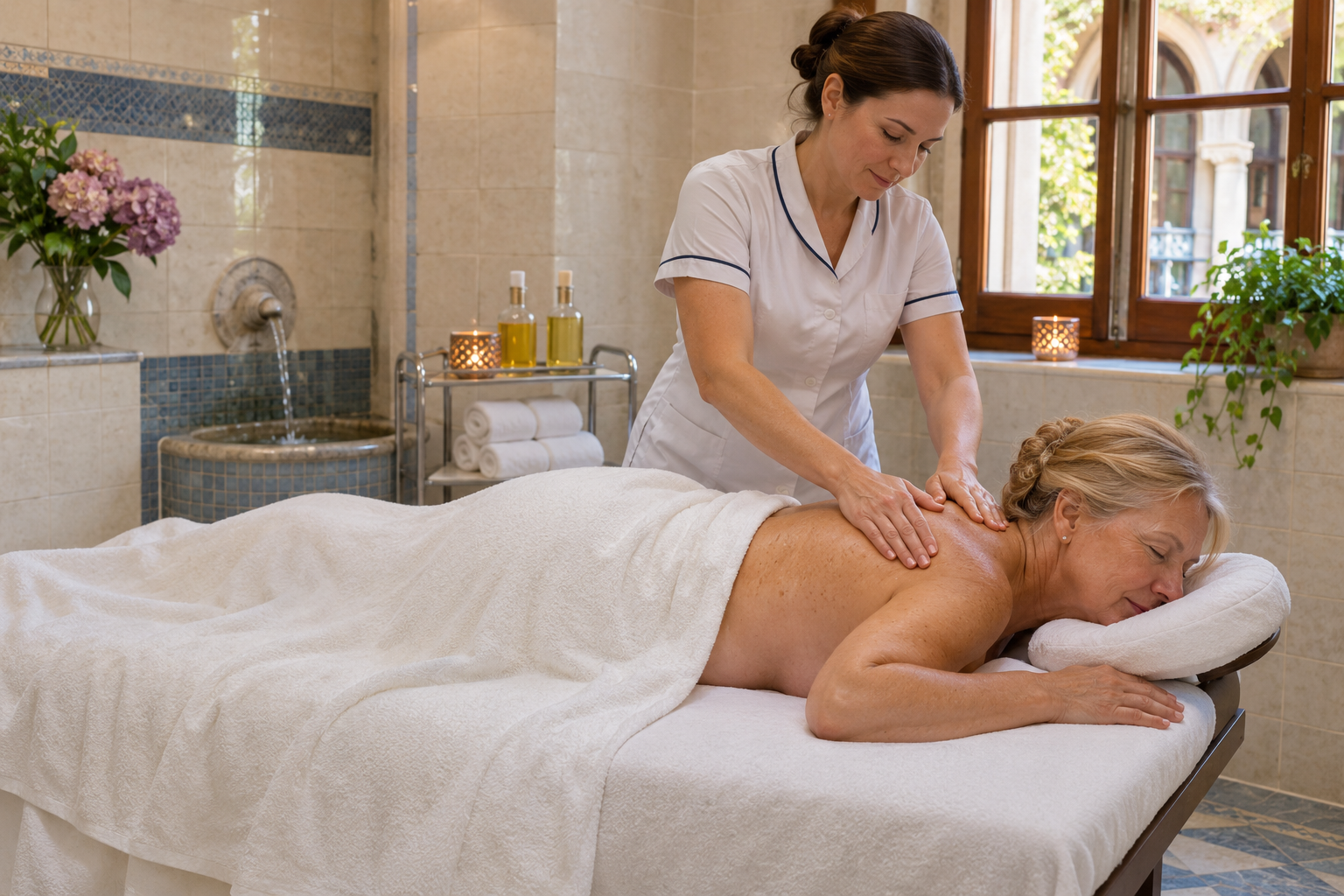
The European approach, or more accurately the approach common in much of continental Europe, treats the matter more simply and more matter-of-factly, with far less ceremony around covering the body. In many European spas, particularly in the German-speaking countries and in Scandinavia, a massage is given with minimal or no draping, the client lying on a towel rather than under a sheet, often undressed or in disposable paper underwear, with the therapist working freely without the constant fold-and-cover routine. A towel may be placed over the areas not being worked, especially for warmth, but the elaborate American choreography of exposing and re-covering one small region at a time is largely absent.
This flows directly from a broader European ease with the unclothed body that runs through the whole spa and bathing culture of these countries, the same comfort that produces mixed-gender nude saunas and thermal baths where nobody blinks. In a culture where the body at a spa is simply a body, not something charged or embarrassing, the need to keep it carefully hidden under a sheet throughout a massage feels unnecessary, even faintly odd. The therapist is a professional doing a job on a body, the client is there to be treated, and the covering is reduced to what is useful for warmth and hygiene rather than elevated into a system for managing modesty.
There is a practical logic to it as well, because working without the constant draping is simply more efficient and continuous for the therapist, who can move from one area to the next and treat the body as a whole without interrupting the flow to rearrange the sheet every few minutes. The towel underneath handles the hygiene, keeping the client off the table surface, and warmth is managed with a towel or blanket laid over the parts at rest. Seen from the European side, the American sheet ritual can look fussy and disruptive, a lot of fabric management in service of a modesty that the European spa does not feel the same need to perform. Neither approach is wrong, they simply rest on different feelings about the body.
Where You Are Most Likely to Meet It
Knowing where this difference is sharpest helps you anticipate it rather than be caught out, because it is far more pronounced in some places than others. It is most strongly associated with Germany, Austria, and Switzerland, and with the Scandinavian countries, the same regions with the most relaxed sauna and bathing cultures, where the minimal-draping approach to massage is simply the local norm. In these countries a standard spa or thermal-bath massage may well be given with little covering, and the staff will not think to explain it because to them there is nothing to explain, it is just how a massage is done.
You are also more likely to meet it in thermal spas, bathhouses, and medical or physiotherapy settings than in international luxury hotels, because these local institutions follow local custom rather than catering to the expectations of American guests. A massage booked as part of a day at a German thermal bath, or a physiotherapy massage prescribed for a bad back, will tend to follow the no-nonsense local approach. The treatment is embedded in a bathing culture that is already relaxed about the body, so the massage simply matches it.
By contrast, high-end international hotel spas, and spas in countries with a more reserved body culture, are much more likely to drape in the way Americans expect, precisely because they serve a global clientele and have adopted the more modest international standard. A massage at a luxury resort spa in, say, France, Italy, or the UK, or at an international chain hotel anywhere, will quite possibly give you the sheet and the familiar routine. This is why the experience is so variable and why it pays to know the spectrum rather than assume one rule, since the same traveler might be fully draped at a Paris hotel on Monday and undraped at a German thermal spa on Friday.
What Actually Happens in the Room
It helps to know the concrete shape of the European version so that none of it catches you off guard, because the specifics are perfectly civilized once you know them. Typically you will be asked to undress, often fully or down to disposable paper underwear that the spa provides, and to lie on the table on a towel laid over the surface. The therapist steps out or turns away while you do this, as a courtesy, and then returns to begin. A second towel or a light blanket is frequently placed over you, over the back or the legs, both for warmth and as a nod to covering, so it is rarely a case of lying completely exposed with nothing at all.
During the massage the therapist works the body region by region but without the constant American re-covering, moving the towel as needed to reach the area being treated and leaving the rest draped or not according to the local style. The atmosphere is professional and unremarkable, the therapist entirely matter-of-fact, and once the initial surprise passes most people find it no more exposing in feeling than the American version, simply less fussy. The body is kept warm, the treatment flows, and the whole thing proceeds with a calm practicality.
The key thing to hold onto is that this is normal and professional, not improper or a sign that you have wandered into the wrong kind of establishment, which is the anxious thought that can flash through an unprepared American mind. A reputable European spa doing minimal-draping massage is simply following its own long-standing, respectable custom, staffed by trained professionals, and the lack of a sheet carries none of the meaning an American instinct might wrongly attach to it. Understanding that in advance drains away the alarm and lets you receive the massage as the ordinary, pleasant treatment it is meant to be.
How to Handle It Comfortably
The good news is that your own comfort is entirely within your control, because the European approach is a default, not a demand, and you are always free to ask for what you want. If being more covered would let you relax, simply ask for extra draping or more towels when you arrive, or tell the therapist you would prefer to be covered, and any professional will accommodate you without the slightest fuss. Spas are in the business of your relaxation, and a polite request for more covering is completely normal and easily met, so you never have to simply endure a level of exposure that makes you tense.
The single most useful habit is to ask about the draping policy when you book, especially at a local spa in one of the German-speaking or Scandinavian countries, so that you walk in knowing what to expect rather than discovering it on the table. A quick question at reception or in the booking, about how the massage is draped and whether you should undress fully or keep underwear on, settles the whole matter in advance and removes the surprise entirely. Forewarned, you can decide what you are comfortable with and arrange it before you are lying down.
It also helps to go in with the right frame of mind, understanding that the local approach is professional and ordinary, so that if you do meet the no-sheet version you can take it in stride rather than freeze. Most people find that once the initial jolt of the unfamiliar passes, the European massage is just as relaxing as the American one, and that the sheet they were so attached to turns out to have been more about habit than about any real need. You can always ask for more covering, you can always keep your underwear on, and you can always choose an international hotel spa if the familiar routine matters to you, so the whole thing reduces to a small piece of knowledge and a simple preference, held in advance rather than sprung on you in the room.
Country by Country, Roughly
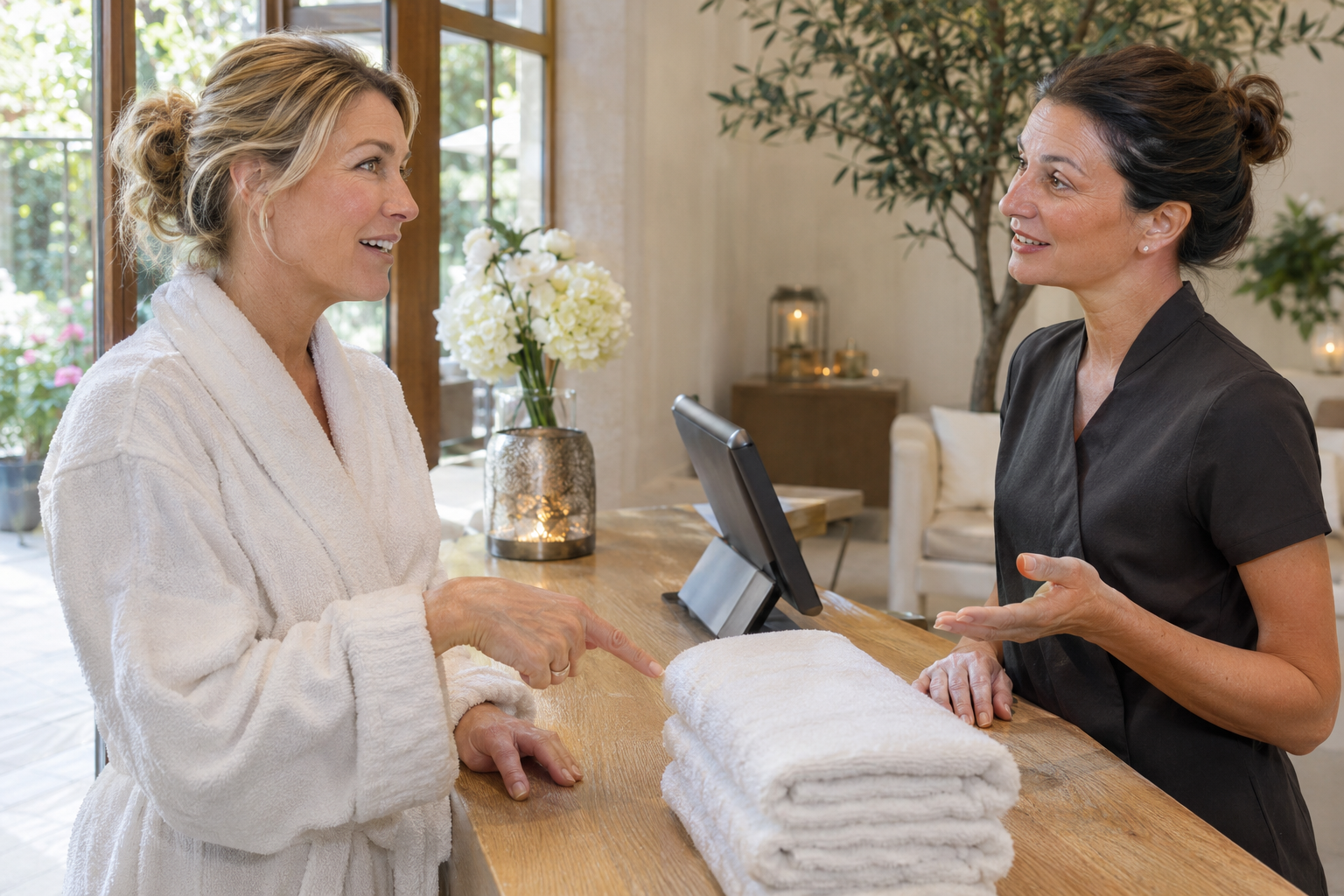
It helps to carry a rough map of where the difference is sharpest, because the spectrum runs a long way. The German-speaking countries and Scandinavia sit at one end, where minimal draping is simply standard and where a local spa or thermal-bath massage may well be given with little covering and no explanation offered. The further north and east into that body-relaxed heartland you go, the more you should expect the no-sheet approach as the default rather than the exception, especially away from the big international hotels.
At the other end sit countries with a more reserved body culture and the international luxury spas everywhere, which tend toward the draping Americans know. A massage in France, Italy, Spain, or the UK, and above all at a global chain hotel, is much more likely to give you the sheet and the familiar routine, though even there a smaller local establishment may lean toward the European norm. The safe rule is to assume nothing from the country alone, treat the German-speaking and Nordic regions as the most likely place to meet minimal draping, and simply ask when you book, which settles the question wherever you are far better than any generalization can.
The Bigger Picture
Step back and this small surprise is really one more window onto the broader European ease with the body that threads through the whole continent’s spa, sauna, and bathing life, the same current that produces the shared saunas and the unbothered thermal baths. The massage table is simply another place where a culture comfortable with the unclothed body sees no need for elaborate concealment, and where the American instinct to cover meets a local instinct that does not share the same urgency. Seen that way, the missing sheet is not a lapse but a signal, a reminder that you are in a culture with a different and entirely respectable relationship to the body.
For the American traveler the lesson is the familiar one that so much of comfortable travel comes down to knowing the local defaults before you meet them, so that a difference becomes an interesting feature of the place rather than an ambush. The massage with no sheet is harmless, professional, and easily adjusted to your taste, and the only thing that makes it stressful is meeting it unprepared. Learn that European massage often does without the draping you know, ask about it when you book, request more covering whenever you like, and the treatment goes back to being what it was always meant to be, a quiet hour of being looked after, in a culture a little more relaxed about the body than the one you came from.

About the Author: Ruben, co-founder of Gamintraveler.com since 2014, is a seasoned traveler from Spain who has explored over 100 countries since 2009. Known for his extensive travel adventures across South America, Europe, the US, Australia, New Zealand, Asia, and Africa, Ruben combines his passion for adventurous yet sustainable living with his love for cycling, highlighted by his remarkable 5-month bicycle journey from Spain to Norway. He currently resides in Spain, where he continues sharing his travel experiences with his partner, Rachel, and their son, Han.