
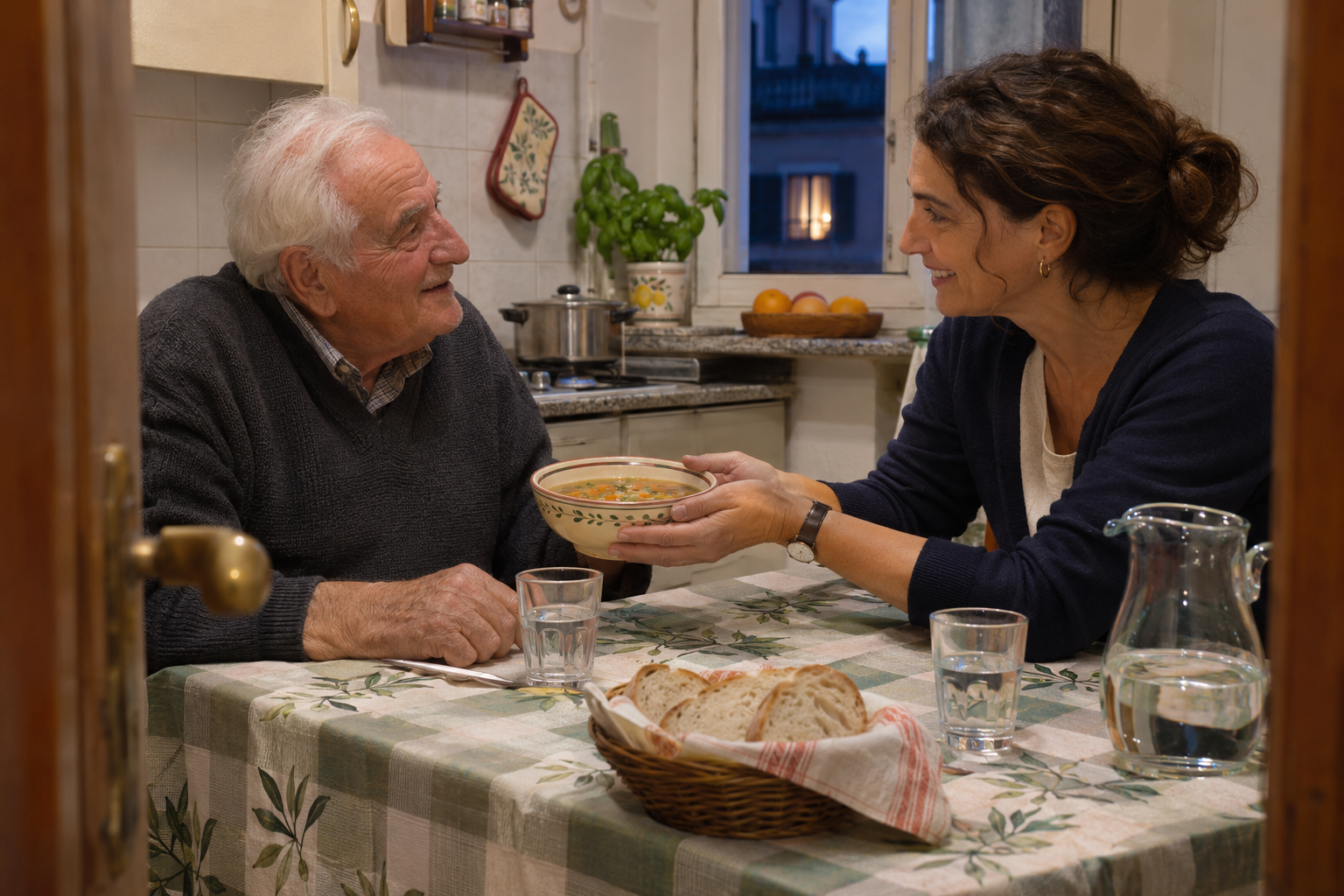
In an Italian family there is a rule so deeply held that nobody would ever call it a rule, because it is simply how life is arranged: at the main meal of the day, nobody eats alone. The table is laid, the family gathers, and the grandmother or grandfather is there in their place, every day, part of the noise and the passing of dishes and the arguments about the sauce, woven into the ordinary fabric of family life by the simple fact of the shared meal. And that daily table, more than any policy or program, is a big part of why so many Italian grandparents grow old inside the family rather than in an institution, because a person who has a seat at the table every day is a person who is still fully part of the household, still seen, still fed, still belonging.
This is not to romanticize, because Italy has care homes too and its families face real strains, but the cultural pattern is genuine and the contrast with the American way is stark. Where the American default has drifted toward elders living alone and, eventually, moving into assisted living or a nursing home, the Italian default keeps the older generation embedded in daily family life, and the shared meal is the engine that drives it. Here is what the dinner rule actually is, how it keeps grandparents woven into the household, why that matters for an older person’s health and happiness, and what an American family might borrow from it even without upending their whole way of living. This piece touches on wellbeing and is general cultural information, not medical or caregiving advice.
The Rule and the Table
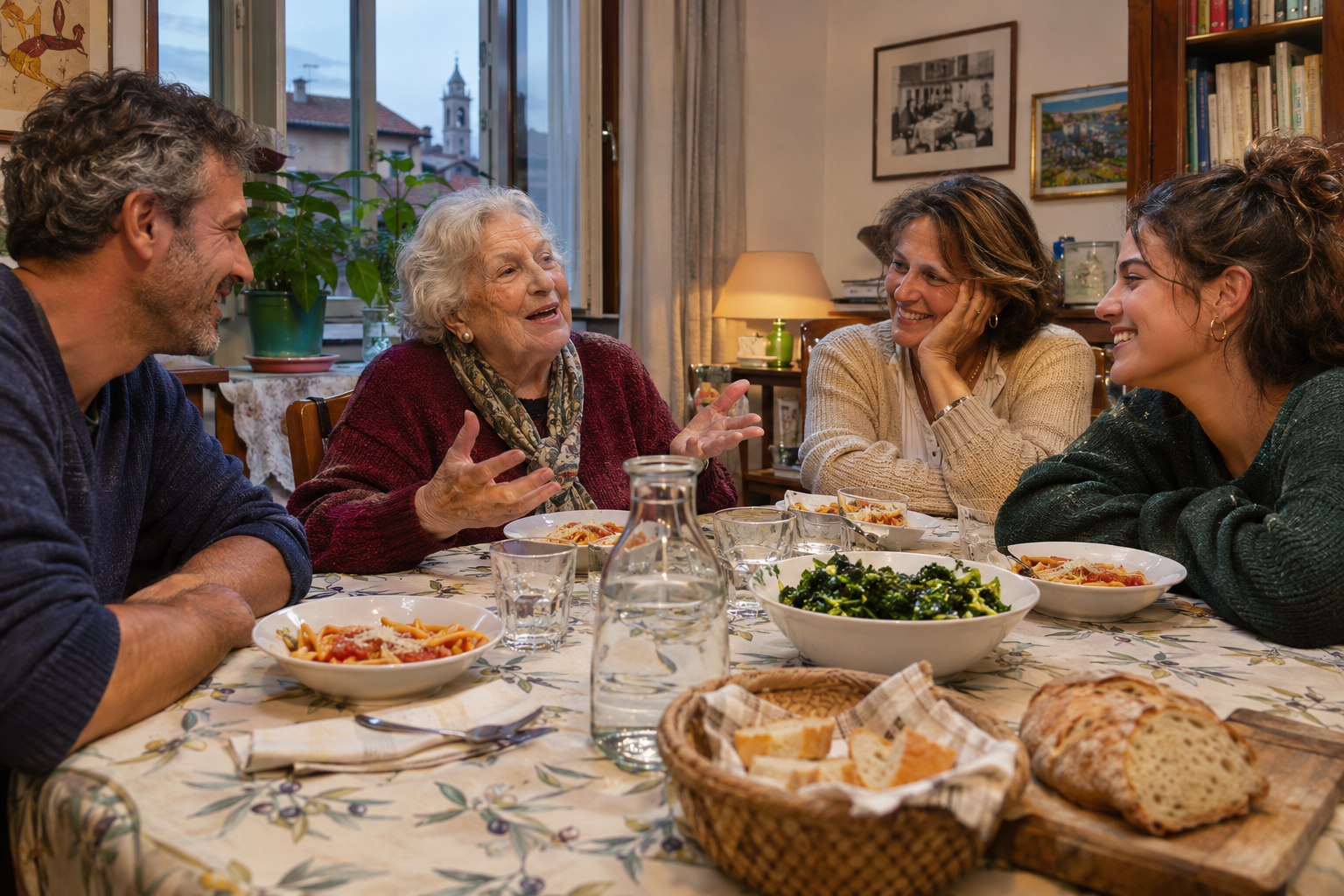
The rule at its simplest is that the main meal is a shared, communal event, not a thing done alone or on the move, and that the whole household, across the generations, comes together for it. In the traditional Italian pattern this is often the midday meal, long and unhurried, or the evening meal, and it is treated as the fixed point of the day around which other things arrange themselves. People come to the table, they sit, they eat together, they talk, and the meal has a social weight far beyond the food, functioning as the daily ritual that holds the family in contact.
For the older generation this daily gathering is everything, because it guarantees that the grandparent is present and included as a matter of course, not as a special visit or an occasional duty but as the ordinary rhythm of every single day. The grandmother who cooks, or sits while others cook, who has her chair and her opinions and her role in the meal, is by that fact still a central figure in the household rather than a person off to the side. The table does not let anyone be forgotten, because the empty place would be noticed instantly, and so the structure of the shared meal continually pulls the elder into the heart of family life.
This is why the phrase to keep in mind is that nobody eats alone, because eating alone, day after day, is one of the quiet markers and causes of an older person’s drift to the margins. In the Italian pattern that drift is resisted structurally, by the simple insistence that meals are shared, so that the grandparent is anchored to the family by the most basic and most frequent of human activities. The table is not sentimental about it, it just works, three hundred and sixty five days a year.
The Household Behind the Table
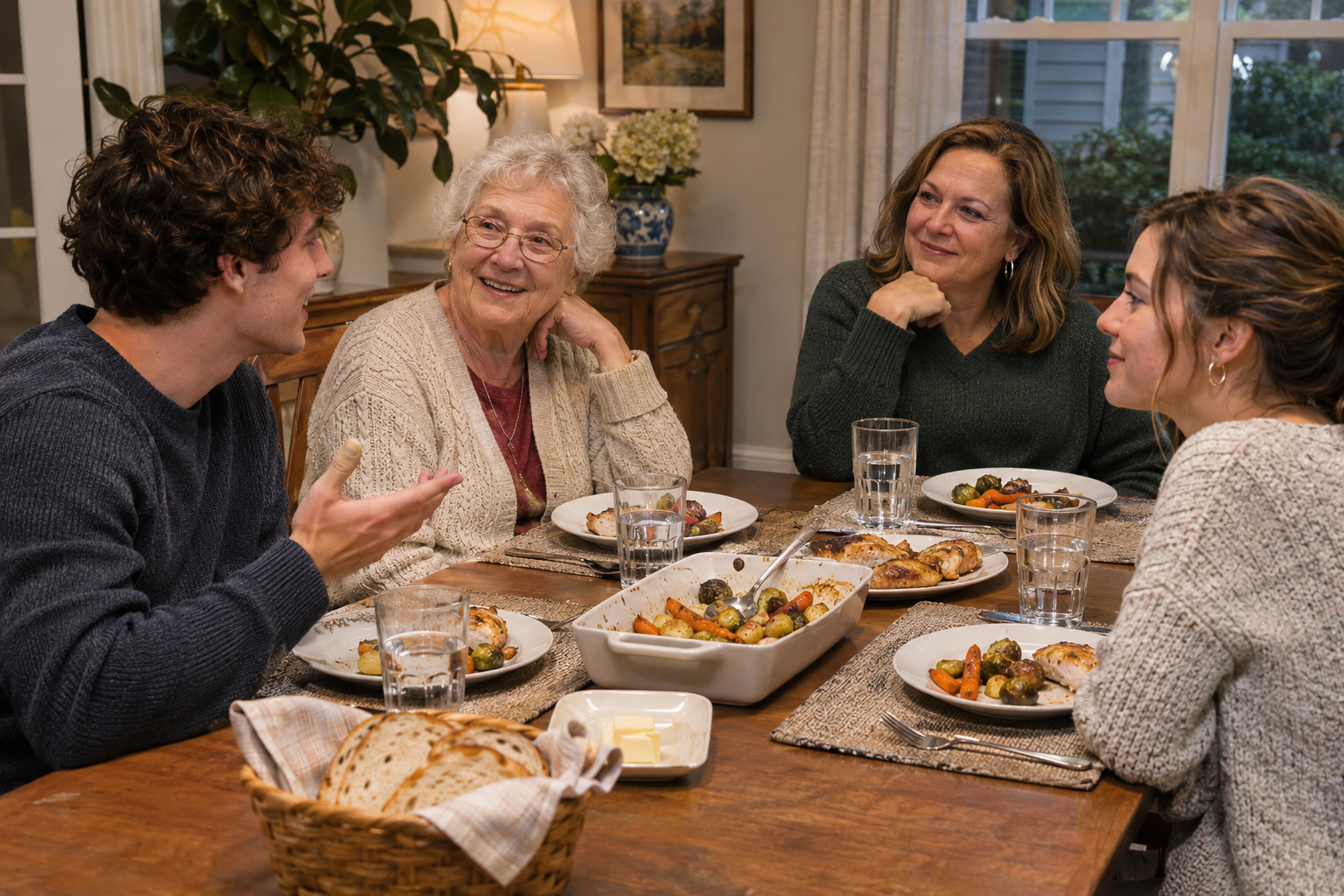
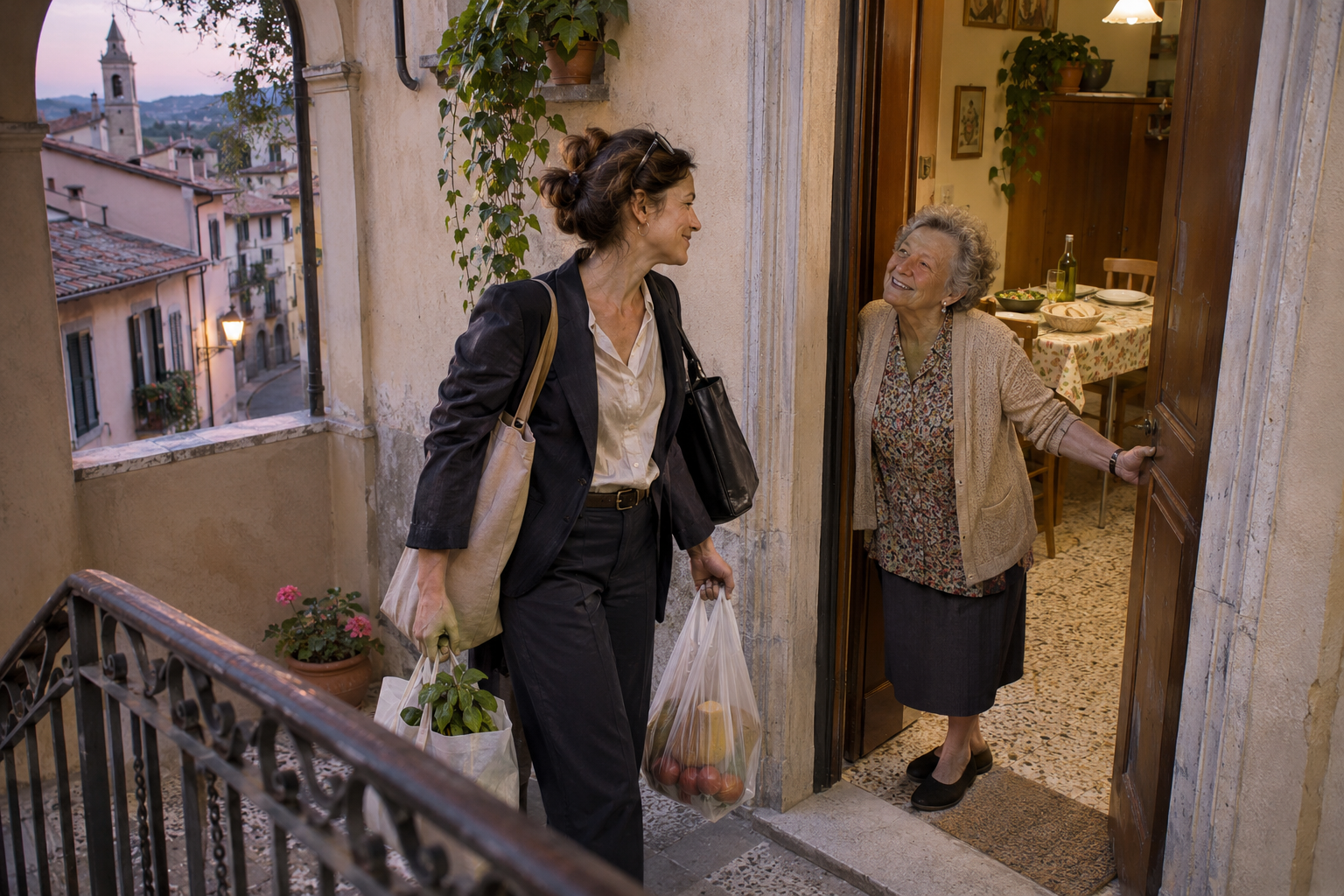
The daily shared meal rests on a broader arrangement, the strong Italian tradition of the multigenerational family, in which the generations live together or very close by and consider the care of elders a family responsibility. In many Italian families the grandparent lives in the same home, or in the same building, or a few streets away, near enough that the daily meal together is simply practical. This closeness is not an accident but a value, the famous centrality of la famiglia, in which the family is the primary unit of care and the idea of handing an aging parent to an institution is approached with real reluctance.
Within that arrangement the generations are interdependent rather than separated, each contributing what they can. The grandparents often help with the grandchildren, with the cooking, with the household, giving them a continuing role and a sense of being needed, while the younger generation provides the support and care the elders come to need. This exchange runs in both directions and keeps everyone useful to everyone else, so that the older person is not a passive recipient of care but an active member of a working household, which protects their dignity and their place.
The shared meal is where all of this becomes visible and concrete every day, the daily enactment of the multigenerational bargain. It is at the table that the help with the grandchildren, the cooking, the staying-in-touch all converge, that the family confirms itself as a unit, and that the elder’s membership is renewed. Take away the shared table and the multigenerational household loses its daily heartbeat, which is why the two go together, the living arrangement and the meal that gives it its rhythm.
How the Meal Keeps Watch
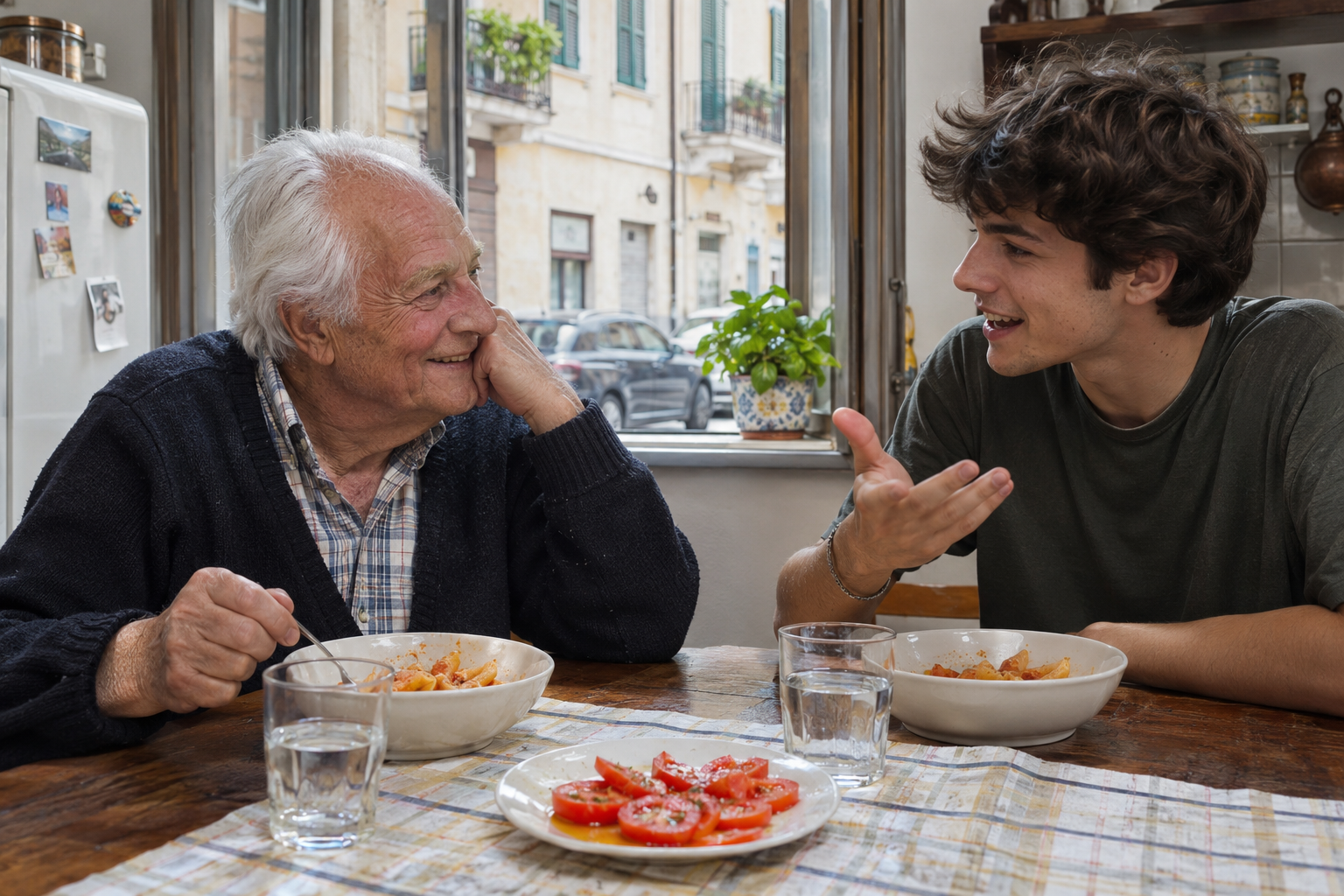
Beyond belonging, the daily shared meal does something quietly practical for an aging person, which is that it keeps the family in close, frequent contact with how the elder is actually doing. When you sit down to eat with your mother or father every day, you notice things, whether they are eating well, whether they seem confused or low, whether they are steady on their feet, whether something has changed, and you notice it early, as part of ordinary life rather than through a crisis or a scheduled check. The table is a daily, informal monitoring that no visiting service can match.
This matters enormously for an older person’s safety and health, because so much of what goes wrong in old age is caught, or missed, in exactly these small daily observations. A decline in appetite, a new difficulty, a shift in mood, the first signs of a problem, all of these show up at the table where attentive family can see them, and being seen daily means help can come sooner. The grandparent who eats alone can slide a long way before anyone notices, while the grandparent at the family table is under the gentle, constant, loving watch of people who know them well.
The meal also ensures the basic thing that older people living alone so often lose, which is that they are actually eating, properly and regularly. Appetite and the will to cook can fade when there is no one to eat with, and poor nutrition is a real danger for the elderly, so the daily shared meal, with its real food and its social pull, keeps the older person nourished in a way that solitary eating frequently fails to. Belonging, monitoring, and nutrition all arrive together in the same simple act, which is part of why the shared table punches so far above its weight.
The Contrast With the American Pattern
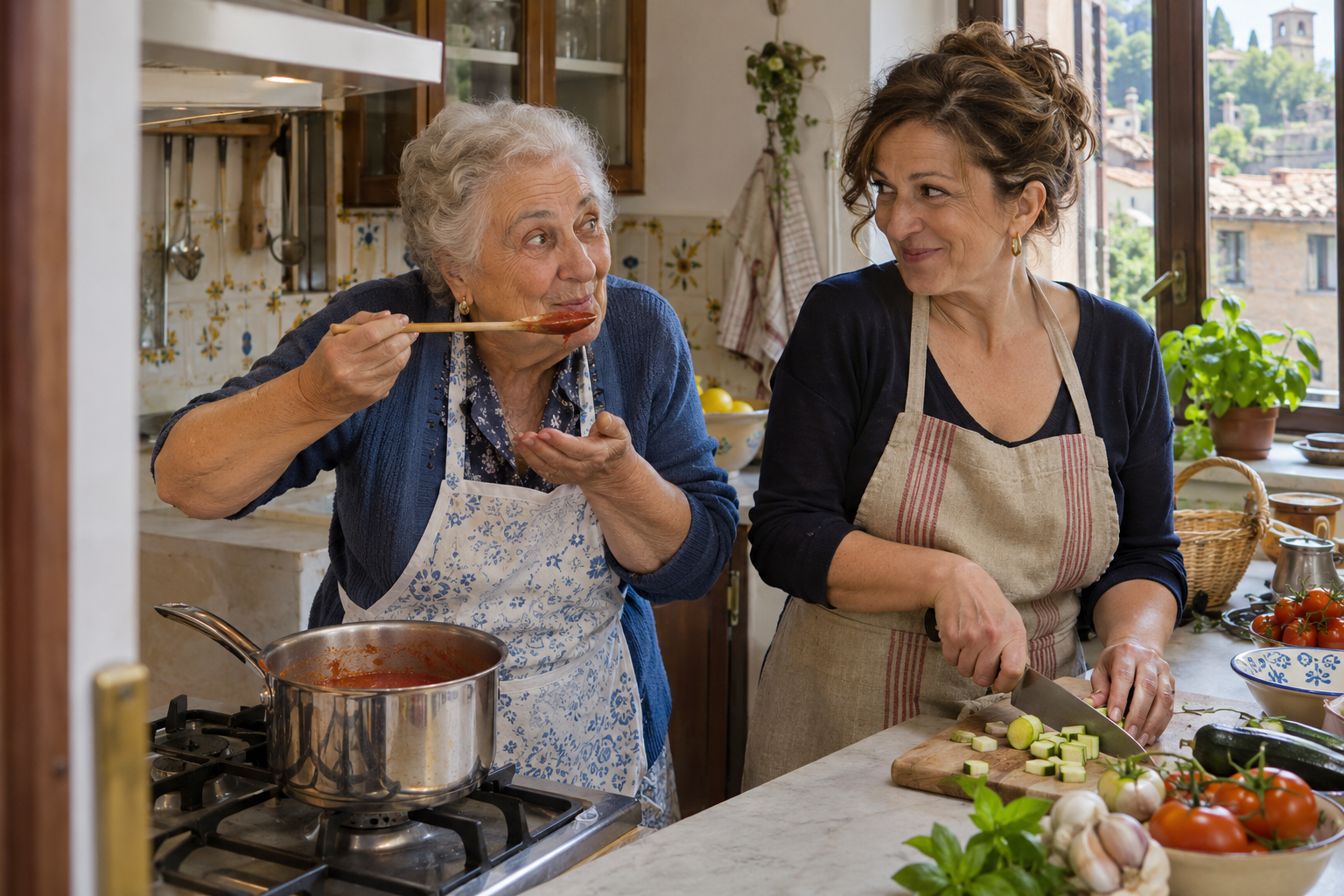
The Italian pattern throws the American one into sharp relief, because the American default has moved in almost the opposite direction over the past decades. In the United States it has become normal for aging parents to live alone, often far from their adult children, to eat many meals by themselves, and in time to move into assisted living or a nursing home when living alone becomes unsafe. This is not because American families love their parents less, but because the whole structure of American life, its mobility, its spread-out geography, its cultural emphasis on independence, pushes the generations apart rather than together.
The result is that the American elder often experiences exactly the isolation the Italian table prevents, the solitary meals, the days without company, the slow loosening of daily ties to family, and then the institutional care that follows when independence finally fails. The nursing home, which can cost a great deal and which many older people dread, becomes the expected endpoint, the place you go when living alone stops working, and the trajectory toward it begins long before, in the years of eating alone and seeing family only occasionally. The absence of the shared daily table is both a symptom and a cause of that trajectory.
None of this is to cast the American way as heartless, because it arises from real circumstances and American families do their devoted best within a structure that works against them. But the contrast is instructive, because it shows that the drift toward isolation and institutional care is not inevitable, that another arrangement is possible, and that a surprisingly large part of the difference comes down to something as ordinary as whether the generations eat together every day. The Italian grandparent at the family table and the American elder at the solitary one are living out two different cultural answers to the same question of how we grow old.
Why It Is Good for an Older Person
There is real substance behind the warm picture, because the daily connection the Italian table provides maps onto things that genuinely matter for an older person’s health and happiness. Social isolation and loneliness are now widely recognized as serious risks for older adults, associated in research with worse physical and mental health and with poorer outcomes overall, so the simple fact of daily company is not just pleasant but protective. The shared meal is a direct, daily antidote to the isolation that undermines so many solitary elders.
The arrangement also gives the older person a continuing sense of purpose and role, which matters more than it might seem. The grandmother who still has a place in the running of the household, who helps and is needed and is consulted, holds onto a reason to stay engaged and active that the retired, isolated elder can lose, and that sense of mattering is tied up with everything from mood to cognition to the will to keep going. Being embedded in family life keeps a person participating in life, which is its own kind of medicine.
And the steadiness of it, the fact that the connection is daily and dependable rather than occasional, is what makes it work, because connection you can count on every day is far more sustaining than a visit now and then. The older person in the Italian pattern knows that tomorrow, as today, there will be a table and a family and a place for them, and that reliable belonging is a deep source of security in a stage of life that can otherwise feel precarious. The health benefits of connection, purpose, and being watched over all flow from the same source, the ordinary, unfailing daily table.
The Honest Picture
Honesty requires acknowledging that this is a cultural ideal under real strain, not a flawless system, and that modern Italy is changing in ways that pull against it. Italians are having fewer children, young people move away for work, women who once provided much of the family care now work outside the home, and the population is aging fast, all of which make the traditional multigenerational arrangement harder to sustain. Care homes do exist in Italy and are used, and many Italian families struggle with the same tensions that strain families everywhere, so the picture of every grandparent happily at the family table is partly an ideal rather than a universal reality.
It is also true that the arrangement can carry costs and burdens, particularly for the family members, often women, who do the caregiving, and it would be wrong to present multigenerational elder care as pure warmth with no hard edges. Caring for aging parents at home is demanding, can be exhausting and isolating for the carer, and is not always the right answer for every family or every elder, some of whom genuinely need the specialized care an institution provides. The Italian model has real virtues, but it is not a cost-free paradise, and romanticizing it does a disservice to the people who shoulder its weight.
So the sensible way to take the Italian example is not as a reproach or an impossible standard but as a pointer, a demonstration that the daily shared table keeps elders connected, watched over, and woven into family life, and that this is worth something real. The lesson is not that every family must live together or that institutional care is a failure, but that the drift toward isolated aging is not fixed and that small structures, above all the habit of eating together, can push against it. Held honestly, with its strains admitted, the Italian table still has a great deal to teach.
What an American Family Can Borrow
The encouraging part is that you do not need to recreate the whole Italian multigenerational household to borrow the heart of it, because the portable piece is the habit of the shared meal itself. Even families spread across a city or a country can build in regular shared meals, a standing weekly dinner, a daily lunch with a nearby parent, a video call at mealtime with a distant one, anything that resists the pattern of the elder eating alone day after day. The specific arrangement matters less than the commitment that the older person is regularly fed and accompanied rather than left to solitary meals.
For families who do live near their aging parents, the Italian example is an invitation to make the shared table a fixed habit rather than an occasional event, to build the week around a few reliable meals together, knowing that those meals deliver connection, monitoring, and nutrition all at once. It costs little, it asks mainly for consistency, and it pushes directly against the isolation that does older people so much harm, so it may be one of the highest-value habits a family can adopt. The grandparent who eats with family several times a week is in a very different situation from the one who eats alone.
The deepest thing to take from the Italian table is the principle underneath it, that nobody should eat alone if it can be helped, and that the ordinary shared meal is one of the simplest and most powerful ways we have to keep the people we love woven into our lives as they age. You can honor that principle in a thousand practical shapes that fit your own family’s geography and life, from a daily lunch to a weekly dinner to a standing call, and in doing so you borrow the real engine of the Italian model without needing its whole structure. Set the table, keep the place, and make sure the older person you love has somewhere to belong, every day that you can manage it.

About the Author: Ruben, co-founder of Gamintraveler.com since 2014, is a seasoned traveler from Spain who has explored over 100 countries since 2009. Known for his extensive travel adventures across South America, Europe, the US, Australia, New Zealand, Asia, and Africa, Ruben combines his passion for adventurous yet sustainable living with his love for cycling, highlighted by his remarkable 5-month bicycle journey from Spain to Norway. He currently resides in Spain, where he continues sharing his travel experiences with his partner, Rachel, and their son, Han.