
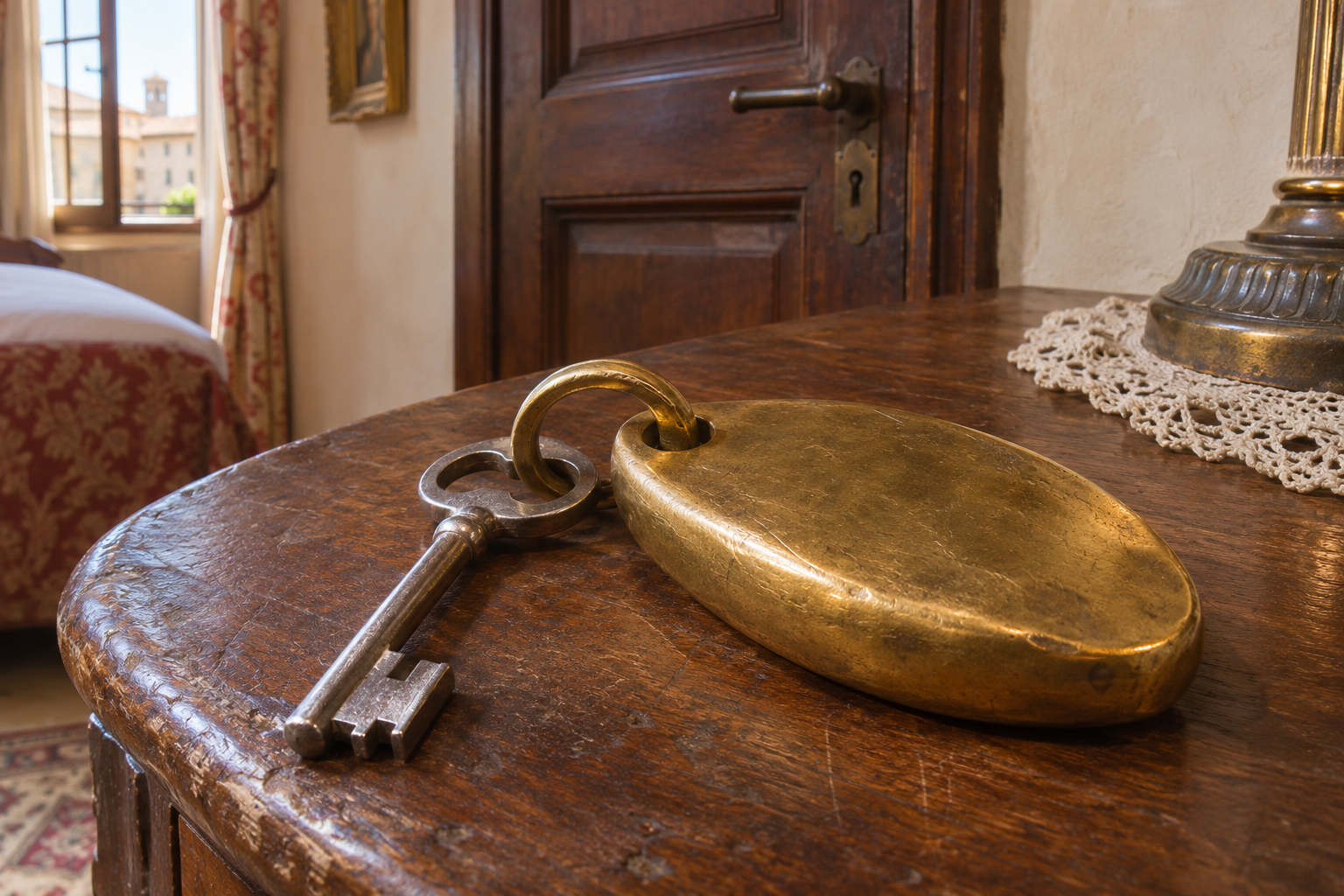
You check into a small hotel in Europe, and instead of the plastic keycard you expected, the receptionist hands you an actual metal key, attached to a fob so large and heavy it feels like a small dumbbell, a brass weight or a leather tag the size of your palm. You take it up to your room, and the next morning, on your way out to explore, you do the natural American thing, you drop the key in your pocket and head for the door. And the receptionist, politely, stops you: would you like to leave the key here? You are confused, because of course you are taking your key, that is what you do with a key. But in much of Europe, you are not supposed to, and the oversized fob was the hotel’s first hint.
Leaving the room key at reception when you go out is one of those small, deeply ingrained European hotel customs that Americans break without realizing, every single morning, until someone explains it. It is not a rule with a fine attached, but it has real stakes, the stakes of a lost key, a worried staff, and a little friction you could have avoided, and behind it sits a surprising amount of sensible logic. Here is why European hotels want the key at the desk, why the fob is so absurdly heavy, what the custom is really for, how keycards are changing it, and how to simply go along with it like a seasoned traveler.
The Key and the Enormous Fob

The first thing to understand is the physical key itself, because the whole custom flows from it. Where American hotels long ago switched almost entirely to disposable plastic keycards, a great many European hotels, especially the smaller, older, family-run places, the pensions and guesthouses and traditional hotels, still use a single real metal key for each room, the kind that turns in an actual lock. That key is not disposable and not easily replaced, because the lock is often old and the key is one of a very small number that fit it, sometimes the only spare.
And then there is the fob, the tag or weight attached to the key, which in these hotels is frequently enormous, a heavy brass knob, a thick leather paddle, a solid tag stamped with the room number, far larger and heavier than anything a key needs for mere identification. Americans tend to find this charming and slightly absurd, a comically oversized thing to carry around, and they are not wrong, but the size is entirely deliberate. The fob is big and heavy on purpose, and once you know why, the whole custom clicks into place.
The purpose of the weight is to make the key inconvenient to carry, specifically to discourage you from stuffing it in your pocket and walking off with it into the city. A key on a small ring is easy to pocket and easy to lose, but a key on a fist-sized brass weight is something you do not want to lug around all day, something that pulls your pocket down and bangs against your leg, and that discomfort is a gentle physical nudge toward doing exactly what the hotel wants, which is handing it back at the desk on your way out. The absurd fob is not an accident of old-fashioned taste, it is a quiet piece of behavioral design, a hint you carry in your pocket.
Why the Hotel Wants It Back
The custom exists for several genuinely sensible reasons, and the first is simply the irreplaceability of the key. With a single physical metal key per room and an old lock, a lost key is a real problem for the hotel, potentially requiring a locksmith or a lock change, an expense and a hassle that a disposable keycard never poses. Keeping the key at reception when the guest is out is the simplest possible protection against loss, because a key hanging on a hook behind the desk cannot be dropped in a taxi, left in a restaurant, or washed in a pair of trousers. The hotel is protecting a small but genuinely valuable object.
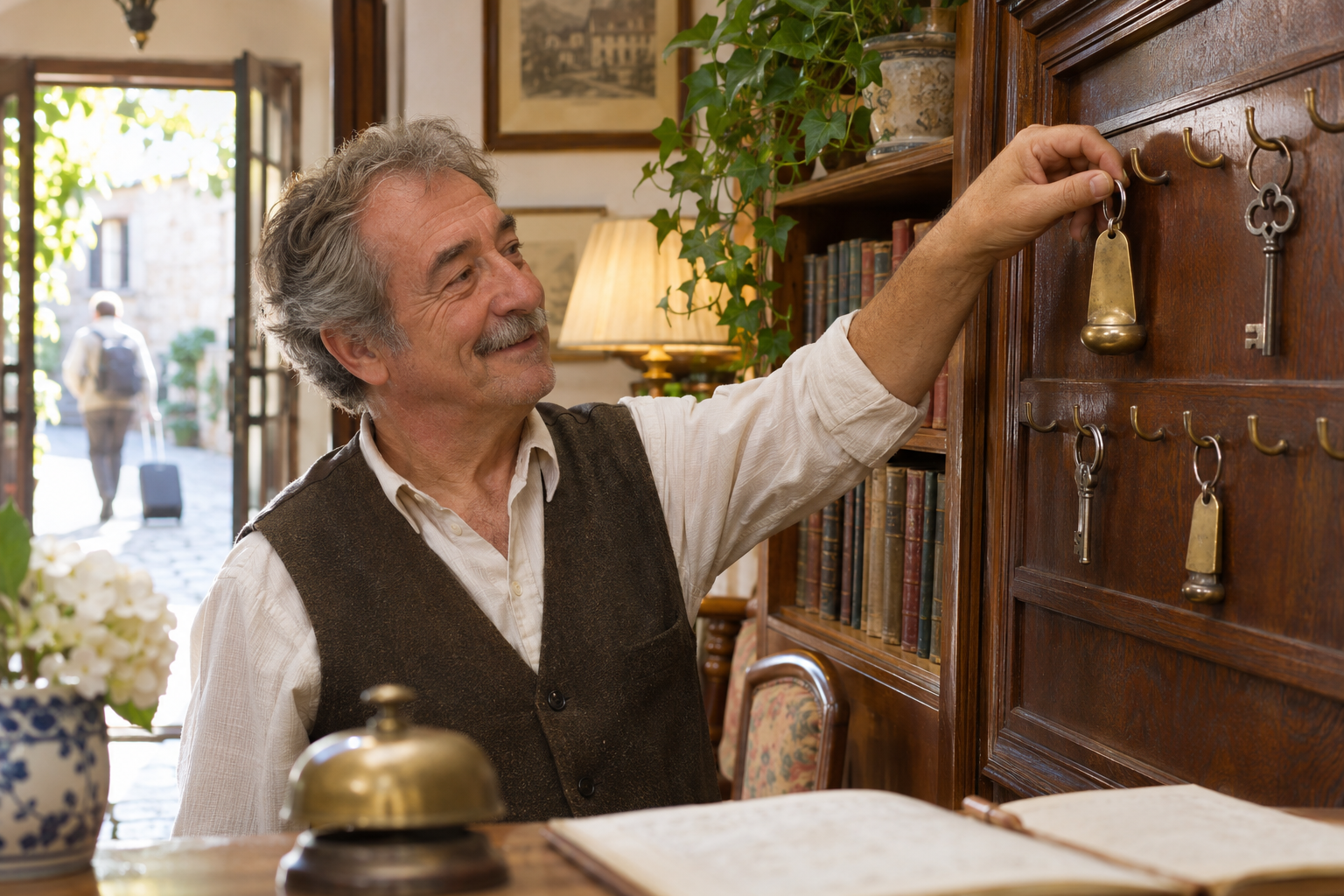
The second reason is knowing who is in the building, which matters more than it first appears. When keys live on a board at reception, a glance tells the staff which rooms are occupied and which guests are out, information that is useful for housekeeping, for taking messages, and, importantly, for safety. In the event of a fire or an emergency, knowing who is actually in the building can matter a great deal, and the key board is a simple, analog register of presence that an old hotel relies on. The custom is partly a safety system hiding inside a courtesy.
There is a third, gentler reason, which is the relationship the custom creates between guest and reception. Handing your key over on the way out and collecting it on the way back means a small interaction with the desk each time, a greeting, a word about the weather or a dinner recommendation or a message waiting for you, the kind of human contact that the keycard and the self-service lobby have engineered out of modern hotels. In the traditional European hotel, the key at the desk keeps the receptionist at the center of the guest’s day, a person who knows you are in or out and greets you coming and going, which is part of the warmth of staying in such a place. The custom is not just practical but social, a thread of connection woven into the stay.
The Rule Americans Break Every Morning
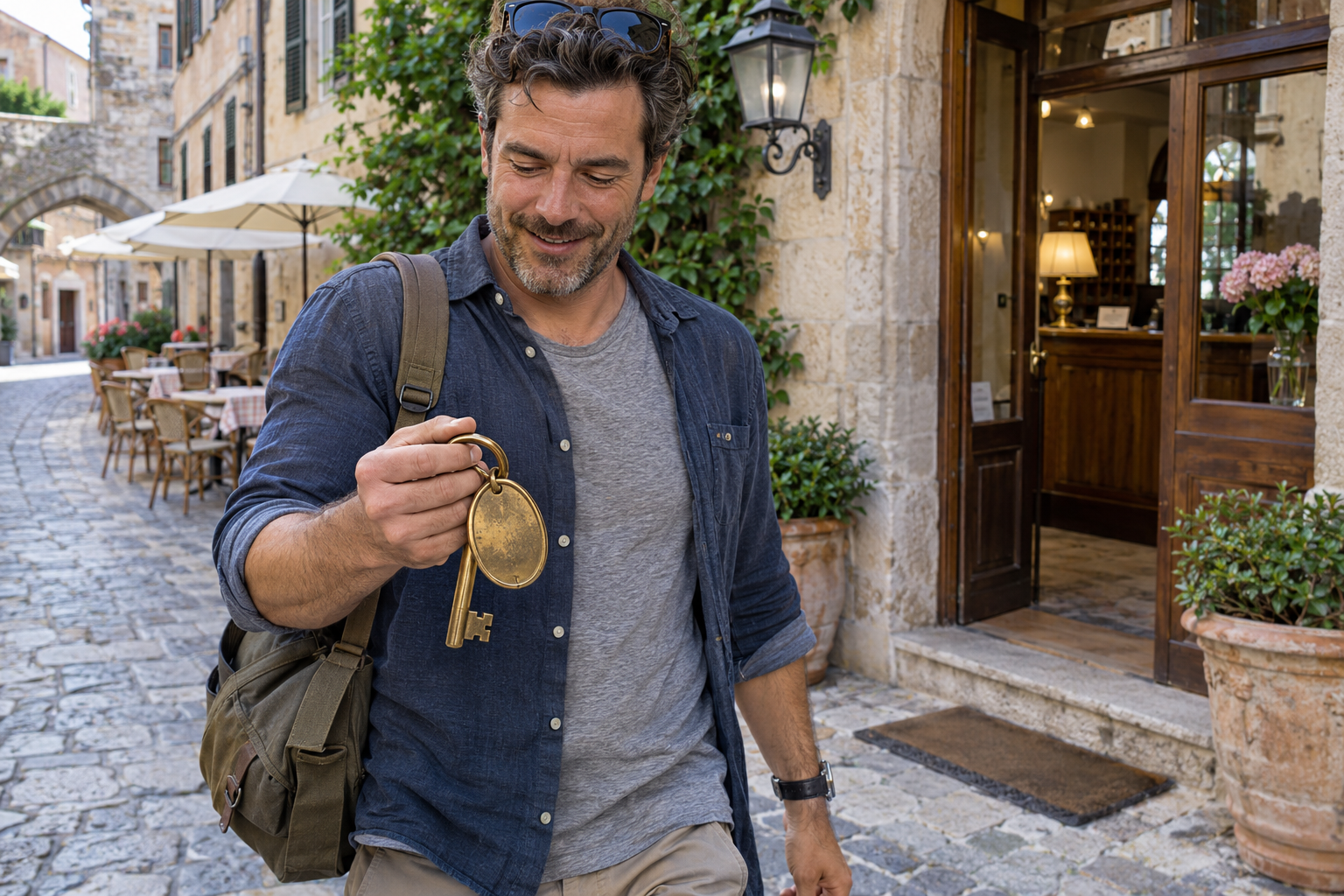
Knowing all this, you can see exactly why Americans trip over the custom, and why they do it repeatedly. The American instinct, trained by a lifetime of keycards, is that the key is yours for the stay, a thing you keep on your person and use to come and go freely, and the idea of handing it back every time you leave the building feels strange, even faintly like surrendering access to your own room. So the American pockets the key out of pure habit and walks out, morning after morning, not out of rudeness but out of a reflex the keycard built.
The result is the small daily friction this piece is named for. The guest walks out with the key, the receptionist either gently reminds them or quietly notes the key is gone, and the heavy fob bangs against the guest’s leg all day until they return, having carried the thing around the city for no reason. Nobody is fined and nobody is truly upset, but there is a low hum of the guest doing it wrong, of the staff wishing the key were on its hook, of a custom being broken out of ignorance rather than defiance. It is the kind of thing that marks you instantly as a newcomer who has not yet learned how a European hotel works.
The fix, of course, is simply to go along with it, to hand the key to reception on your way out and collect it on your way back, which takes seconds and turns the friction into the small pleasant ritual it is meant to be. Once an American tries it, the logic becomes obvious and the habit forms quickly, and they stop lugging the brass weight around and start enjoying the little exchange at the desk. The rule is easy to keep once you know it exists, and keeping it is part of staying gracefully in the kind of hotel that still does things the old way.
How Keycards Changed the Picture

It would be wrong to suggest that every European hotel still works this way, because the keycard has swept through Europe too, especially in the larger, modern, and chain hotels, and in those places the custom has largely faded. A plastic keycard is cheap to replace, easy to deactivate and reissue, and carries no heavy fob, so the reasons to leave it at reception evaporate, and guests in a modern European hotel keep their keycards exactly as they would in America. If you stay only in big international hotels, you may never meet the key-at-reception custom at all.
But the custom lives on, robustly, in the kind of hotels that give a European trip much of its character, the small, old, family-run, independent places, the pensions, the guesthouses, the traditional town hotels, where the real metal key and the heavy fob persist and the key board still hangs behind the desk. These are often exactly the hotels worth staying in, the ones with charm and history and a human at the desk who knows your name, and in them the custom is alive and expected. So whether you meet it depends entirely on the kind of hotel you choose, and the more characterful your choice, the more likely the key and its fob.
This gives the custom a slightly nostalgic quality now, a survival from an age before plastic and automation, kept alive in the places that have not fully modernized and that many travelers love precisely for not having done so. Encountering the heavy key is, in a way, a sign that you have chosen well, that you are staying somewhere with a bit of soul rather than a soulless efficiency, and the small ritual of the key at the desk is part of the texture of that older, warmer kind of hospitality. The keycard is more convenient, but it took something with it when it came, and the hotels that kept the key kept that something too.
What a Lost Key Actually Costs
It is worth dwelling on the lost-key scenario, because it is the real stake behind the whole custom and the thing that makes it more than fussiness. Lose a plastic keycard and the hotel shrugs and prints another in ten seconds for nothing. Lose an old metal key, and the picture is very different, because that key may be one of only two or three that exist for a lock that is decades old, and replacing it is a real task.
Depending on the hotel and the lock, a lost key can mean cutting a new one from a dwindling original, calling out a locksmith, or in the worst case changing the lock entirely, and the hotel will reasonably pass that cost to the guest who lost it. The charge can run from modest to genuinely steep, far more than anyone expects for losing what looks like an ordinary key, which is precisely why the hotel would rather it never leave the building.
Seen against that, the heavy fob and the leave-it-at-reception custom stop looking quaint and start looking prudent, a cheap insurance policy against an expensive little disaster. The hotel is not being controlling, it is protecting both itself and you from the cost of a key that is far harder to replace than it appears.
The Cluster of Old-Hotel Customs
The key is only one of a whole cluster of customs that mark the traditional European hotel and surprise the American used to the chains. There is the arrival-time question, the hotel asking when you will check in and expecting you to honor it, because a small family place may not have someone at the desk around the clock. There is the breakfast included in the room rate, often a fixed spread served only within set morning hours, not an all-day buffet.
There is the local tourist tax collected in cash at the desk, the occasional hotel that still holds your passport briefly to register you with the police, the room without air conditioning because the thick walls were the original cooling, and in the most traditional pensions, the bathroom shared down the hall. None of these is a problem once expected, but together they make the old European hotel a different creature from the American one, governed by customs the newcomer has to learn.
The key at reception belongs to this family of quirks, and learning it is part of learning to read the whole style of place. Meet the heavy fob and you can reasonably expect some of its cousins too, the set breakfast, the arrival time, the cash tourist tax, and taking them all in stride is simply what it means to travel comfortably in the Europe that has not been flattened into chains.
Staying Gracefully With the Old Key
For the traveler who wants to navigate this smoothly, the whole thing reduces to a simple habit and a little awareness. When you are handed a real metal key with a heavy fob, read it as the signal it is, that this is a hotel where you leave the key at reception when you go out, and act accordingly from the first morning rather than learning it through correction. Hand the key over on your way out, collect it on your way back, and enjoy the small exchange with the desk that comes with it.
A few practical notes make it easier. Do not be alarmed by the custom as a loss of control over your room, since the key is simply waiting for you on its hook and the staff are not entering your room in your absence any more than an American hotel would. Be genuinely careful with the key on the occasions you do carry it, because losing an old metal key can mean a real replacement charge, sometimes a significant one, as the hotel may have to replace a lock or cut a new key from a dwindling set. And treat the ritual as part of the pleasure rather than a chore, because the receptionist who takes your key is also the person who will tell you where to eat, hold your bag after checkout, and greet you like a returning friend by the third day.
The deeper point is that the heavy key and its custom are a small window onto a whole style of hospitality, personal, analog, human, that the keycard age has mostly swept away, and that survives in exactly the hotels most worth seeking out. Learning to leave the key at reception is not just avoiding a small daily faux pas, it is learning to stay in the European way, at the kind of place where the person at the desk knows whether you are in or out and is glad to see you either way. So take the hint from the enormous fob, leave the key on its hook, and let the old custom do its quiet work of keeping you known, safe, and welcome.

About the Author: Ruben, co-founder of Gamintraveler.com since 2014, is a seasoned traveler from Spain who has explored over 100 countries since 2009. Known for his extensive travel adventures across South America, Europe, the US, Australia, New Zealand, Asia, and Africa, Ruben combines his passion for adventurous yet sustainable living with his love for cycling, highlighted by his remarkable 5-month bicycle journey from Spain to Norway. He currently resides in Spain, where he continues sharing his travel experiences with his partner, Rachel, and their son, Han.