
In towns all over Spain, if you are out early enough, you will see them: small groups of retired men walking together, round and round the park, along the seafront promenade, or out and back on the same stretch of road, morning after morning. They walk at an unhurried pace, talking the whole way, a steady little pack of grey-haired men putting in their kilometers before the day gets hot. And if you asked them what they were doing, they would shrug and tell you it is nothing. Just a walk.
But that daily walk, done in a group, done every morning, done for years, quietly delivers a remarkable number of the things that researchers keep linking to a long and healthy old age. The men who do it are not following a wellness plan or chasing a step count; they are just taking their morning walk with their friends, as they always have. And in calling it nothing, they may be describing one of the most effective health habits there is.
Here is what the Spanish walking groups actually are, what that unremarkable morning walk quietly does, why the pack matters as much as the movement, what American men tend to lose in retirement by comparison, and the honest limits of the whole picture. None of this is medical advice; it is a look at a simple old habit that happens to line up with much of what we know about aging well.
The Morning Pack
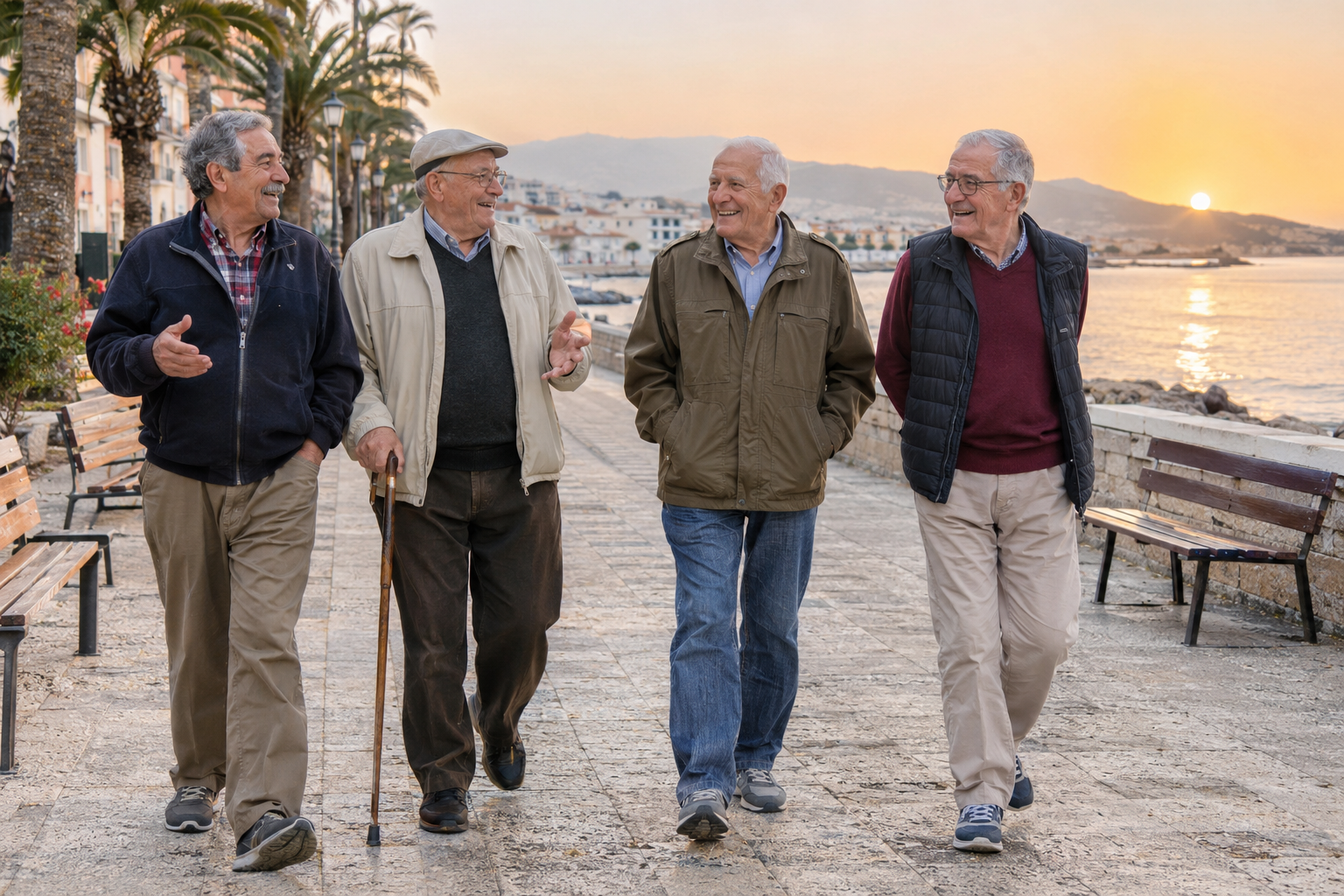
The ritual is a familiar sight across Spain, an extension of the country’s deep culture of the paseo, the walk taken for its own sake. Groups of retired men head out in the morning and walk together, covering a regular circuit at a sociable pace, and they do it with the reliability of a standing appointment.
The details are always the same. It is the same men, more or less, meeting at the same hour, walking the same route, day after day, a fixed feature of their week and their lives.
They walk the park paths, the promenades, the quiet morning streets, in twos and threes and larger clusters, and the walking is unhurried and companionable rather than brisk and solitary; the point is not to race but to move and to talk. It is a thoroughly ordinary, thoroughly Spanish scene, repeated in every town, and so woven into the rhythm of retired life here that nobody involved would think to describe it as anything at all. You will see the women doing their own version too, in their own groups, but it is the men’s packs that are the most visible fixture of the Spanish morning.
That is precisely what makes it worth noticing. These men are not exercising, in their own minds; they are socializing, taking the air, keeping their routine, doing what one does in the morning.
The health benefit, if they even think of it as one, is incidental to the pleasure and the habit. And that unselfconscious quality, a good habit lived as simple daily pleasure rather than undertaken as a health regime, is a large part of why it is so durable and so effective. The best thing you can do for your health is often the thing you do without ever calling it that.
Movement They Do Not Call Exercise
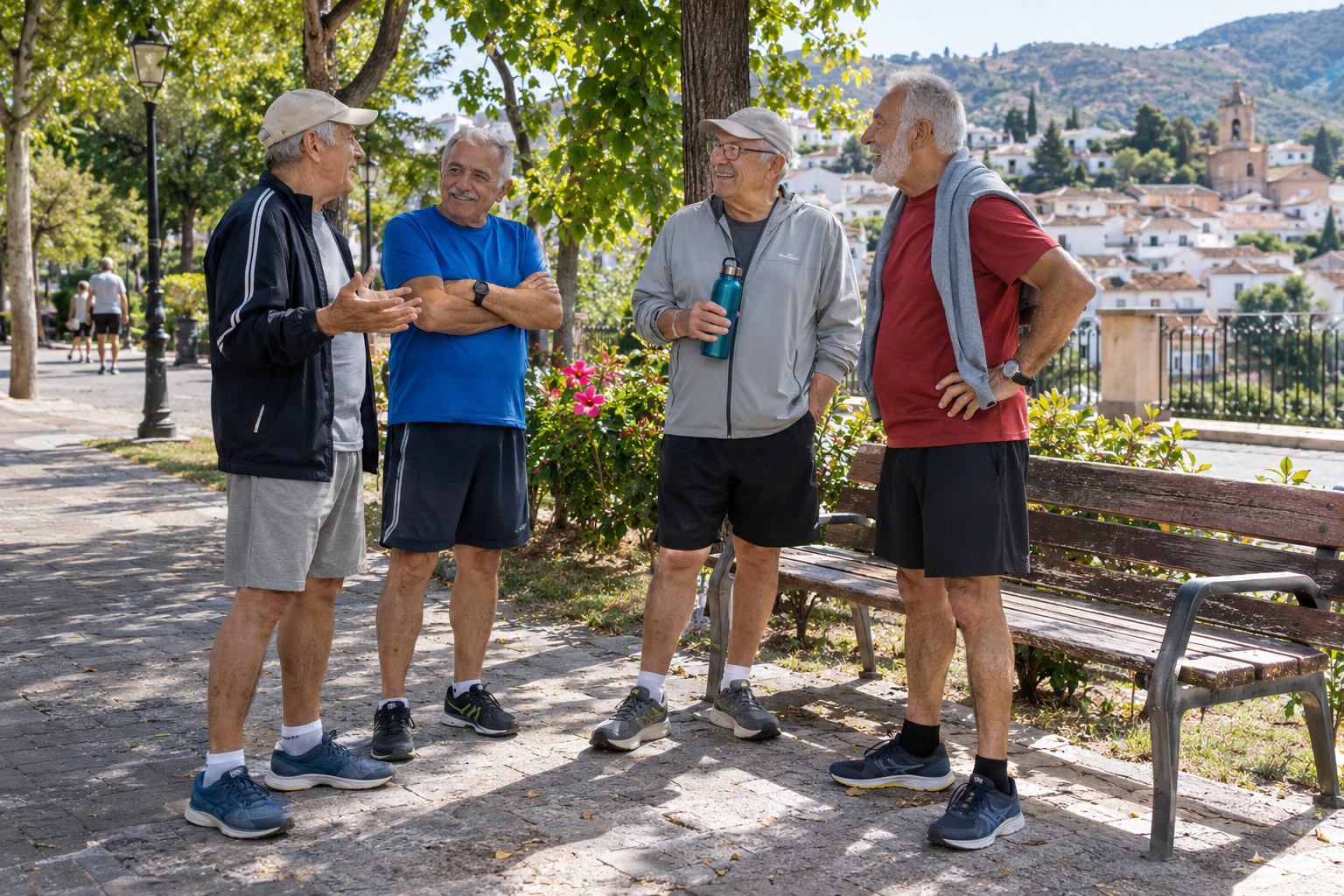
Start with the most obvious benefit, the movement itself, because it is real even though no one involved would dignify it with the word exercise. A daily walk is, quietly, a meaningful dose of regular physical activity, and walking is about the most accessible and sustainable form of movement there is.
The virtues of daily walking are well established and genuinely substantial. Regular walking is associated with better cardiovascular health, healthier metabolism and weight, preserved mobility and balance, and a lower risk of many of the conditions that shadow old age, and it does all this gently, without strain, in a form that an eighty-year-old can keep up as easily as a sixty-year-old. Unlike the gym memberships and exercise plans that people start and abandon, a morning walk requires no equipment, no instruction, and no willpower to speak of once it is a habit; you simply go, because it is morning and that is what you do. It is the most sustainable exercise precisely because it barely feels like exercise.
This is the quiet genius of the walking habit as a form of movement. It delivers the real benefits of daily moderate activity, accumulated steadily over years and decades, in a package so easy and so pleasant that people actually keep doing it for life, which is more than can be said for almost any formal fitness regime. The Spanish retired men are getting a lifetime of consistent, joint-friendly, heart-healthy movement, and they are getting it without ever experiencing it as a chore, which is why it works where so many deliberate exercise programs fail. Movement you do not call exercise is movement you actually keep doing.
The Pack Is the Point
Here is the part that matters most, and that is easy to miss if you focus only on the steps: they walk together. The Spanish morning walk is a group activity, a social ritual, and the companionship is not incidental to it but central, arguably more important to their wellbeing than the walking itself.
Think about what the group provides beyond the exercise. Every morning, these men have guaranteed social contact, real conversation, companionship, and the sense of belonging to a small, reliable community of friends, built into the very structure of their day. They talk as they walk, about everything and nothing, maintaining friendships and staying connected to other people in a way that is effortless because it is woven into an activity they would be doing anyway. For older men in particular, this is enormously valuable, because the daily, low-effort social connection that work and family once provided tends to drain away in retirement, and the walking group quietly replaces it.
This matters so much because social connection is, by a wide margin, among the strongest predictors of a long and healthy life, rivaling or exceeding many purely physical factors. Isolation and loneliness are genuinely bad for health and longevity, and older men are especially vulnerable to both, often losing their social worlds when they stop working and being least likely to build new ones. The walking group is a near-perfect antidote: a standing, daily, undemanding source of companionship and belonging that the men keep up for years without ever thinking of it as addressing a health risk. The movement is good for them, but the company may be the real medicine, the same quiet truth that sits behind the older Spanish men gathered in the morning bar.
Routine, Outdoors, Daily
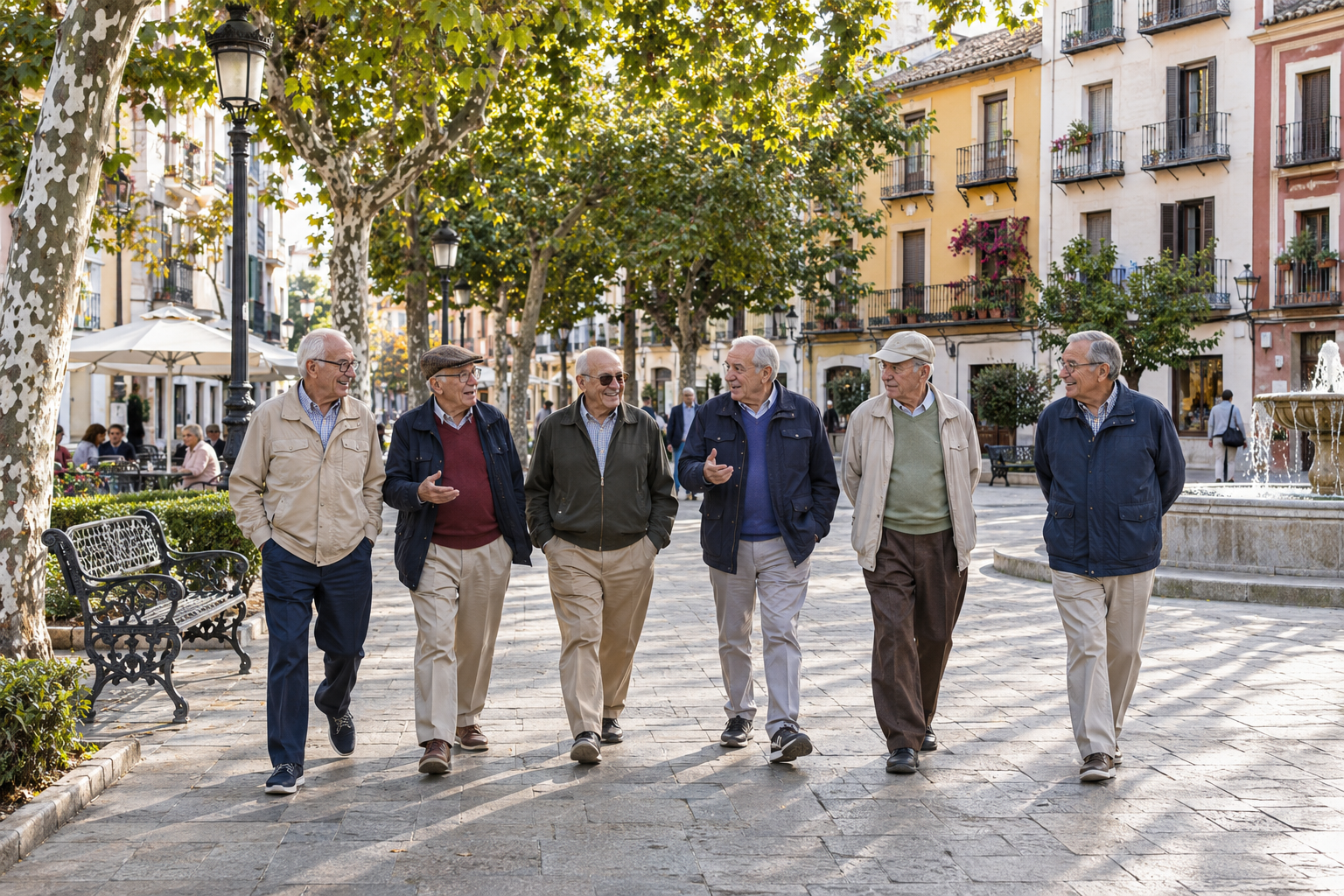
Beyond movement and company, the morning walk quietly supplies two more things that research associates with aging well, and together they complete the picture. The first is routine, the simple structure of having a reason to get up, get dressed, and go out at the same time every single day.
That structure is more valuable than it sounds, especially in retirement, when the scaffolding of work falls away and the days can lose their shape. A daily walking appointment gives the morning a purpose and the week a rhythm, a reliable anchor that pulls a person out of bed and into the world, which supports both mental wellbeing and the sense of a life that still has order and meaning. The second thing the walk supplies is time outdoors in natural daylight, which is associated with better mood, healthier sleep through its effect on the body’s clock, and the simple benefits of fresh air and sunshine, all of it delivered automatically by the act of walking outside each morning.
Put the four together, movement, connection, routine, and daylight, and you have a remarkably complete package of the gentle ingredients of healthy aging, all bundled into one ordinary daily habit. This is the same cluster that researchers notice hiding inside so many traditional European morning rituals, from a Portuguese village waking up to a Spanish town’s walking pack, and it is no coincidence that these simple old routines keep lining up with modern findings. The morning walk is not doing one good thing; it is doing four at once, quietly, every day, which is why its effect is so much greater than a walk would seem to warrant. Each ingredient is modest on its own, but stacked together and repeated for decades, they add up to something that no single pill or program could easily match.
The American Retirement Gap
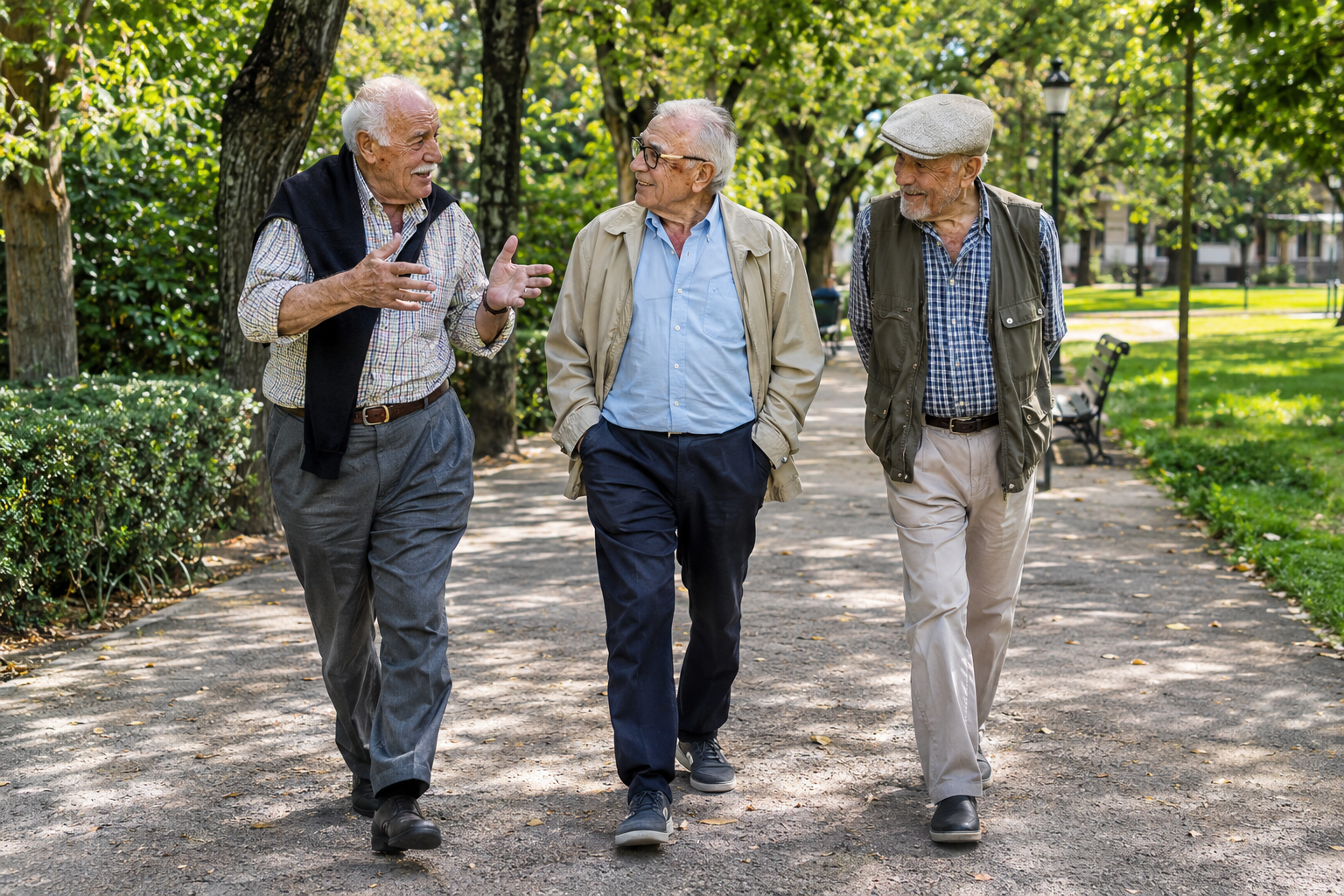
The contrast with a typical American retirement throws all of this into sharp relief, and it is worth drawing out, because the gap is real and consequential. The Spanish walking group is the product of a culture built around public space, walkability, and sociable daily routine, and much of that is missing from the American pattern.
American life, and American retirement, tends to be more car-centric, more private, and more isolating. The built environment often makes a sociable daily walk impractical; the culture does not supply a ready-made ritual like the paseo; and retirement can arrive as a sudden removal of the main source of daily structure and social contact a man had, namely his work, with nothing comparable to replace it. The result is that many American men, on retiring, lose their routine, their daily movement, and their social world all at once, and slide into a more sedentary, more solitary old age, not through any failing of their own but through the simple absence of the structures that Spanish towns provide automatically.
This is the same structural gap that shows up wherever these European male social rituals are examined, whether the morning bar or the walking pack: these cultures hand older men a daily, effortless framework of movement and connection, and American culture, by and large, does not. It is not that American men want isolation or sedentary days; it is that nothing in their environment nudges them gently toward the alternative the way a Spanish town does. Recognizing that the Spanish advantage is structural rather than personal is the key to borrowing it, because it means the solution is also structural: not willpower, but building the ritual.
It Is Not a Miracle
Before romanticizing the walking men into a longevity secret, honesty demands some caveats, because the picture, lovely as it is, has real limits. The connections drawn here are associations, not proven causes, and a morning walk, however good, is not a magic shield against age or illness.
Several honest points are worth making. The benefits of walking, connection, routine, and daylight are well supported individually, but no one has proven that these specific walking groups are why these specific men thrive, and plenty of long-lived people never walked in a morning pack.
Spain has its own health challenges and is no paradise of perfect aging, and these men, like everyone, still fall ill and grow frail and die. Walking will not undo a poor diet, serious disease, or bad luck, and presenting it as a cure would be both false and unkind to those for whom it is not enough. The habit is a contributor to wellbeing, plausibly a significant one, not a guarantee of anything.
There is also a gentle irony worth naming, which is that the men’s own attitude, calling it nothing, is part of why it works and part of why it should not be oversold. They do not walk for their health, which is exactly why they keep it up, and turning their lovely ordinary habit into a marketed longevity protocol would risk killing the very unselfconsciousness that makes it sustainable. So take the walking groups as encouragement and illustration rather than prescription: a beautiful, well-supported example of how a simple social routine can contribute to a good old age, offered honestly, without the promise of a miracle that no morning walk can deliver.
Building Your Own Morning Pack
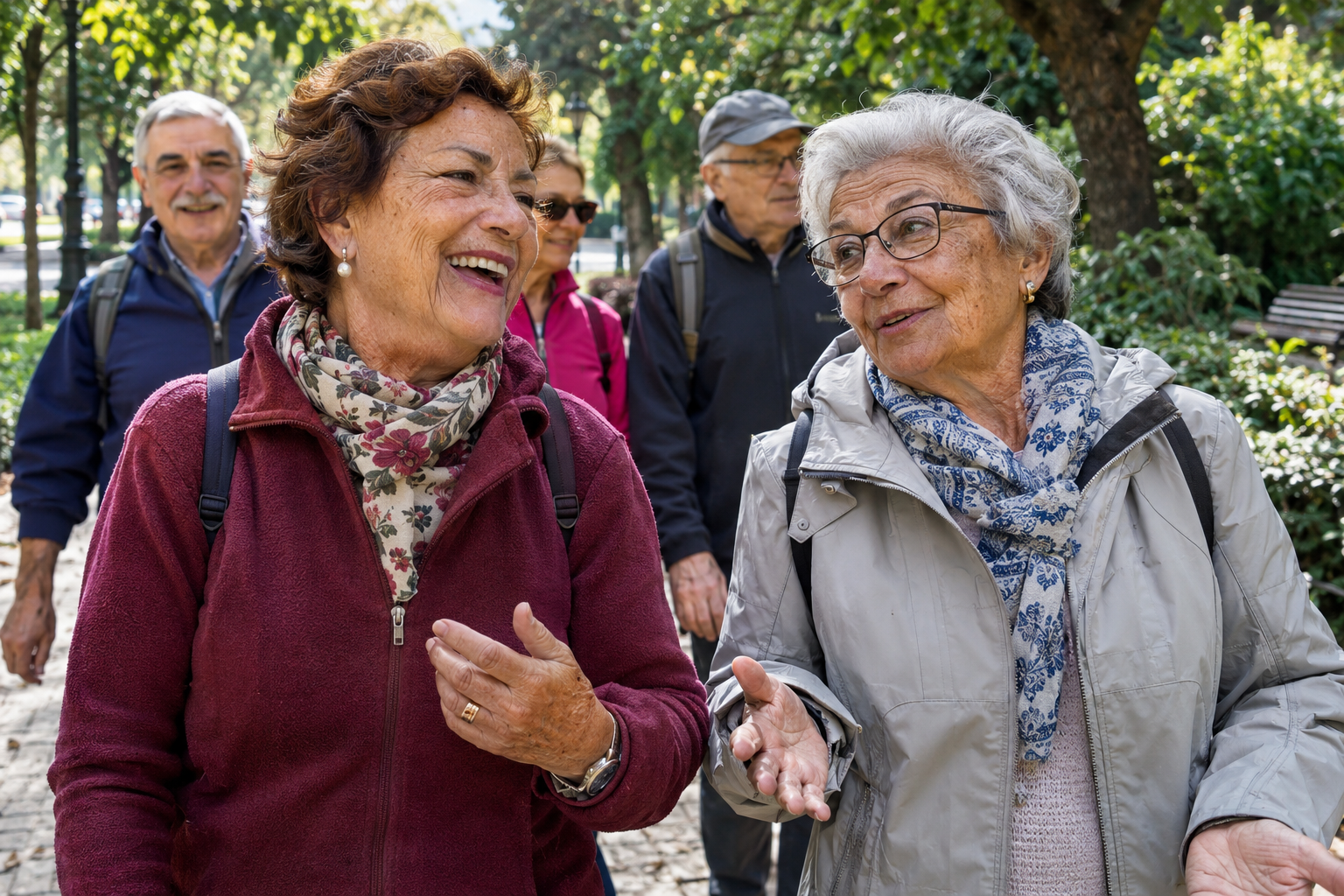
For all those caveats, the lesson the Spanish walking men offer is genuinely useful and genuinely borrowable, wherever you live. It is not complicated, and it does not require a Spanish town; it requires only that you build, deliberately, the kind of ritual their culture hands them for free.
The recipe is simple: a daily, outdoor, moving, social routine, kept up for the pleasure of it. Find or start a walking group, a few friends or neighbors who will meet at the same time each morning and walk a regular route together, and let it become a fixed, unmissable part of your day. The specifics are flexible, the route, the pace, the size of the group, but the four ingredients are not: move your body, be outdoors in the daylight, do it on a reliable daily schedule, and above all do it with other people. Assemble those four into a standing habit and you have built, from scratch, the thing that keeps the Spanish retired men moving and connected and content into deep old age.
The deepest piece of wisdom in the whole phenomenon is also the simplest, and it is worth holding onto: the most powerful things you can do for a long, well old age are often the most ordinary, as long as you do them daily and do them with other people.
You do not need a gym, a program, or a plan; you need a walk, a friend or two, and the habit of showing up every morning. Build your own morning pack, call it nothing if you like, and keep it up for the rest of your life. That, quietly, is how the Spanish do it.

About the Author: Ruben, co-founder of Gamintraveler.com since 2014, is a seasoned traveler from Spain who has explored over 100 countries since 2009. Known for his extensive travel adventures across South America, Europe, the US, Australia, New Zealand, Asia, and Africa, Ruben combines his passion for adventurous yet sustainable living with his love for cycling, highlighted by his remarkable 5-month bicycle journey from Spain to Norway. He currently resides in Spain, where he continues sharing his travel experiences with his partner, Rachel, and their son, Han.