

The bloating had been with me since college. Twenty years of feeling heavy after sandwiches, distended after pizza, vaguely off after pasta. I had assumed it was gluten. I had been tested for celiac disease and the test was negative. I had tried gluten-free periods that helped some but not enough. I had assumed I had non-celiac gluten sensitivity and accepted the bloating as the price of eating bread, which I was not willing to give up. That assumption turned out to be wrong. The problem was not gluten. It was a specific chemical in industrial American bread that the European Union does not permit in food.
The chemical is azodicarbonamide. The food industry calls it ADA. The headlines that briefly made it famous called it the yoga mat chemical, because the same compound is used to make foamed plastic in exercise mats and shoe soles. The EU has never authorized it as a food additive. The US permits it and roughly 130 American bread products still contain it. For 30 days I ate bread that did not have it, and a digestive pattern I had lived with for two decades stopped. This piece tells that story and explains what ADA is and why two regulators looking at the same evidence reached opposite conclusions.
What ADA Actually Is
Azodicarbonamide is an industrial flour treatment agent and dough conditioner. It serves two functions in commercial baking, both of them about industrial efficiency rather than food quality.
It bleaches flour fast. Naturally aged flour develops the qualities that bakers want over weeks of resting. ADA produces the same bleaching effect in hours. The mill can ship faster, the baker can use the flour sooner, and the supply chain compresses. The chemical aging replaces the natural aging.
It strengthens dough mechanically. ADA produces uniform handling on high-speed industrial bread lines. The dough behaves predictably at machine speeds that natural dough cannot match. The chemical does the work that long fermentation would otherwise do. The bread that comes out has the uniform soft texture that defines American industrial sandwich bread.
It is also a foamed plastic blowing agent. The same compound is used industrially to put air bubbles into foam plastics, including yoga mats and the soles of athletic shoes. This is not a metaphor. It is the same molecule serving two industrial purposes, one inside food and one inside plastics. The chemistry is identical.
It breaks down during baking into compounds that worry regulators. When ADA is heated, it decomposes into semicarbazide and urethane, among other compounds. Both have been associated with cancer in animal studies at the relevant exposures. The concern that drives EU policy is not ADA itself in the cold form but what it becomes when baked into bread at high temperatures.
It has caused respiratory problems in factory workers. The compound is recognized as a respiratory sensitizer in occupational exposure. Workers handling ADA in food and plastic manufacturing have developed asthma at rates that prompted occupational health responses. This concern is distinct from the food consumption question but contributes to the overall regulatory caution.
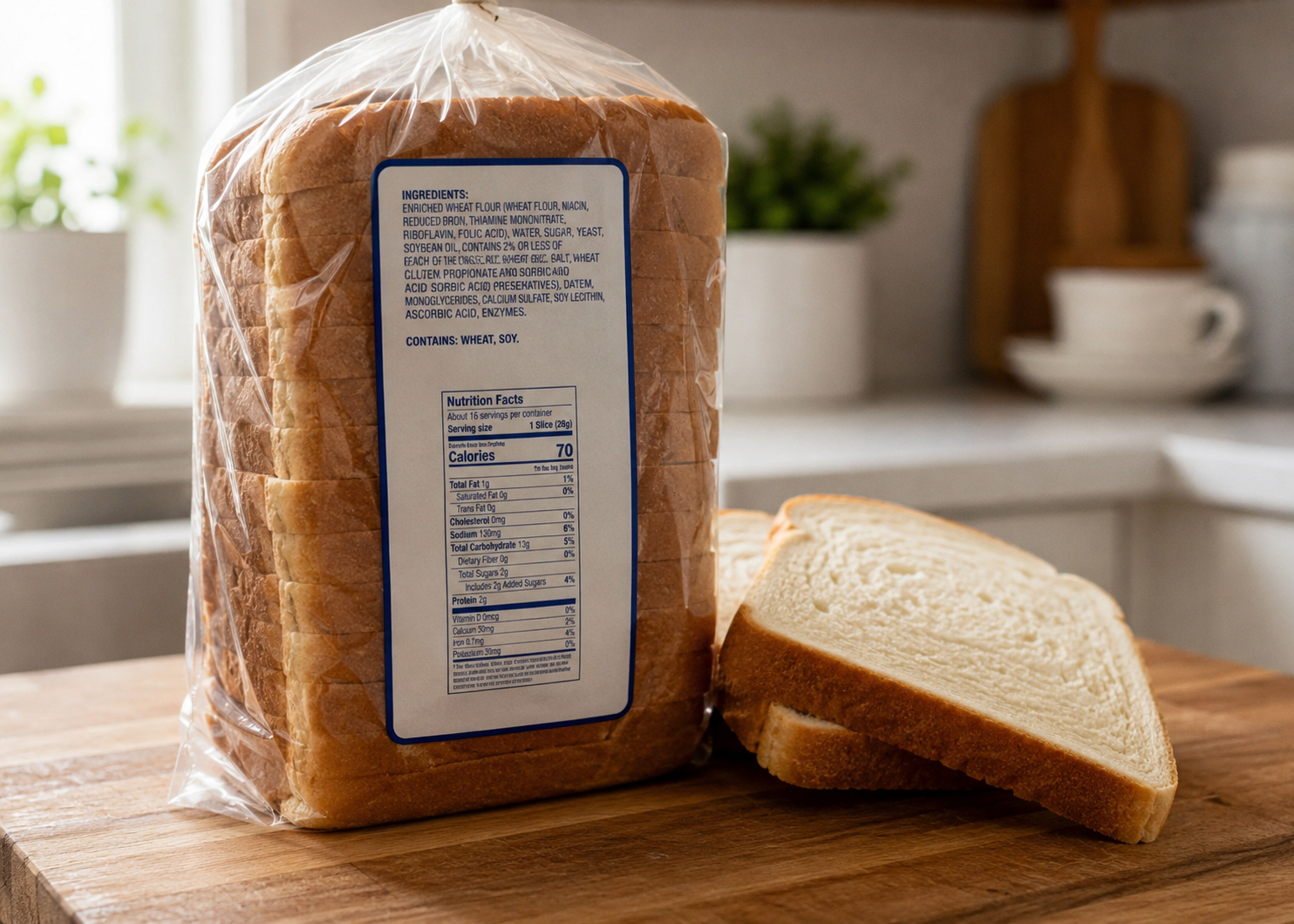
It can be identified on a label. ADA appears in ingredient lists as “azodicarbonamide.” If you do not see it, the bread does not contain it. The label clue is simple. The label reading habit, which I did not have before this experiment, is what made the elimination possible.
Why The EU Banned It And The US Did Not

Two regulators looked at substantially the same evidence and reached opposite conclusions, which is one of the more striking features of this story.
The EU operates on a positive-list system. Food additives must be specifically authorized before they can be used. Anything not authorized is prohibited by default. ADA was reviewed and never made it onto the authorized list for food use. The EU did not need to ban it specifically; it simply never permitted it. The structural caution of the positive-list approach kept it out.
The US permits it under GRAS rules. The American framework treats additives as Generally Recognized as Safe unless specific harm is proven. ADA was grandfathered in under this framework and has remained permitted while remaining “under review” by the FDA. The structural permissiveness of the American approach kept it in.
Many other countries followed the EU position. Australia, Singapore, and most of Europe do not permit ADA in food. Roughly 40 to 50 countries prohibit or do not permit it. The US is increasingly an outlier among developed countries.
Several US states have moved to ban it. California’s AB 418, which took effect in 2024, banned ADA in food sold in the state starting in 2027. New York has similar legislation moving through. State-level action is filling the gap that federal action has not. The American regulatory consensus is shifting toward the EU position, slowly.
The same brand often sells a reformulated version in Europe. McDonald’s removed ADA from its US bread in 2014 after public pressure, but the chemistry of American industrial bread broadly still includes it. Subway removed it after similar pressure. The reformulations show that production without ADA is feasible. The industry just has not done it across the category in the US.
The regulatory split is not a case of one side ignoring evidence the other side has. Both have the same studies. They have made different choices about what level of uncertainty justifies what level of caution. The EU has chosen to keep it out. The US has chosen to keep it in.
What The 30 Days Looked Like

The experiment was simpler than I expected once I learned to read the label.
I switched to bakery bread and supermarket brands without ADA. Real sourdough from a local bakery. The supermarket whole grain breads that do not contain it, which I identified by reading every ingredient list in the bread aisle one Saturday morning. A few specific commercial brands that have made the choice not to use ADA. The bread did not disappear from my diet. It just changed in source.
The texture was noticeably different. ADA-free bread has more variation in crumb structure. The slices are not perfectly uniform. The bread tears rather than slices cleanly when you pull a piece from a loaf. It is the texture of bread made without the industrial dough conditioner, which is to say, the texture of how bread looked for most of human history.
It also tasted better. I had not expected this. The bread had more flavor, more character, more presence as food. The industrial uniform softness had been replaced by something that registered as actually bread. This was an unexpected pleasure rather than the point of the experiment.
The first week, the digestive change was already noticeable. The post-sandwich bloating that had been a constant for twenty years was reduced. I noted it at the time and assumed it might be random. The second week confirmed it. By the end of week two, the bloating that had been part of my daily life since I was 21 had effectively stopped.
By week three, I had forgotten what the discomfort felt like. This is the part that surprised me. A pattern I had lived with for so long that it had become the baseline simply faded. The new baseline was not noticing my digestion at all after eating bread. I had no idea this was even possible. I had assumed the post-bread heaviness was just how bread worked.
The 30 days ended and I kept going. I had no intention of returning to ADA bread. I assumed the experiment was over and the answer was clear. It was not until two months later that the unintentional reintroduction test happened, which is what actually established the connection in my own mind.
What Happened When I Ate ADA Bread Again
Two months after the experiment ended, I was traveling and ate a sandwich on what turned out to be standard American industrial bread at a chain restaurant. I was not thinking about ADA at the time. The bloating arrived within an hour.
It was the exact pattern I had not experienced in three months. The heaviness, the distension, the vague sense of digestive wrongness. I had genuinely forgotten what it felt like. It hit me hard enough that I sat in the car after lunch and tried to think through what was different. The sandwich. The bread. The bread I had not eaten in months.
I checked online when I got home. The chain’s bread contained ADA. I had eaten it without thinking and my body had responded exactly as it always had before the experiment. The two-month gap made the reaction newly visible to me. What I had thought of as my normal digestion for twenty years was actually my response to a specific industrial additive that I had eaten almost daily without realizing it.
Three weeks later, I tested it deliberately. I bought a specific brand of bread I knew contained ADA and ate sandwiches on it for two days. The bloating returned immediately and stayed for those two days. I went back to the ADA-free bread the third day and it cleared within 24 hours. The pattern was consistent enough that I no longer doubted what I was seeing.
I have not eaten ADA-containing bread intentionally since. That was three years ago. The digestive pattern that defined my twenties and thirties does not exist in my forties. When I have accidentally eaten ADA bread while traveling or eating out, the bloating has appeared every time, within hours, every time. The mechanism is reliable enough in my body that I treat it as established.
What I Think Happened
I am not a scientist and I am not going to overclaim what my own experience proves about anyone else. But I can say what I think happened and let readers consider whether it might apply to them.
ADA may not be the only factor. The shift from industrial bread to bakery sourdough and whole grain bread involved more than just removing the additive. Longer fermentation in sourdough breaks down some of the harder-to-digest components of wheat, including some of the FODMAPs that affect a substantial subset of people. Whole grain bread has more fiber and different starch structures than the industrial soft white bread that contains ADA. Any of these differences could contribute.
The reintroduction test points at ADA specifically though. When I ate ADA-containing bread that was otherwise similar to what I had been eating before, the bloating returned. When I ate ADA-free bread of a similar style, it did not. The variable that changed in the reintroduction test was ADA, not fermentation or whole grain content. That is the closest thing to evidence about which factor mattered, and it pointed at ADA.
Individual sensitivity varies enormously. The fact that ADA produces digestive issues for me does not mean it produces them for everyone. A subset of people may be sensitive in ways that the average consumer is not. The EU regulatory caution exists partly because such subsets are large enough to matter even when most people show no acute reaction.
The mechanism is plausible but not proven. ADA and its baked breakdown products may affect gut function in ways that the available research has not fully characterized. Or it may be acting through some other pathway I do not know about. The connection I have established for my own body does not tell me exactly why it works.
What To Take From This
For American adults with chronic digestive issues that have resisted obvious explanations, this is worth trying.
Read the labels on the bread you currently eat. Look for “azodicarbonamide” in the ingredient list. If you see it, you have a candidate worth eliminating for 30 days. If you do not see it, this is not your issue and you can look elsewhere.
Switch to ADA-free bread for 30 days. Bakery bread, sourdough, the supermarket brands that have already removed it. The shift is real food, not a sacrifice. You will likely find the bread tastes better than what you were eating before.
Watch what happens to your digestion. If a pattern shifts in those 30 days, you have learned something. If nothing shifts, you have learned something else and can move on to investigating other possibilities.
Then test the reintroduction. This is the step that matters. Eat ADA bread again and see what happens. If symptoms return, you have a connection. If they do not, the change came from somewhere else and the question stays open.
Treat the European versions of familiar brands as information. When a brand sells the same product in the EU without an additive it uses in the US version, the European regulator is telling you something about what is in the American version. Comparing ingredient lists between regions is one of the most useful consumer practices available.
The American bread additive that the EU does not permit in food was sitting in my sandwiches for twenty years before I knew what it was. Removing it for 30 days produced a digestive change that two decades of other interventions had not produced. The chemistry was not what the gluten conversation had focused on. It was something specific, identifiable, and avoidable. For me, removing it reset a pattern I had assumed was permanent.
A general note. Persistent digestive symptoms can have serious causes including celiac disease, inflammatory bowel disease, and other conditions that require medical evaluation. Anyone with chronic digestive issues should see a physician for proper testing before assuming the cause is a single food additive. This is a personal account, not medical advice.
If reading bread labels suddenly feels exhausting, one of the easiest alternatives is making a basic loaf at home. Traditional bread does not need a long list of conditioners, preservatives, or bleaching agents. Flour, water, yeast, salt, and a little patience are enough to make a loaf that works for sandwiches, toast, or serving alongside dinner.
This recipe contains no azodicarbonamide and relies on time and fermentation rather than industrial dough conditioners to create structure and flavor.
Ingredients
- 3 1/2 cups (440 grams) bread flour or all-purpose flour
- 1 1/2 cups (355 ml) warm water
- 2 teaspoons active dry yeast or instant yeast
- 1 1/2 teaspoons salt
- 1 tablespoon extra virgin olive oil
- 1 teaspoon honey or sugar, optional
How to Make It
In a large mixing bowl, combine the warm water, yeast, and honey or sugar if using. If you are using active dry yeast, let the mixture sit for about 5 to 10 minutes until slightly foamy. Instant yeast can usually be mixed directly into the flour.
Add the flour, salt, and olive oil. Stir until a shaggy dough forms. Transfer the dough to a lightly floured surface and knead for approximately 8 to 10 minutes, until it becomes smooth and elastic. You can also knead it in a stand mixer with a dough hook for about 6 to 8 minutes.
Place the dough in a lightly oiled bowl, cover it with a clean kitchen towel or reusable cover, and let it rise somewhere warm for about 1 to 1 1/2 hours. The dough should roughly double in size.
Gently press the air from the dough and shape it into a loaf. Place it in a greased loaf pan or shape it into a rustic round loaf on a baking sheet lined with parchment paper. Cover again and allow it to rise for another 30 to 45 minutes.
Preheat the oven to 400°F (200°C). If making a rustic loaf, score the top with a sharp knife. Bake for approximately 30 to 35 minutes, or until the crust is golden and the loaf sounds hollow when tapped underneath.
Let the bread cool for at least 30 minutes before slicing. Cutting it immediately may compress the crumb and make the interior seem gummy.
Tips for Better Homemade Bread
For deeper flavor, let the dough rise slowly in the refrigerator overnight after mixing. Longer fermentation gives the yeast more time to develop flavor and can produce a noticeably more interesting loaf.
Use bread flour if you want a chewier structure and stronger rise. All-purpose flour works perfectly well for a softer everyday loaf.
Do not add extra flour too quickly if the dough feels slightly sticky. Bread dough becomes smoother as it is kneaded, and adding too much flour can produce a dense loaf.
For a crispier crust, place a small oven-safe pan of hot water on the lower rack during the first part of baking. The steam helps the surface stay flexible while the bread expands.
Once cooled completely, store the loaf in a bread bag or airtight container for two to three days. You can also slice and freeze it, then toast individual slices straight from frozen.
Why This Recipe Fits This Experiment
One advantage of homemade bread is that you know exactly what went into it. There are no mystery dough conditioners, no lengthy ingredient list, and no need to wonder whether an additive is hidden under an unfamiliar name.
That does not mean homemade bread will automatically solve digestive symptoms. Your own article correctly notes that the switch from industrial bread also changed other variables, including fermentation style, fiber content, and bread source, so one person’s response cannot prove that ADA was the sole cause.
What this recipe does provide is a simple baseline. If you want to compare highly processed sandwich bread with a basic loaf made from familiar ingredients, this gives you an easy place to start.
You can also compare this bread with real sourdough, traditionally fermented bakery bread, or other products with short ingredient lists. Keeping the ingredients simple makes it much easier to understand what you are actually eating.
And if digestive problems are frequent or persistent, bread experiments should not replace proper medical evaluation. As the original article notes, chronic digestive symptoms can have many causes that require appropriate testing.

About the Author: Ruben, co-founder of Gamintraveler.com since 2014, is a seasoned traveler from Spain who has explored over 100 countries since 2009. Known for his extensive travel adventures across South America, Europe, the US, Australia, New Zealand, Asia, and Africa, Ruben combines his passion for adventurous yet sustainable living with his love for cycling, highlighted by his remarkable 5-month bicycle journey from Spain to Norway. He currently resides in Spain, where he continues sharing his travel experiences with his partner, Rachel, and their son, Han.