
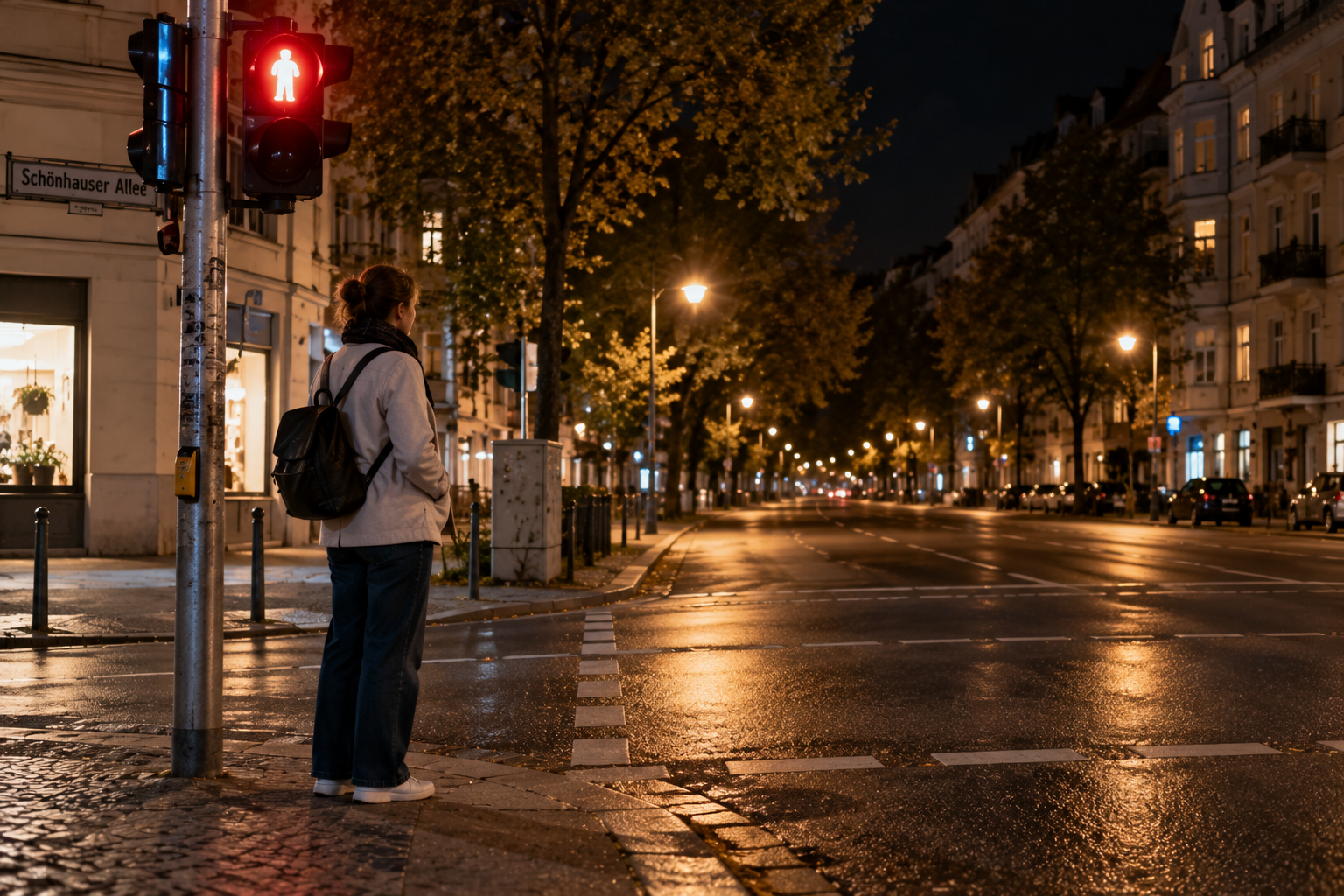
It is two in the morning on a quiet residential street in Germany. There is not a car in sight, not a headlight, not an engine, nothing but silence and a red pedestrian light glowing over an empty road.
And standing at the curb, waiting patiently for the little green man to appear before they will take a single step, is a German. They could cross in complete safety. They can see for a quarter mile in each direction.
And still they wait, because the light is red, and in Germany you do not cross against a red light, empty street or not. To an American, who would have crossed that road without a flicker of thought the instant they saw it was clear, this is one of the most baffling and oddly charming things about the country, and it is a rule they will almost certainly break on their very first day, earning themselves a disapproving look or an outright scolding in the process. Here is why Germans really wait, what the actual rule is, how uniquely German it is, and the deeper cultural logic that an American eventually comes to understand, and maybe, a little to their own surprise, to admire. It is one of the small, telling differences that says a great deal about two whole ways of living.
What follows is the rule Americans break on day one, the law behind it, the real reason Germans wait, the culture of order underneath it, and what Americans eventually learn.
The Rule Americans Break on Day One
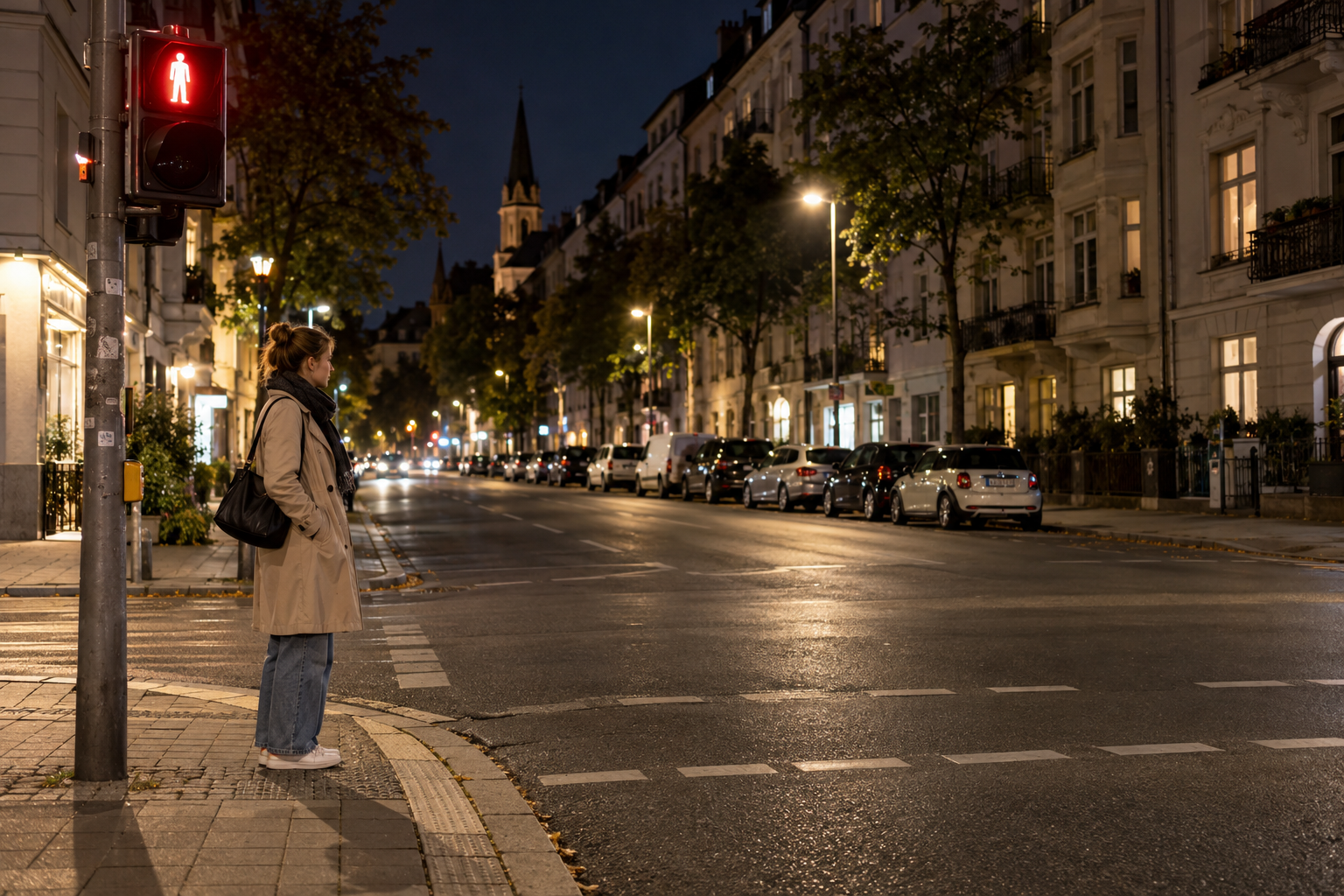
For an American, jaywalking is not a crime; it is practically a civic skill. You look both ways, you judge the gap, and if the road is clear you cross, red light or no red light, and nobody thinks anything of it at all. It is so automatic, so woven into how Americans move through a city, that most do it without even registering a decision. So when a fresh-off-the-plane American arrives in Germany, jet-lagged and wandering a quiet evening street, and comes to a completely empty intersection with a red pedestrian light glowing over it, their lifelong instinct takes over and they simply walk, exactly as they always have back home, straight across the clear and carless road without a flicker of hesitation or guilt. Why on earth would you wait for a light to permit you to cross a road with no cars on it? To the American mind, the question answers itself.
And then they notice the looks. The Germans waiting at the curb, who did not cross, are watching them with expressions ranging from mild disapproval to genuine disdain, and the American realizes, with a jolt, that they have done something wrong,
something everyone around them considers obviously improper.
It is one of the very first and most reliable culture shocks of arriving in Germany, the discovery that this small, reflexive, harmless-feeling act is simply not done here, and that the locals take it far more seriously than seems possible to someone from a country where crossing an empty street is a non-event. The empty road that an American sees as an open and obvious invitation to cross, a German sees as entirely beside the point, almost an irrelevance. The question for the German is not whether a car is coming; the question is what color the light is, and the light is red. The light is red. You wait. That is all there is to it.
It Really Is Against the Law
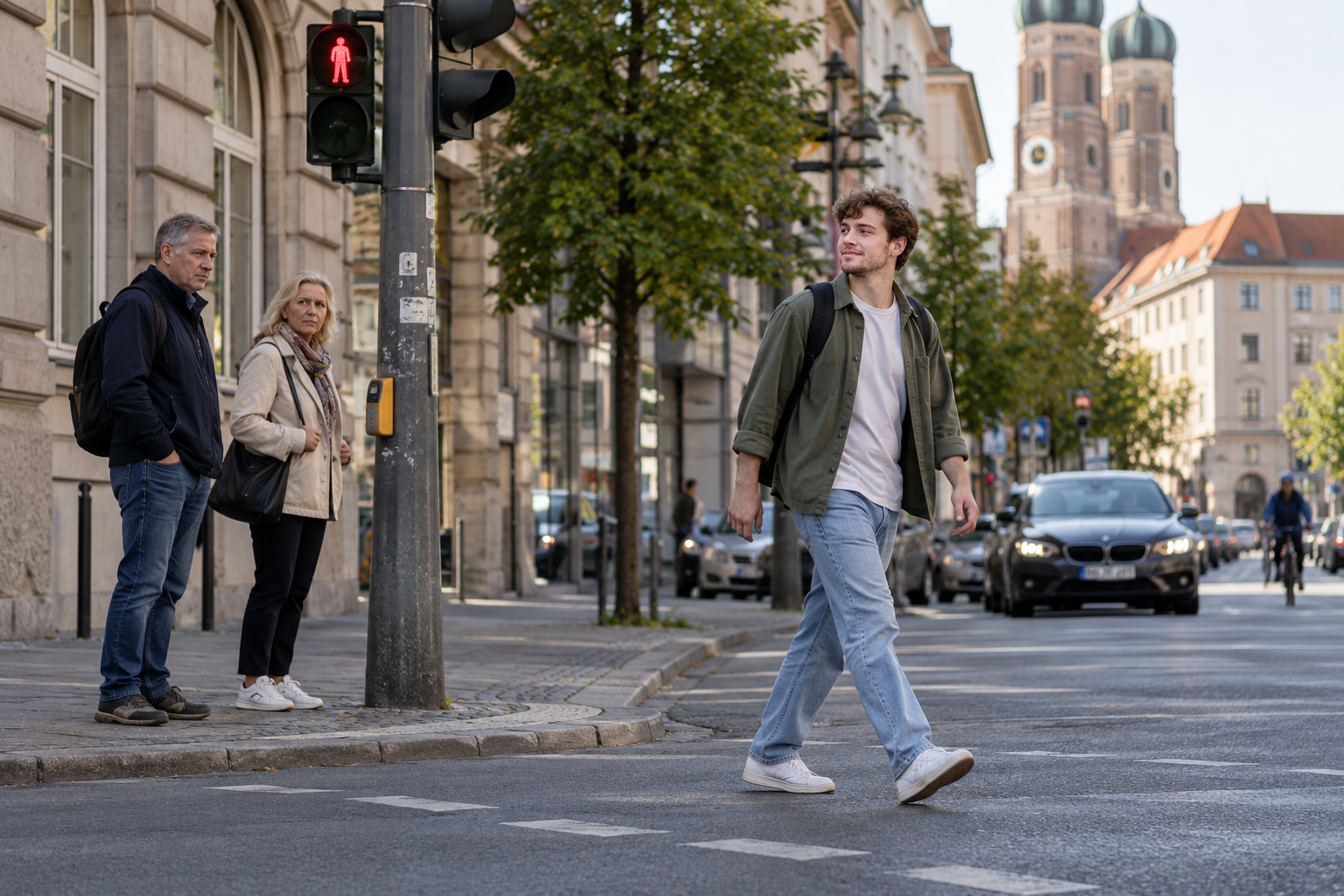
Part of what surprises Americans is that this is not merely a social preference but an actual legal rule. In Germany, crossing against a red pedestrian light at a signal-controlled crossing is against the road traffic law, and you can, in principle, be fined for it, with the standard penalty somewhere in the range of five to ten euros for a simple crossing on red. So the waiting German at 2 AM is, technically, obeying the law, and the walking American is, technically, breaking it.
But there are two important pieces of nuance here. The first is that enforcement is actually quite rare; a police officer is unlikely to materialize to fine you for stepping across an empty street, and the small fine is not really what keeps Germans on the curb.
The second is a point of precision that even many visitors miss: the rule is specifically about crossing against a red light at a pedestrian signal. Crossing a street mid-block where there is no traffic light at all, safely and without obstructing traffic, is generally perfectly legal in Germany. So the iconic image is precise: it is the glowing red Ampelmann, the little traffic-light man, that must be obeyed, and the sight that stuns Americans is specifically a German standing obediently before a red pedestrian signal on an empty road. The law exists, the fine is real but minor and rarely applied, and yet the behavior is near-universal, which tells you that the law is not actually the main thing holding these people at the curb. Something stronger is.
The Real Reason: The Children Are Watching
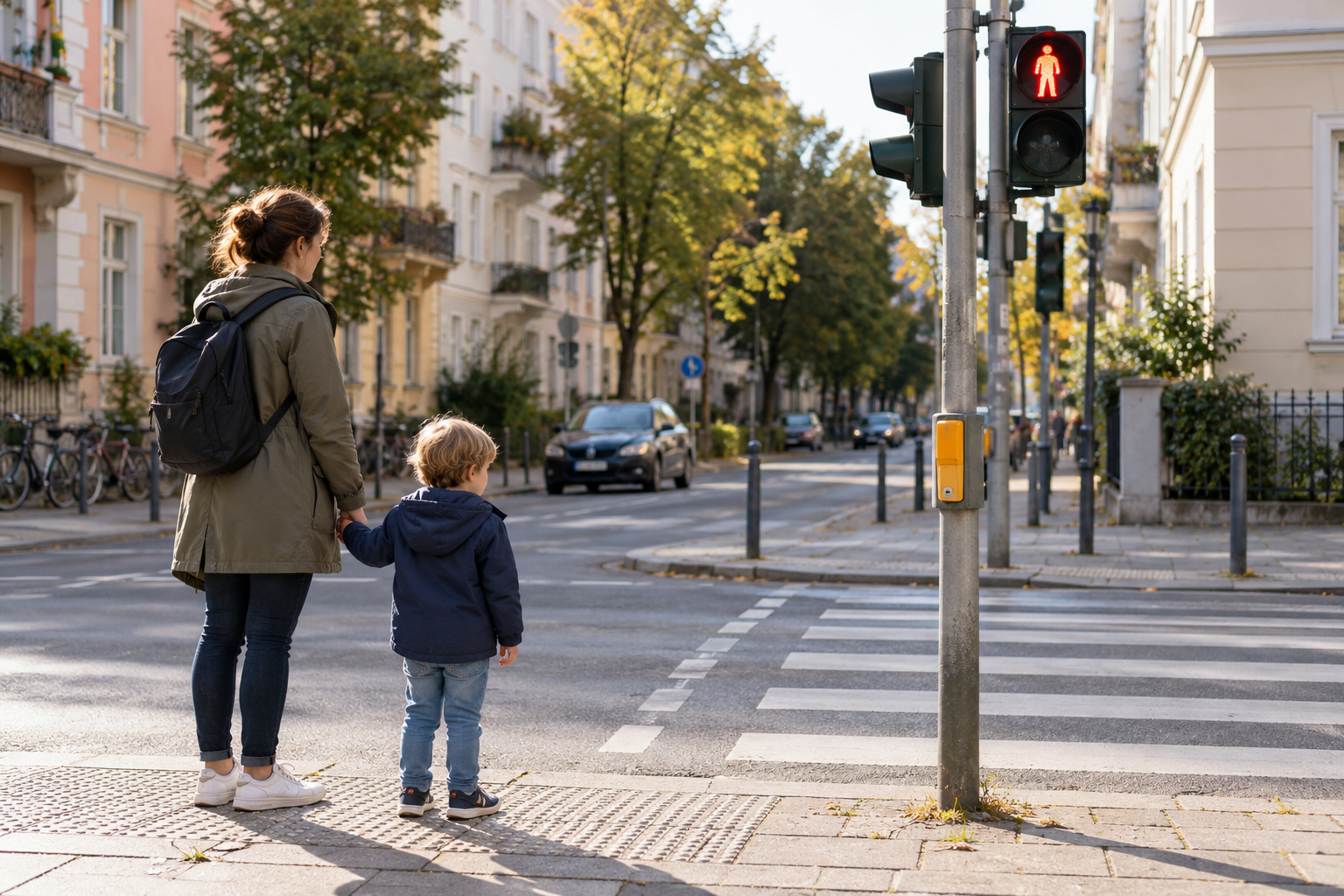
The true engine is not the law at all but a powerful social norm, and it has a specific, revealing focus: children. The deepest reason a German waits at an empty red light is the belief that one must set a good example for children, who are taught from their earliest years to always obey traffic signals and who might be watching at any moment. To cross on red in front of a child is to model dangerous, irresponsible behavior, to undermine the lesson that keeps children safe, and it is this, far more than any fine, that Germans find genuinely objectionable.
This is why the social correction, when it comes, so often invokes children directly. The classic scolding that an unwary jaywalker may receive, even on a quiet street, is some version of Es ist rot! Hier sind Kinder!, meaning it is red, there are children here, delivered by an affronted parent or passerby.
Expats in Germany trade stories, half-rueful and half-admiring, of being loudly and unexpectedly reprimanded by complete strangers for crossing on red near children, sometimes by a parent with a pram, sometimes by an elderly passerby, and the reprimand is immediate, public, pointed, and far more effective than any ticket a police officer could write. One such scolding tends to cure a newcomer of the habit for good, at least whenever anyone else is around. There is even a cultural icon bound up in all of this: the Ampelmannchen, the beloved little traffic-light man, especially the chubby, hatted East German version, which became part of children’s road-safety education decades ago and is now a genuine object of national affection. The whole interlocking system, the law, the deep social norm, the cheerful little man on the signal taught in nursery schools, is wrapped tightly around the single idea of keeping children safe and teaching them to respect the rules that will one day keep them alive, and an adult who flouts it in front of a watching child is seen as quietly letting the whole side down, undoing in one careless step a lesson a parent has worked hard to instill. That framing, child-safety rather than personal convenience, is the key that unlocks the entire custom for a baffled outsider. Wait at the light, and you are being a responsible member of society; stride across, and you are teaching the neighborhood’s children to get themselves run over.
Ordnung and the Logic of Rules
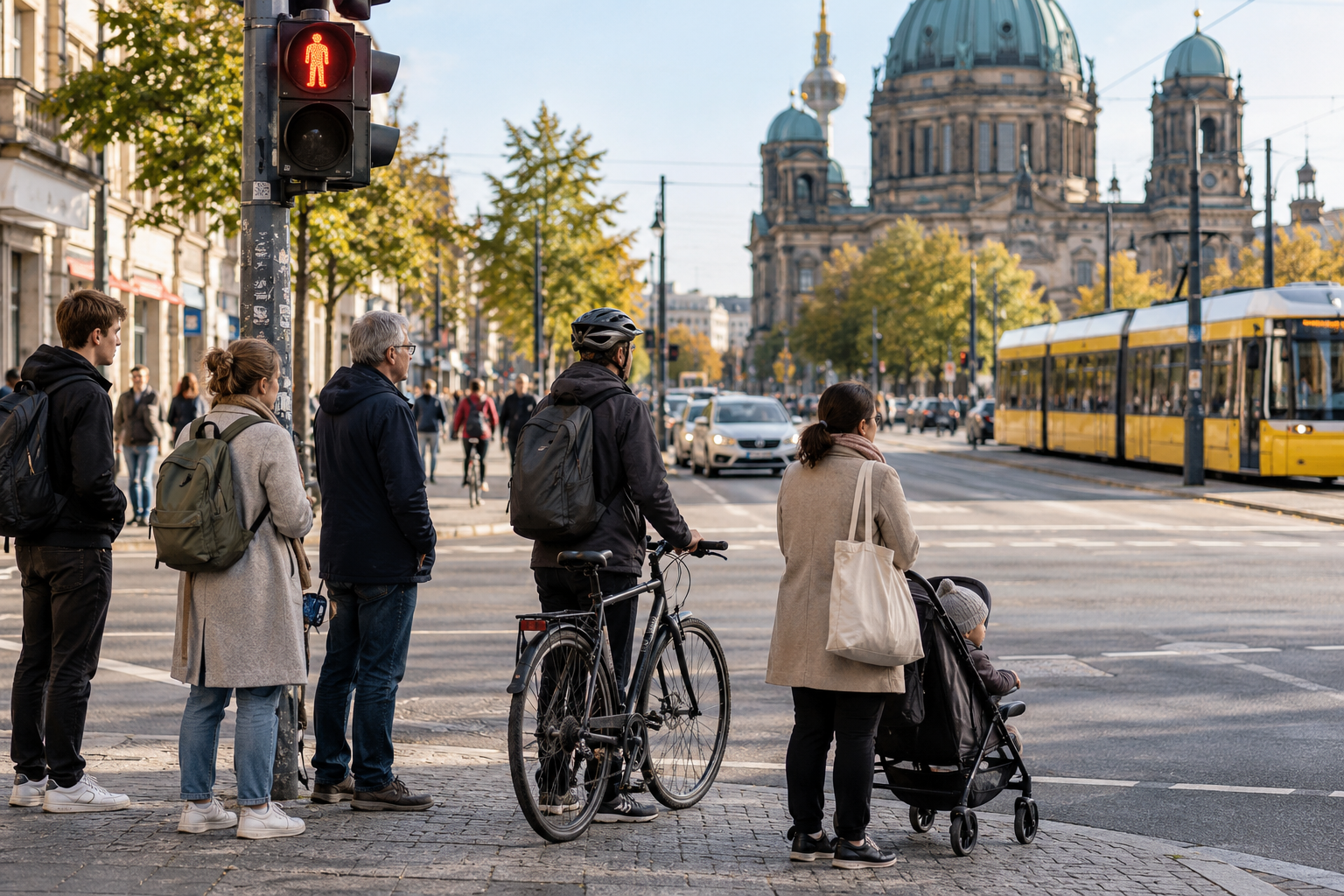
Underneath the specific matter of traffic lights lies a broader and genuinely important feature of German culture, often summed up in the word Ordnung, meaning order. There is a deep and widely shared cultural appreciation in Germany for rules, for structure, and for the idea that a well-ordered society depends on everyone following the agreed-upon rules even when, in a given moment, breaking one would harm no one. The red light on the empty street is almost the perfect distillation of this value: the rule says wait, so you wait, not because a car is coming but because following the rule is itself the point, a small act of faith in the system that keeps everything running smoothly and fairly for everyone.
To an outsider, and especially to an American raised on a more individualistic, use-your-own-judgment approach, this can look at first like mindless, robotic rule-following, obedience for its own sake. But seen from the inside it is something more considered than that. It reflects a belief that rules are a collective agreement, that a society works better when people can rely on each other to keep to them, and that your own momentary convenience does not entitle you to opt out of the shared system whenever you personally judge it safe. The very same instinct that keeps a German standing at an empty red light shows up everywhere you look throughout the culture, in the orderly queues, the meticulously sorted recycling, the respected quiet hours, the general and deeply held sense that there is a right and proper way to do things and that doing it, even when no one is checking, is a small but genuine civic duty. The red light is simply the most visible, most photographed tip of a very large and very orderly iceberg. The waiting pedestrian is not a sucker; they are being a good citizen, upholding their small end of a social contract that they genuinely value.
A Very German Intensity
It is worth knowing that this is not simply a European thing that Americans fail to understand, because the intensity of it is specifically, distinctively German, and the contrast within Europe is striking. Cross the border into France, Italy, or the Netherlands, and the whole drama evaporates, because in those countries jaywalking is not penalized and barely remarked upon, and people cross empty streets on red with the same easy shrug an American would. A Parisian or a Roman waiting piously at a deserted red light would look slightly odd to their own neighbors. So the frozen 2 AM pedestrian is not a generic European figure at all; he is a particularly German one, with the orderly cultures of Central and Northern Europe, Switzerland and Austria and the Nordic countries, leaning the same way to varying degrees.
This matters for the traveler, because it means you cannot simply learn one rule for the whole continent. The relaxed street-crossing of Mediterranean Europe and the strict signal-obedience of Germany are two genuinely different cultures of the pavement, and the same confident stride across an empty red light that earns an indulgent non-reaction in Naples can earn a sharp scolding in Nuremberg. It is one more reminder that Europe is not a single place with a single set of manners but a patchwork of distinct national temperaments, and that the German relationship with rules, order, and the red Ampelmann is one of the clearest and most charming expressions of a particular national character. Knowing which country you are standing in, in other words, tells you whether to walk or to wait.
What Americans Eventually Learn
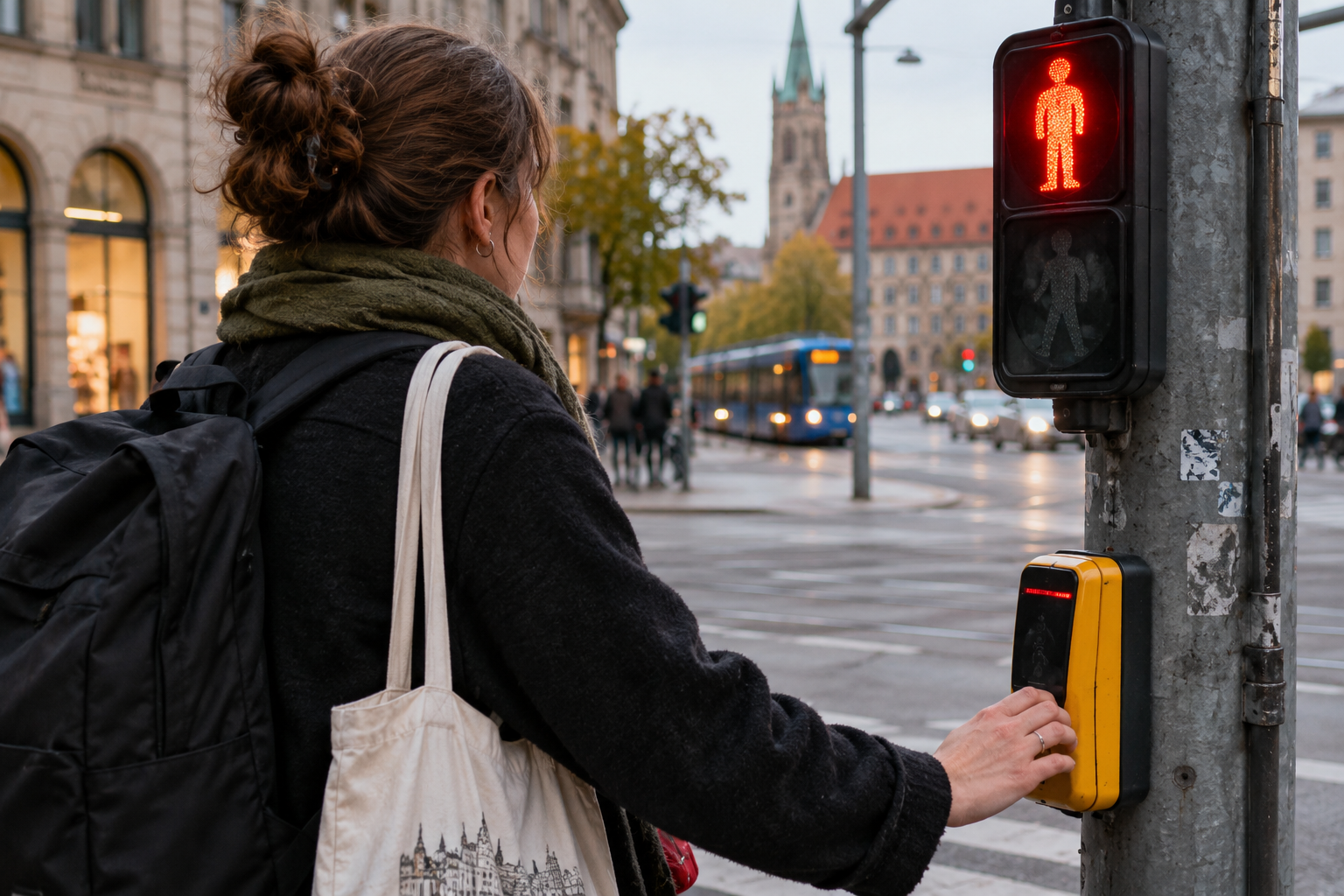
So the stage is set for a classic transatlantic misunderstanding, and both sides have a point. The American looks at the German frozen at an empty intersection and sees wasted time, pointless rigidity, a failure to think for oneself. The German looks at the American breezing nonchalantly across on red and sees selfishness, poor discipline, a disregard for the shared rules, and a bad example being set for the children who are, remember, always potentially watching and learning. To the German, it is not a harmless little shortcut; it is a small civic betrayal, however unintended. Each is a little bit right, and the gap between them is really a gap between two different philosophies of how a person should relate to the rules of a shared society.
The curious thing is what tends to happen to Americans who stay.
Many arrive scoffing at the whole business and jaywalking defiantly, and then, over months, find themselves quietly changing, until one day they catch themselves standing at a deserted 2 AM intersection, waiting for the little green man, and feeling, to their own surprise, that it would be somehow wrong to cross.
There is a small but real satisfaction in it, a sense of participating in a kind of shared civic calm, of being a predictable and trustworthy part of an orderly whole, that the constant little improvisations and judgment calls of American street-crossing somehow never offered.
You stop having to decide, and there is a quiet relief in that; the light decides for everyone, and everyone abides, and the street runs on a gentle, dependable rhythm. But for the visitor, the practical lesson is simple and worth taking to heart: in Germany, wait for the green man, especially when there are children anywhere nearby, and do not be the tourist who teaches a German four-year-old that red lights are optional. You will break the rule on your first day out of pure reflex. Give it a few weeks, and a few pointed looks, and you may well find yourself, a little sheepishly and almost without deciding to, waiting at empty intersections too, little green man and all, and understanding from the inside exactly why. That quiet conversion, from scoffing to waiting, is one of the small, telling ways a country gets into you.

About the Author: Ruben, co-founder of Gamintraveler.com since 2014, is a seasoned traveler from Spain who has explored over 100 countries since 2009. Known for his extensive travel adventures across South America, Europe, the US, Australia, New Zealand, Asia, and Africa, Ruben combines his passion for adventurous yet sustainable living with his love for cycling, highlighted by his remarkable 5-month bicycle journey from Spain to Norway. He currently resides in Spain, where he continues sharing his travel experiences with his partner, Rachel, and their son, Han.