
An American renting an apartment in Europe for the first time often has two small domestic shocks in fairly quick succession. The first is finding the washing machine tucked under the kitchen counter, sitting there between the dishwasher and the fridge as though that were the most natural place in the entire world for it.
The second, and the bigger one, is realizing there is no dryer at all, anywhere, and that the drying rack folded in the corner is not a quaint accessory at all but the actual, only plan for getting clothes dry. To an American accustomed to a dedicated laundry room with a big matching washer and dryer, both of these small discoveries feel faintly wrong, like a house quietly missing a whole room it ought to have. But neither one is an oversight or a sign of poverty.
Both are perfectly sensible answers to how European homes are built, how much energy costs, and how Europeans have long thought about the whole simple business of washing and drying clothes. Here is why the machine lives in the kitchen and the dryer barely exists. Once you see the reasons, both stop looking like quirks and start looking like the obvious result of a different set of conditions, and you may even come to prefer the European way.
What follows is why the washing machine ends up in the kitchen, why dryers are so rare, the real reasons Europeans skip them, how Europe actually gets its clothes dry, and what all of it means if you are living or staying there.
The Machine in the Kitchen

To an American eye, a washing machine in the kitchen looks like a mistake, but it is the product of simple logic once you understand European homes. The first and biggest factor is space, because homes across much of Europe, and especially the older housing stock of its cities, are considerably smaller than their American counterparts and were never built with a dedicated laundry room in mind. Square footage that an American takes for granted is a genuine luxury in a European city, where centuries-old buildings were carved into flats long before anyone imagined a room set aside just for washing clothes. There are no sprawling utility rooms and often no basements at all in the terraced houses and apartments where so many Europeans live, so the washing machine has to go somewhere, and the kitchen is the obvious place. Where an American house might devote an entire room to laundry, a European home is more likely to be measuring space by the square foot and cannot spare one, so the machine tucks in wherever it fits.
The reason it is the kitchen specifically comes down to plumbing. The kitchen is a room that already has the water supply and the drainage a washing machine needs, along with the electrical connections, so slotting a machine in there requires no new pipework or major alteration, and European kitchens have long been designed with exactly this in mind, leaving an under-counter gap for a washer beside the one for the dishwasher. The bathroom is often ruled out by strict electrical safety regulations that discourage or forbid major appliances near so much water. Between the lack of a spare room, the plumbing already present, and the safety rules around bathrooms, the kitchen wins almost by default, and generations of European homes have simply been built that way. What looks like an odd choice is really the only sensible one the layout allows. An American arriving with the expectation of a laundry room is really expecting a room that European homes, built on older and denser footprints, were simply never designed to include.
The Smaller, Cleverer Machine
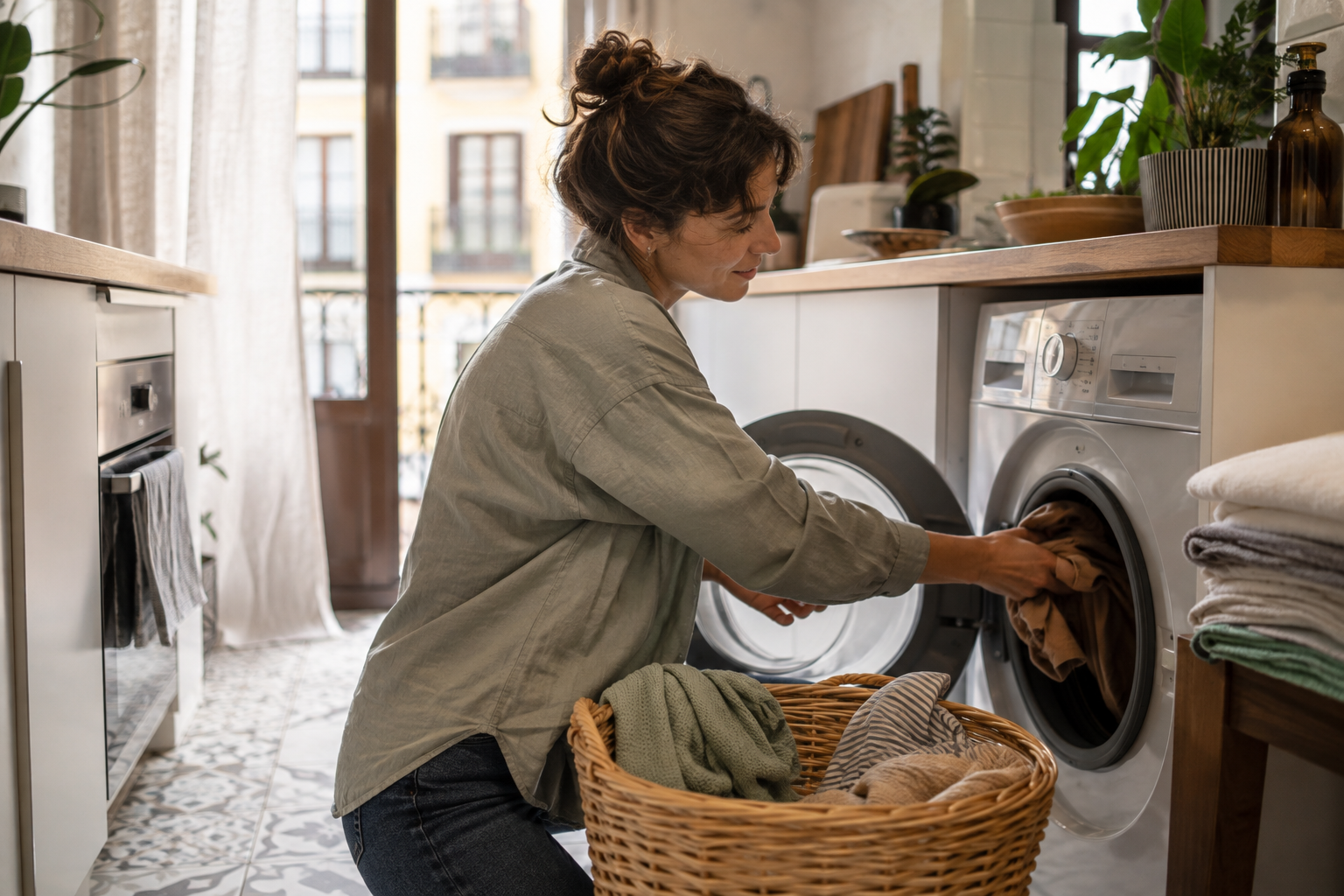
While you are noticing where the washing machine sits, it is worth noticing the machine itself, because the European washer is a rather different beast from the American one, and the differences are not accidental. The first thing you register is size, since European machines are markedly smaller than the big American drums, built to fit under a counter and to suit both the smaller homes and the smaller, more frequent loads that European laundry habits favor. You wash more often and in smaller batches, which suits a machine sized to a kitchen rather than a laundry room.
The bigger differences are inside. European washing machines are almost always front-loaders, and they are built around the high cost of energy and water that shapes so much of European domestic life, so they use far less of both than a typical American top-loader, heat their own water, and run long, efficient cycles that can stretch to a couple of hours as they wash thoroughly at lower temperatures. Most strikingly, they spin at very high speeds at the end of the cycle, wringing far more water out of the clothes than an American machine, which is not a minor detail but the quiet key to the whole European laundry system, because clothes that come out barely damp air-dry far faster on a rack. The machine and the drying method, in other words, are designed as a pair, the fierce spin cycle making the absent dryer far less missed than it would otherwise be. Understanding that the European washer is engineered for a world of expensive energy and air-drying explains a great deal about why the rest of the setup looks the way it does.
The Missing Dryer
If the kitchen washing machine merely puzzles Americans, the absence of a dryer genuinely startles them, because in the United States the tumble dryer is close to universal, found in the great majority of homes as the automatic partner to the washer. Americans wash and then dry by machine without a second thought, and the idea of not owning a dryer at all can seem not just inconvenient but almost primitive. So the discovery that many European households simply do not have one, and that even those who do use it sparingly, comes as a real surprise, often the first thing a newly arrived American mentions when describing how daily life is different.
The numbers make the contrast stark. Where the tumble dryer sits in the large majority of American homes, in some European countries it is a genuine rarity, owned by only a small fraction of households, with Italy often cited as an extreme case where the machine is found in a tiny share of homes. Across Europe as a whole the dryer is far less common and far less used than in America, treated as an occasional luxury or a winter convenience rather than a default. This is not because dryers are unavailable or unknown, since they can be bought in any European appliance shop, but because Europeans, for a cluster of good reasons, have largely chosen not to build their lives around them. Understanding why they made that choice is the interesting part, because it is not resignation but a genuine preference, arrived at for reasons that make a good deal of sense once you hear them.
Why Europeans Skip the Dryer
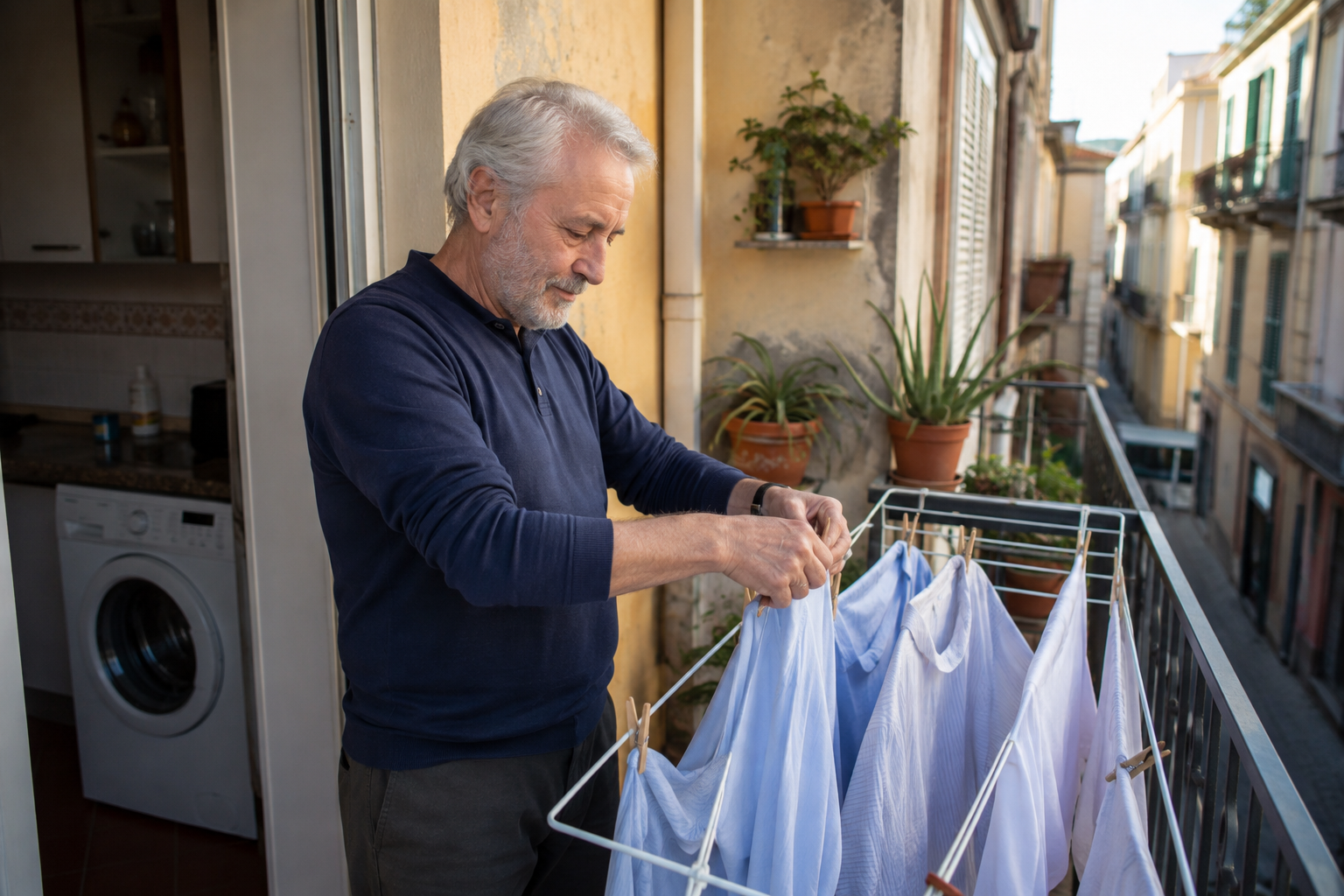
The single biggest reason Europeans avoid the tumble dryer is the cost of running it, because electricity is far more expensive in Europe than in America, and the tumble dryer is one of the hungriest appliances in the house. Running a dryer regularly adds a meaningful sum to an already high electricity bill, and in a place where energy has long been costly, that expense is simply not one most households are willing to take on for something they can do for free by hanging clothes up. When drying a load costs real money every time, and a rack costs nothing after you have bought it, the arithmetic makes itself, load after load, year after year. In Italy, where electricity prices are especially steep, that math is a large part of why so few homes bother with a dryer at all.
Space plays its part again too, since the same small homes that have no laundry room also have little room for a second large appliance, and a dryer is a bulky thing to fit into a kitchen already holding a washer. But beyond the practical calculations of cost and space sits something more cultural, a long and settled habit of air-drying clothes that Europeans simply grew up with and see no reason to abandon. There is a widespread sense that line-dried clothes smell fresher, and a genuine environmental consciousness that makes running an energy-hungry machine feel wasteful when the sun and air will do the job for nothing. There is also the practical point that tumble drying is hard on fabrics, shrinking and wearing them, so air-drying is gentler and makes clothes last longer. Between the cost, the space, the environmental values, and the simple force of habit, skipping the dryer is, for most Europeans, not a hardship at all but an obvious and sensible choice. To many Europeans it is the American default, tumbling every load in an energy-hungry machine when a rack and a little patience would do, that looks slightly odd, which is a useful reminder that the puzzled looks run in both directions.
How Europe Actually Dries Its Clothes
If Europeans are not using dryers, the natural question is how they get their clothes dry, and the answer is a whole quiet ecosystem of air-drying that Americans rarely see. The most visible form is the outdoor one, the clotheslines strung across courtyards and the drying racks crowding balconies that give so many European streets their characteristic look, with laundry hung out to dry in the sun and air, especially in the warmer south. It is such a normal sight that it fades into the background, but it is the backbone of how a continent dries its washing. The lines of laundry strung between buildings that strike tourists as so picturesque are not staged for charm; they are simply Tuesday, the ordinary machinery of getting clothes dry in a place that never took to the tumble dryer.
Indoors, the workhorse is the humble folding drying rack, a collapsible frame that stands in a spare corner, a bathroom, or a spare room, holding a full load of washing to dry over a day or two and folding flat when it is done. In colder months and northern climates, clothes go over radiators to dry on the free heat of the central heating, or into airing cupboards built around the hot-water tank, and some households use electric heated airers that dry clothes far more cheaply than a tumble dryer would. There is real ingenuity in it, a whole repertoire of ways to coax clothes dry using warmth and air that would otherwise go to waste, passed down and adapted household by household.
European washing machines help the whole system along by spinning at very high speeds, wringing far more water out of the clothes than an American machine typically does, so that what comes out is already half-dry and air-dries much faster. Newer, energy-efficient heat-pump dryers have been gaining ground in the wealthier northern countries as a gentler, cheaper middle path, but even where they exist they are often reserved for towels and bulky items, with everything else still going on the rack. It is a slower rhythm than the American wash-and-tumble, but it works, and it has worked for generations. The whole system hangs together, the small high-spin machine, the fierce final spin, the rack in the corner and the line on the balcony, into a way of doing laundry that is cheaper, gentler, and greener, if undeniably slower, than the American one.
What It Means for You
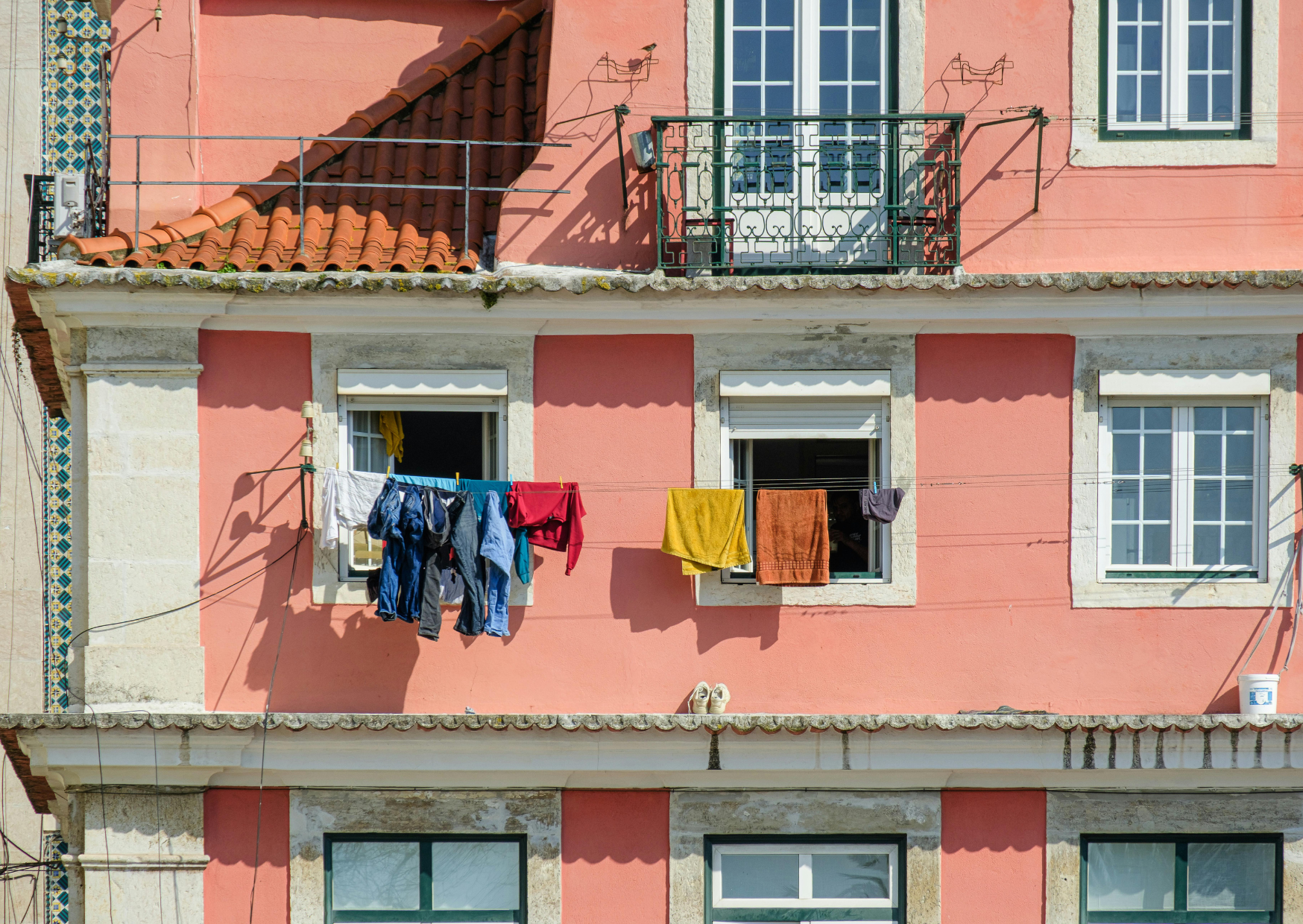
If you are going to live in or even just rent a place in Europe for a while, this all adds up to some genuinely useful expectations to pack alongside your clothes. The first is simply to plan for air-drying, because whatever the listing says, you should assume there will be no dryer, or that if there is one it will be small and slow, and that a drying rack will be your real tool. Building a day or two of drying time into your laundry rhythm, rather than expecting clothes clean and dry within an hour, is the single biggest mental adjustment, and once you make it the system stops feeling like a hardship. You simply start a wash knowing the clothes will be ready to wear the day after tomorrow rather than this afternoon, and plan your favorite shirts around that, which after a week or two becomes second nature.
A few small practices make it painless. Use your machine’s high spin setting so clothes come out as dry as possible, hang things promptly so they do not crease or sour, and give yourself enough rack space that a load can breathe rather than sitting damp in a clump.
And it is worth appreciating the quiet upsides rather than just enduring the differences, because the European way is genuinely cheaper, running up no dryer bill at all, and it is gentler on your clothes, which really do last longer without the constant battering of the tumble dryer. Many people who move to Europe grumbling about the missing dryer end up converts, keeping the drying rack even when they could have a machine, having discovered that the slower, cheaper, gentler way suits them fine. It is a common arc, from bafflement to grudging acceptance to genuine preference, and plenty of returning expats find themselves oddly reluctant to go back to tumbling everything the moment they can. The washing machine in the kitchen and the rack in the corner are not signs of a place doing without, but of a place that long ago worked out a different, and in many ways smarter, answer to a chore everyone shares. Like so much that puzzles a visitor at first, it turns out to be not a lack but a choice, and a fairly sensible one at that.

About the Author: Ruben, co-founder of Gamintraveler.com since 2014, is a seasoned traveler from Spain who has explored over 100 countries since 2009. Known for his extensive travel adventures across South America, Europe, the US, Australia, New Zealand, Asia, and Africa, Ruben combines his passion for adventurous yet sustainable living with his love for cycling, highlighted by his remarkable 5-month bicycle journey from Spain to Norway. He currently resides in Spain, where he continues sharing his travel experiences with his partner, Rachel, and their son, Han.