
Start browsing property in Europe, whether idly dreaming or seriously house-hunting from across the ocean, and you hit a wall almost immediately: every home is measured in square meters, a unit of area that means precisely nothing at all to an American eye. A listing proudly announces ninety square meters, or seventy, or a hundred and twenty, and unless you happen to think in metric, those numbers are just noise, a string of digits with no shape to them. You genuinely cannot tell whether the place is poky or palatial. The number just sits there, precise and useless, telling a European everything and you nothing.
And when you finally do the conversion, the shock tends to land twice over, because not only is the unit unfamiliar, but the actual sizes, once translated, turn out to be far smaller than an American is ever braced for. So here is how the square-meter measurement actually works, the simple way to convert it in your head, and the genuine size difference it quietly reveals between American and European homes. Master the small piece of arithmetic and you can read any European listing at a glance, which is the first real skill of house-hunting abroad.
What follows is why the number means nothing to you at first, the conversion and the mental shortcut, the real shock of how small the homes are, the wrinkle that the measurements are not even taken the same way, and why smaller turns out to be perfectly fine.
The Number That Means Nothing to You

The root of the problem is simply that the United States is one of the very few places that measures home size in square feet, while essentially the entire rest of the world, Europe included, uses square meters. This is not a quirk of a few countries; it is the global default, with square feet the odd exception clung to mainly by the US and a shrinking handful of other markets. So when an American looks at a European listing, they are reading it in a foreign language of area, and a figure like seventy square meters carries no instinctive meaning at all, in a way it never would for a local.
This creates a genuine practical problem, not just a moment of confusion, because it makes comparison impossible without conversion. An American trying to weigh their two-thousand-square-foot house back home against an eighty-square-meter apartment in Barcelona is comparing two numbers that simply cannot be set side by side, like trying to decide whether five miles is longer than eight kilometers without converting one of them. Many people, faced with the unfamiliar number, either guess, and guess badly, or gloss over it entirely and form no real sense of the space at all, which is a poor way to make one of the biggest decisions of your life. The first step to house-hunting sanely in Europe, then, is simply to accept that the square-meter figure has to be converted into something your American brain understands before it can mean anything, and to get comfortable doing that conversion quickly, because you will be doing it constantly. It is the metric equivalent of learning to read prices in a foreign currency, awkward for a day or two and then automatic.
The Conversion and the Shortcut
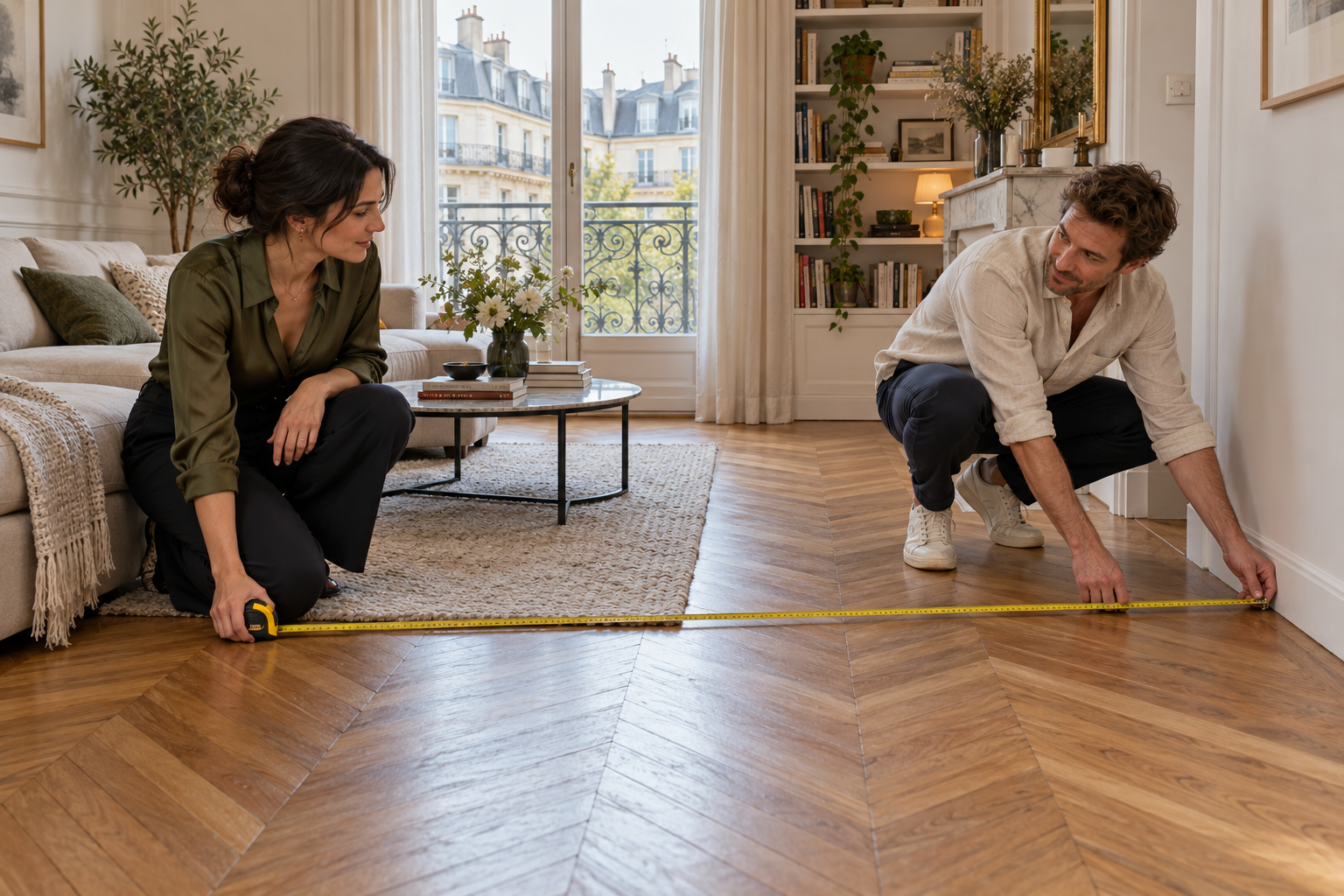
The exact conversion is straightforward: one square meter equals about ten and three-quarters square feet, or 10.76. To turn a European listing’s square meters into square feet, you multiply by that figure, and to go the other way, from your American square footage to metric, you divide. So a ninety-square-meter apartment is about nine hundred and seventy square feet, and a hundred-square-meter place is roughly one thousand and seventy-six. Commit those two to memory and you already have a usable frame for most of what you will see, since so many European homes cluster in that range.
For house-hunting on the fly, though, you do not need the precise number, and there is a mental shortcut that gets you close enough instantly. The rough version is simply to multiply the square meters by ten: a seventy-square-meter flat becomes about seven hundred square feet, near enough to judge it. If you want to be a little more accurate, multiply by eleven and then knock off a couple of percent, which lands you within a whisker of the true figure. Either way, the point is to have a fast, in-your-head move so that when a listing says a number, you can convert it on the spot and know roughly what you are looking at.
A few anchors are worth memorizing: fifty square meters is about five hundred and forty square feet, a small one-bedroom; seventy is around seven hundred and fifty, a standard two-bedroom in most cities; a hundred is a bit over a thousand, a comfortable family apartment. Fix a couple of those in mind and you can read European listings almost as fluently as a local, without reaching for a calculator every time. After a few weeks of looking, the square-meter figure stops being an abstraction and starts summoning an actual mental picture of the space, which is exactly the fluency you need.
The Real Shock: How Small

Here is where the second, larger jolt arrives, because once you can convert the numbers, you discover that European homes are dramatically smaller than what Americans are used to, and it is not a marginal difference. The average new single-family home in the United States runs around two thousand three hundred square feet, which is a little over two hundred square meters. The average home in Germany or the UK is around ninety square meters, which is about nine hundred and seventy square feet. That means the typical American home is more than twice the size of the typical German or British one, and in some comparisons closer to two and a half times.
Put in concrete terms, the numbers reshape your expectations fast. A European city apartment that a listing describes as spacious, at say a hundred square meters, works out to a bit over a thousand square feet, which in American terms is a small starter home or a modest condo, not a family house. A perfectly normal two-bedroom flat at seventy-five square meters is around eight hundred square feet, a figure that sounds cramped to an American ear but is completely standard across European cities. Families raise children in it, couples grow old in it, and nobody considers it small, because it is simply what a home is where they live.
The rule of thumb many relocating Americans end up using is brutal but useful: take your current American square footage and roughly halve it to get a realistic sense of the European space your money and your life will actually involve. This is the real content of the conversion shock, and the part that lingers long after the arithmetic has become second nature. It is not just that the unit is unfamiliar; it is that translating it reveals homes built to a completely different, and far more compact, sense of how much space a household needs, and coming to terms with that is a bigger adjustment than the arithmetic.
Why European Homes Got Small

It helps to understand why the homes are so much smaller, because the reasons make the difference feel less like Europe shortchanging its residents and more like a different, older set of constraints and choices. The most basic factor is age and density. European cities were largely built long before the car, on land that was already occupied and expensive, in compact patterns of apartment blocks and terraced houses rather than the sprawling single-family lots that American suburbs spread across freely. When you build up and in, on scarce and costly urban land, homes come out smaller, and most Europeans live in exactly those dense, old, apartment-heavy cities.
Cost pushes the same way. Land, construction, and above all energy are expensive in Europe, and a bigger home means more to buy, more to heat, and more to power, all at prices well above American levels, so there is a constant economic pressure toward building and choosing less space. There is a cultural dimension too, a long-settled sense that a modest, well-used home in a good location beats a large one further out, and less of the American impulse to equate square footage with success. The United States, with its abundant cheap land, cheap energy, and car-based sprawl, went the other way and became the global outlier in home size, so the real oddity in the comparison is arguably the enormous American house, not the compact European one. Seen against the rest of the world, it is America that is unusual, and the European home is closer to the global norm, which is worth remembering before judging the smaller size as a deficiency rather than simply a different, and very common, way of housing people.
The Measurements Are Not Even the Same

Just when you think you have it figured out, there is a further wrinkle that makes the gap even wider than the raw numbers suggest, which is that a European square meter and an American square foot are often not measuring quite the same thing. American home sizes tend to be quoted generously, and European measurements are frequently stricter about what counts. In France, for instance, the legal measurement used to sell an apartment, known as the Loi Carrez area, excludes spaces with low ceilings, along with cellars, garages, and outdoor areas like balconies and terraces, counting only the genuinely usable interior floor space. Other European systems have their own rules about what is and is not included.
The upshot is that a European home’s stated size can represent a leaner, more honest measure of actual living space than an American figure, so the already-smaller European number may correspond to even less than a like-for-like comparison would suggest, or at least to space measured more conservatively. When an American number might quietly include a garage or a partly-finished basement, the European figure is often just the rooms you actually live in.
It also means you cannot always compare two European listings directly either, since different countries count differently. A ninety-square-meter apartment in one country and a ninety in another may not represent the same amount of usable room, depending on what each one’s rules fold into the figure. A related trap for Americans is the way prices are quoted: Europe often advertises property by price per square meter, so a figure like a certain number of euros per square meter has to be converted both for area and for currency before it can be weighed against an American price per square foot. That is two conversions stacked on top of each other, and skipping either one produces a number that looks reassuring or alarming for entirely the wrong reasons. And a small but real gotcha is that many European countries swap commas and periods in numbers, so a listing showing a size or price with a period where you would expect a comma can briefly throw you. None of these are complicated once you know them, but each is a way the simple-seeming square-meter figure hides a little more complexity than it appears to.
Why Smaller Turns Out to Be Fine

For all the shock, it would be a mistake to read the smaller European home as simply a worse deal, because in practice a great many Americans who move find they not only adjust to less space but come to prefer it, and the reasons are worth understanding. A smaller home is cheaper to buy or rent, cheaper to heat, faster to clean, and impossible to fill with the accumulated clutter that larger American houses seem to demand, so downsizing into a European-sized home often brings a lightness and simplicity people did not expect to enjoy. The compactness is also tied to a different and often better way of living, one where life spills out of the home and into the city, the cafe, the park, and the street, rather than being centered on a large private house, so the smaller dwelling is part of a package that includes a richer public life. You need less living room when the city is your living room, and less of everything when a walk replaces a second den.
The European home is also typically better designed for its size, making clever use of compact space in a way American homes, with square footage to spare, rarely bother to, so a hundred square meters in a European city can feel more genuinely livable than the raw number suggests. None of this means the space difference is not real or that it will not take adjustment, especially for anyone used to a large suburban house full of rooms that were barely used.
But the reframing that helps is to stop seeing the smaller size as a sacrifice and start seeing it as a different, leaner, often more sociable model of home, in which less indoor space is traded for lower costs, less to maintain, and more life lived out in the world. Convert the square meters, brace for the smaller number, and then remember that the number is only the size of the box, not the size of the life, which in a walkable European city may turn out to be a good deal larger than the one you left. People who moved from a big quiet house to a small lively city flat often report their world got bigger even as their home got smaller. The math is the easy part; recalibrating what you think you need is the real move, and most people who make it are glad they did. The house shrinks, the world outside it grows, and the trade is one a surprising number of Americans would happily make again. The square meters, in the end, measure only the smaller half of the bargain.

About the Author: Ruben, co-founder of Gamintraveler.com since 2014, is a seasoned traveler from Spain who has explored over 100 countries since 2009. Known for his extensive travel adventures across South America, Europe, the US, Australia, New Zealand, Asia, and Africa, Ruben combines his passion for adventurous yet sustainable living with his love for cycling, highlighted by his remarkable 5-month bicycle journey from Spain to Norway. He currently resides in Spain, where he continues sharing his travel experiences with his partner, Rachel, and their son, Han.