

The first time an American stays in a German apartment and reaches up to open a window, something strange and slightly disorienting happens. The window does not slide up the way American windows always have. Instead there is a single handle, and depending on how you turn it, the whole window either swings open into the room like a door, or tilts inward from the top with a gap at the top for air.
It is clever, it is elegant, and it is the source of endless confusion and no small number of jammed, diagonally-hanging windows, because Americans, unfamiliar with how it works, keep operating the handle at the wrong moment and breaking the thing, or at least appearing to. This is the tilt-turn window, standard across Germany and much of Europe, and once you understand it, it is wonderful. So here is how the tilt-turn window actually works, what each handle position does, how people break them, and how to use one without ever ending up with a window hanging off its hinges. It is one of those things that seems baffling for about a day and obvious forever after.
What follows is the one-handle system, the everyday tilt setting, the full-swing turn setting, how Americans break them, and how to avoid and undo the damage.
One Handle, Two Ways to Open

The genius of the tilt-turn window, and the thing that confuses newcomers, is that a single handle controls three completely different states, depending on which way you point it. It is one handle, three positions, two ways to open, and once you have that phrase in your head the whole mystery dissolves. The window is not broken or complicated; it is simply doing exactly what the handle tells it to.
Handle down: the window is closed and locked, sealed tight all around by a set of locking points hidden in the frame, which is part of why European windows seal so much better than the sliding American kind. When you turn the handle down and feel the window pull itself snug against the frame on every side, you are feeling the multi-point lock engage, and it is the reason these windows keep out cold and noise so well. Handle sideways: you engage the turn function: the window releases on hinges down one side and swings open inward, into the room, exactly like a door. And Handle up: you engage the tilt function: the window stays hinged along the bottom but the top leans inward a few inches, opening a gap along the top edge. That is the entire system. Down is locked, sideways is swing-open, up is tilt-open, and every tilt-turn window in Europe works this way.
The confusion Americans feel is simply unfamiliarity, because they grew up with windows that slide vertically and have no concept of a single handle that offers two utterly different ways of opening; once the three positions are clear, the window becomes not a mystery but a genuinely superior piece of design. You stop seeing a confusing foreign object and start seeing a single handle that does the work of three.
The Tilt Is the Everyday Setting
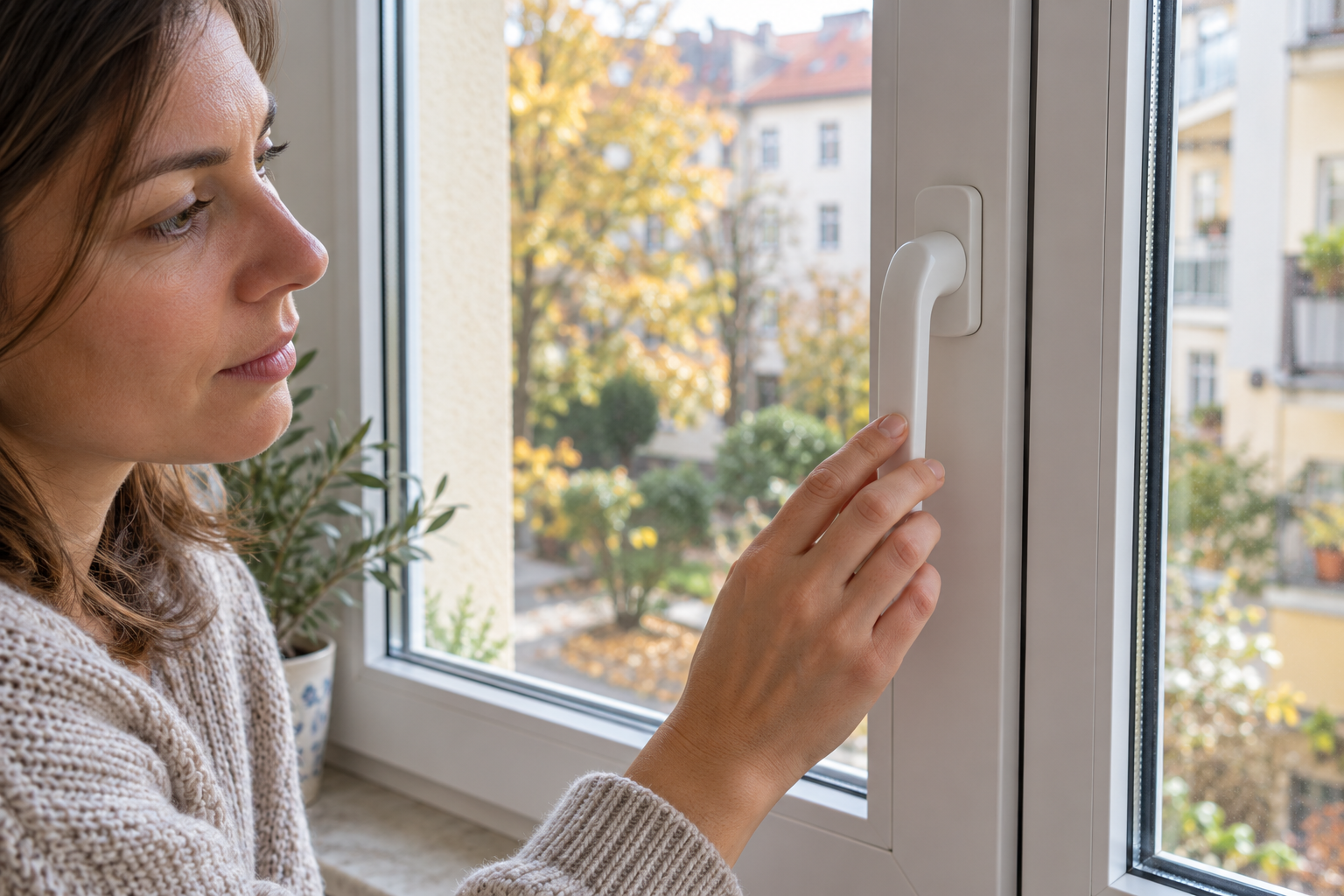
Of the two ways to open, the tilt is the one you will use almost all the time, and understanding why is the key to living comfortably with these windows. In the tilt position, with the handle up and the top of the window leaning inward, you get secure, gentle ventilation perfect for everyday airing. The opening is a narrow gap high up, which means air flows in and, importantly, upward into the room rather than blasting straight at you, so you can leave a room airing without sitting in a direct draft. It is a thoughtful piece of design, giving you fresh air without the chill of a wind blowing directly across the room.
Just as valuable is the security the tilt offers. Because the opening is a small gap at the top of the window, well out of easy reach, a tilted window is far harder for an intruder to climb through than a wide-open one, which means you can leave a window tilted for ventilation while you are out or asleep with much less worry than leaving one swung wide.
This is why the tilt is the default, the position Germans leave their windows in for ordinary air, and it is also the position that does the work of their famous airing habits, since a tilted window provides steady background ventilation. The brief, wide-open burst of airing uses the turn; the gentle all-day freshness uses the tilt, and between them the two settings cover every ventilation need a home has. For an American, the tilt is the setting to reach for ninety percent of the time: handle up, top leans in, fresh air comes in gently and securely, and you get on with your day. If you learn only one thing about these windows, learn the tilt, because it is the position you will live in. It is a genuinely better everyday ventilation than anything an American sliding window offers, letting in controlled air without the exposure of a gaping opening, and once you are used to it you will wonder why American windows never worked this way. The combination of a small, high, secure gap and air directed upward is simply more useful than a slider pushed partway up, and it is the detail people miss most when they leave Europe.
The Turn Is for Cleaning and Full Air

The other opening, the turn, where the whole window swings inward like a door, is the dramatic one, and it has its own distinct uses. Swung fully open, the window gives you the largest possible opening for maximum airflow on a hot day, an unobstructed view, and, not trivially, an emergency exit if one were ever needed. But its most beloved use is cleaning, because when the window swings all the way into the room, you can reach the outside face of the glass from inside, standing safely in your own living room to clean both sides of a window that might be several floors up. Anyone who has struggled to clean the outside of an American window from a precarious position, or paid someone to do it, will appreciate what a gift this is. For an upper-floor apartment it is not a luxury but the only safe way to clean the glass at all.
The turn comes with one sensible caution: a fully swung-open window is more exposed to the weather and to being caught by the wind, so you would not normally leave it swung wide and unattended, especially on a gusty day, when a sudden gust could slam it. For sustained, unattended, or overnight ventilation, the tilt is the right choice; the turn is for when you are present and want the window fully open, to clean it, to air a room out hard and fast, or to lean out and enjoy the view. Think of the turn as the occasional, deliberate full opening and the tilt as the everyday one, and you will reach for the right one without thinking. Knowing which opening to use for which purpose, tilt for everyday and unattended air, turn for cleaning and full open-window moments, is most of what it takes to live happily with a tilt-turn window, and it is knowledge that, once gained, feels completely natural.
Why Europe Builds Windows This Way

It is worth asking why Europe settled on this more complicated window when America stuck with the simple slider, because the answer reveals a different set of priorities about what a window should do. The tilt-turn design solves several European concerns at once, and each one reflects something about how Europeans live. The tight, multi-point seal when the handle is down answers the European obsession with energy efficiency, since a window that clamps shut all around its frame loses far less heat than a sliding sash with its inevitable gaps, which matters enormously in a continent of cold winters and high energy prices.
The inward-swinging turn function answers the realities of apartment living, where most Europeans reside, because being able to clean the outside of the glass from inside is essential when your window is four floors up with no yard to stand a ladder in. The tilt function answers the demand for secure, controllable ventilation, letting you air a flat safely even when you are out, which suits both the airing culture and the density of city life. In other words, the tilt-turn window is not needlessly fancy; it is purpose-built for a continent of insulated apartments where sealing, security, ventilation, and inside-cleaning all matter, and it does all four jobs from a single handle. The American double-hung slider, by contrast, was built for a different world of detached houses and cheaper energy, where none of those pressures bit as hard. Seen that way, the window is not a baffling foreign complication but a sensible answer to a set of questions American windows were never asked, which is exactly why Americans, meeting it for the first time, find it both confusing and, once understood, quietly superior.
How Americans Break Them
Now for the part that causes so much panic: how people break these windows, and why it happens so often to newcomers. The cardinal sin is operating the handle while the window is already open. The window is designed to go from closed to one opening or the other, with the handle turned only when the window is shut against the frame. The handle, the hidden gearbox, and the hinges are built to switch cleanly between modes only from the closed position, never mid-air. If you turn the handle while the window is hanging open, you ask the mechanism to switch between tilt and turn at the same time, and it cannot do both at once.
The result is alarming. The window partially releases from its top hinge and hangs inward at an angle, attached only at the bottom corner, looking for all the world as though it has broken off and is about to crash to the floor, with the handle stuck immovably somewhere in between.
This is the classic tilt-turn disaster, and it has frightened countless newcomers who were sure they had destroyed an expensive window, when in fact they have simply triggered the exact failure the design is prone to when the handle is mishandled. It happens because the American instinct, faced with an open window and a handle, is to fiddle with the handle, which is precisely the wrong move; with these windows you leave the handle alone until the window is closed. The very reflex that works on every American window is the one that breaks this one. The window has a small safety device inside meant to prevent this double-engagement, but it can be defeated by forcing the handle, and force is exactly what a confused person tends to apply. The good news, which anyone staring at a diagonally-dangling window badly needs to hear, is that it is almost always not broken at all, and usually fixed in under a minute.
How Not to Break It, and How to Fix It

The prevention is simple and worth committing to memory: only ever turn the handle when the window is fully closed, and never force the handle if it resists. Close the window completely, then choose your position, down to lock, sideways to swing, up to tilt, and move the handle smoothly with the window shut. Never turn the handle while the window is open, never try to go directly from tilt to turn or back without closing first, and if the handle will not move easily, stop and check that the window is properly closed rather than forcing it. Follow that one rule, handle only when closed, and you will likely never have a problem for the entire time you live with these windows. It really is the whole secret, and once it becomes a habit you stop even thinking about it.
And if you do find yourself facing the dreaded diagonal dangle, do not panic and do not call a repairman yet, because the fix is usually quick. Take the weight of the window with one hand and push it flat, square against the frame, as if closing it, holding it firmly in place.
While holding it flat, look along the edge near the handle for a small lever, catch, or button, the safety device that got confused, press or hold it, and at the same time turn the handle to the tilt or closed position.
With the window held flat and the safety catch pressed, the handle should move and the mechanism re-engage properly, bringing the window back under control, after which you can close and reopen it normally. It can take a try or two to get the knack, and it helps to stay calm and work slowly rather than yanking at a jammed handle, but it genuinely does reset, and the window that looked ruined is fine. Thousands of panicked newcomers have performed this exact rescue and lived to air another day. Learn the one rule and the one fix, and the tilt-turn window stops being a mystery to be feared and becomes what it was always meant to be: one of the quiet pleasures of a European home, a window that seals tight, airs securely, and cleans from inside, all from a single handle you finally know how to use. People who move home to America after years in Europe genuinely miss these windows, which is about the highest praise a window can get.

About the Author: Ruben, co-founder of Gamintraveler.com since 2014, is a seasoned traveler from Spain who has explored over 100 countries since 2009. Known for his extensive travel adventures across South America, Europe, the US, Australia, New Zealand, Asia, and Africa, Ruben combines his passion for adventurous yet sustainable living with his love for cycling, highlighted by his remarkable 5-month bicycle journey from Spain to Norway. He currently resides in Spain, where he continues sharing his travel experiences with his partner, Rachel, and their son, Han.