
A good pair of prescription hearing aids in the United States today can cost as much as a decent used car, four, five, even seven thousand dollars, and the program most older Americans rely on, Medicare, does not pay a cent toward them. So a great many Americans who need hearing aids simply go without, straining to follow conversations rather than spend a small fortune on the devices that would actually fix it, or making do with a cheap amplifier that helps only a little.
Cross the Atlantic, though, and the picture is transformed. In much of Europe, the very same hearing aids, made by the very same companies, cost a small fraction of the American price, and in a number of countries they are effectively free. The devices are identical; only the math is different, and the difference in the math is entirely a difference in how each country has decided to handle the cost. So here is what hearing aids actually cost on each side of the ocean, why the same product carries such wildly different price tags, and what it means for an American who needs to hear. It is one of the cleaner illustrations of how differently the two systems treat the same basic human need.
What follows is the American number and the Medicare gap, the surprising fact that the devices are mostly European, what Europeans actually pay, why the math diverges so sharply, and what all of it means for an American.
The American Number

Start with what Americans pay, because it is genuinely steep. A pair of prescription hearing aids, bought the traditional way through an audiologist or hearing clinic, commonly runs about two and a half to seven thousand dollars, with premium models from the leading brands landing at the higher end. Survey data puts the average price actually paid at somewhere in the region of two to three thousand dollars a pair, though plenty of people pay far more, and a top-tier pair at a traditional clinic can easily exceed six or seven thousand. For a retiree on a fixed income, that is not a small purchase but a major one, on the scale of a serious home repair or a modest car, and it recurs every several years as the devices age and need replacing.
Compounding the cost is a coverage gap that surprises people every year: Medicare does not cover hearing aids at all, leaving the entire bill to be paid out of pocket. Some Medicare Advantage plans offer partial help, and there are cheaper routes, warehouse clubs like Costco sell prescription-level aids for markedly less, and a newer category of over-the-counter hearing aids, legalized in 2022, can be had for a few hundred dollars.
But the headline reality stands: for the traditional, professionally fitted hearing aids that most people with real hearing loss are steered toward, Americans face a large bill with no public help, which is precisely why so many who could benefit from hearing aids never get them, with cost cited as the leading reason. It is a genuine public health problem dressed up as a pricing quirk. Hearing loss is one of the most common conditions of later life, and a large share of the people who could benefit from treatment never get it, with the price the single most cited reason they do not.
The Devices Are Mostly European

Here is the fact that reframes the whole comparison and makes the price gap so galling: the expensive hearing aids Americans are buying are, for the most part, European products. The global hearing aid industry is dominated by a small handful of manufacturers, the so-called Big Five, and they are overwhelmingly European companies. The biggest names, Oticon, Widex, ReSound, Phonak, Signia, trace back to Denmark, Switzerland, and Germany, and these same firms supply the devices sold in America under prices that would astonish their European customers. A Danish engineer who designed a hearing aid might be quietly amazed to learn what an American pays for the very thing that costs their own countrymen almost nothing.
This matters because it demolishes any assumption that Americans are paying more for a better or different product. They are not.
The hearing aid a retiree buys for five thousand dollars in Florida is, very often, the identical model, from the identical Danish or Swiss manufacturer, that a retiree in France or Germany obtains for little or nothing. There is no meaningful difference in the hardware, the technology, or the quality; it is the same device coming off the same production lines and shipping to both continents. Whatever explains the enormous price gap, then, it is emphatically not that Americans are getting more advanced or more capable hearing aids for their money. They are frequently getting the exact same European device, at several times the European price, which sharpens the real question considerably: if the product is identical, where does all that extra money go? The answer, it turns out, has nothing to do with the device and everything to do with the system it is sold through.
What Europeans Actually Pay

The answer to what Europeans pay varies by country, but everywhere it is dramatically less than the American figure, and in the most generous systems it approaches zero. France offers the most striking example. Under a reform known as 100% Sante, in force since 2021, France defined a category of quality hearing aids and arranged for them to be entirely reimbursed, through a combination of national health insurance and the complementary top-up insurance most French people carry, so that an eligible resident pays essentially nothing out of pocket for a perfectly good, modern hearing aid. Those wanting premium models pay the difference, but for a capable device, the French system has made hearing aids effectively free. A French pensioner walks out of the audiologist with working hearing and no meaningful bill, an outcome that sounds like fantasy to an American who was just quoted five thousand dollars for the same box of electronics.
Other European countries land in a similar place by different routes. Germany’s statutory health insurance covers a fixed allowance per ear, on the order of seven or eight hundred euros, and requires providers to offer patients a solid device within that covered amount, so a German with basic needs pays little or nothing and only those wanting premium technology pay extra.
Britain’s National Health Service supplies hearing aids free of charge to those who need them, on loan, with wide access and high uptake. The Nordic countries fund hearing care heavily through their health systems, keeping costs to the user minimal, on the same logic that governs the rest of their generous public provision.
Not every European country is equally generous, and Spain is a notable laggard, offering little public coverage of hearing aids for most adults and leaving many to buy privately, though even Spanish private prices tend to sit below the American ones and regional subsidies exist. But the overall European pattern is unmistakable: through public reimbursement, fixed insurance allowances, or free national provision, Europeans obtain the same hearing aids for a fraction of what Americans pay, and often for nothing at all. The routes differ from country to country, but the destination is the same: hearing care treated as something the health system helps with, rather than a large private purchase you are left to fund alone.
Why the Math Diverges
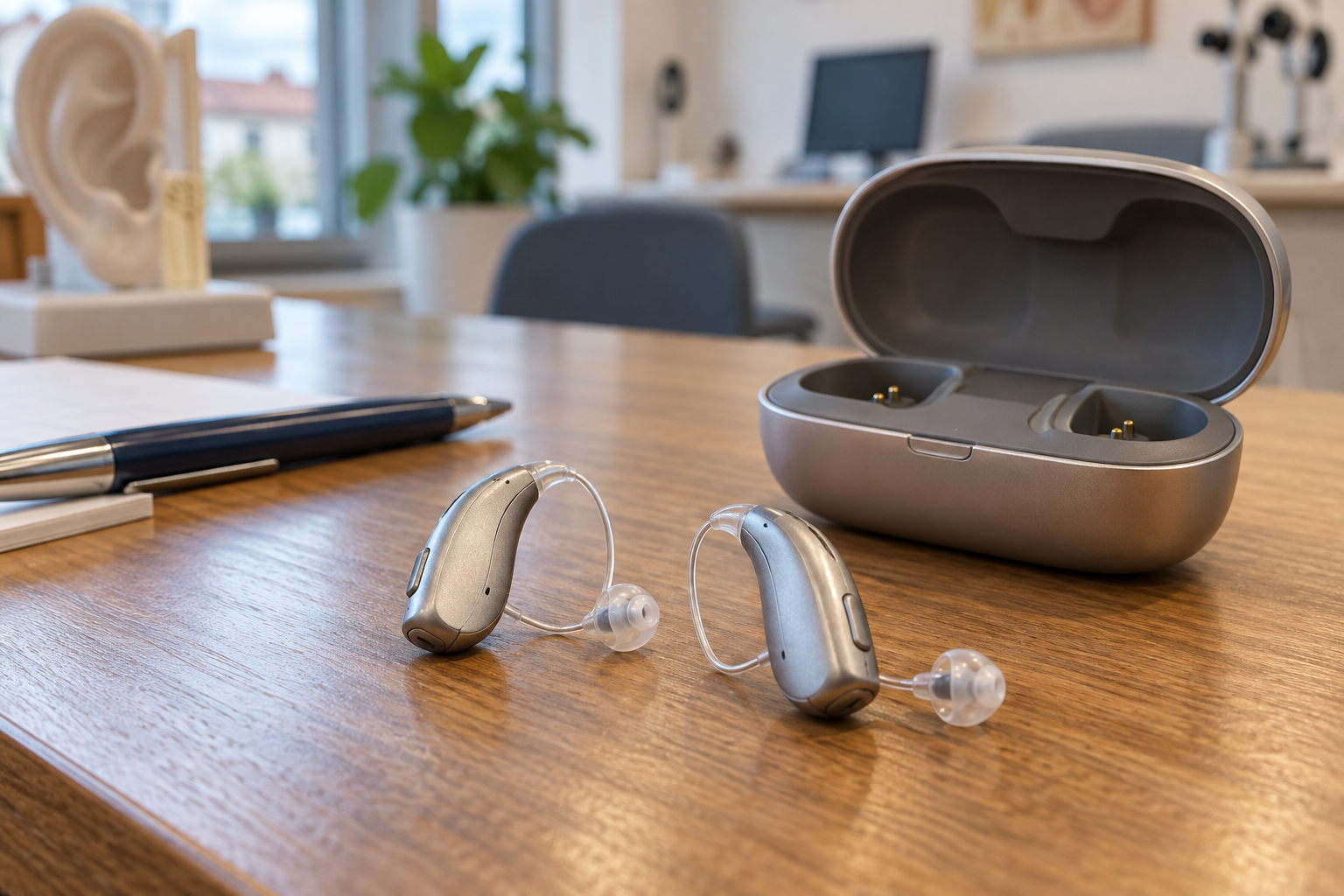
If the devices are the same, the entire difference has to lie in the systems around them, and it does, in two connected ways. The first is how the aids are sold and priced. In the American model, manufacturers sell to clinics, who set their own retail prices, bundling the hardware together with fitting and follow-up services and applying markups that can more than double the underlying cost. The price you pay is not really the price of the device; it is the price of the device plus a substantial professional and retail margin, all rolled into one opaque figure. Because the fitting, the follow-up visits, and the hardware are bundled into a single number, it is nearly impossible for the buyer to see how much they are paying for the aid itself and how much for everything around it, which is exactly what makes the markup so easy to sustain. Europe, by contrast, tends to regulate this, capping the price of covered devices or fixing what insurance will pay, which squeezes out the markup that inflates the American price.
The second and larger difference is coverage. American healthcare, and Medicare in particular, simply does not treat hearing aids as something the system pays for, so the full inflated price falls on the individual. European systems treat hearing care as a covered health need and pick up most or all of the tab, spreading the cost across the whole population rather than dumping it on the unlucky individual who happens to lose their hearing. Put the two together, uncapped prices plus no public coverage on one side, regulated prices plus broad public coverage on the other, and the enormous gap resolves into simple arithmetic. It is not that European hearing aids are cheaper to make; it is that Europe has decided hearing is worth paying for collectively and has arranged its prices accordingly, while America has left the whole thing to the market and the individual. America’s own answer to the access problem, tellingly, was not to cover hearing aids but to deregulate them, creating the cheap over-the-counter category so people could at least buy something affordable without a prescription, a very American solution of expanding the market rather than funding the need.
The Real Cost of Going Without

Before treating this as merely a story about prices, it is worth pausing on what the American price barrier actually causes, because the consequence of unaffordable hearing aids is not just a minor inconvenience of missed conversations. Untreated hearing loss, research increasingly suggests, carries real costs to health and wellbeing that go well beyond the difficulty of following a dinner-table chat. It is associated with social isolation and withdrawal, as people who struggle to hear gradually pull back from the conversations and gatherings that have become exhausting or embarrassing. It is linked to depression, and, in a growing body of research, to accelerated cognitive decline, with some studies naming untreated hearing loss as a significant modifiable risk factor for dementia in later life.
This reframes the price gap as something more consequential than a consumer-goods disparity. When a country makes hearing aids effectively free, as France has, it is not merely being generous about a gadget; it is removing a barrier to a device that helps keep older people connected, engaged, and mentally sharp, with plausible downstream benefits for their broader health and independence. When America leaves the same devices unaffordable and uncovered, the people who go without are not just missing some conversations; they may be paying a slow price in isolation and decline that dwarfs the cost of the hearing aids themselves. The point is not to be alarmist, since hearing loss is common and manageable and none of these outcomes is inevitable, but to recognize that the stakes of the price barrier are higher than the sticker shock suggests. A hearing aid is not a luxury accessory whose high price is merely annoying; it is, for many older people, a piece of equipment for staying fully present in their own lives, which makes the question of who can afford one genuinely important.
What It Means for an American

For an American who needs hearing aids, or will, the practical takeaways depend a good deal on circumstances, and honesty requires a few caveats before any celebration. The most important is that an American cannot simply fly to France and collect free hearing aids; the generous European reimbursement systems are for residents who pay into them, so a visitor or a new arrival without residency and contributions generally cannot tap the local largesse, at least not right away. And Spain, the country many American retirees actually choose, is precisely the European exception that covers adult hearing aids least generously, so the dream of free devices does not automatically come true even for those who move.
Still, the knowledge genuinely helps. An American who moves to a country with strong coverage and establishes residency may, in time, gain access to hearing care that would be unthinkable at home, which is a real if slow benefit of European residency.
Even paying privately, European prices generally undercut American ones, so the same device often costs less abroad regardless of coverage, and an American who buys hearing aids while traveling or living in Europe may find the private price alone is a pleasant surprise. And perhaps most useful of all, simply knowing that the expensive American hearing aid is the same European device sold cheaply elsewhere should change how an American shops for one at home: it is an argument for the warehouse-club and over-the-counter options, for asking hard questions about what the bundled price actually includes, and for refusing to assume that the highest price buys a better device when it usually just buys a bigger markup. The informed shopper who knows the game can often get the same hearing, from the same manufacturer, for a fraction of the first quoted price, right there in America. The hearing aids are the same everywhere; what differs is whether the system helps you pay for them, and knowing that is the first step to paying less. Once you stop believing the price reflects the product, the whole American hearing aid market looks different, and a good deal more negotiable.

About the Author: Ruben, co-founder of Gamintraveler.com since 2014, is a seasoned traveler from Spain who has explored over 100 countries since 2009. Known for his extensive travel adventures across South America, Europe, the US, Australia, New Zealand, Asia, and Africa, Ruben combines his passion for adventurous yet sustainable living with his love for cycling, highlighted by his remarkable 5-month bicycle journey from Spain to Norway. He currently resides in Spain, where he continues sharing his travel experiences with his partner, Rachel, and their son, Han.