

Every American who has ever been to the beach knows the towel dance. You have just finished your swim, you are wet and cold and shivering slightly, and you need to get out of a soaked suit and into dry clothes, so you wrap a towel around yourself, tuck one corner precariously under an arm, and begin the frantic, contorted struggle to change underneath it without the whole thing dropping and exposing you to the parking lot. It is undignified, it is stressful, and it is so universal in America that most people assume it is simply how changing at the beach works, a fixed law of physics rather than a cultural habit that could be otherwise. Then they go to Europe, watch how the locals handle the same moment, and cannot quite believe what they are seeing, because Europeans have largely dispensed with the anxious towel dance altogether. Here is how the two cultures approach that awkward beachside change so differently, and what the more relaxed European way can quietly teach a self-conscious American. It is a small thing, changing out of a wet swimsuit, but it turns out to reveal a surprising amount about how the two places think about bodies, modesty, and making a fuss.
What follows is the great American towel dance, how Europeans actually change at the beach, why the two approaches diverge so sharply, the clever piece of gear that solves the problem entirely, and what all of it means for your next trip.
The Great American Towel Dance

To appreciate the difference, it helps to look honestly at the American ritual, because it is a small masterpiece of self-inflicted awkwardness. Faced with the need to change, the American instinct is to achieve total concealment at all costs, which usually means the towel wrapped tightly around the body, or a retreat to change inside a hot car with the doors as shields, or a long trek to a distant restroom simply to swap a swimsuit. The whole performance is governed by a deep anxiety about any sliver of skin being seen, and it turns a thirty-second task into a fraught, sweaty ordeal. Anyone who has done it knows the particular indignity of hopping on one foot inside a car, elbow jammed against the window, trying to peel off a wet suit in a space built for sitting, and emerging flushed and rumpled as if from a wrestling match.
That anxiety is worth naming, because it is the real engine of the towel dance. American beach culture carries a strong strain of body-consciousness and a sense that changing in public is somehow improper or exposing, even when done under full cover, so the changer is not just managing the practical problem of the towel but the social terror of being caught mid-change. The result is a maneuver performed with the tension of a bomb disposal, everyone hyperaware, nobody quite relaxed, all to accomplish something that need not be dramatic at all. Parents choreograph it for their children, teenagers agonize over it, and grown adults will drive home in a cold wet suit rather than face it, which is a remarkable amount of collective effort spent avoiding a task that Europeans barely think about. It is so ingrained that Americans rarely question it, which is exactly why seeing the European alternative comes as such a revelation. You do not realize the towel dance is a choice rather than a law of physics until you watch a whole beach full of people decline to perform it.
How Europeans Actually Do It
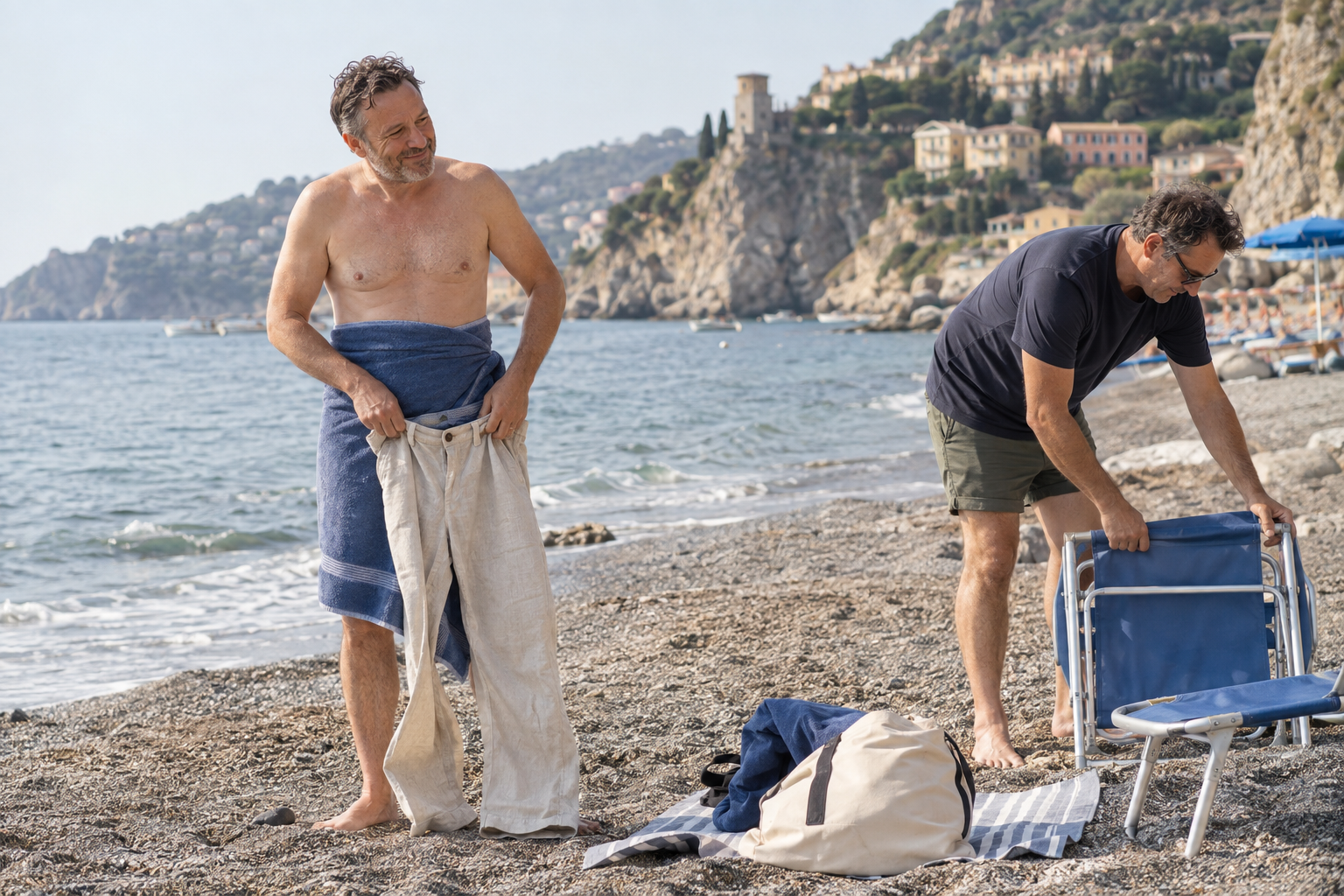
Cross to a European beach and the same moment unfolds with a fraction of the fuss. The first thing to understand is structural: many European beaches, especially the free public ones, simply do not have changing cabins or facilities at all, so changing on the beach itself is not a transgression but the normal and expected thing to do. This surprises Americans, who assume a beach comes with a bathhouse or at least a row of stalls, and who can spend a frustrating while searching for one that was never going to be there. Rather than fight this, Europeans have adapted sensibly, and the most common approach is the simplest one, which is to wear your swimsuit under your clothes to the beach and just strip down to it on arrival, and reverse the process to leave, sidestepping the whole changing problem before it starts. It seems almost too obvious to mention, and yet it dissolves most of the difficulty at a stroke, since a person who arrives already dressed for the water never has to perform a real change at all, only shed and later replace an outer layer.
When a full change is needed, Europeans manage it with a casual efficiency that astonishes Americans. A quick, practiced shimmy under a towel, or even just a brisk change with a towel held loosely for a moment of modesty, gets the job done in seconds without any visible anxiety, and in many places, particularly around the Mediterranean, people change into and out of their swimwear quite openly with little more than a towel and a bit of speed, drawing no attention whatsoever.
This is not exhibitionism and it is not carelessness, it is simply a matter-of-fact attitude that treats changing as the ordinary, un-shameful task it is. A European changing on the beach is not making a statement any more than they are when they tie a shoelace; it is a small practical necessity handled and forgotten, with none of the freight an American loads onto the same moment. Nobody is staring, nobody is scandalized, and the whole thing is over before an American would have finished wrapping their towel. The absence of reaction is the most striking part, since it is the collective indifference of everyone around that makes the casual change possible, a shared agreement that this is simply not something worth looking at. The change happens; life goes on.
Why the Two Cultures Diverge

The gap between the frantic towel dance and the casual European change comes down to a genuinely different relationship with the body and with public space. In much of Europe, and especially around the Mediterranean, there is a long-standing cultural ease about bodies that Americans, raised in a more modest and body-conscious tradition, often lack. Changing at the beach is seen through the lens of practicality and comfort rather than propriety, so the question is simply how to get dry and dressed efficiently, not how to avoid the shame of being glimpsed, and that shift in framing removes almost all the stress.
It is worth being clear that this is not about Europeans being exhibitionists or Americans being uptight prudes, but about two different default settings. The European approach values comfort and treats the body as unremarkable, so a quick change is a non-event; the American approach values a particular kind of modesty and treats exposure as fraught, so the same change becomes an ordeal. The same few seconds of half-dressed vulnerability reads as nothing to one culture and as acutely embarrassing to the other, which tells you the awkwardness lives in the mind rather than the moment.
Neither is wrong, exactly, but the European way is undeniably more relaxed and more practical, and many Americans who spend time on European beaches find the self-consciousness they arrived with slowly loosening, discovering that the sky does not fall when a change is handled matter-of-factly. The towel dance, they realize, was never really required by the task. It was required by the anxiety, and the anxiety turned out to be optional. That is a genuinely freeing discovery, and one of the small, unexpected gifts of time spent on a European beach, the quiet loosening of a tension you did not even know you were carrying.
The Gear That Solves It Entirely
For anyone who wants the European ease without abandoning coverage, there is a genuinely brilliant solution that the surfing world worked out years ago and that has since spread far beyond it, the changing robe. Also called a surf poncho or a dryrobe, it is essentially a large, loose, hooded robe, often with a towel-like interior, that you pull on over your head while still in your wet suit, and it changes the whole calculation. Under its full, tent-like coverage you can peel off the wet swimwear, dry yourself, and pull on dry clothes in complete privacy, standing up, anywhere at all, with your hands free the entire time because the robe simply hangs from your shoulders. It is, in effect, a portable changing room you wear, and it removes the single biggest failure point of the towel dance, which was always the towel itself, forever threatening to slip at the worst possible moment.
The advantages over the towel dance are total. There is no clutching, no slipping, no desperate one-handed balancing act, no fear of the towel dropping at the crucial moment, just a minute or two of unhurried changing under a garment that stays up on its own. You can do it in a parking lot, on the sand, at a trailhead, in full view of a crowd, and remain completely covered throughout, warm and dry into the bargain, which is a real bonus in the chilly moment after a swim. It is the American desire for coverage married to the European ease of changing anywhere, the best of both approaches in a single piece of gear, and once someone tries one they rarely go back to the towel. They have become a common sight on beaches across Britain and northern Europe in particular, where the cold post-swim chill makes their warmth as welcome as their coverage, and they travel beautifully, packing down small enough to throw in any beach bag. For the traveler who loves the idea of changing at a facility-free European beach but cannot quite shed the instinct for total privacy, it is close to the perfect answer.
The Beach Club Alternative
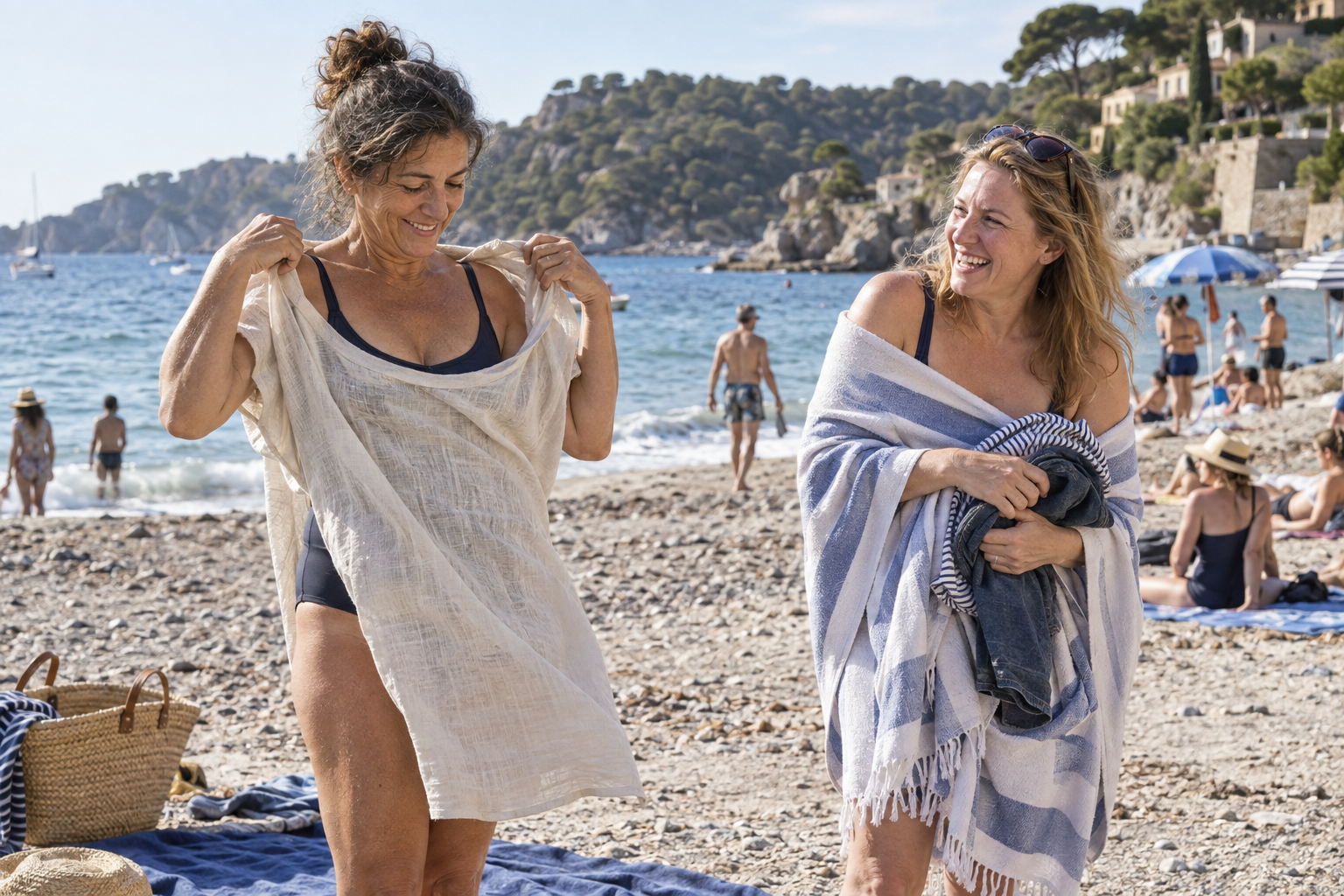
It is worth knowing that the facility-free free beach is only half of the European picture, because alongside it sits a whole parallel world of paid beach clubs, and these do offer the changing rooms and showers an American might be craving. Known as lidos or stabilimenti balneari in Italy and as organized beaches in Greece, these clubs charge a daily or seasonal rate for a sun bed, a lounger, and an umbrella in an assigned spot, and the better ones come with proper facilities, changing rooms, toilets, and showers, where you can swap into your swimsuit in comfort and privacy.
For a traveler who wants the amenities, this is the option to seek out, and it comes with other comforts besides, the reserved spot, the tidy rows, the attendant, sometimes a bar or restaurant, a more managed and predictable beach experience than the free-for-all of the public sand. The trade is money, since you pay for what the free beach gives away, and a certain loss of the wild, come-as-you-are charm of an ordinary Spanish or Italian beach. Many Europeans happily use both, a free beach on a casual day and a club when they want the full setup, and a visitor can do the same, choosing the club on the days they want a changing room and the free beach on the days they are content to wear their suit under their clothes and change with the easy local shrug. The two coexist all along the same coastlines, often within sight of each other, so the choice is usually available on any given stretch of sand. Knowing both options exist means you are never stuck, and can match the beach to the kind of day, and the level of fuss, you are in the mood for.
What It Means for Your Next Trip

The practical lessons for a beach day in Europe follow naturally, and they will save you a good deal of stress. The first and most important is to expect no changing facilities on most beaches, particularly the free public ones, so plan accordingly rather than arriving in full clothing and then hunting in vain for a cabin. The simplest plan, and the one most Europeans use, is to put your swimsuit on at home and wear it under your clothes to the beach, so that arriving and leaving is just a matter of adding or removing a layer, no changing required at all. Bring a change of dry underwear for the trip home if you like, but even that can be managed with a towel and a shrug once you have caught the local habit.
Beyond that, it is mostly a matter of attitude. If you do need to change on the beach, know that it is completely normal to do so, and that a quick change under a towel, or even a brisk and confident one, will draw absolutely no attention, because nobody is watching and nobody cares. If the idea still makes you uneasy, a changing robe solves it entirely and is well worth packing.
And if you find yourself at a paid beach club rather than a free beach, you will often find proper changing rooms and showers there, so that is the option to seek out on the days you want them. Above all, try to let a little of the European ease rub off on you, because the relaxed approach is genuinely more pleasant than the anxious one, and there is a small freedom in discovering that the whole fraught ritual you grew up with was never necessary in the first place. You need not go full Mediterranean and change in the open if that is not you, but even dialing the anxiety down a notch, and trusting that nobody is watching or caring, makes the whole business lighter. The beach is meant to be the least stressful place there is, and losing the towel dance is a fine way to keep it that way.

About the Author: Ruben, co-founder of Gamintraveler.com since 2014, is a seasoned traveler from Spain who has explored over 100 countries since 2009. Known for his extensive travel adventures across South America, Europe, the US, Australia, New Zealand, Asia, and Africa, Ruben combines his passion for adventurous yet sustainable living with his love for cycling, highlighted by his remarkable 5-month bicycle journey from Spain to Norway. He currently resides in Spain, where he continues sharing his travel experiences with his partner, Rachel, and their son, Han.