
An American couple is invited to dinner at the home of a Greek family they met two evenings earlier at a taverna north of Athens. The family has gone to real trouble: appetizers crowding a big central table, a lamb slow-roasted for hours, side dishes, homemade wine. It is a serious act of welcome.
The couple arrives with a bottle of wine they picked up that afternoon at a tourist shop, a California red from a vineyard they loved on their honeymoon, and the husband presents it warmly with the story attached. The host takes it graciously, sets it on a side table, and does not open it. Over the rest of the evening something quietly cools. The conversation carries on, but the eye contact thins, the warmth dials down a notch, and the couple senses the shift without ever understanding what caused it.
The bottle itself was not the problem, and no Greek host worth the name would truly hold a wine against a guest. What shifted was subtler, a small signal about how well the couple understood the evening they had walked into. Greek hospitality runs on an old and specific set of expectations, and the wine, without anyone meaning it to, quietly announced that the couple had misread the whole occasion. It is worth understanding what actually happened, because a tiny change at the door would have opened the evening rather than cooling it. The couple did nothing unkind, and nothing they could not easily have done differently. That is what makes it such a useful little story for anyone about to be welcomed into a home abroad.
What follows is what the wine unintentionally said, the deep logic of Greek hosting, what to carry to the door instead, the other well-meant gestures that misfire, and how to be the kind of guest a Greek table opens up for.
What the Bottle Really Said

To an American, a nice bottle of wine with a personal story is a generous, thoughtful gift, and in an American context it would be exactly right. The trouble is that in this particular setting it carried a set of meanings the couple never intended. Greece has been making wine for something like six thousand years, one of the oldest wine cultures on earth, and the host had built the meal around his own wine, quite possibly homemade or from a small producer he knew and trusted. A bottle from California, however lovely, gently implied that Greek wine had not even entered the couple’s minds, that they had brought their own country’s tradition to a country whose tradition on this exact subject is among the deepest in the world.
There was a second layer, too, in where the bottle came from. A Greek host recognizes a tourist-shop bottle at a glance, the kind sold at a steep markup to visitors who have not found their way to the little shops where locals actually buy wine.
It is not snobbery so much as recognition, the same way you would clock a fridge-magnet souvenir of your own hometown. The bottle quietly placed the couple as visitors passing through rather than people leaning into the place. And there was the matter of the meal as a coordinated whole. A host who has spent a day pairing wines to courses has a plan, and a foreign red that fits none of it sits slightly outside the evening he has designed. None of this was rudeness on the couple’s part, only a small stack of accidental signals, and a warm host reads them the way anyone reads the little cues of a first meeting, not as an insult but as information about how much a guest has understood.
Philoxenia, and Why the Meal Is a Gift
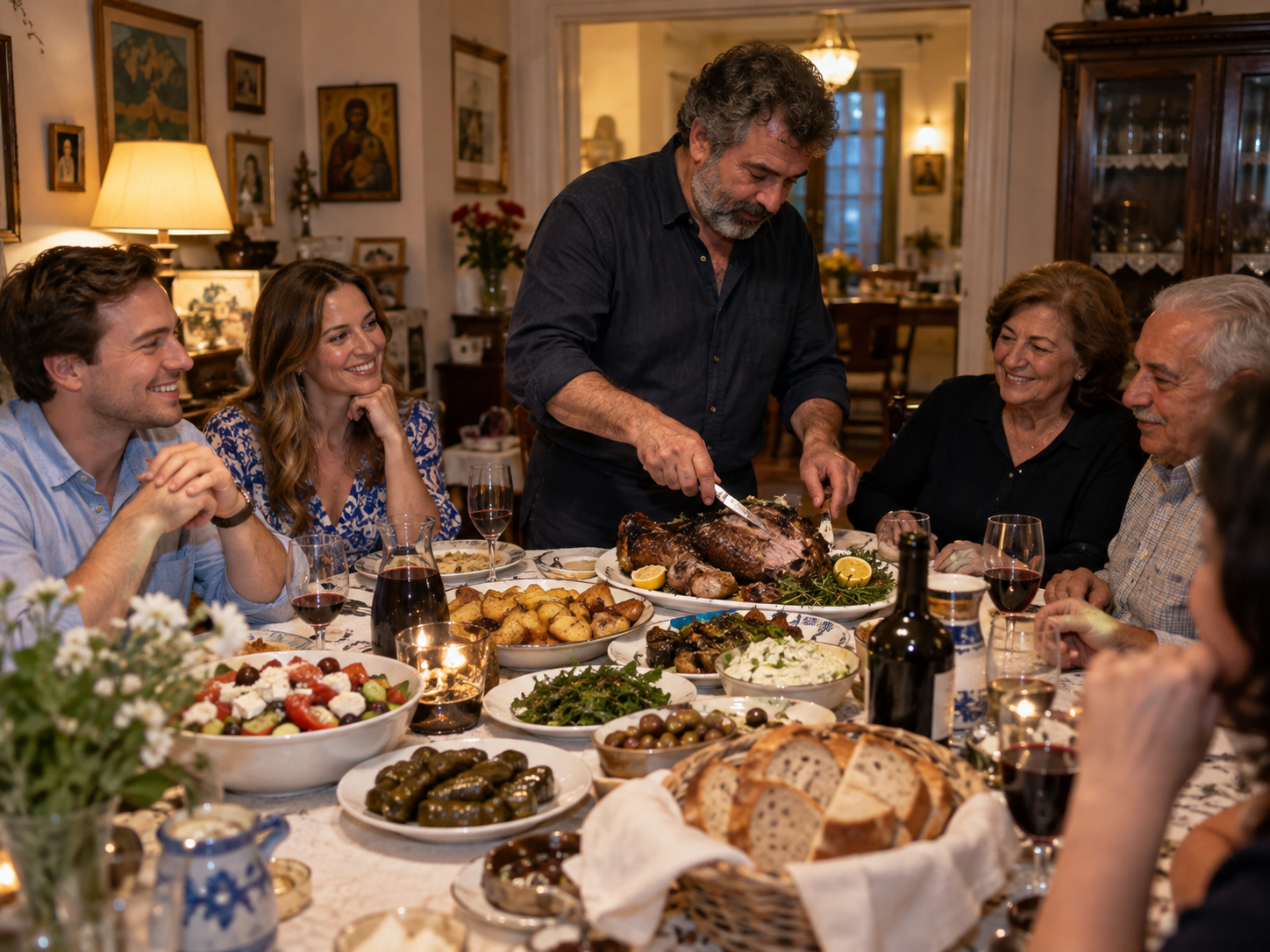
To understand why any of this registers, you have to understand that Greek hosting is not quite the same creature as the American dinner party. At its heart sits an old idea called philoxenia, which translates roughly as love of the stranger, and which runs back through Greek culture all the way to Homer.
Under it, the host’s role is to provide everything, abundantly and without expecting anything equivalent in return, and the guest’s role is to receive that generosity gracefully rather than to match it. The lopsidedness is not an accident or an oversight. It is the entire point of the framework. A host gives, a guest receives, and the imbalance is the shape of the welcome rather than a flaw in it. Once you see that, a great deal of Greek hospitality suddenly makes sense.
That single idea explains almost everything else.
Because the meal is a gift, the guest is not expected to contribute to it in any substantial way, which is why a guest offering does not try to supply part of the dinner but instead simply honors the welcome. A small bunch of flowers for the woman of the house, a box of sweets from a good local bakery, some particular thing you happen to know the host loves, these are the traditional offerings, and they work precisely because they sit at the level of a guest rather than the level of a host. Bringing an ambitious bottle of wine, by contrast, reaches for the host’s own role and quietly disrupts the balance.
What the host genuinely wants from you is not a contribution to the table but your evident pleasure at it, your appetite, your praise, your willingness to stay late and let the evening unspool. In this world a heartfelt compliment about the lamb is worth more than any gift you could carry through the door.
What to Bring Instead

The good news is that getting this right is easy, and there are several offerings that fit the framework beautifully. Flowers are almost always safe, a modest bouquet from a local florist that honors the welcome without competing with the meal, and that becomes part of the evening rather than a rival to it. A small box of Greek sweets is just as good, baklava or kataifi or something similar from a neighborhood bakery, since it slots naturally into the end of the meal and the host can serve it or keep it for the next day as they please. It fits the meal instead of competing with it. And it carries a quiet compliment of its own, a nod to the local tradition rather than an import from yours.
Better still, when you can manage it, is something aimed at the particular person. If an earlier conversation revealed that your host adores a certain cheese, a certain honey, a certain kind of olive, then a small gift of exactly that thing says you were paying attention to them as a person rather than reaching for a generic gesture.
If you have genuinely engaged with Greek wine on your trip, visited a winery, learned a producer, then a bottle from that experience is wonderful, because now the wine honors the Greek tradition instead of substituting an American one for it, and the story behind it becomes part of the gift. The difference is not really the wine but the direction of the gesture. One reaches toward Greece, the other away from it, and a host feels which is which at once.
And here is the reassuring part: you can also arrive with nothing material at all and be a perfect guest, provided you turn up with full attention and appetite and warmth. The framework does not require a gift. It requires participation, and a guest with empty hands who throws themselves into the evening is far more welcome than one bearing the wrong bottle.
The Other Well-Meant Mistakes
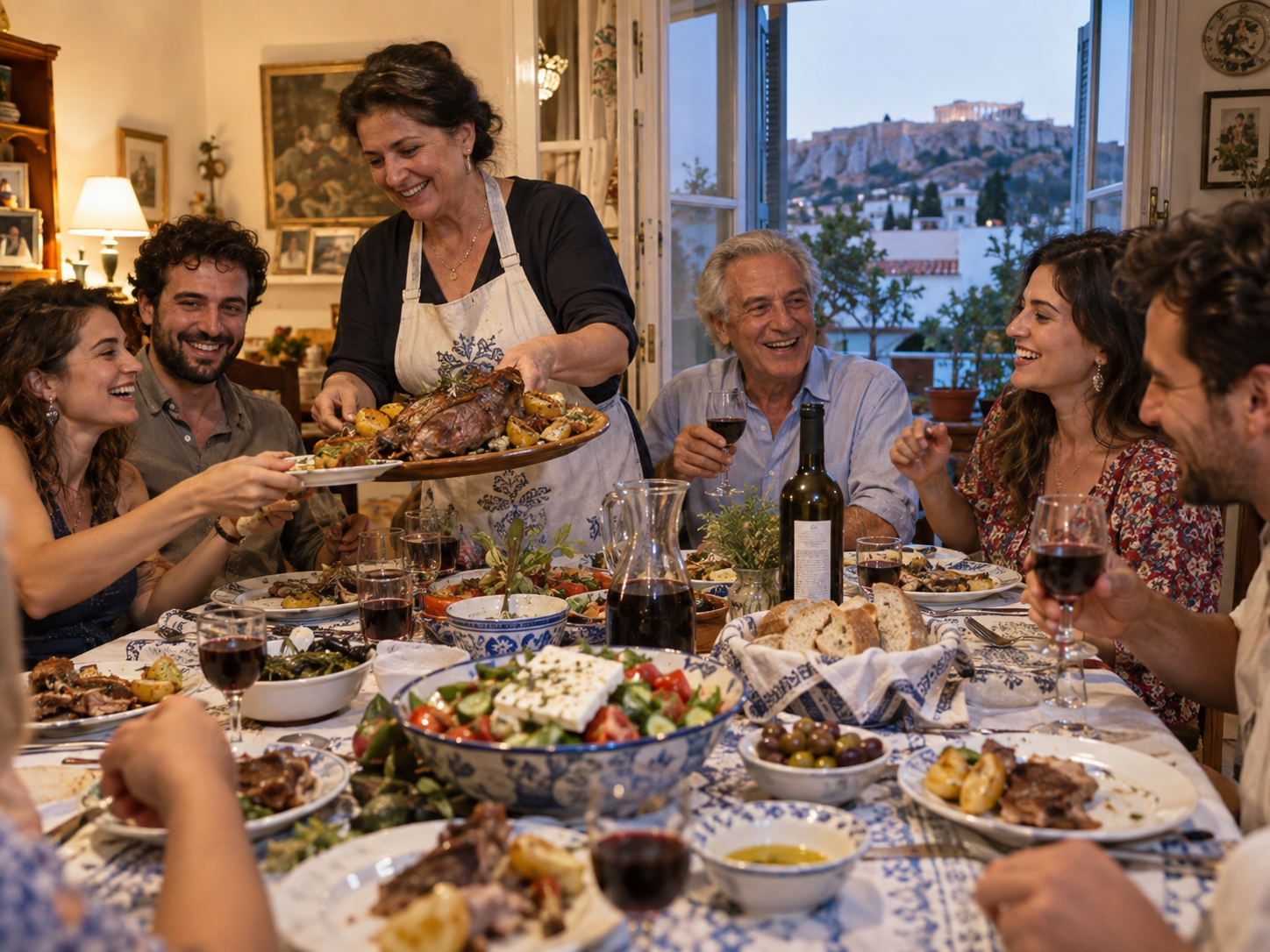
The wine is only the most vivid example of a wider pattern, and several other thoroughly well-intentioned American habits can land oddly at a Greek table. Offering to help clear the dishes is a reflex of good American manners, but in a Greek home it can gently imply the host cannot manage, since providing everything, cleanup included, is bound up in the host’s role. Offering once and letting it go is fine; it is the insistent, repeated offer that quietly works against the framework. The host wants you seated and enjoying yourself, not stacking plates. Let yourself be waited on, which is harder for some of us than it sounds.
Eating sparingly is another. A Greek host has cooked in abundance on purpose, and picking at the food or leading with a list of dietary restrictions can read as a rejection of that generosity, so genuine needs aside, the guest who eats heartily and takes a second helping is speaking the host’s language.
Slipping away early belongs on the same list, because a Greek dinner is a long, unhurried thing, and heading for the door at ten after a meal that began at nine signals that you have not quite settled into the evening. So does proposing a specific reciprocal date on the spot, the very American we’ll have you over next Saturday, which in this setting can feel oddly transactional, since reciprocation here comes later and in looser forms, as the friendship itself continues.
A few smaller things round it out. Asking what something cost touches on a financial dimension that Greek hospitality keeps private, and defaulting to English throughout, when your hosts are reaching for their own second language, quietly asks them to do all the accommodating.
How to Be a Good Guest at a Greek Table

Set the missteps aside, though, because the positive version of all this is simple and genuinely joyful, and it is worth framing as what to do rather than what to avoid. Greet people warmly and physically, meeting the cheek kisses and the handshakes rather than holding yourself at a reserved American distance, since the warmth is part of the welcome and it is meant to be returned. Then eat, and eat with visible pleasure, accepting the second helping, because both the appetite and the acceptance tell the host that all that effort landed.
When you praise the food, and you should, be specific about it, since the lamb is extraordinary carries far more than a vague this is delicious, and specificity shows you were really tasting. Say a kind word about the wine the host chose, whatever you know or do not know about wine, because it was a deliberate part of the meal and recognizing that honors the thought behind it. You do not need the vocabulary of a sommelier for this. Noticing that it suits the food, or simply that you are enjoying it, is more than enough.
Then linger. Let the coffee and the sweets and the conversation carry the evening into the late hours, keep your phone out of sight, and be present for the whole long arc of it rather than the formal courses alone.
Talk to everyone, too, the grandmother and the children and the visiting cousins, because Greek hospitality tends to run across the generations and so should your attention. A Greek table is rarely just the couple who invited you. It is a small gathering of a family, and being seen to enjoy all of them is part of enjoying the evening. A few words of Greek go a long way here, a yamas raised over a glass, an efharisto, a ti orea for something lovely, offered imperfectly and gladly. And when it is over, follow up, with a note or a call or a small thank-you the next day, because in this tradition a shared meal is the beginning of a relationship rather than the closing of a transaction.
Two Ways of Being a Host
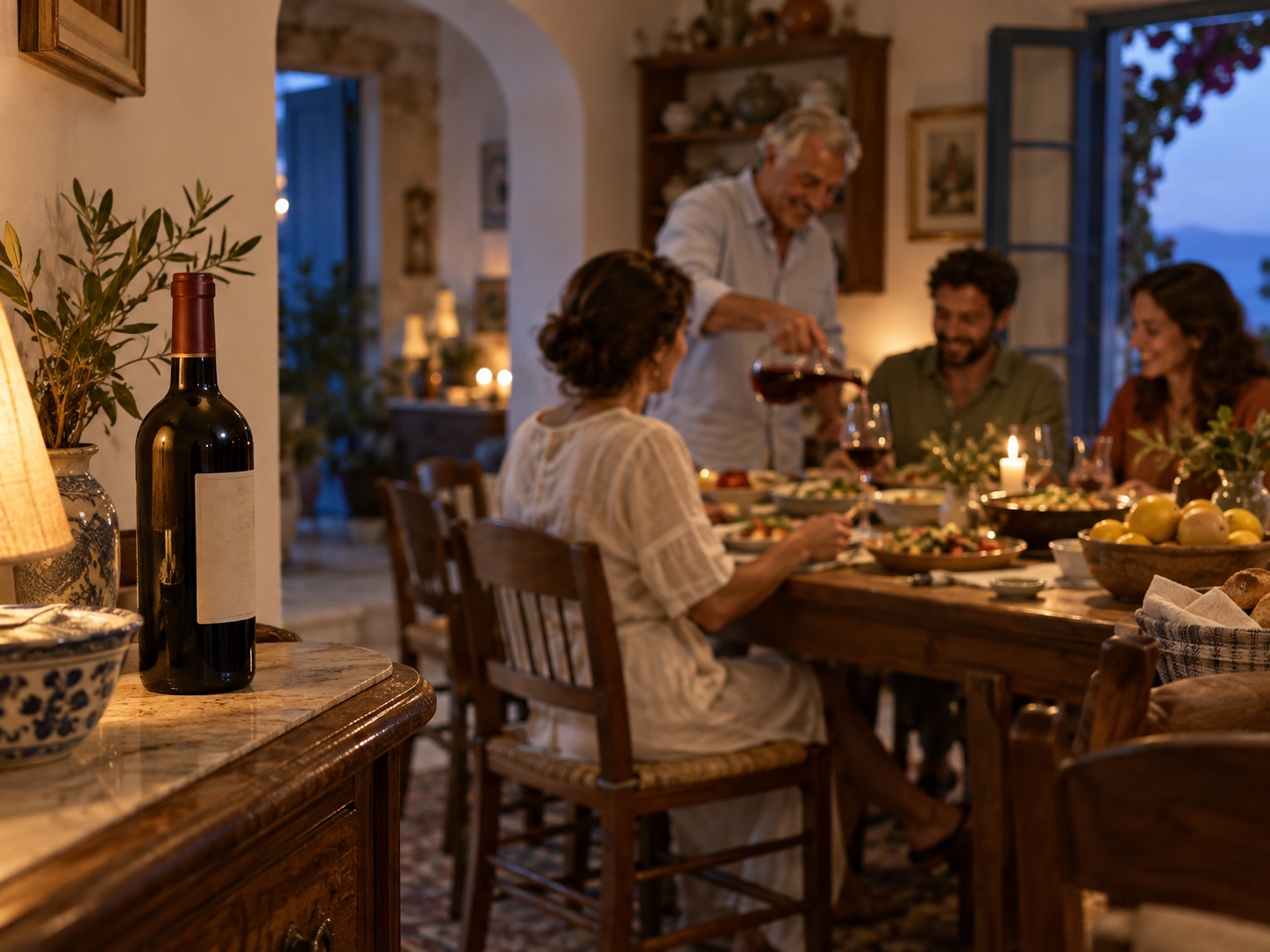
It helps, in the end, to see that neither way of hosting is wrong, only that they are different, and that most of the friction comes from applying one framework’s rules to the other. The American style leans more transactional, built on rough equivalence and prompt reciprocation, a fair and friendly system in its own right. There is nothing cold about it; it simply keeps a gentle ledger, and expects both sides to take their turn. The Greek style treats hospitality as something closer to sacred, an abundant gift freely given and a relationship gradually built, and it asks the guest not to balance the ledger but simply to receive with open pleasure. Coming from the first and stepping into the second, it is easy to reach instinctively for equivalence, the impressive bottle, the offer to help, the reciprocal invitation, and to miss that the kindest thing you can do is let yourself be thoroughly looked after.
That is really the whole lesson of the cooled evening in Athens. The couple did not lose Greek hospitality; the food kept coming and the talk went on. What they missed was the deepest version of it, the warmth that opens up when a host senses a guest has understood the gift for what it is.
None of this should be carried as anxiety, since these are tendencies and traditions rather than a test being silently scored, and Greek hosts are among the most forgiving and generous people a traveler will meet, quick to overlook a fumble made in obvious good faith. Treat what is here as a map rather than a rulebook, adjust for the particular family and the particular evening, and understand that customs vary from home to home and region to region.
Bring the flowers or the sweets instead of the foreign wine, turn up hungry and curious and ready to stay late, and you give a Greek host the one thing they most want, which is a guest who knows how to be welcomed. Do that, and the eye contact does not thin at all. It warms, and it holds, and the evening becomes the thing philoxenia was always meant to produce, which is not a well-executed dinner but the beginning of a friendship. That, in the end, is the real gift on offer, and it costs a guest nothing but the willingness to be generously looked after.

About the Author: Ruben, co-founder of Gamintraveler.com since 2014, is a seasoned traveler from Spain who has explored over 100 countries since 2009. Known for his extensive travel adventures across South America, Europe, the US, Australia, New Zealand, Asia, and Africa, Ruben combines his passion for adventurous yet sustainable living with his love for cycling, highlighted by his remarkable 5-month bicycle journey from Spain to Norway. He currently resides in Spain, where he continues sharing his travel experiences with his partner, Rachel, and their son, Han.