
Walk into almost any American restaurant that calls itself Italian and the menu will be full of it: chicken alfredo, chicken penne, grilled chicken over spaghetti, chicken tossed into every creamy sauce on the page. To an American, chicken and pasta go together as naturally as peanut butter and jelly, a default pairing nobody thinks to question. To an Italian, the combination is close to unthinkable, a pairing so foreign that many Italians have genuinely never encountered it, and who would be genuinely baffled to see a piece of grilled chicken breast sitting on top of a plate of pasta. This is one of the widest and most revealing gaps between American and Italian food, a rule Italians follow without thinking and Americans break every single day, and the reason behind it opens a window onto how Italians understand a meal itself.
What follows is the rule as Italians actually live it, the structure of the meal that explains it, where the American habit came from, and what Italians do put in their pasta instead. It is one of those differences that seems trivial until you see the whole philosophy of eating hiding behind it. Master this one rule and you understand more about Italian food than a dozen recipes could teach you, because it is not really about chicken at all but about how a whole culture believes a meal should be built and enjoyed.
The Rule, Stated Plainly
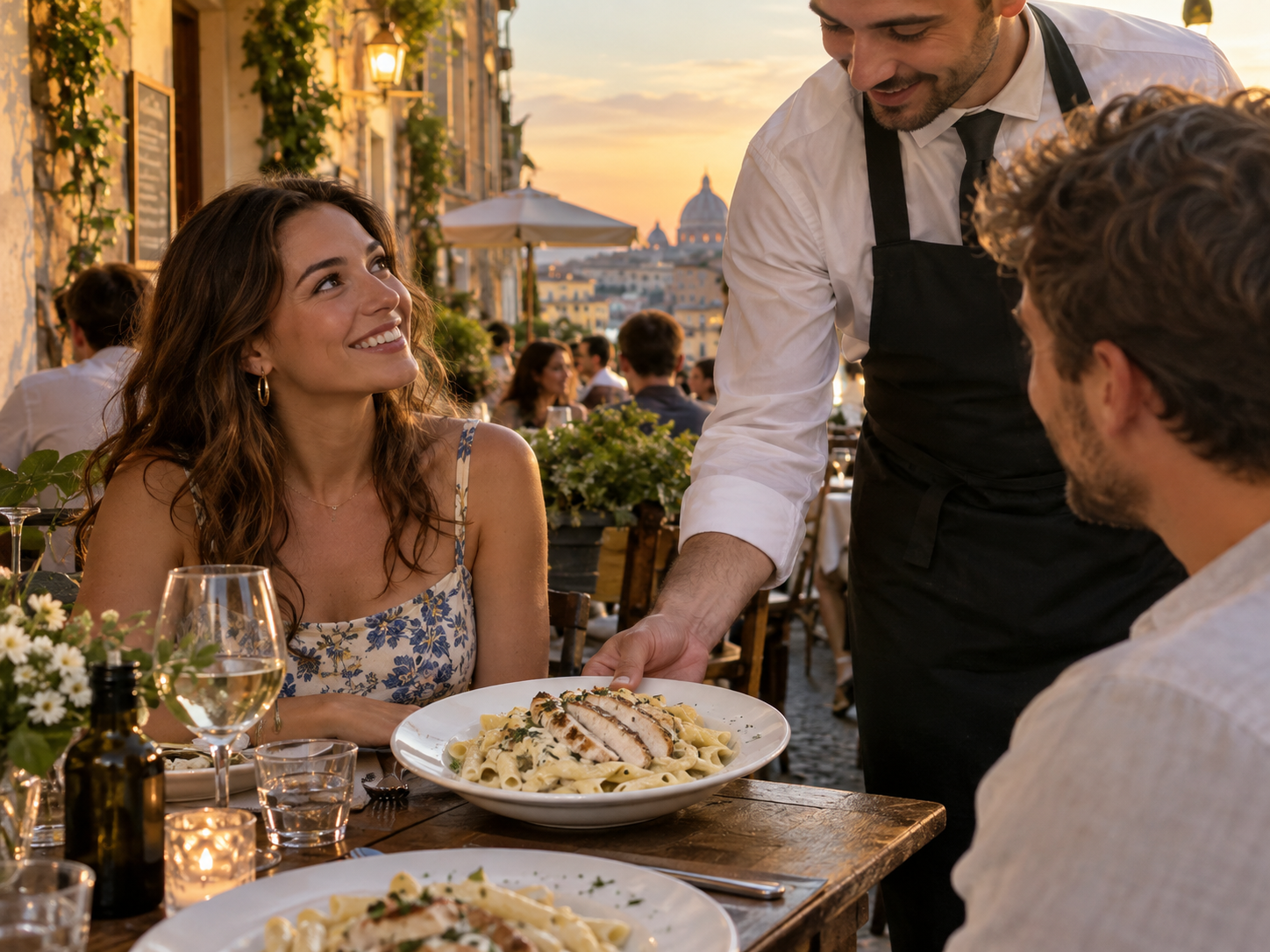
There is no gentle way to put this, so here it is directly: in Italy, chicken does not go in pasta. Not on top of it, not stirred through it, not draped over it in strips, not in the sauce. Chicken pasta, as a category, simply does not exist in Italian cooking. An Italian chef confronted with the idea tends to react with a mix of confusion and quiet horror, the way you might react if someone offered you a slice of pizza with the toppings blended into a smoothie and served in a glass. It is not that it would taste bad, exactly, so much as that it would be a violation of what the thing is supposed to be. The dishes Americans think of as Italian classics, the chicken alfredos and chicken parmesans piled high on spaghetti, are simply nowhere to be found on a genuine Italian table.
Look for them in Rome and you will look in vain. They belong to another country entirely.
This is not a matter of one region differing from another, or of old-fashioned cooks resisting change, but a near-universal principle across the whole country. Italians eat plenty of chicken and plenty of pasta, sometimes even in the same meal, but never on the same plate. The rule is so deeply held that it functions less like a rule anyone consciously follows and more like an instinct, the way an American might instinctively feel that ketchup does not belong on a birthday cake. To understand why, you have to understand how an Italian meal is built. The structure is everything here, and it is where the whole rule comes from.
Primo and Secondo
The key to the whole thing is the structure of the traditional Italian meal, which is divided into distinct courses, each with its own job. The primo, or first course, is the starchy heart of the meal, the pasta, the risotto, or the soup, and it is served and eaten on its own. The secondo, or second course, is the protein, the meat or the fish, served afterward as a separate course, usually with a simple vegetable side. Pasta and chicken are not enemies in Italian cooking, they simply live in different courses, and mixing them collapses two courses into one. An Italian would no sooner put the chicken on the pasta than an American would pour their coffee into their soup, not because there is a written law against it but because it violates a shared sense of what goes where.
This course structure is the entire explanation. Chicken belongs to the secondo, so putting it on the pasta of the primo is a genuine category error, like serving the salad and the dessert in the same bowl.
It breaks the order of things, and in Italian cooking the order of things is close to sacred. The Italian meal is designed so that each course is savored on its own terms, the pasta appreciated for its texture and sauce, the chicken appreciated afterward for itself, each with the diner’s full attention. It is a bit like the difference between listening to two songs one after the other and playing them both at once, since the second way you hear neither properly, and the Italians simply prefer to hear each in turn. To an Italian, combining them does not make a richer dish, it makes a confused one, muddling together two distinct things that were each meant to be enjoyed separately and in their own sequence. The pleasure of the meal comes partly from that sequence, the anticipation of moving from one distinct course to the next, and dumping everything onto one plate throws that rhythm away.
Chicken Alfredo Is an American Invention
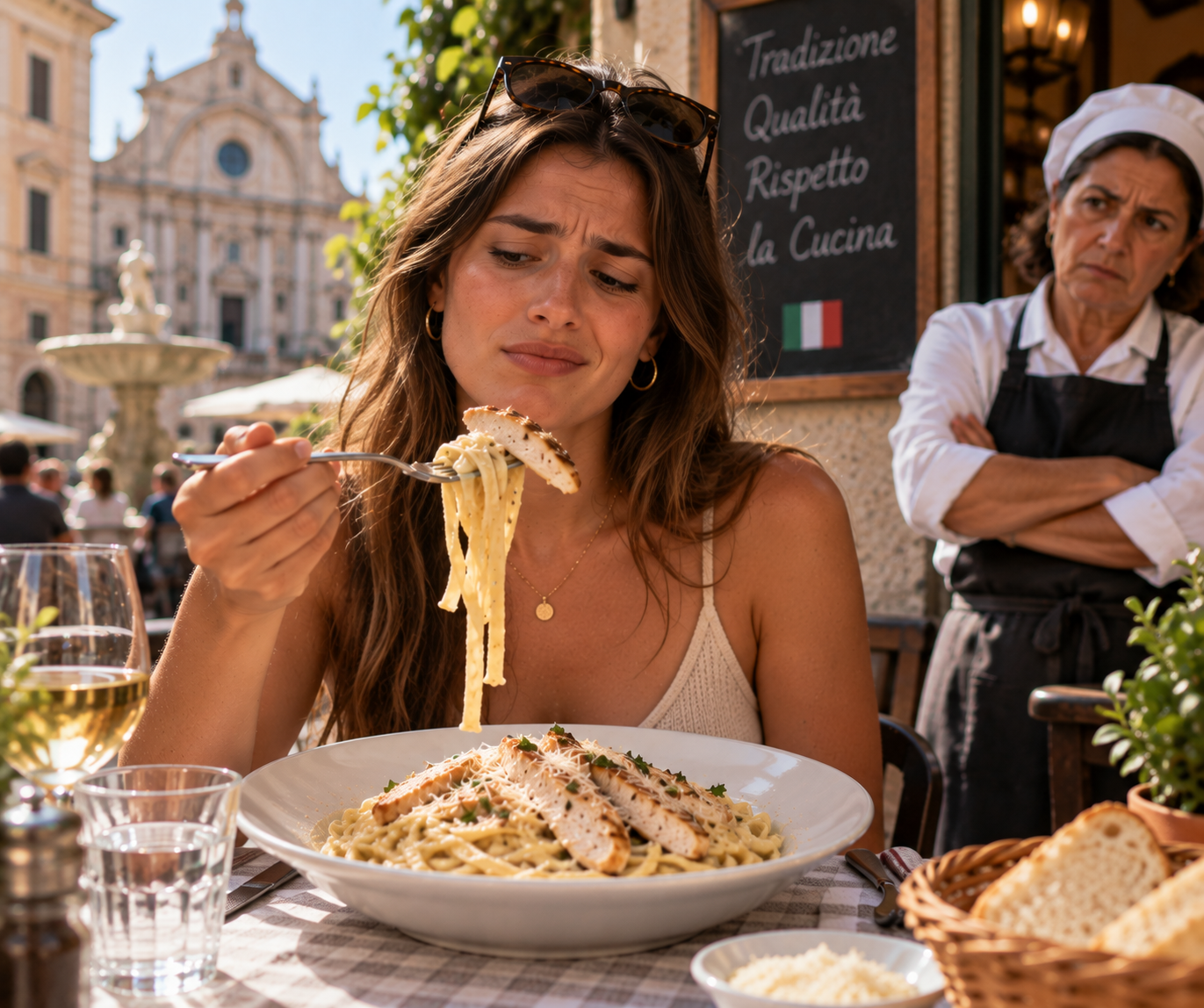
The dish that most embodies the American habit, chicken alfredo, is worth examining, because it is not Italian at all. The original Roman dish it descends from is fettuccine al burro, which is nothing more than fresh fettuccine tossed with butter and Parmigiano-Reggiano, a simple, elegant preparation with no cream and certainly no chicken. It was popularized in the early twentieth century, and when American visitors carried the idea home, it mutated into something unrecognizable, thickened with heavy cream and loaded with additions the original never had.
Chicken was one of those additions, bolted on somewhere along the way in America, and the result, chicken alfredo, became a staple of American-Italian menus while remaining almost entirely unknown in Italy itself. Most Italians have never heard of it, and those who encounter it abroad regard it as a strange foreign creation wearing an Italian name. It sits alongside a whole family of American dishes, chicken parmesan, spaghetti and meatballs, garlic bread, that Americans believe to be Italian but that Italians would not recognize, inventions of the Italian-American kitchen rather than the Italian one. This can genuinely surprise Americans, who grow up assuming these dishes came straight from Italy, when in truth they were born in the restaurants and homes of Italian immigrants adapting to a new country, a cuisine of its own rather than a transplant of the old one.
What Italians Do Put in Pasta
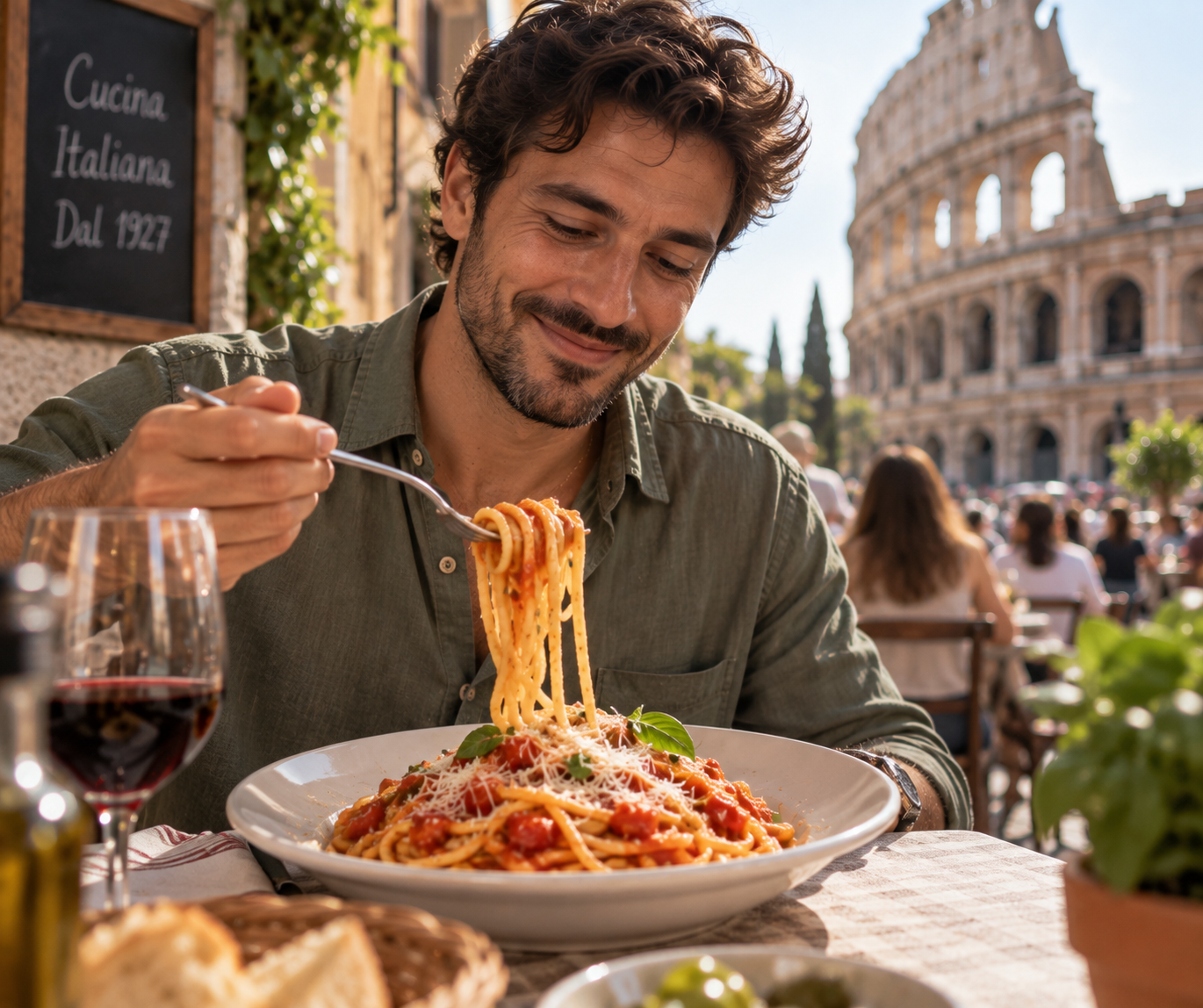
It would be wrong to conclude that Italians are purists who keep all meat away from pasta, because they absolutely do put meat in it, just not the way Americans do. The crucial distinction is that in Italian cooking, meat is woven into the sauce rather than laid on top as a separate element. A slow-cooked ragu, the rich meat sauce of dishes like tagliatelle al ragu, is built from ground or finely chopped meat simmered for hours until it becomes one with the sauce, coating the pasta rather than sitting on it.
Cured meats play a similar role, with guanciale, the cured pork jowl at the heart of a true carbonara or an amatriciana, rendered down so its fat and flavor infuse the whole dish. The meat all but disappears into the sauce, leaving behind its richness rather than sitting on the plate as a separate thing to cut and chew, which is exactly the point.
Seafood, vegetables, and legumes all belong in pasta too, again integrated into the sauce rather than added as a topping. What Italians avoid is precisely the American move of taking a cooked protein, a chicken breast, and placing it on top of a finished plate of pasta as a separate component. Meat in Italian pasta is a flavor that permeates the dish, not a chunk that sits on it, and chicken, which does not lend itself to that kind of integration, simply never made the cut. Chicken breast, in particular, is lean and mild and does not melt into a sauce the way fatty pork or long-simmered beef does, so even if an Italian cook wanted to build a chicken pasta, the meat itself would resist the treatment that makes other meats belong.
Where the American Habit Came From
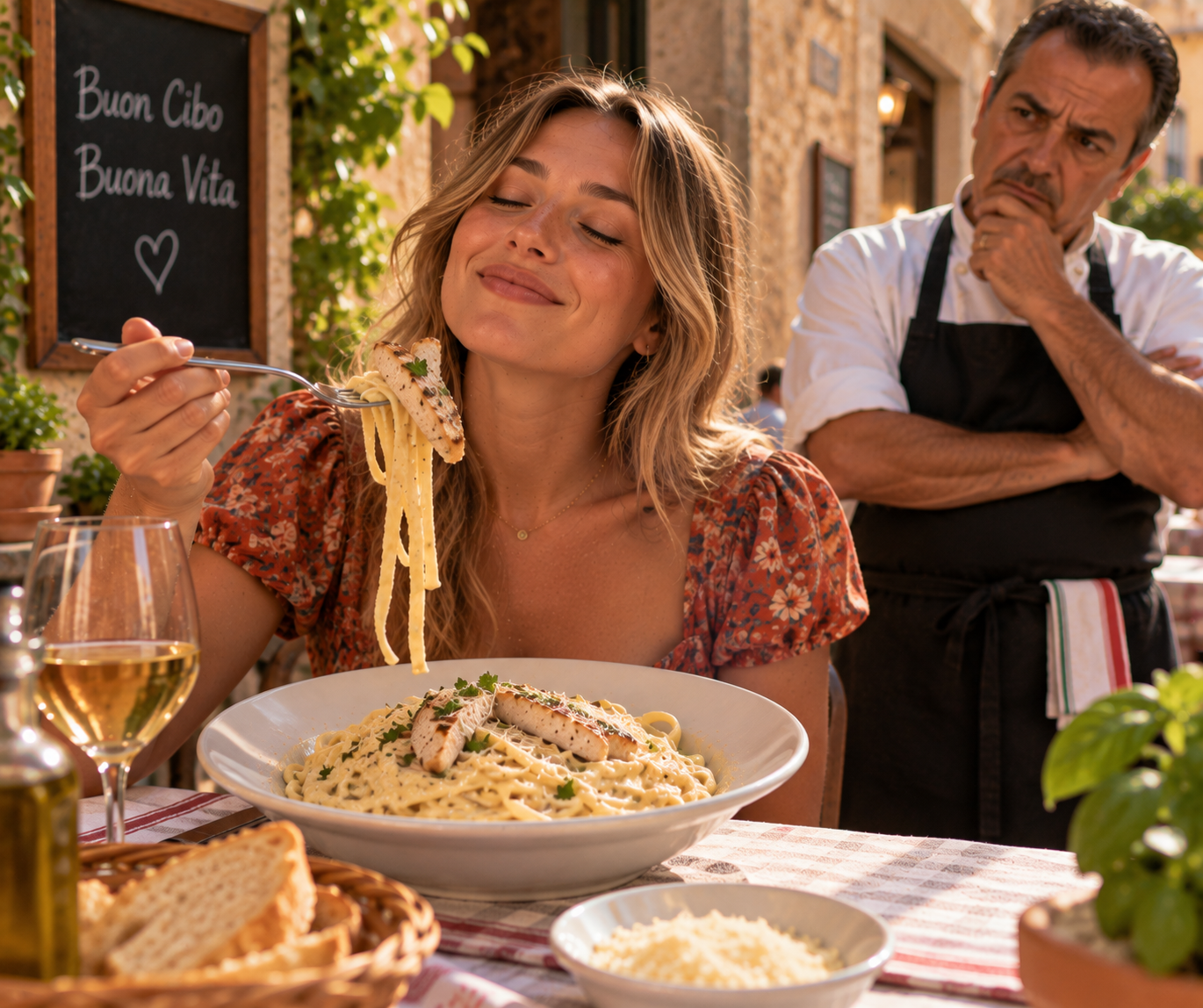
The gap makes more sense once you understand the history on both sides, because the two food cultures grew from very different circumstances. Traditional Italian cooking is rooted in cucina povera, the poor kitchen, a tradition of making wonderful food from humble, inexpensive ingredients, and for much of Italian history meat like chicken was a relative luxury, eaten sparingly and treated with respect rather than piled onto everything. Pasta was the everyday staple, dressed simply with whatever was cheap and good, and the idea of crowning it with a whole portion of meat would have been both extravagant and against the grain of the cuisine. Meat, when there was meat, was made to stretch, chopped small and simmered long so a little could flavor a lot, which is exactly how it ended up woven into sauces rather than served in slabs.
When Italians emigrated to America, they found something they had rarely known at home: cheap, abundant meat. In a new country where chicken and beef were plentiful and affordable, the old restraint gave way to a natural desire to eat richly, and dishes grew heartier, meatier, and larger to suit both the abundance and the American appetite. Chicken on pasta, meatballs on spaghetti, and the whole hearty repertoire of Italian-American food were born from that encounter between Italian tradition and American plenty.
It was not a corruption so much as an adaptation, a cuisine evolving to fit a new world, which is exactly why it feels so Italian to Americans and so foreign to Italians. It was not a corruption so much as an adaptation, a cuisine evolving to fit a new world, which is exactly why it feels so Italian to Americans and so foreign to Italians. The chicken on the pasta is, in a sense, a monument to how much more meat the new country could offer. Where the old country had taught restraint born of scarcity, the new one invited abundance, and the food changed to match. Neither version is wrong, but they tell two different stories, one of making much from little, the other of celebrating plenty.
The Deeper Logic of the Rule
Underneath the specific prohibition lies a whole philosophy of eating, and it is genuinely worth understanding. Italian cooking prizes balance over abundance, the idea that a dish should be complete and harmonious rather than piled high with everything at once. A plate of good pasta, dressed with a fine sauce and perhaps some excellent olive oil, is considered whole and satisfying on its own, needing no protein bolted on to justify it. To an American raised to see a plate without a slab of meat as somehow incomplete, this can be a genuinely new idea, that a bowl of pasta can be the meal, or at least a whole course of it, rather than merely the bed for something else. Adding chicken does not improve it, in the Italian view, but overloads it, disrupting the clean harmony the dish was built to have.
This connects to a deeper respect for ingredients and for the pleasure of doing one thing at a time. The Italian meal, with its separate courses each savored in turn, reflects an unhurried, attentive way of eating in which each element gets its moment rather than everything competing on a single crowded plate. The American instinct to combine, to make every plate a complete one-dish meal with starch and protein together, runs directly against this, which is why the two food cultures collide so sharply on exactly this point. The chicken-in-pasta rule is not fussiness, it is the visible tip of an entire way of thinking about food.
Chicken Is Loved, Just on Its Own
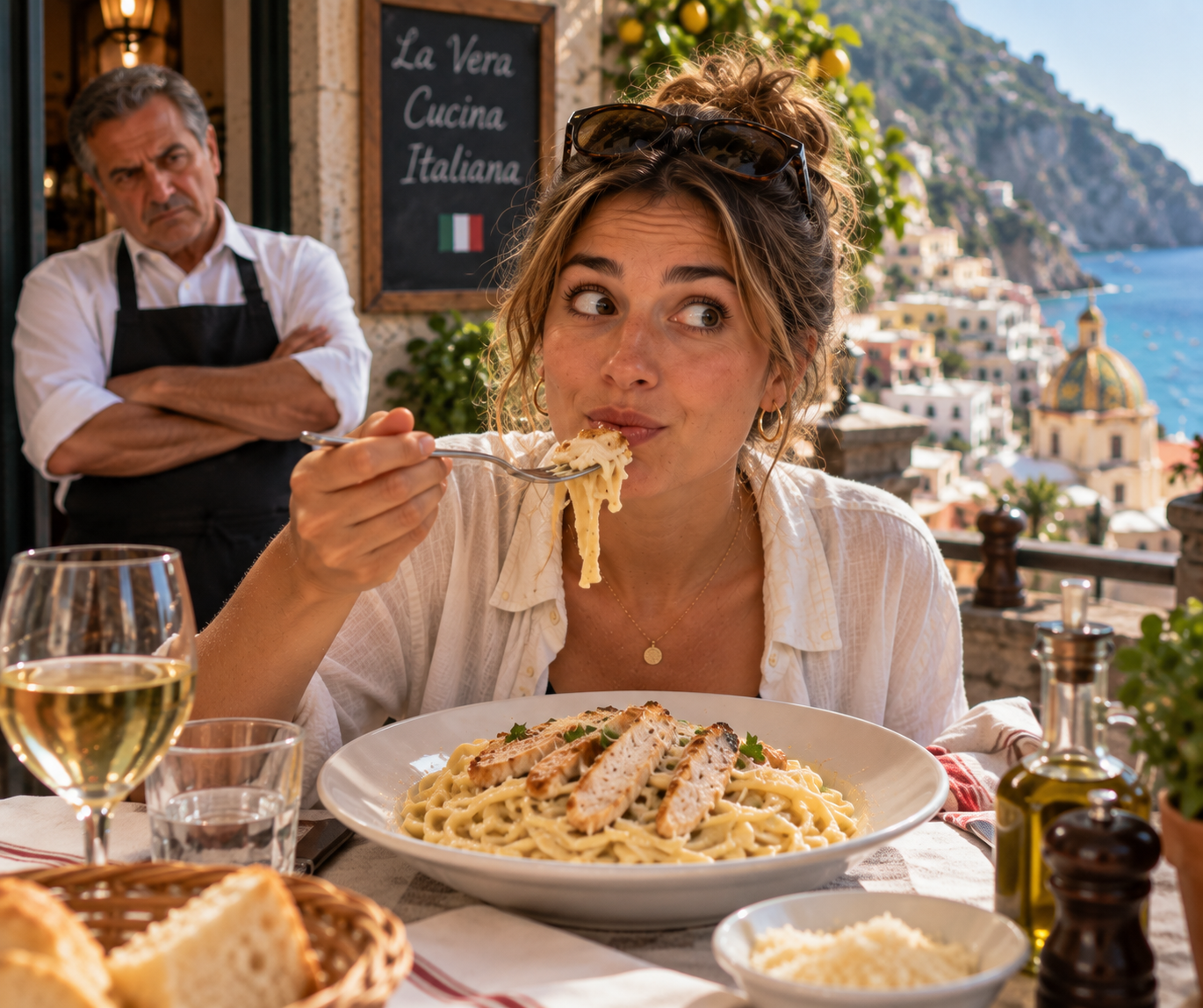
None of this means Italians dislike chicken, which they eat happily and often, so the rule is about structure rather than any aversion to the bird. A beautifully roasted chicken, or one cooked with peppers and wine in the style of a good secondo, is a beloved part of Italian home cooking, prepared simply and respectfully and served as the main protein course it is meant to be. The chicken is not banished from the Italian table, it is simply given its proper place in the sequence of the meal, after the pasta rather than on it. A Sunday lunch in an Italian home might well feature both, the pasta as the primo and a roast chicken as the secondo, arriving one after the other, which to an Italian is the natural and pleasing order of things.
So the way to eat like an Italian is not to give up chicken or pasta but simply to stop combining them, to enjoy a plate of pasta first, on its own, and then, if you like, a piece of chicken afterward as a separate course. It is worth saying clearly that none of this is a criticism of Italian-American food, which is its own rich and beloved tradition with every right to exist and be enjoyed, chicken alfredo included.
But if you want to eat the way Italians actually do, the first and easiest step is simply to take the chicken off the pasta, and to discover, as Italians long ago did, that each is better, and more itself, when it is not asked to share a plate. Eat the pasta first, unhurried, appreciating the sauce and the shape and nothing else. Then bring out the chicken as its own small course. You may find that both taste better for the separation, and that the meal, stretched into two unrushed acts, is more satisfying than the crowded single plate ever was. That small discovery is the whole of Italian eating in miniature, the realization that less on the plate, and more attention paid to it, is very often the better way.

About the Author: Ruben, co-founder of Gamintraveler.com since 2014, is a seasoned traveler from Spain who has explored over 100 countries since 2009. Known for his extensive travel adventures across South America, Europe, the US, Australia, New Zealand, Asia, and Africa, Ruben combines his passion for adventurous yet sustainable living with his love for cycling, highlighted by his remarkable 5-month bicycle journey from Spain to Norway. He currently resides in Spain, where he continues sharing his travel experiences with his partner, Rachel, and their son, Han.