
Watch an American at a European beach shower and you can often spot them in seconds, because they treat the little post by the sand like the shower at home. Out comes the soap, or the shampoo, and a full scrub-down begins while a queue forms and the locals exchange a look. The outdoor beach shower in Europe is for a quick rinse, sand and salt off, thirty seconds and gone, not for a bath, and that small misunderstanding is one of a whole set of unwritten beach rules that Americans cross without ever knowing they did. None of them are catastrophes, but knowing them ahead of time saves the confusion, the awkward stares, and in a surprising number of cases an actual fine.
What follows are the beach rules Americans most often get wrong in Europe, starting with the shower and running through the ones that can genuinely cost you money. Most of them come down to a single idea, that a European beach is a shared, regulated, slightly more formal place than the wide-open American one, and that reading it correctly is half the pleasure.
Rinse, Don’t Bathe

The beach shower is the clearest tell, so it is worth being plain about how it works. Those showers exist for one purpose, to rinse the sand and the salt off your skin and your feet before you leave, and the etiquette is a quick, efficient rinse of a few seconds, not a leisurely wash. Pulling out soap, shampoo, or a full-body lather is the faux pas, both because it holds up everyone waiting and because the runoff goes straight into the sand and the sea, which is exactly what a beach does not need.
There is a practical and an environmental logic braided together here. Practically, these are shared, often low-pressure rinse stations with a line behind you, so a long wash is inconsiderate in the plain way that hogging any shared thing is. Environmentally, soapy runoff on a beach is a small pollution event repeated by every tourist who does it, which is why many places quietly discourage or outright forbid soap at beach showers. The rule to carry is simple, rinse don’t bathe, keep it to seconds, and save the real shower for your accommodation, and you will look like someone who has done this before rather than someone the lifeguard is watching. A useful mental picture is that the beach shower is a doormat, not a bathroom, there to knock the outside off you before you go, and treating it that way keeps the line moving and the sand clean for everyone behind you.
The Beach You Have to Pay For

The single most confusing thing for an American at a Mediterranean beach is discovering that a large stretch of the sand is not free. In Italy especially, and in parts of Spain, France, and Greece, much of the good beach is divided into private clubs, the Italian stabilimenti or lidi, where you pay for the day to use a numbered sunbed and parasol in a tidy row, with the fee buying access, the lounger, showers, and often a bar and restaurant. Walking onto one and flopping down on the sand without paying is a genuine misunderstanding, not a right.
The free public beach exists too, called the spiaggia libera in Italy, but it is often the smaller, more crowded strip between or beside the paid sections, and it is not always obvious where one ends and the other begins. The trick is to look for the rows of matching umbrellas, which mean paid, versus the jumble of people with their own towels, which usually means free, and if you are unsure, to ask.
Greece, worth noting, passed a law in 2024 pushing back against sunbed sprawl, requiring a large share of beach in protected areas to stay clear of loungers and keeping a set distance from the water open, precisely because the paid rows had crept too far. The lesson for a visitor is simply to expect the paid-and-free split, work out which patch you are on, and not assume that beach in Europe automatically means free beach the way it often does back home. It is not a scam or a trap, just a different model, and once you know to look for it the sand sorts itself into two kinds at a glance.
The Swimwear Fine Nobody Sees Coming

Here is the rule that genuinely costs Americans money, and it has nothing to do with the beach itself but with the walk away from it. In a growing number of European coastal towns, it is now an offense to wander through the town center in just your swimwear, or shirtless, once you leave the sand, and the fines are real. Spanish cities on the costas have led the way, so Malaga can fine you up to €750 for going shirtless in the streets, Barcelona and Mallorca levy penalties for walking around town in swimwear, and towns in France and Portugal have brought in similar rules, with one Portuguese resort threatening fines up to €1,500.
The mental model that catches people out is the American beach-town one, where you drift from sand to shop to taco stand in a bikini or board shorts all day without a thought. In much of Europe the beach and the town are treated as different places with different dress codes, so the swimwear that is perfectly normal on the sand becomes a finable state of undress three streets inland, in the supermarket, the pharmacy, or the cafe. The fix is easy and cheap, a cover-up, a shirt, a sundress, or a pair of shorts pulled on the moment you leave the beach, and it keeps you both respectful and un-fined. Treat the edge of the sand as the line where clothes go back on, and the whole problem disappears.
The Smoking Bans Spreading Along the Coast

A newer rule keeps catching visitors off guard, which is that lighting up on the beach is increasingly not allowed. Spain in particular has been expanding beach smoking bans, with more and more stretches of coast designated smoke-free and fines attached, and other countries have moved in the same direction, so the casual beach cigarette that was once part of the scenery is now, in many places, an offense. This surprises smokers used to the beach as one of the last easy places to light up.
The bans exist for the obvious reasons, since cigarette butts are one of the most common forms of beach litter forms of beach litter and secondhand smoke on a crowded family beach is exactly what the rules aim to remove. For a visitor the practical point is not to assume, but to look for the signs, since a beach that is smoke-free will usually say so, and the penalty for ignoring it is a fine rather than a warning. If you smoke, the safe move is to check before lighting up and to step off the designated beach if it is covered, because these rules have spread fast and quietly, and the beach that allowed it last year may not this year.
The Flags That Actually Mean Something
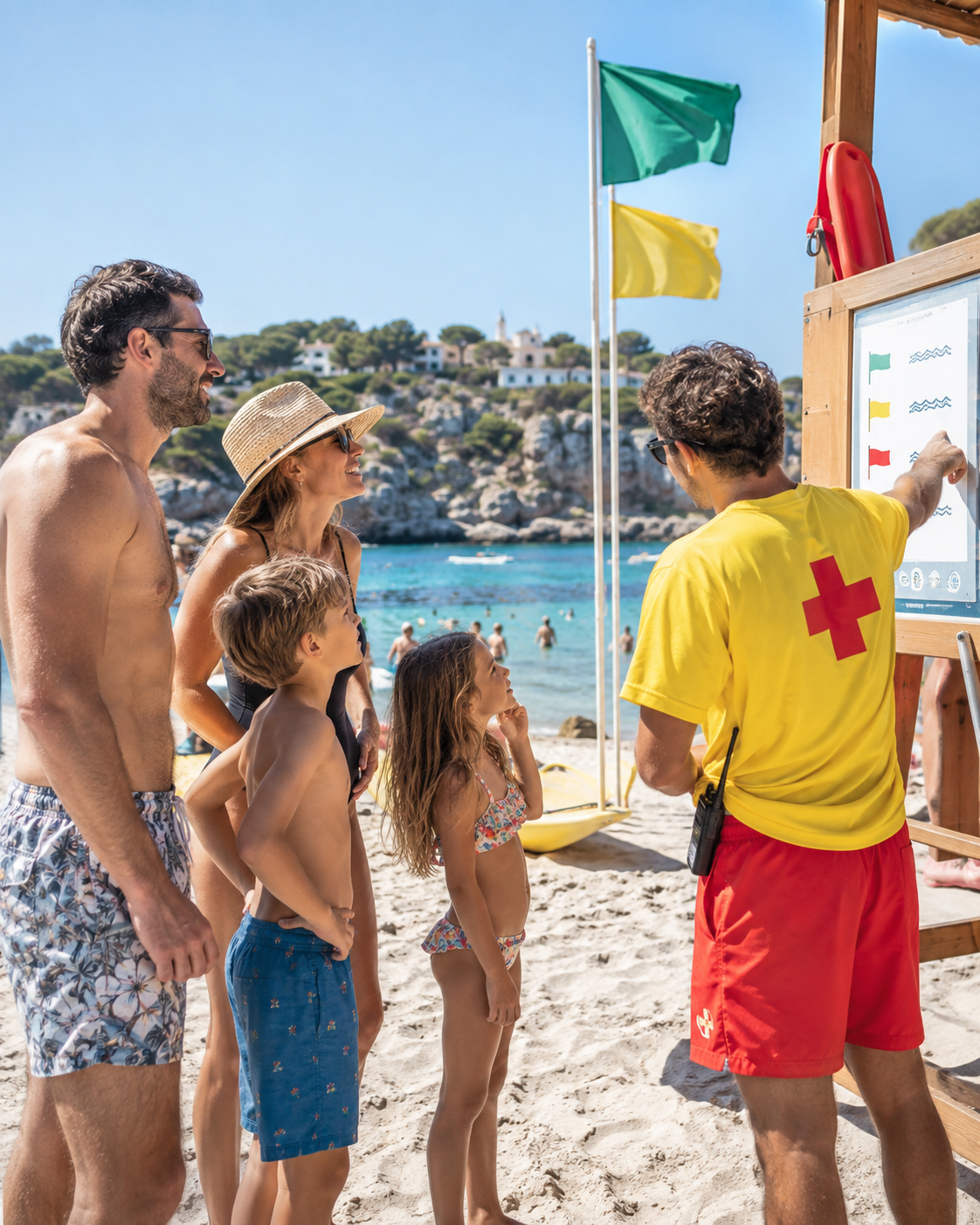
One more piece of beach literacy is worth carrying, because the flags flying at a European beach are not decoration, they are instructions. The safety flags follow a broadly shared color code, so a green flag means the water is safe to swim, yellow means caution and to stay close to shore, and red means dangerous conditions and no swimming, with a double red often meaning the beach is closed to the water entirely. Ignoring a red flag is both dangerous and, in some places, finable, and the lifeguards do watch, so it is a code worth knowing rather than guessing at.
A separate flag, the Blue Flag, means something different and reassuring, since it is an international award given to beaches that meet standards for water quality, safety, and environmental management, so a Blue Flag flying is a sign of a clean, well-run beach rather than a warning about the water. Do not confuse the two, since the safety flags change with the day’s conditions while the Blue Flag is a season-long mark of quality. Between the two systems, a glance at what is flying tells an alert visitor both whether the beach is a good one and whether it is safe to get in the water today, which is exactly the kind of quick read the locals make without thinking.
Towels, Noise, and Reading the Beach

A handful of softer etiquette rules round out the picture, none of them finable but all of them capable of marking you as the oblivious tourist. The first is noise, because European beaches, outside the party stretches, tend to run quieter than American ones, so a loud speaker blasting music or a phone conversation on speaker carries in a way that draws irritation rather than the shrug it might get at home. Keep the volume low and the beach mostly keeps its calm.
The second is the towel-and-spot question, which varies by place and is worth reading rather than assuming. In some spots people do reserve a patch with a towel and it is respected, while in others, especially on the paid clubs and the sunbed-heavy beaches, laying claim to loungers for hours while you go elsewhere is frowned upon, and the famous stereotype of the pre-dawn towel on the empty sunbed is a real source of friction. When in doubt, watch what the locals do for ten minutes before you settle, since every beach has its own rhythm, and the fastest way to fit in anywhere is to copy the people who clearly belong. That single habit, watch first and match the room, quietly solves most of the unwritten rules at once.
What to Bring, and What to Leave at Home

Two smaller rules are worth knowing before you even pack the bag. The first is glass, which is banned on a great many European beaches for the obvious reason that broken glass in sand is a serious hazard to bare feet, so the bottle of wine or beer you would bring to an American beach should be swapped for a can, a plastic bottle, or a proper picnic in unbreakable containers. Some beaches enforce this actively, and even where they do not, a broken glass on a busy beach is exactly the kind of thing that gets a nice spot closed to everyone.
The second is a matter of scale, since Europeans tend to arrive at the beach far lighter than Americans do. Where an American family might roll up with a wagon, a cooler the size of a small fridge, a canopy, and a set of chairs, the European default is often a towel, an umbrella, water, and a book, so the enormous cooler-and-gear operation can look out of place, especially on a small paid beach with numbered loungers and little room to spread out. There is nothing wrong with bringing what you like, but the sunbed you paid for usually comes with a small footprint, and a lighter kit simply moves through the day more easily. Dogs are another thing to check rather than assume, since many beaches ban them outright in high season and others allow them only in designated stretches, so the family pet is not a safe bet without looking first.
A Quick Word on Bodies

Since the subject is unavoidable at a European beach, it deserves one calm mention rather than a whole lecture, because we have written about the body-culture side of this at length elsewhere. Topless sunbathing is legal and common on many European beaches, more in some countries and regions than others and fading a little among younger crowds, and naturist beaches are a separate, clearly designated thing. The only etiquette a visitor really needs is the easy one, which is not to stare and never to take photos, and to feel no pressure in either direction for yourself.
For an American the useful reframe is that none of it is a statement, since a bare-chested sunbather or someone changing discreetly under a towel is being practical and comfortable, not making a point, and the relaxed local response is simply to pay it no mind. Match that ease, keep your camera in your bag, and the one part of European beach culture that most rattles first-time visitors turns out to be the easiest to handle. You do nothing, you look away, and you let people be.
Watch First, Then Unroll Your Towel
Put all of it together and the through-line is the same one that serves a traveler everywhere, which is to arrive a little humble and watch before you act. The beach shower is for rinsing, a good stretch of the sand may be paid, your swimwear belongs on the beach and not in the town, the cigarette may be banned, and the noise should stay low, and almost all of it becomes obvious the moment you stop assuming the European beach works like the American one. Spend the first ten minutes watching rather than sprawling, and the rules reveal themselves.
None of this should make anyone nervous about a European beach, because they are among the great pleasures of the continent and the locals are forgiving of an honest tourist who is clearly trying. The point is only that a few small habits, a quick rinse, a cover-up for the walk back, a glance for the smoking signs, and a low voice, will keep you on the right side of both the etiquette and the law, and let you enjoy the sand the way the people around you do. Get those right and the European beach stops being a minefield of unfamiliar rules and becomes what it should be, one of the most relaxed and civilized ways there is to spend a warm afternoon.

About the Author: Ruben, co-founder of Gamintraveler.com since 2014, is a seasoned traveler from Spain who has explored over 100 countries since 2009. Known for his extensive travel adventures across South America, Europe, the US, Australia, New Zealand, Asia, and Africa, Ruben combines his passion for adventurous yet sustainable living with his love for cycling, highlighted by his remarkable 5-month bicycle journey from Spain to Norway. He currently resides in Spain, where he continues sharing his travel experiences with his partner, Rachel, and their son, Han.