
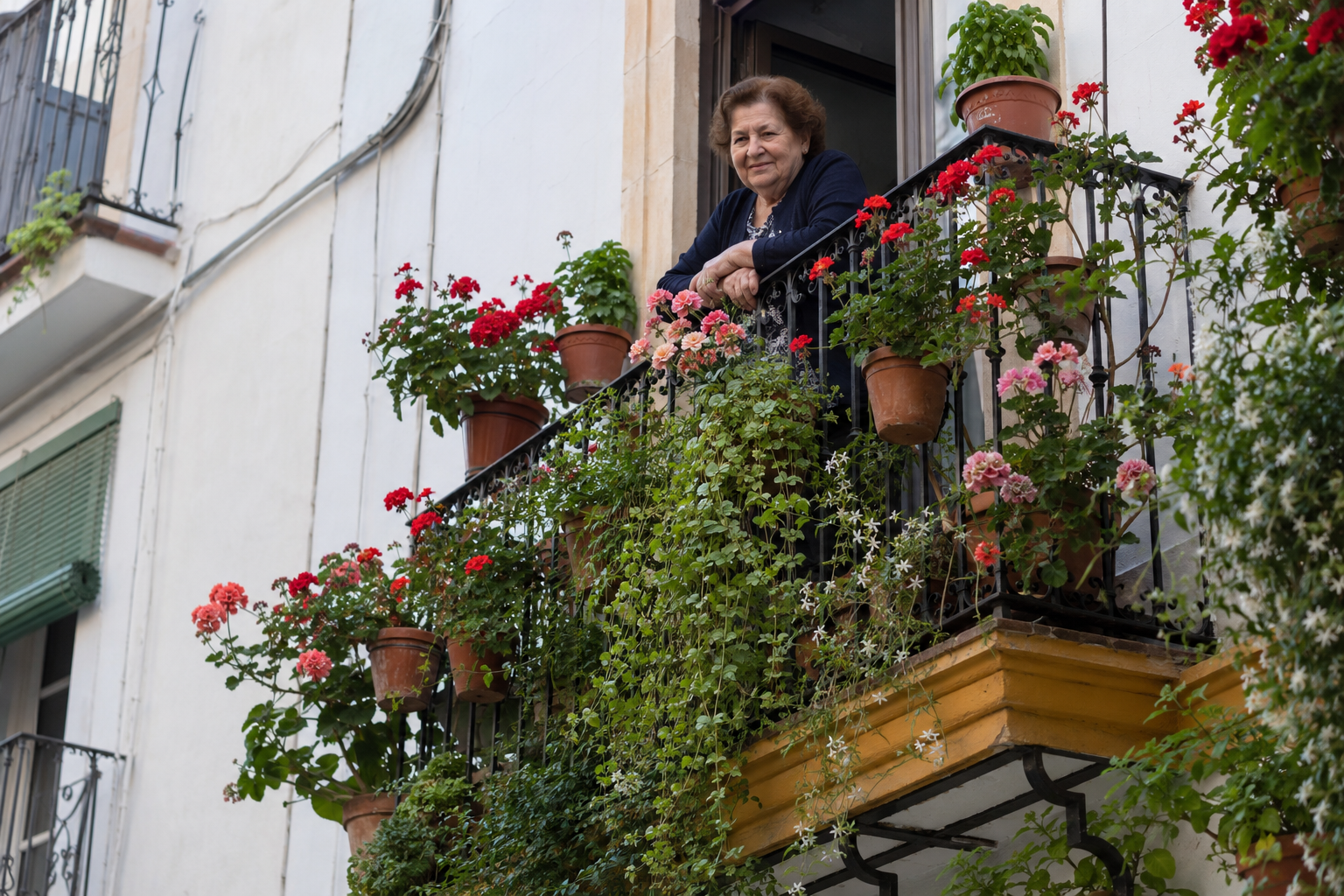
Walk down any street in Spain, look up, and you will see it repeated balcony after balcony, the same small forest of vivid red and pink spilling over the black iron railings, the same weathered terracotta pots crowded along the narrow ledges, the same handful of plants appearing again and again as if by some quiet agreement. There is no rulebook anywhere and no committee, yet the balconies of Spain follow a code as consistent as any written law, a set of unspoken choices passed quietly down through many generations of grandmothers who all seem to have arrived at the same short list of what a balcony ought to hold. The geranium reigns over this world, but it does not rule alone, and the full code, the five plants you will find nine times out of ten, tells a quiet story about climate, thrift, beauty, and the deep continuity of Spanish domestic life. To learn this simple code is to see the ordinary Spanish street with entirely new eyes, to understand that the woman deadheading her flowers at dusk is taking part in a tradition older than she is. Here are the five plants that make up the geranium code of the abuelas, and what each of them means.
What makes this pattern so charming is that no one decided it, and yet everyone follows it. The choices were not handed down as instruction so much as absorbed, watched and quietly copied, a grandmother’s balcony becomes the template for a granddaughter’s without a word spoken. The result is a shared visual language that quietly turns whole neighborhoods into something coherent and genuinely lovely. So let us climb slowly, pot by pot, up through the five plants that nearly every traditional Spanish balcony grows, and see the logic and the love hidden inside a habit so common that most people never think to question it. Each plant, it turns out, earns its place for a reason, whether beauty, scent, usefulness, or meaning, and together they add up to something far greater than a list. Together they add up to a single shared idea of what a home should look like seen from the street.
The Geranium, the Undisputed Queen
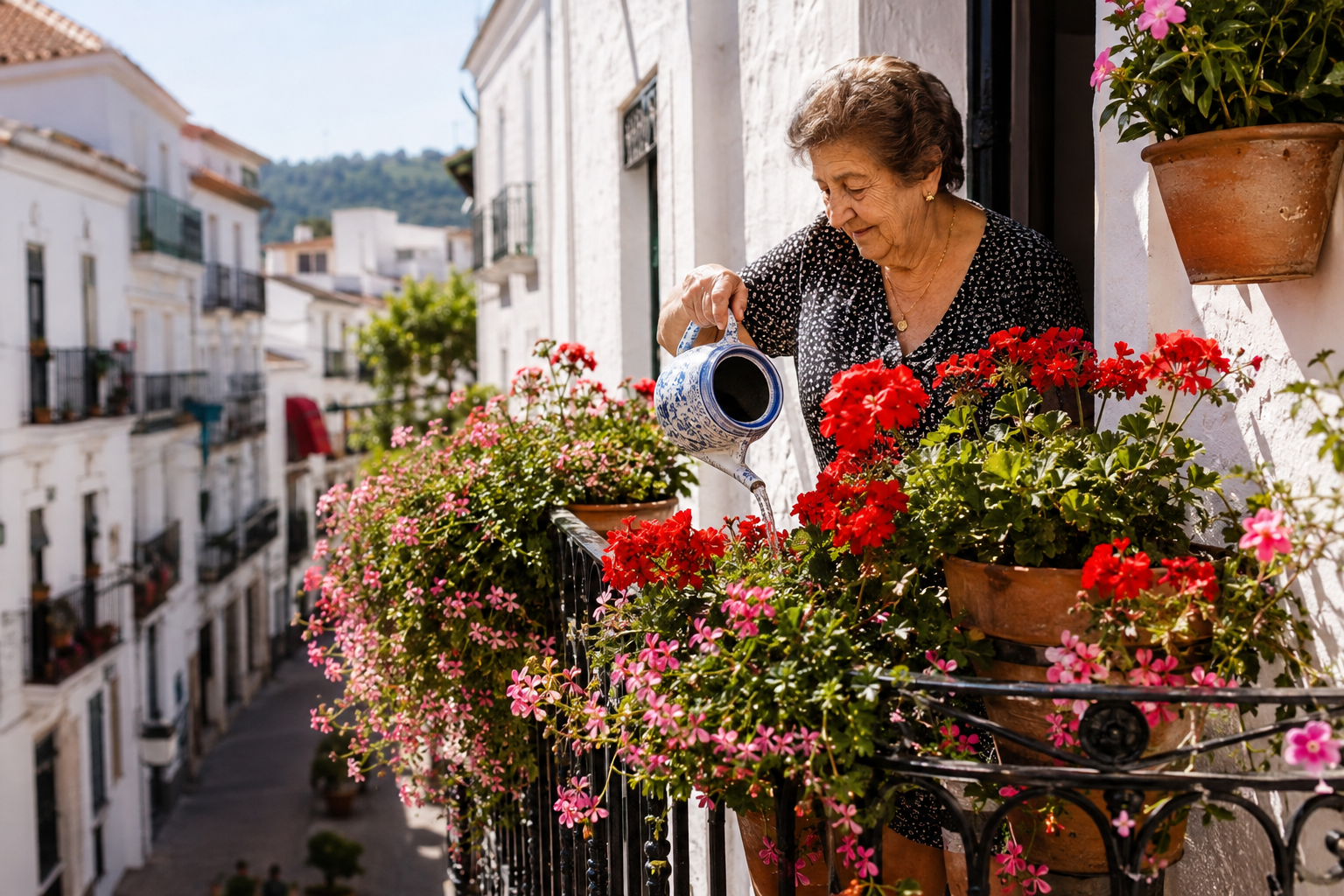
At the center of the code, without rival or serious challenge, stands the geranium, the plant so bound up with the Spanish balcony that the two are almost impossible to picture apart. It is the anchor around which everything else arranges itself.
The geranium is everywhere for good reason. Hardy, drought-tolerant, and blooming for months in the fierce Mediterranean sun, the geranium is almost perfectly suited to the balcony life, asking little and giving a great deal in return, so it thrives where fussier plants would fail. Its bright red and pink blooms are the signature color of the Spanish street in summer, a splash of vivid life against whitewashed walls and dark iron.
It rewards the lightest of care. What endears the geranium to the abuelas above all is its forgiving nature, since it survives forgetful watering, blazing heat, and years in the same tired pot, so even a neglectful gardener is rewarded with flowers. This generosity makes it the natural foundation of the code, the plant no balcony would dream of being without. There is a reason the geranium and not some showier bloom sits at the heart of the tradition. A plant that demands constant attention could never have become universal, spreading to every balcony from the grandest to the most modest. The geranium succeeds precisely because it fits an ordinary, busy life, thriving in the care of a working woman who waters it when she can and trusts it to look after itself the rest of the time. Its beauty is real, but its reliability is what made it the queen.
The Gitanilla, the Cascading Cousin
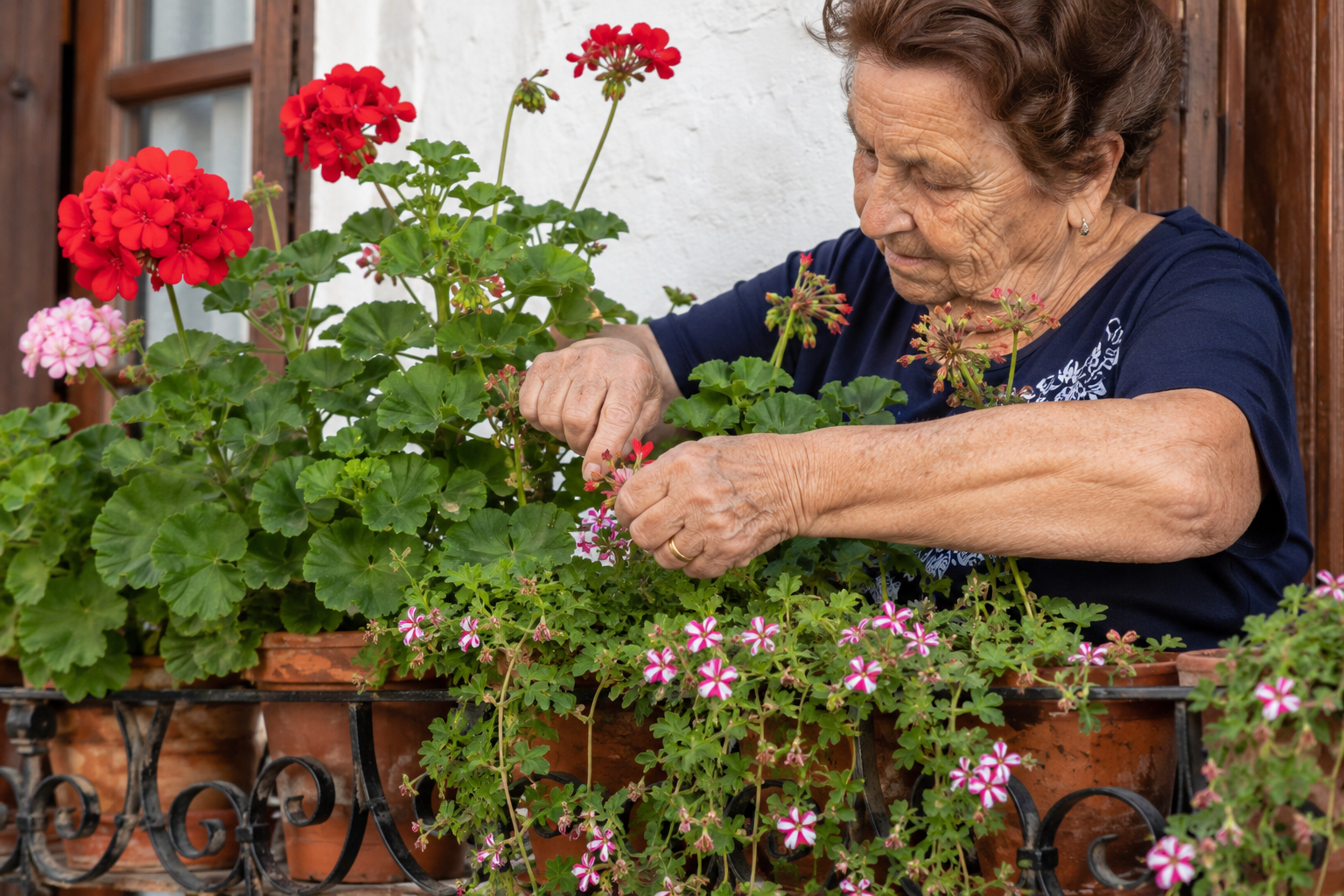
Beside the upright geranium sits its trailing cousin, the gitanilla, whose tumbling growth gives the Spanish balcony its characteristic waterfall of color over the railing. If the geranium is the queen, the gitanilla is the one that steals the show from the street below.
The gitanilla spills rather than stands. This ivy-leaved geranium sends its stems cascading downward in long, flowering trails, so instead of sitting neatly in its pot it pours over the edge of the balcony in a curtain of bloom. Seen from the street, it is the gitanilla that creates the postcard image of the flower-draped Spanish facade, softening the hard lines of iron and stone.
Its name carries old affection. The word gitanilla, meaning little gypsy girl, hints at a free, tumbling, colorful spirit, so even the name it goes by speaks of movement and life. Paired with its upright cousin, it completes the geranium half of the code, the two together supplying most of the color that defines the look. The pairing is a clever one, whether or not anyone planned it. The upright geranium fills the pots with height and body, while the trailing gitanilla drapes the front of the balcony in falling color, so between them they clothe the whole structure from ledge to railing. Seen together from the street below, they turn a plain iron balcony into a hanging garden, and they do it with two plants so closely related that caring for one teaches you to care for the other.
The Carnation, Spain’s Own Flower
Among the geraniums, the abuelas almost always tuck in the clavel, the carnation, a flower so tied to Spanish identity that it feels less a choice than a birthright. It brings a different fragrance and a deeper cultural weight to the balcony.
The carnation is woven into Spanish life. Associated with flamenco, with ferias, and with the traditional dress of Andalusian women, the clavel carries a load of national feeling, so growing one is a small act of belonging as much as gardening. Its ruffled blooms and clove-like scent make it a sentimental favorite handed down through families.
It earns its place on merit too. Beyond its symbolism, the carnation is well suited to the sunny, well-drained conditions of a Spanish balcony, so it flourishes alongside the geraniums without demanding anything different. Practical and patriotic at once, it slots naturally into the code beside its more numerous neighbors. There is something telling in the fact that the carnation is grown as much for what it means as for how it looks. A Spanish balcony is never purely decorative, and the clavel carries memories of ferias, of dances, of flowers worn in the hair on feast days, so a single pot of it can hold a whole season of associations. The abuela who tends one may not put it into words, but she is keeping a small piece of a shared culture alive on her railing, one bloom at a time.
The Jasmine, for the Evening Air
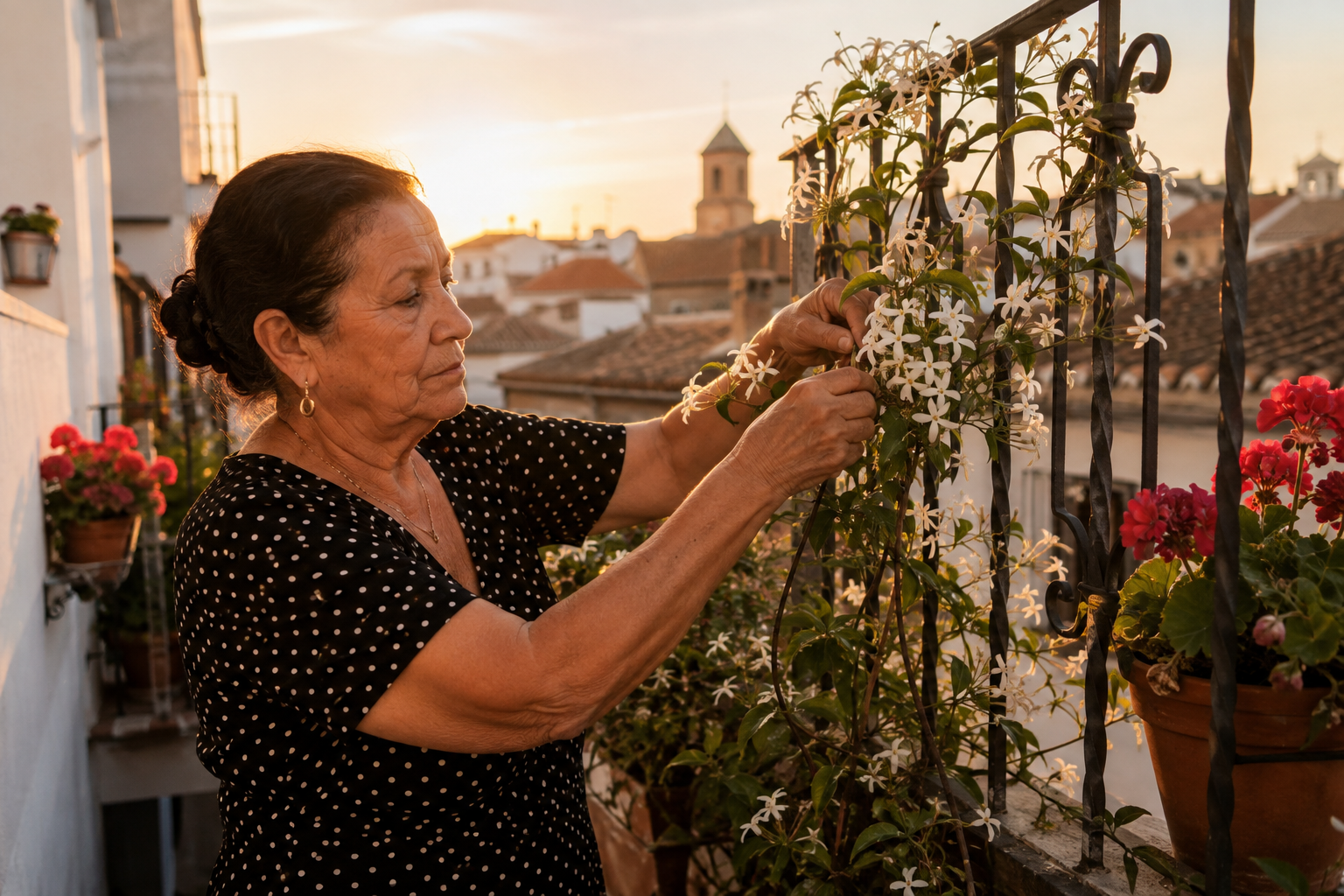
Not every plant in the code is grown for its color, and the jasmine earns its place almost entirely through scent, filling the warm evening air with a perfume that is one of the great pleasures of a Spanish summer night. It is the plant you smell before you see.
The jasmine perfumes the whole street. A climbing jasmine trained up a balcony rail releases its sweet fragrance most strongly after dark, so on summer evenings whole streets can be scented by the jasmine on the balconies above. This gift of perfume, offered freely to every passerby, is one of the loveliest features of the traditional Spanish facade.
It rewards a little patience. Unlike the instantly cheerful geraniums, the jasmine is a climber that takes time to establish and train, so it asks slightly more of its keeper before it gives its reward. The abuelas grow it anyway, prizing the evening perfume enough to wait, and its presence marks a balcony tended with real care. The jasmine is, in a sense, the connoisseur’s plant of the code, the one that signals a gardener who thinks beyond color to scent, beyond the daytime view to the quieter pleasures of the warm night. On a summer evening, with the windows open and the street quiet, the perfume drifting up and down the block is one of the small, free luxuries of Spanish life. It costs almost nothing, it asks only patience, and it is shared freely with everyone in reach.
The Basil Pot by the Door
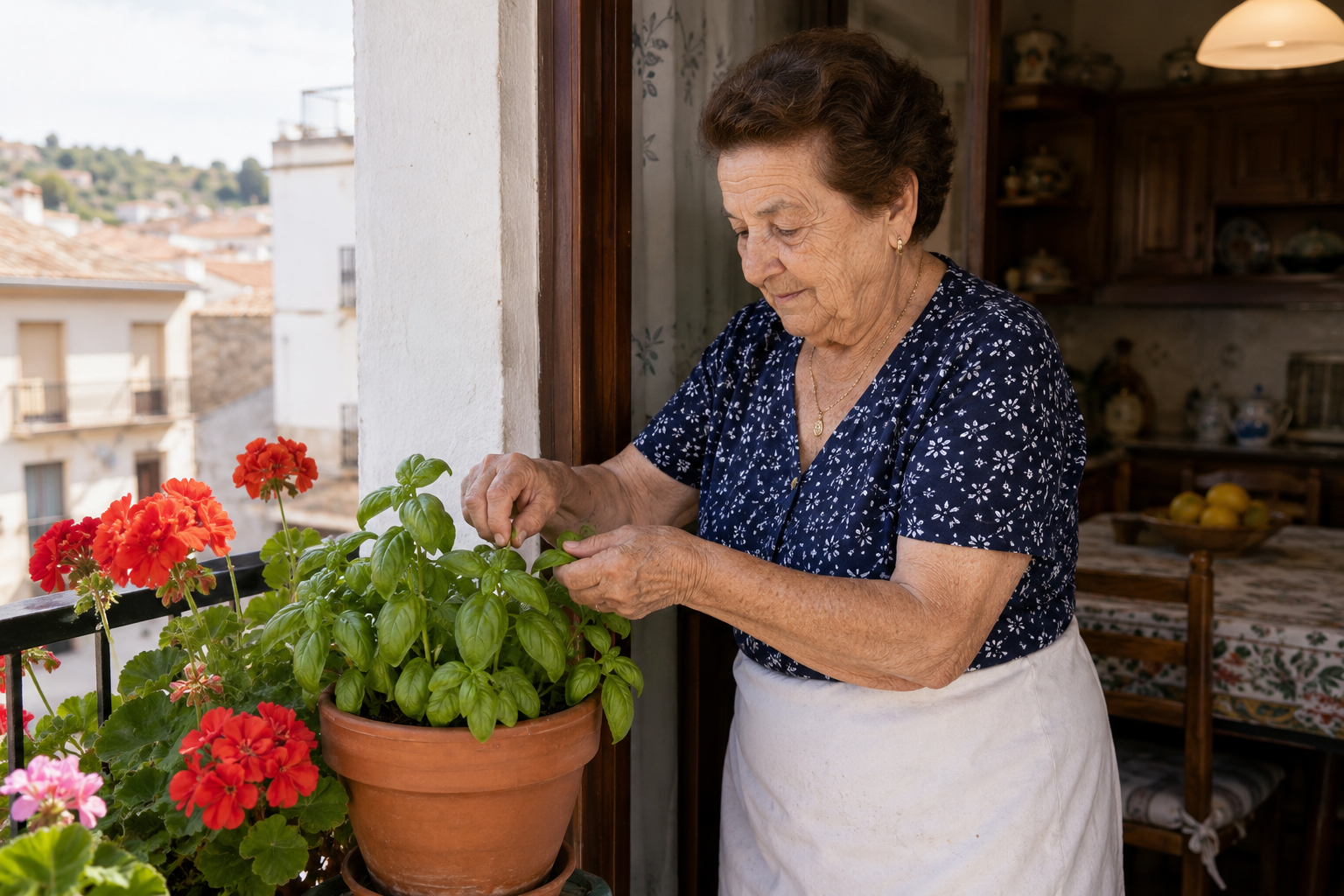
The fifth plant in the code steps away from pure decoration and into the kitchen, the pot of albahaca, or basil, by the balcony door in countless Spanish homes. It is the useful member of the family, valued for more than its looks.
Basil serves the cook and the household. Grown within easy reach of the kitchen, the basil is picked fresh for cooking and prized for its warm, aromatic scent, so it earns its spot through usefulness as much as beauty. A pinch of its leaves finds its way into countless summer dishes, and its smell by the door is part of the character of the home.
Tradition gives it a second job. By long folk custom the basil is also believed to help keep mosquitoes at bay, so the abuelas keep a pot by the door partly in the hope of a more peaceful evening. Whether or not the insects agree, the belief is old and widespread, and it secures the humble basil its lasting place in the code. The basil is a reminder that the Spanish balcony was never meant to be admired from a distance alone. It is a small working space as much as a decorative one, a narrow strip of the household where beauty and usefulness sit side by side without any sense of contradiction. The abuela sees no difference between the geranium she grows for the eye and the basil she grows for the pot, since both are simply part of tending her small outdoor room well.
Terracotta and Iron, the Frame That Holds It All
The five plants do not float in isolation, and the code extends to the vessels and the setting that hold them, the terracotta pots and the iron railings that are as fixed a part of the look as the flowers themselves. The frame matters as much as the picture.
The pots are almost always terracotta. Traditional Spanish balconies favor pots of plain baked clay, whose porous walls suit the plants and whose warm earthy color sets off the flowers, so the humble terracotta pot is itself part of the code. Ranged in rows along the ledge and hung from the railings, these simple pots give the whole arrangement its unmistakable Mediterranean character. There is a quiet wisdom in the humble choice of clay. The porous walls breathe, letting roots dry between waterings in a climate where overwatering is the greater danger, and the earthy tone flatters every color of bloom without competing with any of them. Newer plastic pots exist, of course, and creep onto some balconies, but the traditional eye still reaches for baked clay, and the oldest, most classic balconies remain a study in terracotta.
The iron railing completes the picture. The dark wrought-iron balcony rail, the reja, provides both the stage and the support for the display, its geometric lines a foil for the tumbling softness of the flowers, so the interplay of hard iron and living color is central to the effect. Plant, pot and railing together create the image that repeats down every street.
The Code No One Ever Wrote Down
Standing back from the individual plants, the deeper charm of the balcony code lies in how it came to exist at all, an unwritten tradition maintained not by rules but by love, imitation, and the quiet passing down of knowledge between generations. It is a habit of the heart as much as of the garden.
It is knowledge shared over railings. Cuttings passed from balcony to balcony, watering tips exchanged between neighbors, and grandmothers teaching granddaughters which plant likes what, all of it keeps the code alive without anyone ever formalizing it, so the tradition lives in doing rather than in writing. A geranium on one balcony is often the child of a cutting from next door. This is how the code truly spreads, not through shops or catalogues but through hands, a snapped stem wrapped in wet newspaper and passed between neighbors, rooted in a jar on a windowsill and planted out when it takes. A single well-loved geranium can populate a whole street over the years, so that the plants themselves become a kind of living record of friendship and proximity, each one carrying the memory of the balcony it came from.
It is beauty offered to the street. Above all, the balcony garden is a gift the household gives to everyone who passes below, a small daily act of care that brightens the shared space of the street, so the code is a form of quiet generosity as much as private pleasure. In tending her five plants, the abuela decorates not just her own home but her whole neighborhood. She may never think of it in such grand terms, seeing only her morning routine of watering and pinching back the spent blooms. But the cumulative effect of thousands of women doing the same small thing is a country whose streets bloom from their upper storeys, a shared and unpaid work of beauty that no city planner could ever commission. It is one of the quiet marvels of Spain, hidden in plain sight above the heads of everyone hurrying by.
So the next time you walk a Spanish street and glance up at the cascade of red and pink above you, you will know that you are reading a code, five plants chosen again and again across a whole country by grandmothers who never compared notes and never needed to. It is one of the loveliest of Spanish traditions precisely because it is so ordinary, a shared idea of beauty repeated on a hundred thousand balconies, tended pot by pot, and offered freely to anyone who thinks to look up.

About the Author: Ruben, co-founder of Gamintraveler.com since 2014, is a seasoned traveler from Spain who has explored over 100 countries since 2009. Known for his extensive travel adventures across South America, Europe, the US, Australia, New Zealand, Asia, and Africa, Ruben combines his passion for adventurous yet sustainable living with his love for cycling, highlighted by his remarkable 5-month bicycle journey from Spain to Norway. He currently resides in Spain, where he continues sharing his travel experiences with his partner, Rachel, and their son, Han.