
Walk into almost any Italian home, from a grand apartment in Rome to a tiny mountain kitchen in the Alps, and you will find the same small, faceted aluminum pot sitting on the stove. It is the moka, a humble three-piece coffee maker that has quietly powered Italian mornings for the better part of a century, and it costs a fraction of the gleaming espresso machines that fill kitchen showrooms. Here is the surprising part for the many people who assume that good coffee requires an expensive machine. This little pot, which can be had for the price of a couple of restaurant coffees, makes a cup many Italians prefer to anything a costly espresso machine produces, and with no electricity, nothing to break, and a design that lasts decades. The moka is not just a cheap alternative to the fancy machine. For millions of people, it is simply the better everyday choice, and the story of why is a small lesson in the difference between price and pleasure.
Understanding the moka, how it works, where it came from, and why it has such a grip on Italian life, reveals something about coffee that the expensive-machine market would rather people did not dwell on. Truly wonderful coffee at home has never once required a large outlay of money, and the living proof has been sitting quietly on Italian stoves since 1933. So here is the story of the little pot, the science of how it brews, and the reason it remains, against all the glossy competition, the true heart of the Italian coffee kitchen. It is a story that quietly upends the assumption, so carefully cultivated by the makers of expensive machines, that better coffee must mean spending more. The moka has been offering a delicious daily cup for pocket change for the better part of a century, and its enduring popularity is the strongest possible argument that it was right all along.
The Pot in Every Italian Kitchen

To grasp how central the moka is to Italian life, it helps to see just how universal it is, because this is not a niche gadget but a near-universal household fixture. It is woven into the daily rhythm of the country.
Almost every home has one. Between seventy and ninety percent of Italian households own a moka pot, which makes it one of the most widely owned kitchen objects in the entire country, present across every region and every class. Few possessions are as common in Italy, or as tied to the ordinary rituals of daily life. To an Italian, the shape and sound of the moka carry a whole world of association, the warm smell of a grandmother’s kitchen, the very first coffee of a long working day, and the small welcome pause that punctuates a busy afternoon. It is the kind of object that people grow up with and then buy for their own first homes without a second thought, passing the ritual down as naturally as a recipe or a turn of phrase. For many Italians living abroad, a moka packed in the suitcase is one of the first small comforts of home to be recreated in a new kitchen, the familiar gurgle a way of carrying a piece of the country with them wherever they go.
It is a daily ritual, not a gadget. For most Italian families the moka serves as the instrument of a daily rite rather than an occasional novelty, the little gurgle on the stove that signals the morning or the afternoon pause. This deep embedding in everyday routine is what separates the moka from a mere appliance and turns it into something closer to a household companion. Where a costly machine is a purchase and a project, the moka is simply part of the furniture of the kitchen, as taken for granted as the kettle or the stove itself. That quiet permanence, the sense of an object that is always there and always ready, is a large part of the affection Italians feel for it.
A 1933 Revolution in Aluminum

The pot has a real inventor and a real birthday, and its origin story is as charming as the object itself. It was born from a very Italian mix of engineering and desire.
Bialetti brought the bar home. The moka was invented in 1933 by Alfonso Bialetti, a metalworker in Piedmont, with the goal of bringing the café-style coffee that Italians loved into their own kitchens for the first time. that rich coffee had once been something you went out to a bar to drink, and the moka changed that at a stroke, putting the pleasure within reach of every home.
The name and the inspiration charm. The pot took its name from Mocha, the Yemeni port famous in the coffee trade, lending the humble object a whiff of exotic romance. Its clever mechanism, using steam pressure to push water upward, is said to have been inspired by an early washing machine forcing water up over the laundry, a wonderfully ordinary spark for such an enduring design. The pot arrived at a moment when Italy was hungry for exactly this, a way to enjoy at home the coffee that had until then belonged to the café. A famous advertising slogan captured the promise perfectly, offering an espresso at home just as good as the one at the bar, and the little pot delivered on it so well that it swept through the country and never left.
How the Little Pot Works
For an object so simple to hold, the moka relies on a genuinely clever bit of physics, and understanding it makes the daily ritual all the more satisfying. The whole thing works on steam and pressure.
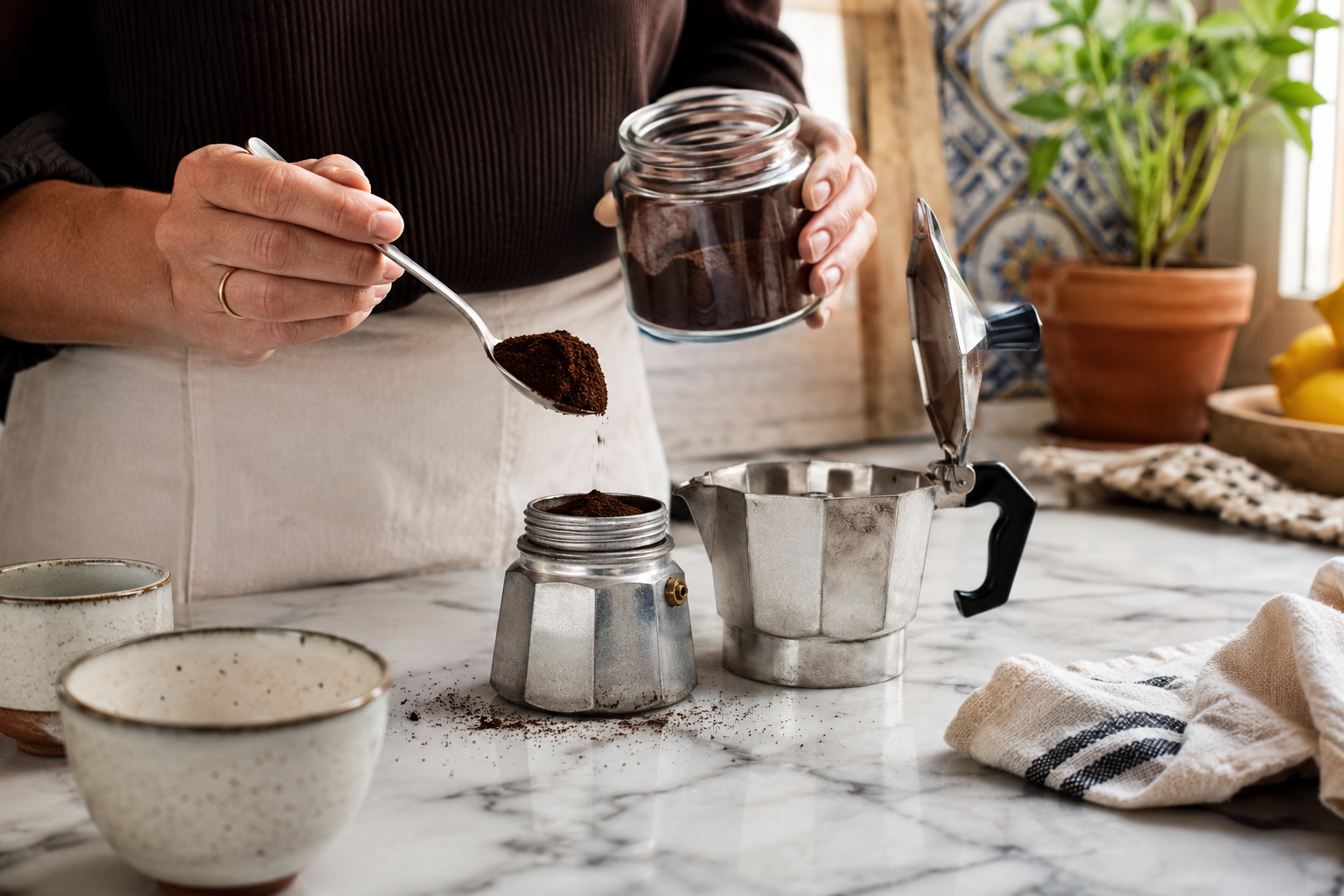
Three chambers and a tube. A moka has three parts, a water chamber, a funnel basket for the grounds, and a top that catches the brew, all joined by a central tube. Water goes in the bottom, coffee in the middle, and the magic happens as the pot heats on the stove. It is a design of real elegance, with no moving parts to speak of and nothing that can easily go wrong, which is a large part of why it has survived essentially unchanged for so very long a time. Once you understand the path the water takes, up from the base, through the coffee, and into the waiting top chamber, the whole simple process feels almost entirely inevitable, a small and satisfying piece of everyday physics playing out quietly on the stove each and every morning across the whole of the country.
Steam does the pushing. As the water in the base heats up, steam pressure forces the hot water up through the coffee grounds into the top chamber, where it collects as a dark, concentrated brew. This gentle pressure is far lower than the intense force of an espresso machine, which is exactly why the moka produces its own distinctive kind of coffee rather than a true espresso.
Not Espresso, but Something Its Own

This is the point that both purists and newcomers often miss, that the moka does not make espresso in the technical sense, and that this is not a flaw but the whole point. What it makes is a different and lovely drink.
It sits between drip and espresso. Because the moka brews at a much lower pressure than an espresso machine, it makes a coffee bolder than drip yet softer than true espresso, with a rich, slightly roasted, almost caramelized character. It is not a watered-down espresso nor a beefed-up filter coffee, but a distinct drink with its own devoted following. Part of its charm is that higher brewing temperature, which coaxes out a roasty, almost chocolatey depth that many people find more comforting than the sharp intensity of a true espresso. It is a coffee to linger over as much as to knock back, equally at home as a quick morning jolt or as the base of a milky drink stretched out across a slow breakfast.
A drink worth loving on its terms. Recognizing moka coffee as its own thing, rather than judging it as a failed imitation of espresso, is the key to appreciating it, and countless coffee lovers prefer its particular character to anything else. Enjoyed in small, strong doses, or lengthened with hot water or milk, it is a genuinely great cup on its own merits. Add a splash of hot water and it becomes a longer, gentler drink in the American style, while a little steamed or frothed milk turns it into something close to a cappuccino without any need for a machine. This versatility, the way a single humble pot can be the starting point for so many drinks, is a quiet part of why it has never been displaced from the Italian kitchen.
Thirty Dollars Against Seven Hundred
Here is where the moka makes its most compelling case, in the sheer gulf between its cost and that of the machines it competes with. The value it offers is almost absurd.
The price gap is enormous. A classic moka costs a few coffees out, while a decent espresso machine runs into the hundreds and the serious ones into the thousands, so the moka delivers proper café-style coffee at only a tiny fraction of the cost. For most households, that difference alone settles the argument before a single cup is poured.
It is almost indestructible. Beyond the low price, the moka has no electronics, no pump, and no parts to service, so it brews faithfully for decades, often outliving several fancier machines. This combination of a trivial price and a near-endless lifespan is what makes the moka such an extraordinary bargain, and why so many Italians never see the need for anything more elaborate. It is worth being honest about what the comparison does and does not mean. The moka does not make a technically superior espresso to a fine machine, because it does not make true espresso at all. What it does is deliver a delicious, characterful cup that a great many people truly prefer, for a fraction of the price and none of the maintenance, and by that measure, the measure of everyday pleasure per dollar spent, it wins the contest handily.
Brewing It the Italian Way

Getting a great cup from a moka is easy, but a few small habits make the difference between a good brew and a slightly bitter one. The Italian way is a matter of simple care rather than skill.
Fill, grind, and do not tamp. Fill the base to just below the safety valve, and the funnel with fine coffee, leveled but never pressed, and the top is screwed on firmly before the pot goes onto a medium heat. Packing the grounds down or overfilling the water are the two most common mistakes, and avoiding both is most of the battle. Some Italians go a step further and start with warm water in the base, which shortens the time the pot spends on the heat and helps keep the coffee from taking on a scorched, metallic edge. The grind matters too, a touch finer than for drip but not as fine as for a machine, and using fresh coffee rather than a stale tin makes a difference you can taste. None of this is difficult, and a few pots in it becomes entirely second nature.
Catch it at the gurgle. As the coffee rises, at the distinctive gurgling, sputtering sound, take it off the heat right then, before the last of the water burns through and turns the brew bitter. Pouring at once, into small cups for a strong shot or lengthened to taste, delivers the pot at its very best. Traditionalists rinse the pot with hot water rather than scrubbing it with soap, believing that a light seasoning built up over time actually improves the coffee, and they dry it well to protect the aluminum. Cared for in this simple way, a single moka can serve a household faithfully for years, quietly turning out cup after cup with the same easy reliability.
The Design That Outlived Its Inventor

Finally, the moka deserves recognition not just as a coffee maker but as a genuine icon of design, one whose cultural standing far exceeds its humble price. It has earned a place in history.
A museum piece you can buy. The moka’s simple, faceted form is so admired that it sits in the design collections of major museums and ranks among the most popular coffee makers ever made, with hundreds of millions produced. Few objects manage to be at once a genuine design classic and an affordable everyday tool, yet the moka is exactly that. Its eight-sided form, chosen partly so the facets would catch and reflect the light like fine silverware, has become one of the most recognizable silhouettes in any kitchen. The same pot that a design museum places behind glass sits on millions of ordinary stoves, brewing coffee every morning, a rare and lovely collapse of the usual distance between fine art and ordinary everyday life.
A love that outlasts a life. So beloved was the pot to the family that built it that when the son who turned it into a global icon died, his ashes were laid to rest inside a giant replica of the moka itself. That a coffee pot could inspire such affection tells you everything about the place this little aluminum object holds in the Italian heart, and why it will keep its spot on the stove for generations to come. In an age of expensive gadgets that promise perfection and are obsolete within a few years, there is something quietly reassuring about a pot that costs almost nothing, lasts almost forever, and makes a cup of coffee worth getting up for. That, in the end, is the real lesson of the moka, that the finest things are not always the most costly, and that a good ritual, faithfully kept, is worth more than any machine.

About the Author: Ruben, co-founder of Gamintraveler.com since 2014, is a seasoned traveler from Spain who has explored over 100 countries since 2009. Known for his extensive travel adventures across South America, Europe, the US, Australia, New Zealand, Asia, and Africa, Ruben combines his passion for adventurous yet sustainable living with his love for cycling, highlighted by his remarkable 5-month bicycle journey from Spain to Norway. He currently resides in Spain, where he continues sharing his travel experiences with his partner, Rachel, and their son, Han.