
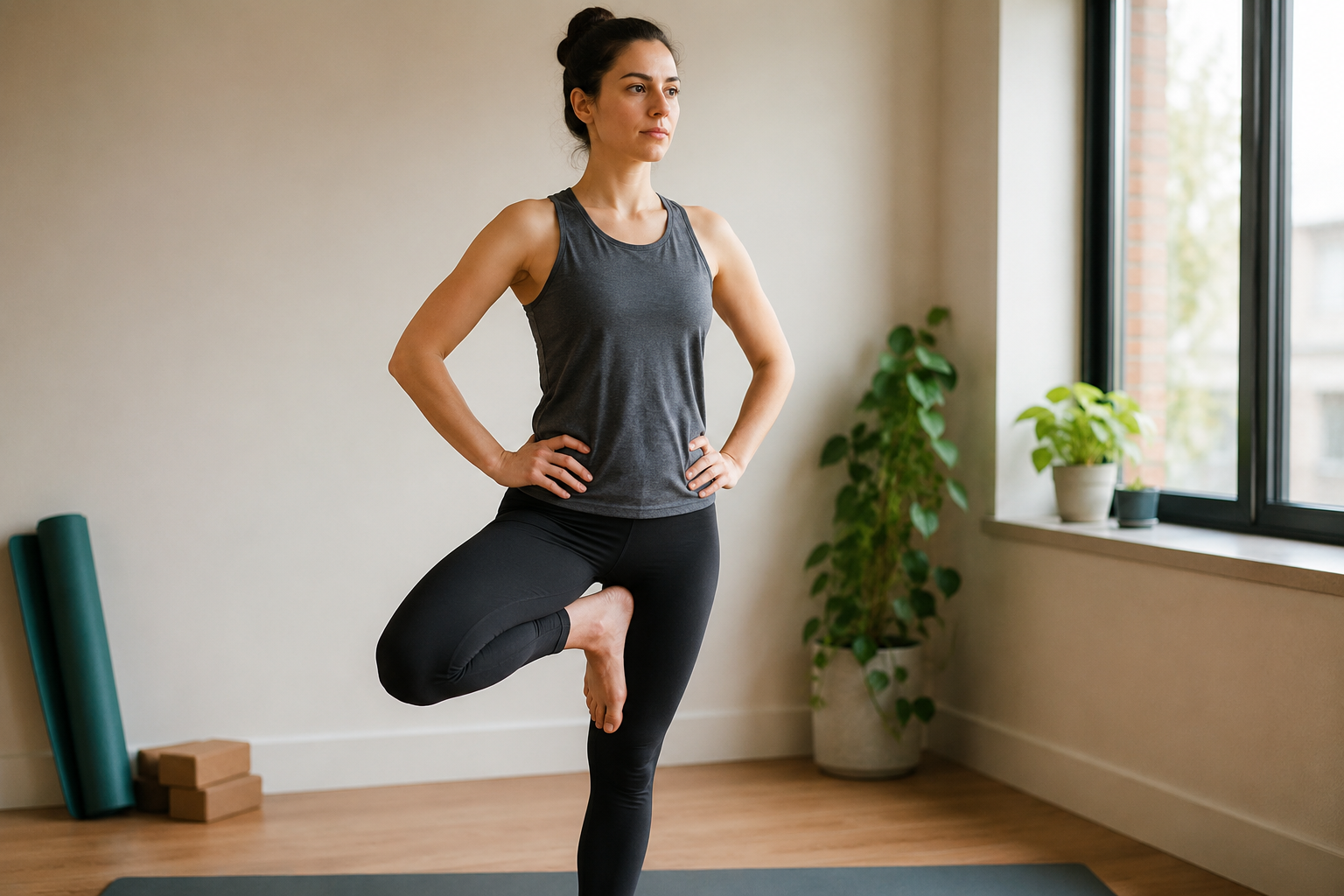
I tried it on the kitchen tile in Getafe before I wrote a word of this, one bare foot planted, the other tucked against the back of my calf, phone timer running. Ten seconds is longer than it sounds when nothing is holding you up. I made it, wobbled at eight, and caught the counter at eleven out of habit. Then I made my partner try, and his uncle, who is 68 and grumbled the whole time, and the grumbling uncle held it flat for the full ten without a flicker. That is the first honest thing to say about this test. It does not always tell you what you expect, and it is not a verdict on anyone.
The test comes from a study that got a lot of headlines a few years ago, and the headlines were both true and easy to misread. It is worth being precise about what the researchers found, because the precise version is more useful than the scary one.
What the Study Actually Measured
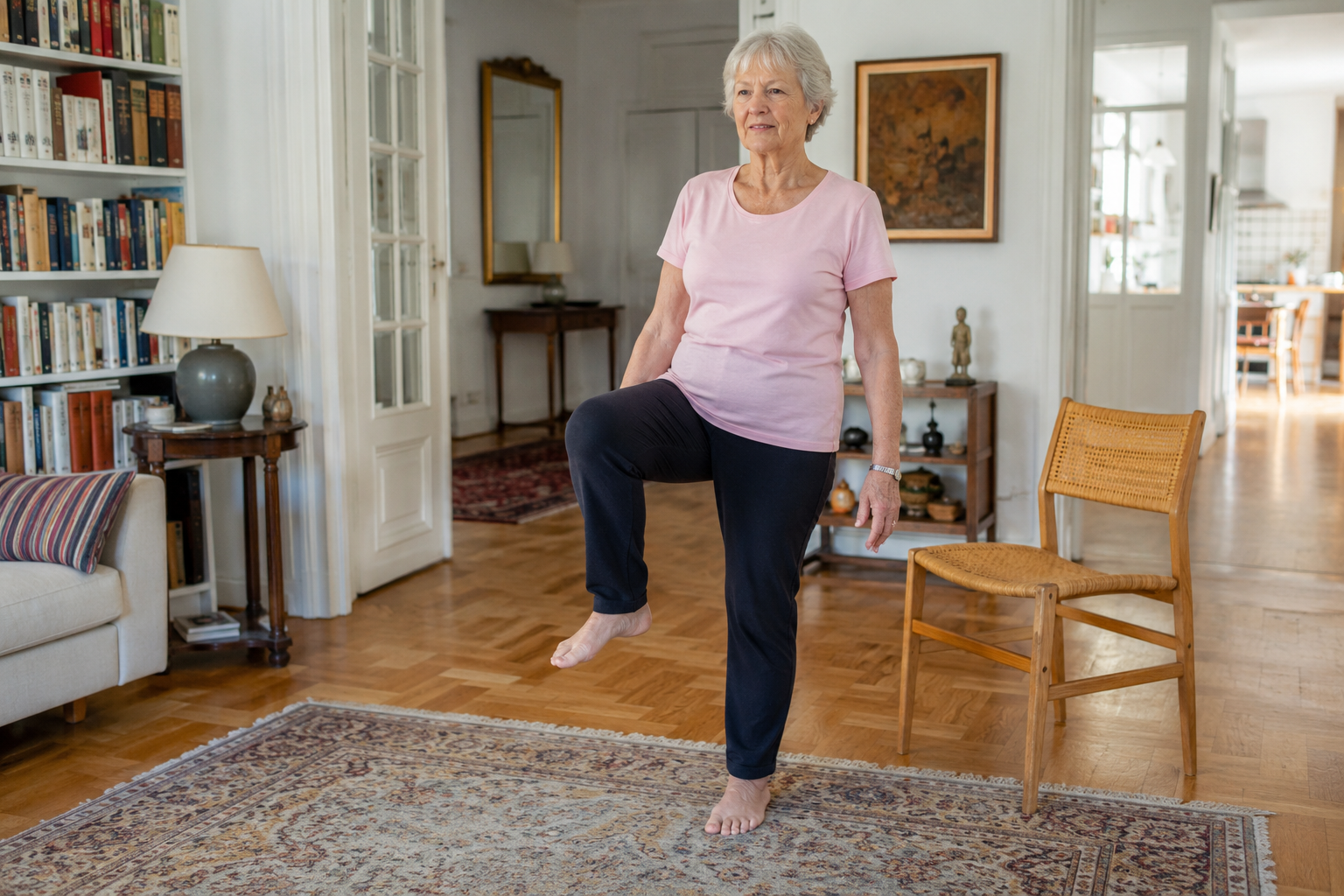
In 2022, the British Journal of Sports Medicine published work from the CLINIMEX exercise cohort, run out of a clinic in Rio de Janeiro by the physician Claudio Gil Araujo, with a co-author, Setor Kunutsor, at the University of Bristol. The researchers followed 1,702 people aged 51 to 75, average age around 61, roughly two thirds of them men. At their first check-up between 2009 and 2020, each person was asked to stand on one leg for ten seconds without any support, placing the front of the free foot against the back of the opposite lower leg.
That was the whole test. No machine, no bloodwork, ten seconds on one foot. The researchers then tracked who was still alive over a follow-up that averaged about seven years, and they looked at whether the ten-second result lined up with survival. It did.
The Number That Made the Headlines
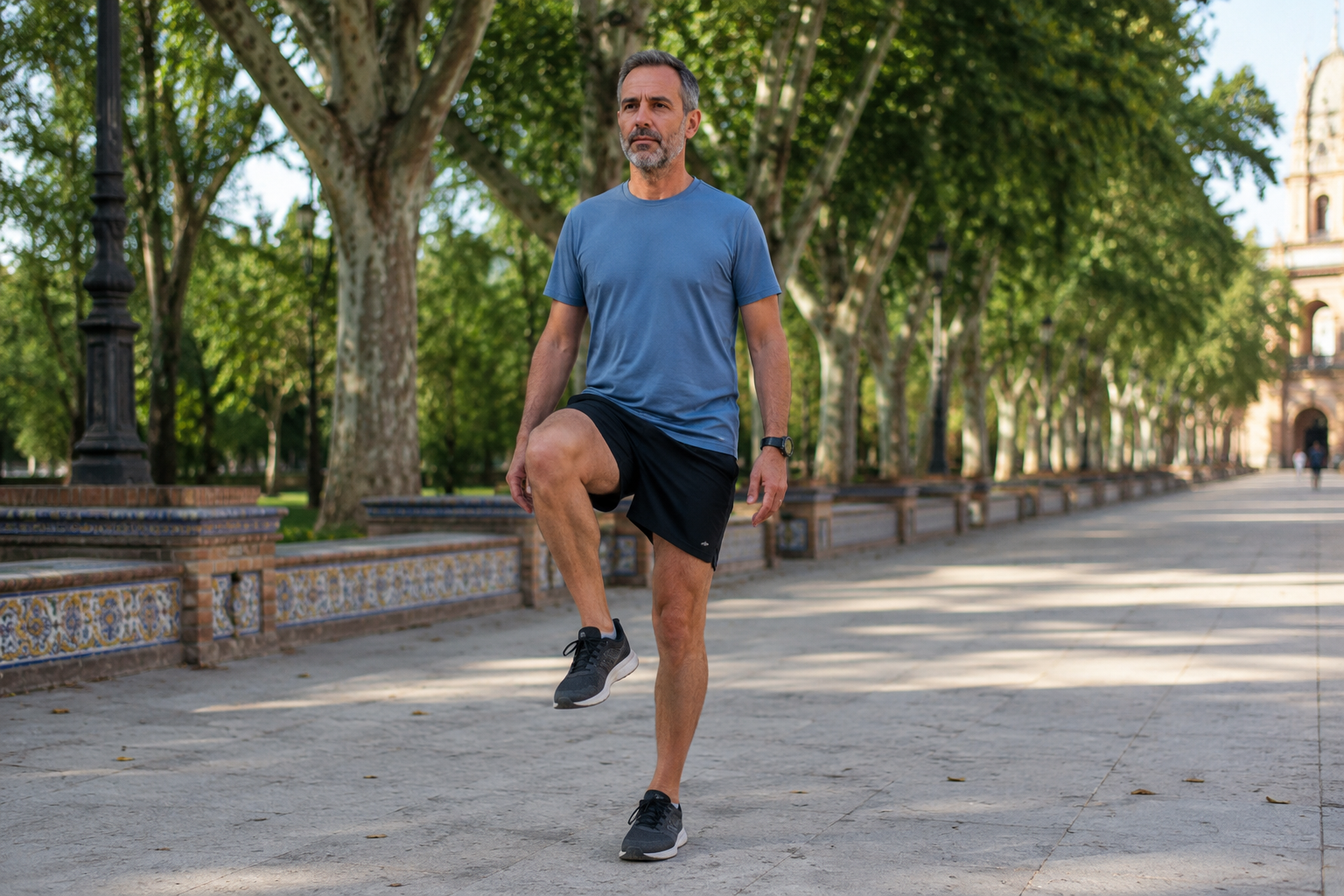
Among the people who could not hold the ten seconds, 17.5% died during the follow-up. Among those who could, the figure was 4.6%. After the researchers adjusted for age, sex, body mass index, and existing health conditions, failing the test was associated with an 84% higher risk of death from any cause over the following decade.
Eighty-four percent is a large-sounding number, and it is the number that traveled. It is worth slowing down on the word “associated,” because that word is carrying the entire honest meaning of the study, and the headlines mostly dropped it.
Why the Word Association Matters Here
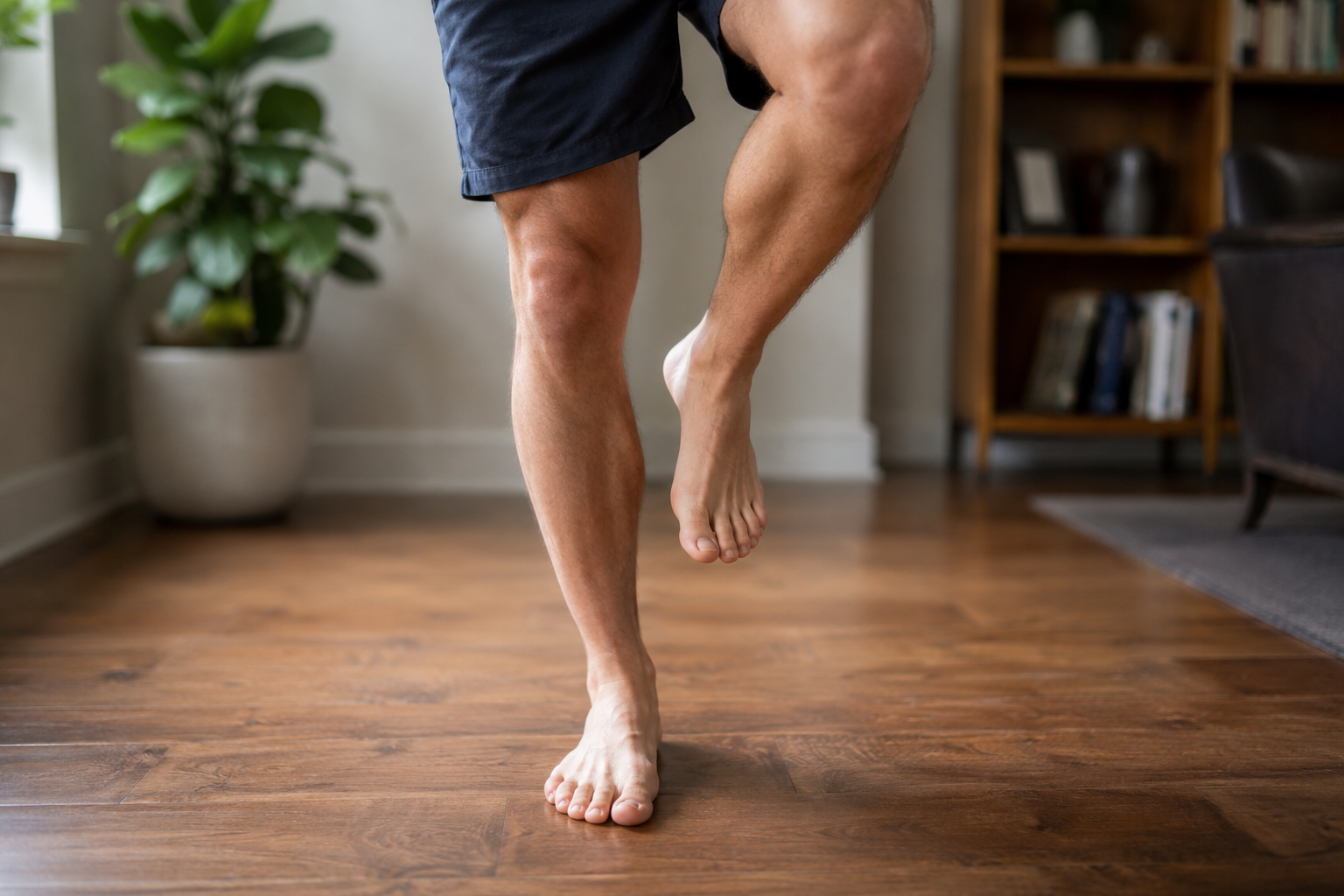
This was an observational study, which means it watched what happened without changing anything. It can show that two things move together. It cannot show that one causes the other, and the researchers themselves said so plainly.
The reason that distinction is not academic hair-splitting is that the people who fail a balance test are rarely failing only a balance test. Poor balance in later life tends to travel with other things: less muscle, less activity, a nervous system or an inner ear that is not what it was, sometimes a medication or an undiagnosed condition quietly affecting the whole picture. The study could not separate all of those, and the authors listed exactly that as a limitation, noting they had not accounted for recent falls, physical activity levels, diet, or medications, any of which can drag balance down on their own. So the ten-second test is best understood as a window, not a cause. It shows you something about the state of the body behind it, the way a check-engine light shows you the engine has an opinion without telling you which part. Reading it as “this test decides whether you live” gets the science backwards. Reading it as “people whose bodies can no longer do this simple thing tend to be less well overall” gets it right, and that reading is genuinely useful.
It is also worth knowing what the researchers did control for, because it makes the signal harder to dismiss. They adjusted their 84% figure for age, for sex, for body mass index, and for a set of existing conditions including heart disease and high blood pressure. In other words, the link was not simply that older or heavier or already-sick people fail the test. Even after accounting for those, the balance result still carried its own weight. That is what lifted the study from a curiosity to something clinicians took seriously. The honest reading holds the two facts together at once: the association is real and survives adjustment, and it still cannot prove the test itself changes anyone’s fate.
Where It Sits Among the Other Quick Tests
The ten-second stand is one of a small family of cheap physical measures that researchers keep finding tied to how well people age, and it helps to see it as part of that group rather than as a lone magic number. Grip strength, measured with a hand dynamometer, tracks with survival in study after study. So does gait speed, simply how fast someone walks a short measured distance. So does the sit-to-stand test, counting how many times a person can rise from a chair and sit back down in thirty seconds without using their arms.
What all of these share is that they are proxies. None of them causes long life. Each is a quick read on a body’s overall reserve, the way a mechanic learns a lot from how a car sounds turning over before any hood is opened. Balance earns its place in that group because it is the one that needs no equipment at all, not even a chair to time yourself against, just ten seconds and a bit of floor. That is why it has spread beyond the lab into ordinary clinics faster than the others. A doctor with a busy waiting room and no gadget can still ask a patient to stand on one leg, and learn something real in the time it takes to write a note.
There is a reason clinicians reach for these instead of expensive scans when they want a fast read on aging. A blood panel or an imaging study tells you about one organ or one system. A physical test like the stand tells you about the whole integrated machine at once, how well the parts are still working together under a real demand. That integration is exactly what falls apart first and what medicine has the hardest time seeing on paper. A person can have tidy cholesterol numbers and still not be able to catch themselves when they trip, and it is the catching that keeps them out of the hospital.
The point of knowing about the whole family is that no single test is destiny. A person who fails the balance stand but has a strong grip and a brisk walk is a different case from someone who fails all three, and the sensible response to a poor result on any one of them is curiosity about the others, not alarm.
Why Balance Falls Away After Sixty
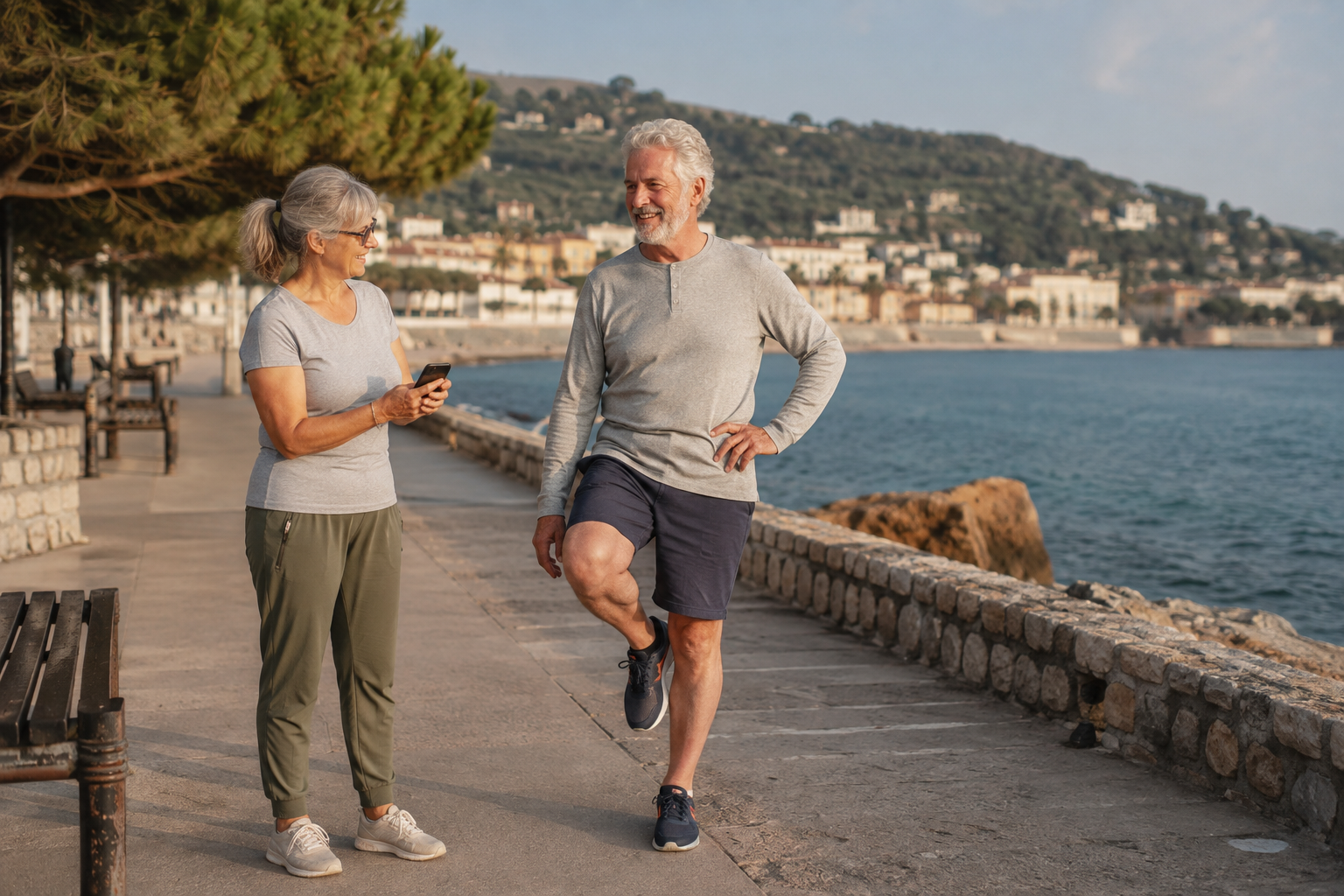
Here is the part that makes the test worth caring about even with the caveats. Balance is not like grip strength or stamina, which decline slowly and steadily across adult life. Balance holds up reasonably well and then, somewhere in the sixth decade, starts to go faster than the rest of you.
That timing is why a ten-second stand separates people so cleanly in exactly the 51 to 75 window the study looked at. Younger than that, almost everyone passes. Older than that, the pass rate falls off, and in the study the share who failed climbed steadily with each age band. Overall, roughly one in five of the participants could not complete the stand, and that share was heavily weighted toward the older end.
Balance is a coordination between three systems that most people never think about until one of them slips. There is the vestibular system in the inner ear, which senses the tilt and motion of your head. There is vision, which tells you where level is. And there is proprioception, the stream of sensation from the joints and the soles of your feet reporting where your body is in space. A young nervous system blends all three so smoothly that standing feels like nothing. With age, each channel dims a little, and the brain’s ability to fuse them slows, so the margin for error shrinks. A life spent mostly sitting lets that whole apparatus quietly rust, and the rust does not announce itself until the day you reach for a high shelf and the room tips.
The Real Reason to Guard Your Balance
Set the mortality statistic aside for a moment, because there is a more immediate reason this matters, and it is not abstract. Falls are the leading cause of injury death for older adults, and the numbers are large. In the United States, older-adult falls drive roughly 3 million emergency-room visits a year and around 1 million hospitalizations, and tens of thousands of deaths annually, with hip fractures and head injuries doing most of the lasting damage.
A person who can stand on one leg is a person less likely to go down when a rug slides or a curb surprises them, and the fall you never take is the hip you never break. This matters enormously because a hip fracture in later life is rarely just a broken bone. It is often the start of a decline, a hospital stay, a loss of independence, a cascade that the person never fully climbs back out of. In one widely cited figure, the great majority of hip-fracture deaths and hospitalizations trace back to a fall.
This is why the balance test is not just a party trick with a grim statistic attached. The U.S. fall-prevention framework used in clinics, called STEADI, already treats single-leg standing time as a screening tool, because it flags the people most likely to end up on that emergency-room list. The test is doing real work there, quietly, on the practical end where broken hips actually happen.
Balance Is a Skill You Can Get Back
None of this is fixed, and that is the point worth ending near rather than the mortality figure. Unlike your age, balance is something you can train, and it responds quickly, often within weeks. The systems involved are use-it-or-lose-it systems, which cuts both ways: neglect brings the decline forward, and practice pushes it back.
The public guidance already reflects this. The UK’s National Health Service recommends that adults over 65 do balance exercises on at least two days a week, alongside strength work on two days, precisely to hold onto physical function and stay steady on their feet. Balance training does not require a gym or equipment. Standing on one leg while the kettle boils, walking heel-to-toe down the hallway, rising from a chair without using your hands, a session of tai chi or yoga, all of it counts, and all of it is free. The grumbling uncle who aced the test had never done a balance exercise in his life, but he had spent sixty years walking everywhere and standing at bars rather than sitting in cars, and his nervous system had kept the receipts.
What Actually Moves the Needle
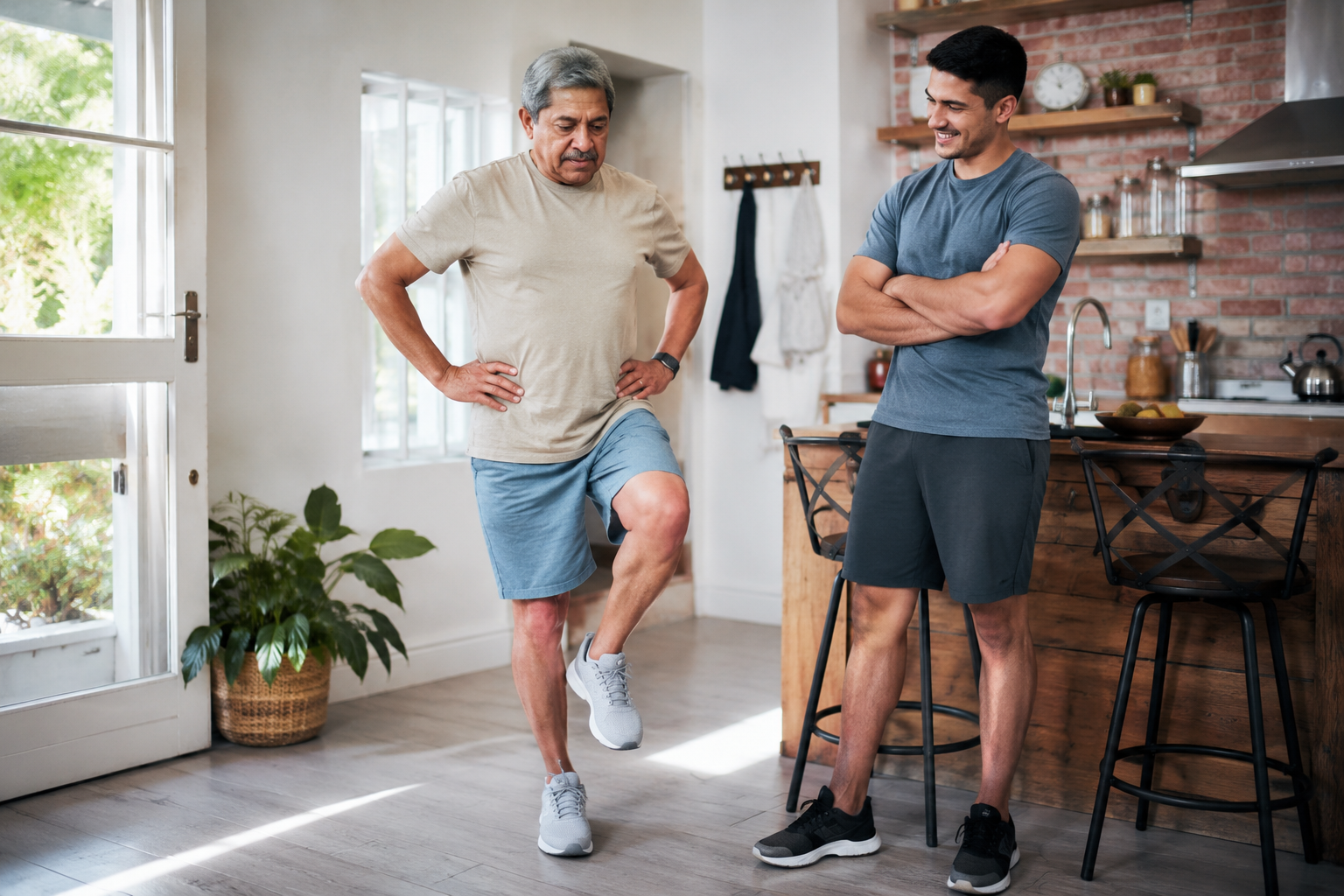
Balance training has a shape, and the shape is simply making the task a little harder as it gets easier. Someone starting from a shaky five seconds does not need to leap to standing on a cushion with their eyes shut. They need to hold the counter with two fingers instead of a whole hand, then one finger, then no fingers, then eventually the same stand with eyes closed, which removes the vision your body leans on and forces the inner ear and the feet to work harder. Each step is small and each one is free.
The everyday version matters more than any drill. Standing on one leg while brushing your teeth turns two wasted minutes a day into practice. Walking heel-to-toe along a hallway like a sobriety test trains the same system. Getting off the sofa without pushing with your hands is a sit-to-stand rep hiding in plain sight. Carrying the shopping in from the car on uneven ground, standing on the bus instead of grabbing a seat, taking the stairs, all of it feeds the coordination that the test measures. This is the environment-over-willpower truth of the whole thing: people whose daily lives keep asking them to balance rarely have to schedule balance, and people whose lives have quietly removed every demand for it are the ones who fail the stand without ever having chosen to.
Structured options work too, and some are genuinely enjoyable. Tai chi is close to a purpose-built balance program with centuries of practice behind it, and it is easy on the joints. Yoga does the same with more variety. A weekly class gives the two sessions the health guidance asks for, plus a room full of people the same age doing the same slightly wobbly thing, which is its own quiet encouragement.
Try It at the Counter, With a Chair Nearby
If you want to take the test, do it the safe way. Stand near a kitchen counter or a sturdy chair, close enough to catch yourself, take off your shoes, fix your eyes on a spot on the wall, and lift one foot so the front of it rests against the back of your other calf. Start a timer and see how long you hold it before you have to touch down or grab on. Try both legs, because they are often not equal, and the weaker one is the one worth practicing.
If ten seconds is easy, good, keep it that way by using it. If it is hard, that is information, not a sentence, and the fix is the most pleasant medicine there is: stand on one leg a little every day until the day it stops being hard. Then keep going, because the whole trick with balance is that it stays only as long as you keep asking for it.

About the Author: Ruben, co-founder of Gamintraveler.com since 2014, is a seasoned traveler from Spain who has explored over 100 countries since 2009. Known for his extensive travel adventures across South America, Europe, the US, Australia, New Zealand, Asia, and Africa, Ruben combines his passion for adventurous yet sustainable living with his love for cycling, highlighted by his remarkable 5-month bicycle journey from Spain to Norway. He currently resides in Spain, where he continues sharing his travel experiences with his partner, Rachel, and their son, Han.