
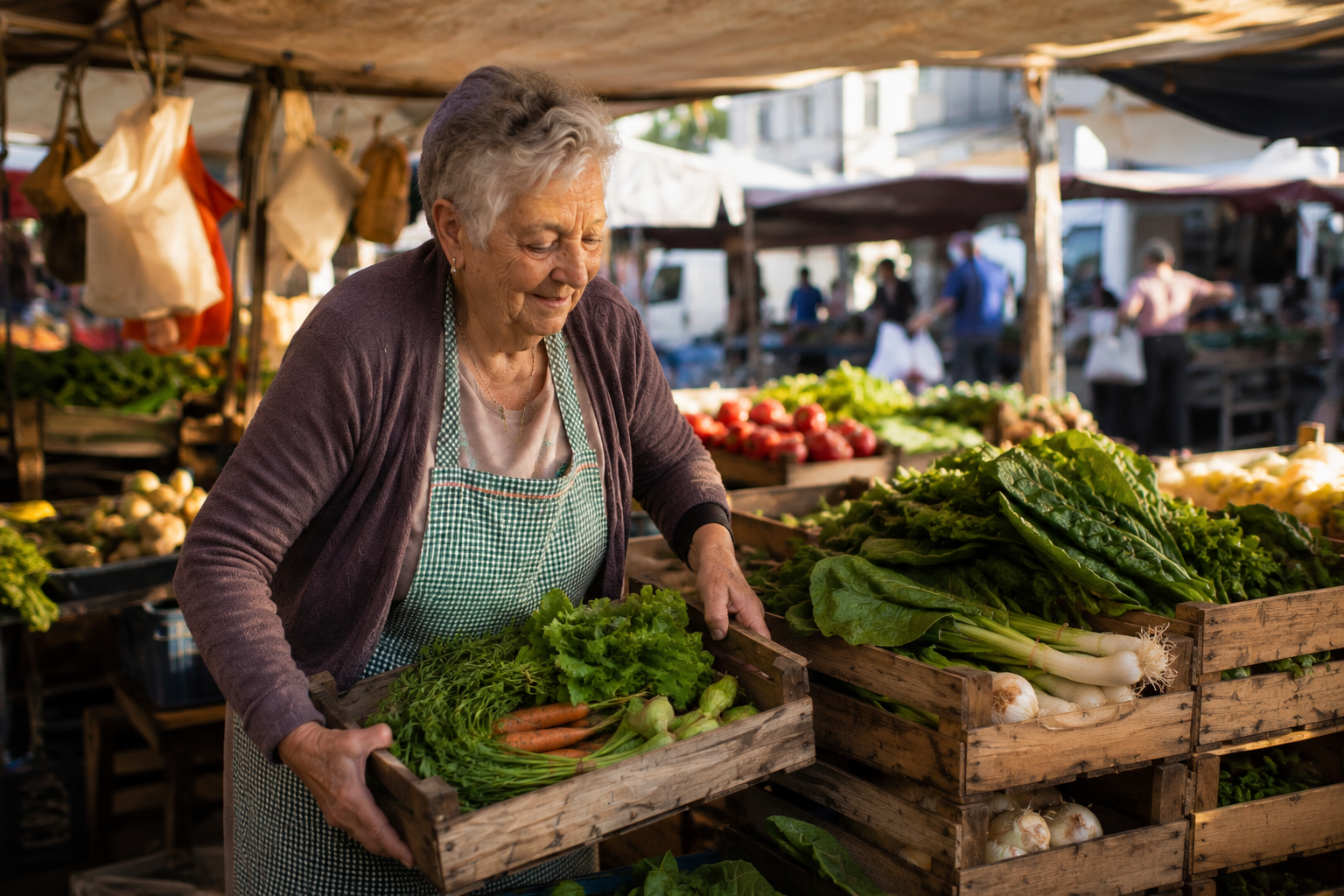
Long before most of the city has stirred, she is already at her stall, arranging tomatoes into gleaming pyramids with hands that have done this ten thousand mornings. She is somewhere past seventy, and she runs her corner of the market with an energy that would exhaust women half her age. In the covered markets of Spain, the mercados that anchor every neighborhood, these women are a fixture as reliable as the clock, presiding over their stalls of fruit, fish, meat and cheese with a quiet authority earned across a whole lifetime. They are not, for the most part, working out of any real financial desperation, but out of something harder to name, a mix of habit, pride, purpose and belonging that keeps them on their feet six mornings a week well into an age when most others have long since retired to their armchairs. To watch one of them move through a working day is to see a way of life that much of the world has forgotten, and to wonder whether her vigor is less a matter of luck than of the life itself. Here is that working day, hour by hour, as lived by the women who still run Spain’s market stalls at seventy-five.
What makes these women so compelling is not simply that they are still working, but how fully alive they seem, sharp, strong and utterly woven into the life around them. Theirs is not a grim endurance but an active, sociable, purposeful existence lived on their feet and among their people. Following the exact shape of their long day reveals not merely the rhythm of a Spanish market but a quiet argument about what keeps a person vital deep into old age. So let us walk through a single working day at the stall, from the dark hour before opening to the weary satisfaction of closing time.
Before the City Wakes
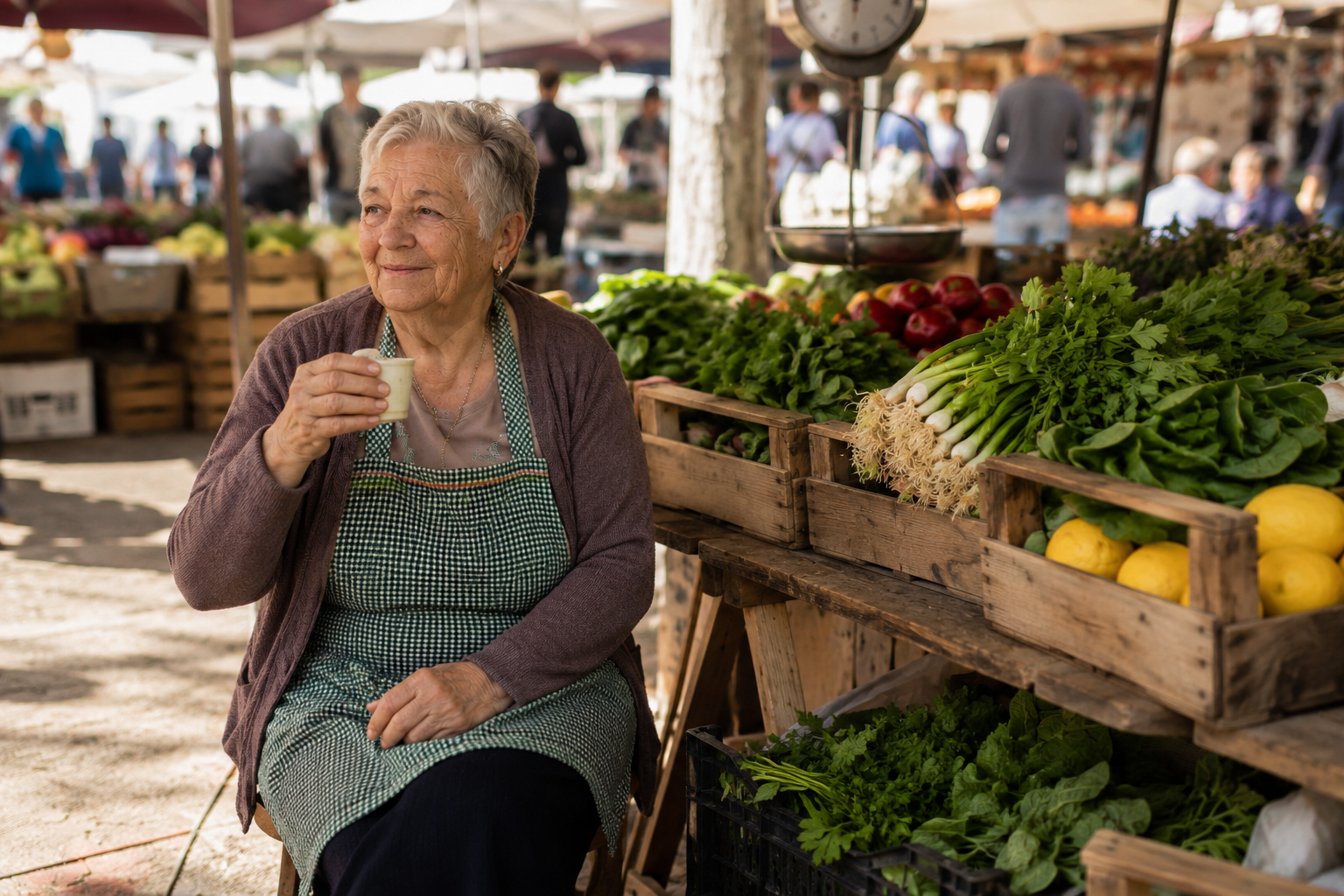
The day begins in darkness, hours before the first customer arrives, in the cold quiet that most people never see. This early start is the unglamorous foundation of everything that follows.
She rises with the dark. While the neighborhood still sleeps, she is already up, heading to the wholesalers to secure the freshest produce before anyone else, so her day starts at an hour most would consider the middle of the night. Decades of these pre-dawn beginnings have made them second nature, a rhythm her body knows better than any alarm clock. There is a particular quality to the market at that hour, the vans pulling in, the crates thudding onto the ground, the calls of the wholesalers and the clean smell of the cold sea still on the fish. She has known it all her working life, and there is a strange comfort in the ritual of it. While the rest of the whole city still dreams on, a small hidden world of early risers is already fully awake, and she is one of its undisputed queens.
The freshest goods go to the early. The reason for the brutal hour is simple and unforgiving, since the best fish, the ripest fruit, the finest cuts go to those who arrive first, so being early is not a virtue but a necessity of the trade. Her reputation rests on the quality of what she sells, and that quality is won in these dark, cold hours before the market even opens. She has a practiced eye that no supermarket buyer could match, pressing a fruit, sniffing a fish, turning over a head of lettuce, rejecting what does not meet her standard. Her customers trust her precisely because she has done this choosing on their behalf for so many years, and that trust is the foundation of everything. It cannot be won cheaply or quickly, only earned across decades of showing up and getting it right.
Building the Stall
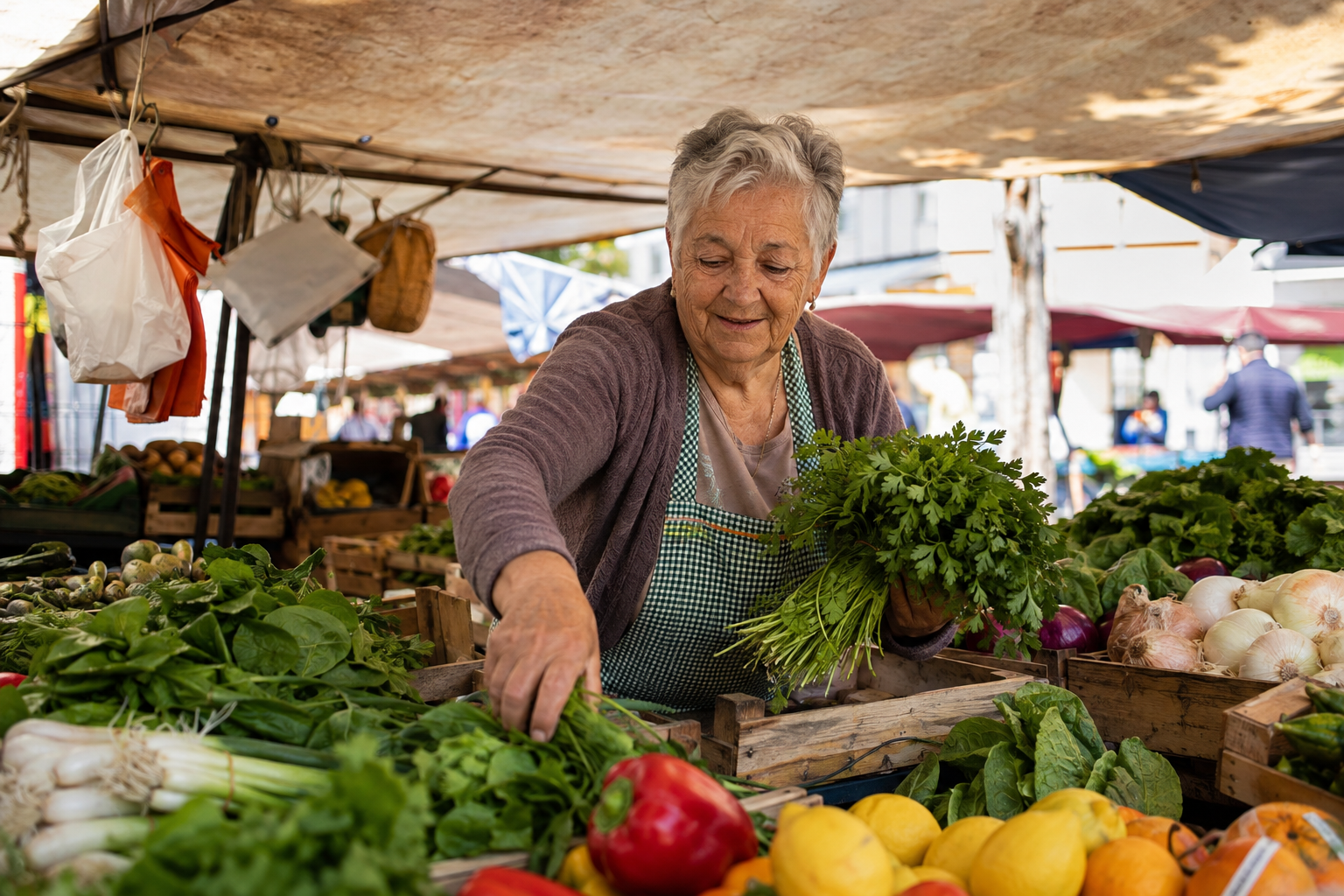
With her goods secured, the physical work of the morning begins, transforming an empty space into an inviting display through sheer practiced labor. The setup is a daily feat of strength and artistry combined.
She lifts, hauls and arranges. Crates must be carried, boxes unpacked, ice laid and everything arranged just so, work that is genuinely physical, and she performs it briskly despite her years, so the stall that looks so effortless by opening time is built by real muscle. There is nothing frail about a woman who hauls crates for an hour before breakfast.
Display is its own craft. Beyond the labor, there is an art to the arrangement, the tomatoes stacked into pyramids, the fish laid to catch the eye, the colors balanced to tempt, so the stall becomes a small daily work of art. Years of practice have taught her exactly how to make her goods irresistible, an instinct no newcomer could match. She knows that people eat first with their eyes, and so her stall is a performance of abundance and freshness, every item placed to look its best. The glistening rows, the careful gradations of color, the little flourishes of parsley or lemon, all of it is calculated to draw the eye and open the purse. It looks artless, which is the surest sign of a true art, honed over a lifetime until it appears to require no thought at all.
The Morning Rush
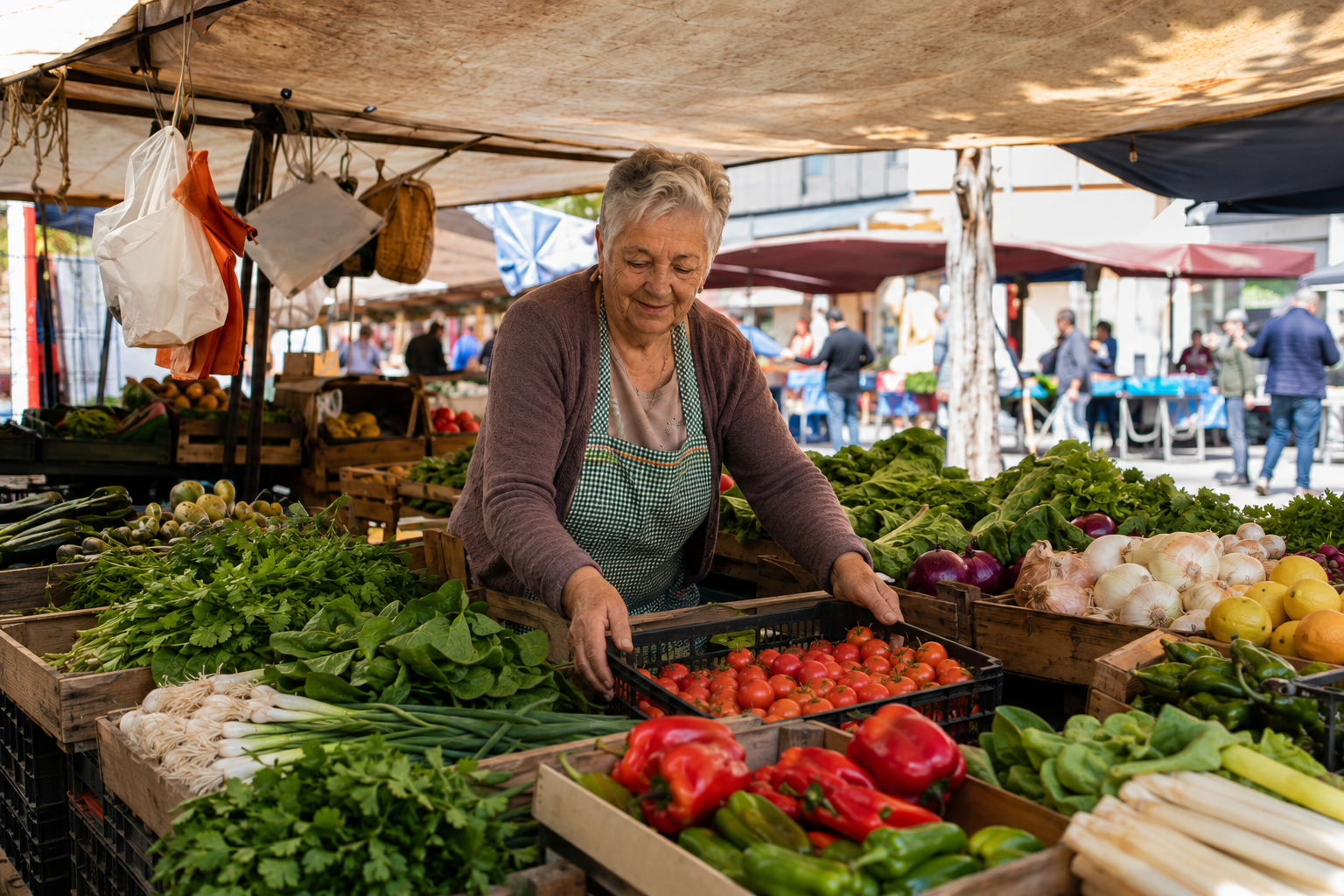
As the market opens and the neighborhood wakes, the pace quickens into the busy heart of the day, when her decades of skill are on full display. This is when the stall truly comes alive.
She moves with practiced speed. When the customers arrive in force, she weighs, wraps, calculates and makes change with a quickness born of endless repetition, so she serves a queue of people with an efficiency that never seems rushed. Her hands know the work so well that her mind is free to chat, charm, and track six orders at once.
Nothing escapes her attention. Even at her busiest she notices everything, who is waiting, which tomato is past its best, who needs an extra moment of care, so she manages the controlled chaos with total command. This sharp, constant alertness is as much a part of her vigor as any physical strength. A morning at the stall is a continuous exercise for the mind as well as the body, a stream of quick sums, snap judgments, names to remember and small kindnesses to dispense. There is no room for a wandering attention here, and perhaps that is part of the secret, that her mind, like her body, is given no chance to grow slack. The work demands everything of her, and in demanding it, keeps her whole.
Every Customer a Neighbor
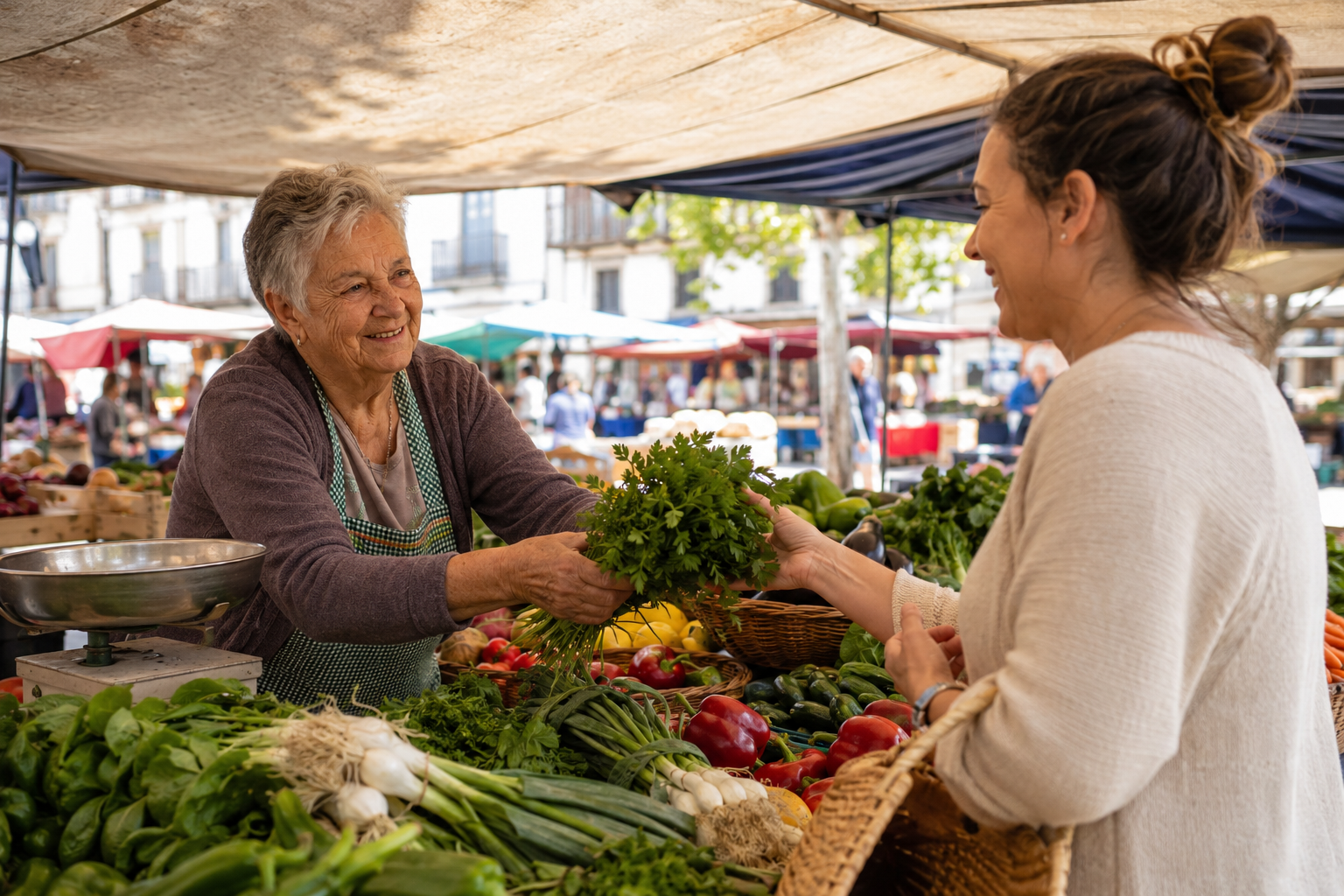
Threaded through all the commerce is something that makes the Spanish market unlike a supermarket, the deep web of personal connection between the woman at the stall and the people she serves. Her customers are not strangers but neighbors of many years.
She knows them all. Many of her customers have been coming to her for decades, and she knows their names, their families, their preferences, and their troubles, so each transaction is also a small act of friendship. She sets aside the good artichokes for one regular and asks after another’s grandchild, weaving the market into the fabric of the neighborhood. In a world where so much shopping has become anonymous and screen-mediated, her stall is a place where you are known, where your absence would be noticed and your return welcomed. For many of her older customers especially, the daily trip to see her may be one of the few reliable human exchanges of their day, and she knows it, and she gives it freely.
The stall is a social hub. Far more than a place to buy food, her stall is a spot to exchange news, to gossip, to check in, so she is at once a merchant, a confidante, and a pillar of her small community. This constant, warm human contact is one of the great sustaining pleasures of her work.
The Quiet Middle Hours
After the morning peak subsides, the market settles into a slower rhythm, a lull that offers a different but no less important part of the day. The quiet hours have their own rewards.
She catches her breath. As the rush fades, there is time to rest the feet, eat something, tidy the stall and take stock, so the relentless pace of the morning gives way to a gentler tempo. These pauses, brief as they are, punctuate the long day and let her gather herself for the hours still to come. A younger worker might spend them staring at a phone, but she is more likely to be found leaning across to the next stall, sharing a coffee and the day’s news, or perched on a stool with a bite of tortilla, watching the market breathe. The rhythm of her day, exertion and rest, bustle and quiet, is a humane one, closer to how bodies are meant to move than the unbroken sitting of modern work.
The real conversations happen now. In the quiet, the exchanges with lingering customers and neighboring stallholders grow longer and deeper, the jokes, the confidences, the long-running conversations of market life, so the slow hours are where much of the community happens. This unhurried sociability is a daily nourishment that few desk-bound jobs could ever provide. Loneliness is one of the quiet afflictions of old age in much of the modern world, yet it has little purchase on a woman who spends every morning at the center of a small, chattering community. She is surrounded by people who need her, tease her, depend on her, and value her, and that web of connection is as sustaining as any medicine. It is impossible to feel invisible when a whole neighborhood files past your stall to say good morning.
Breaking Down and Heading Home
As the market’s hours wind down, the day ends much as it began, with physical labor, this time in reverse, packing away what the morning had so carefully built. Closing is its own tired ritual.
She dismantles what she built. The unsold goods must be packed away or given to regulars, the ice cleared, the surfaces cleaned, the crates stacked, so the stall that took an hour to build must now be taken down again. It is more physical work at the end of an already long and demanding day, performed with the same brisk competence as the setup. Watching her break down the stall, you would never guess how many hours she has already been on her feet, or how early she rose to begin. The stamina is remarkable, but it is not the stamina of an athlete straining for a record. It is the deep, ordinary endurance of a body kept in constant, useful motion for so long that stopping would feel stranger than carrying on.
She heads home spent but satisfied. By early afternoon she is tired in her body but content from a day of honest, useful work among people she loves, so she goes home to rest with the deep satisfaction of a job well done. Tomorrow, before dawn, she will do it all again, and would not have it any other way. Ask her when she plans to retire and she is likely to laugh, or to look at you as if you had asked something faintly absurd. The stall is not a burden she longs to set down but the shape of her life, the thing that gives her days their purpose and their people. To stop would be to lose not just an income but an identity, and she is in no hurry to become someone who used to run a market stall.
What a Life on Her Feet Reveals
Stepping back from the details of the day, the life of the market woman offers a quiet lesson about what seems to keep a person strong and sharp deep into old age. Her vitality is no accident.
Movement, purpose, and people. Her days are filled with the three things that seem to sustain human beings best, constant physical movement, a real sense of purpose, and rich daily connection, so her way of life may be doing more to keep her vigorous than any pill or program could. She does not exercise for its own sake, nor does she follow any regimen at all. She simply lives a life that never stops moving, needing her, and surrounding her with company, and that turns out to be the finest regimen of all.
A model worth admiring. Without any grand theory of healthy aging, these women embody one simply by living it, showing that staying active, useful and connected may be the truest recipe for a long and vital life. That is the quiet wonder of the woman at the stall, that her ordinary working day, lived with strength and joy at seventy-five, is itself a kind of wisdom about how to grow old well.
So the next time you find yourself in a Spanish market, look past the gleaming produce to the older woman who arranged it all, and see in her something far more than a mere vendor. See a person who has built her whole long life around movement, work and community, and who remains, well past the age most people stop, entirely and admirably alive. Her stall is a small monument to a way of aging that asks for no gym and no retirement, only a reason to rise before dawn and a neighborhood that needs her there. We spend a great deal of effort, in the modern world, engineering health back into lives that have had movement and purpose and company designed out of them. The woman at the stall never lost them in the first place. Her long, vital old age is not something she pursues but something that flows naturally from a life still full of work worth doing and people worth doing it for.

About the Author: Ruben, co-founder of Gamintraveler.com since 2014, is a seasoned traveler from Spain who has explored over 100 countries since 2009. Known for his extensive travel adventures across South America, Europe, the US, Australia, New Zealand, Asia, and Africa, Ruben combines his passion for adventurous yet sustainable living with his love for cycling, highlighted by his remarkable 5-month bicycle journey from Spain to Norway. He currently resides in Spain, where he continues sharing his travel experiences with his partner, Rachel, and their son, Han.