
There is an old fisherman in a hundred Mediterranean harbors, past seventy and often well past it, who still takes his small boat out before dawn as he has every working day of his life. He would be quietly surprised to learn that his ordinary working day, the early rise, the physical labor, the fresh fish he eats, the long sociable hours among his neighbors, looks remarkably like the habits a cardiologist might sketch for a patient hoping to protect their heart. He is not following any advice, medical or otherwise, and he would likely laugh at the idea that his hard, salt-stained life is anything to envy. Yet when you lay his routine beside what large studies associate with cardiovascular health, the overlap is striking. None of this suggests that fishing is a heart treatment, or that any single life proves anything, because the science here is about broad patterns across populations, not promises for individuals. But there is something quietly instructive in watching how a traditional working day happens to contain so many of the things research has linked to a healthier heart. Here is that fisherman’s day, hour by hour, set against what the evidence actually says.
Before going further, a clear word of caution is in order, because a piece like this can easily be misread. Everything below describes associations observed in populations, not causes proven in individuals, and nothing here is medical advice or a plan anyone should adopt without proper guidance. A fisherman’s life is also truly hard and carries its own real risks, so this is an observation of an interesting overlap, not a romantic prescription. With that firmly in mind, let us follow the day and see where it meets the science. The point is not to hold the fisherman up as a model anyone should imitate, but to use his familiar, vivid routine as a window onto what the research really describes. A day is easier to picture than a study, and his happens to make several findings unusually concrete.
Before Dawn: The Day Begins in the Dark
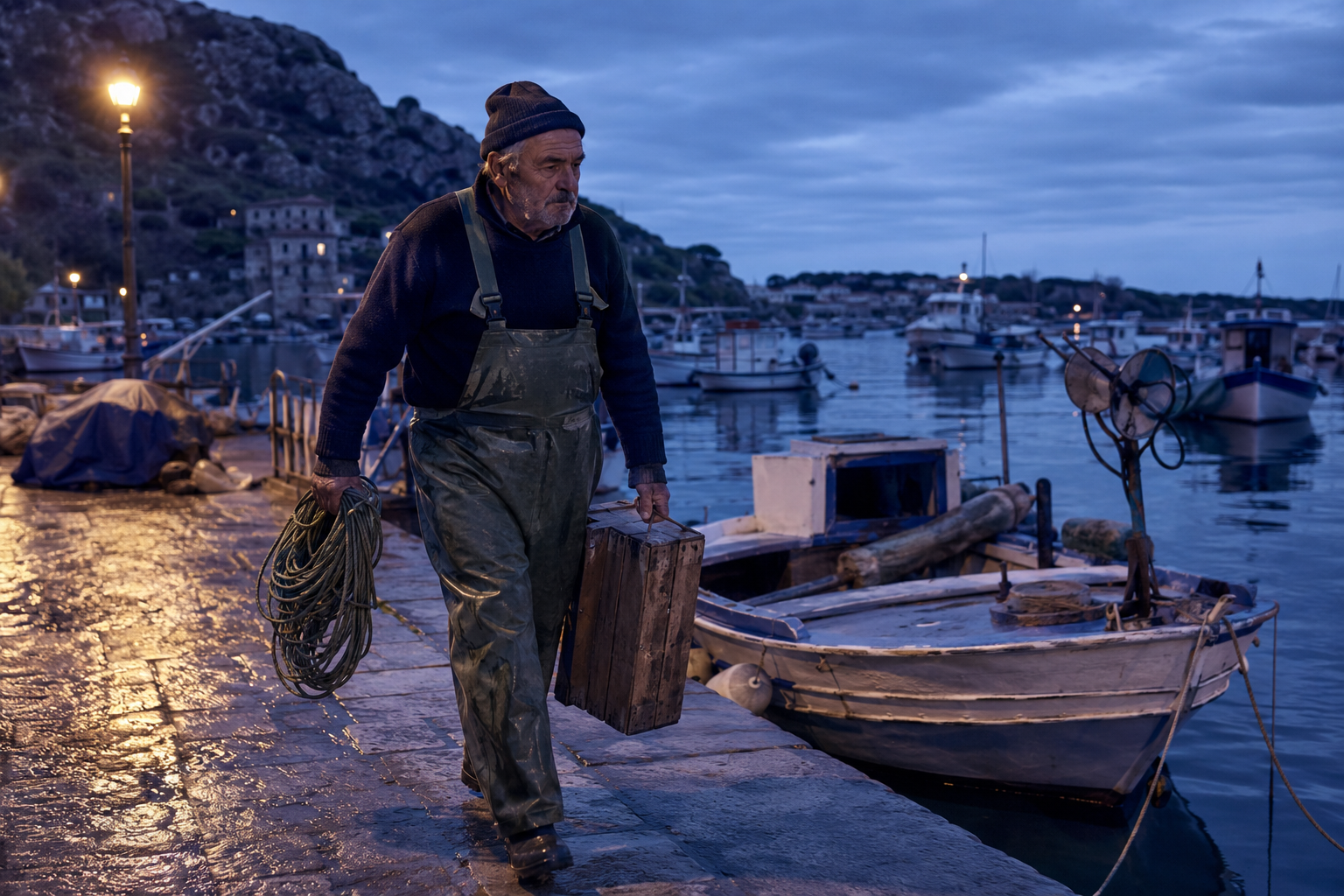
The fisherman’s day starts in a way most modern lives never do, with early rising and immediate physical activity, long before the sun is up. That combination sets the tone for everything that follows.
He rises early and moves at once. Well before dawn, the fisherman is up and heading to his boat, and within minutes he is engaged in real physical effort rather than easing into a sedentary morning, so his day begins with movement rather than stillness. This early, active start stands in sharp contrast to a modern morning of sitting, and it means his body is working from the very first hour. Where a typical day now begins with a commute spent seated and a desk waiting at the end of it, his begins with cold air, effort and purpose. None of this is to romanticize the hardship of it, the dark, the damp, the aching hands, but the plain fact is that his body is called into action at an age when many are encouraged to take things easy. The research on sedentary time has grown steadily more pointed, and a life that resists long sitting sits, so to speak, on the favorable side of it.
Activity woven through the day, not scheduled. What stands out is that his exertion is not a workout he must remember to do but simply the nature of his work, so physical activity is built into his life rather than added to it. The World Health Organization points to regular moderate activity as important for cardiovascular health, and the fisherman accumulates it without ever calling it exercise. There is something worth pausing on in that distinction. So much modern effort to be healthy involves carving out separate time for movement, a class, a run, a session at the gym, all of it easily skipped on a busy or tired day. The fisherman never faces that choice, because his activity is inseparable from his livelihood. He cannot skip the rowing without failing to fish, and so the movement simply happens, reliably, year after year, in a way that no amount of good intention can quite match.
The Morning Haul: Real Physical Work
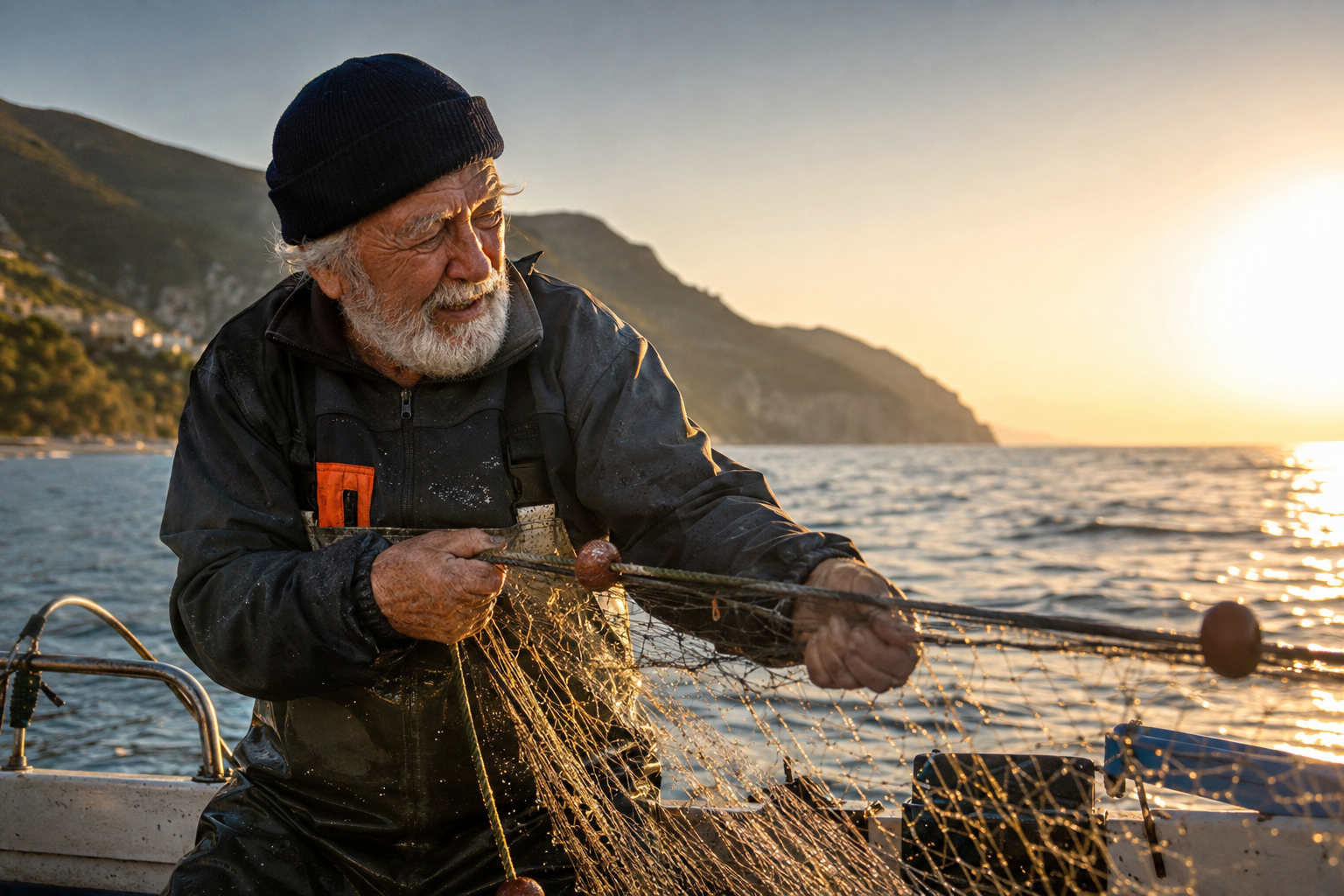
Out on the water, the heart of the morning is labor, the steady, demanding, rhythmic work of fishing that keeps his body genuinely active for hours. This is the engine of his physically active life.
The work is sustained and moderate. Rowing, hauling nets, lifting catch, and managing the boat give hours of continuous, moderate effort, the kind of steady activity that research has broadly associated with cardiovascular benefit. His morning is, in effect, a long session of the sort of movement that guidelines encourage, performed simply as the day’s work.
It engages the whole body. Unlike a narrow gym routine, the varied physical demands of fishing use the whole body in natural, functional ways, so his strength and mobility are maintained through use rather than deliberate training. Decades of this daily labor help explain the capable, unfrail vigor so often seen in these older working men, though of course many factors shape any individual’s health. It is worth stressing that word association again here, because it would be easy to slide from noticing his strength into assuming the work simply made him strong. The truth is more tangled. The men who are still fishing at seventy are, by definition, the ones who stayed well enough to keep going, and that alone complicates any simple story. What can be said fairly is that a life of functional, whole-body movement aligns with what research broadly favors, not that it guarantees anything for anyone.
The Catch on the Plate: A Diet Studied for Decades
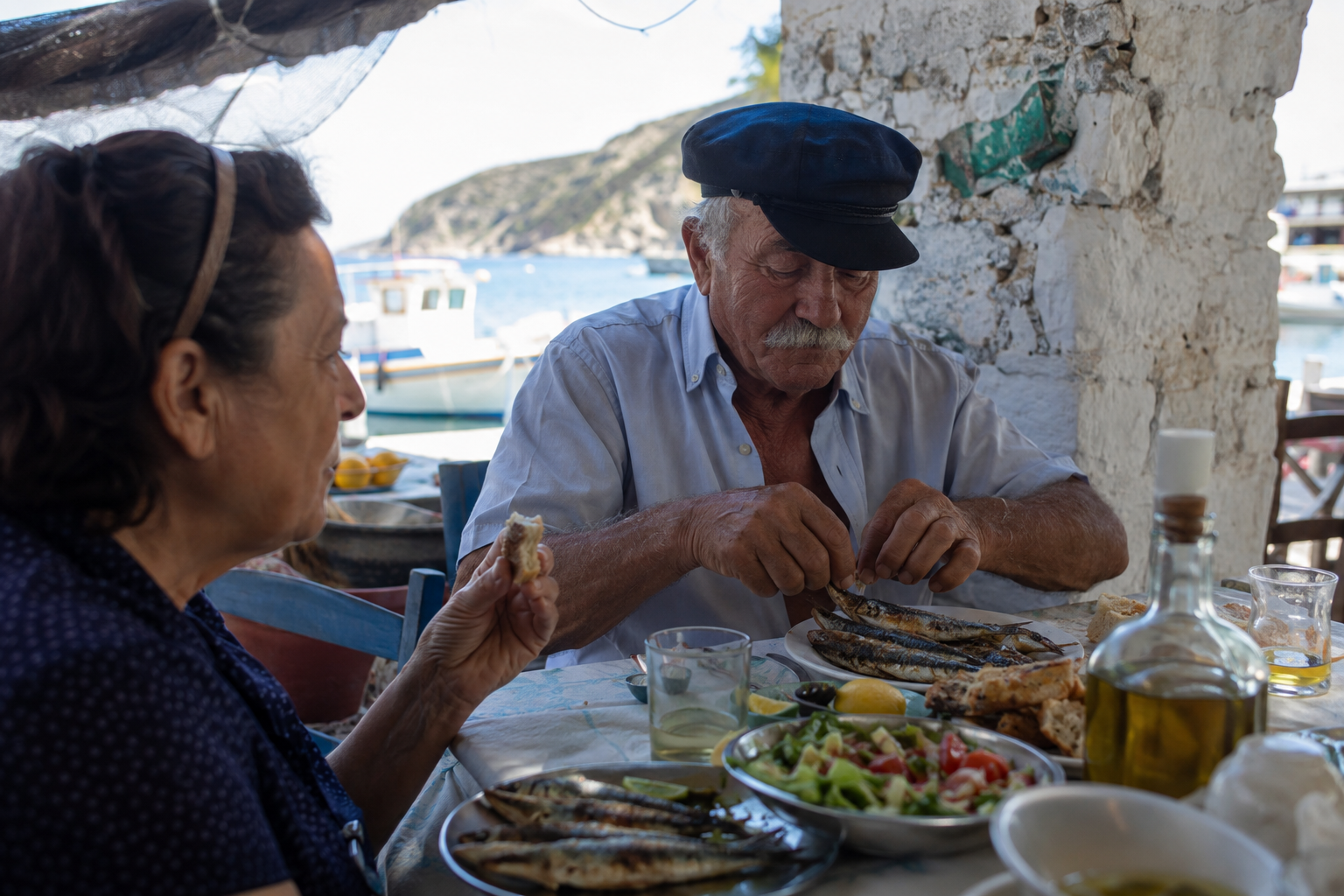
What the fisherman eats is as notable as how he moves, because his traditional diet closely resembles the eating pattern most studied for heart health. The fish he catches is at the center of it.
Fish sits at the heart of his diet. The fisherman naturally eats a good deal of fresh fish, including oily varieties like sardines that are rich in omega-3 fatty acids, and regular fish consumption has been associated in reviews with lower rates of fatal coronary heart disease. The American Heart Association has long suggested eating fish about twice weekly, a target the fisherman effortlessly exceeds.
His whole pattern is the Mediterranean diet. Beyond fish, his plate tends toward olive oil, vegetables, legumes, and whole grains with little red meat, the very pattern tested in the large Spanish trial known as PREDIMED, in which a Mediterranean diet with olive oil or nuts was associated with fewer major cardiovascular events than a control diet. He is not dieting, he is simply eating the food of his place, which happens to be among the most studied for the heart. This, too, is worth dwelling on, because his diet was never a health strategy but a matter of what the sea and the land around him provided. The fish came from his own nets, the oil from local olives, the vegetables from nearby gardens, and the whole pattern was shaped by geography and tradition rather than nutrition science. That the researchers later found so much to admire in it is, from his point of view, beside the point. He simply ate what there was, and what there was happens to be what the studies keep returning to.
Back at the Harbor: A Life Among People
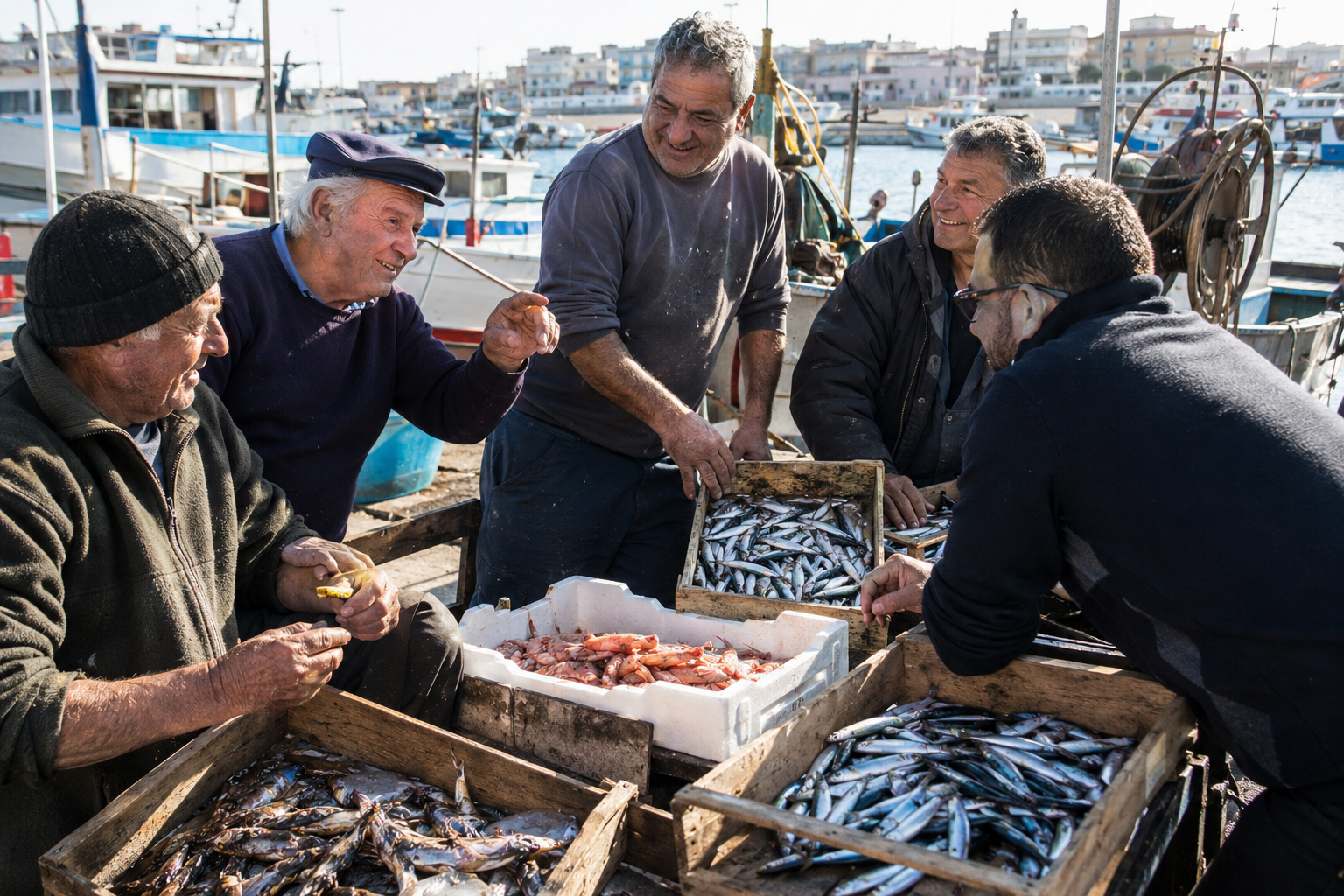
When the boat returns, the day shifts from solitary labor to something deeply social, the web of connection at the harbor that is as much a part of his life as the fishing itself. This social fabric matters more than it might seem.
The harbor is a community. Selling the catch, mending nets, and trading news with the same faces day after day surrounds him with familiar faces and constant human contact, so he remains embedded in a tight, familiar community rather than isolated. This kind of rich, daily social connection is woven right through his working life.
Connection has been linked to survival. A widely cited analysis of many studies found that people with stronger social relationships showed a higher likelihood of survival over time, an association that researchers compare in magnitude to other well-known major health factors. The fisherman’s crowded, sociable days sit naturally on the healthier side of that pattern, again as a matter of association rather than any guarantee. Isolation is one of the quiet risks of growing old, as friends fall away and the world narrows, yet the fisherman remains needed and known, greeted by name at the quayside every single morning. His work keeps him in constant company almost by default, and that steady belonging is not a small thing. Researchers increasingly treat social connection as a serious factor in health, not a soft extra, though here as everywhere the evidence describes tendencies across groups, not certainties for any one life.
The Afternoon: Rest and Rhythm
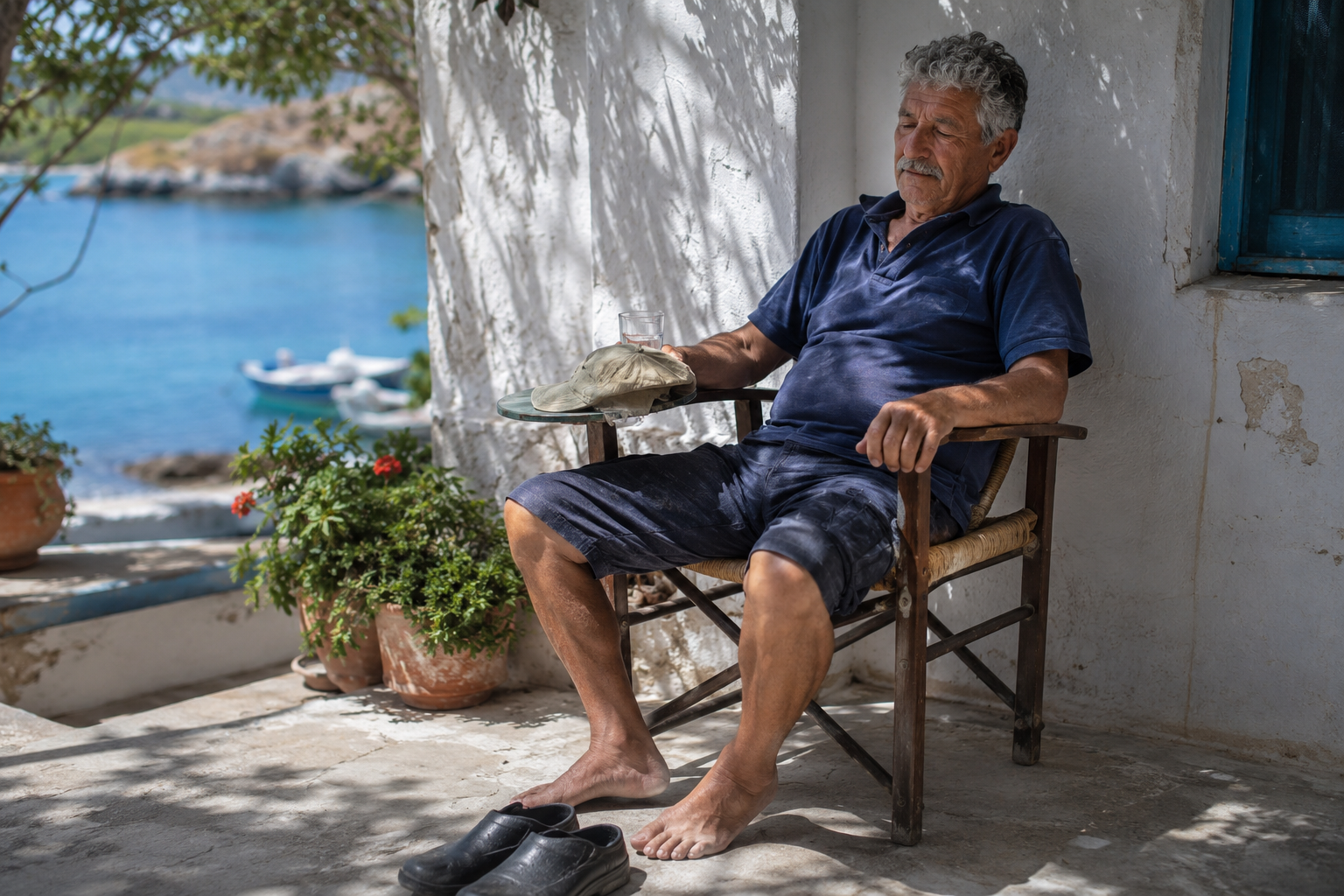
After the exertion of the morning comes rest, and the pattern of hard work followed by genuine recovery gives his day a rhythm that modern life often lacks. That rhythm may matter as much as the activity.
Exertion is balanced by recovery. Having worked hard from before dawn, the fisherman rests properly in the afternoon, so his day alternates real effort with real recovery rather than blurring into constant low-grade stress. This clear rhythm of work and rest is a world away from the unbroken, sedentary tension of many modern days.
Routine brings a kind of calm. The deep predictability of his days, governed by the sea, the seasons, and long habit, lends his life a steadiness unlike the chronic, scattered stress research links to poorer heart health. His is not a stress-free life, far from it, but it has a shape and a rhythm that many modern lives have lost. The sea can be dangerous, the income uncertain, the body tired, and none of that should be waved away. But the stress of it tends to be acute and situational, a storm, a poor catch, followed by real rest, rather than the low, constant, never-quite-switching-off pressure that so many carry now. There is a difference between hard work that ends and hands you a quiet evening, and a diffuse modern busyness that never fully releases its grip.
Why a Cardiologist Would Recognize This Day
Laying the whole day out, the reason it echoes medical advice becomes clear, because it happens to contain several of the very things cardiovascular research keeps pointing toward. The pattern, not any single piece, is what stands out.
The pillars line up. Regular activity, a fish-rich diet, social connection, and a rhythm of rest are all associated in population research with cardiovascular health, and the fisherman’s day contains all of them together. It is the combination, accumulated steadily over a whole lifetime, that makes his ordinary routine resemble a cardiologist’s wish list, and he arrived at all of it entirely by accident.
But association is not a promise. It is crucial to be clear that this overlap does not prove his way of life caused good health, since populations are not individuals and countless other factors, from genetics to luck, shape any one person’s heart. What the fisherman’s day offers is not a proven cure but a real-world picture of a pattern research links, on average, to a healthier heart.
What His Day Can and Cannot Teach
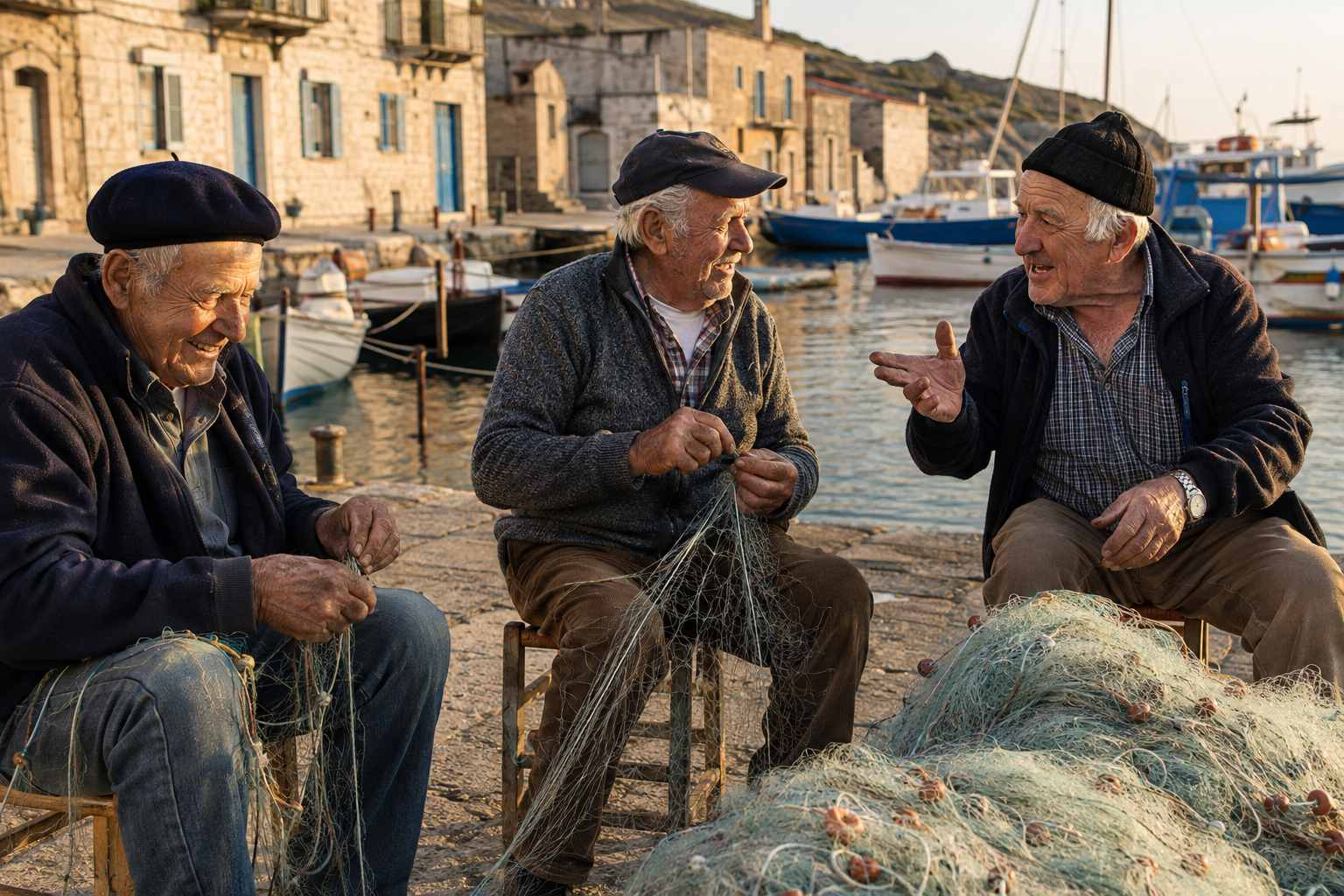
Taken as a whole, the fisherman’s routine is worth reflecting on not as a program to copy but as an illustration of how a certain kind of life aligns with what the evidence tends to favor. Its lesson is gentle, not prescriptive.
The elements travel, even if the life does not. Few of us can or would become fishermen, but the elements of his day can be borrowed by ordinary modern lives in their own ways. That is the quietly useful takeaway, not the boat and the nets, but the shape of a day that keeps a person moving, fed well, connected, and rested.
An observation, not an instruction. In the end, the old fisherman is not a health guru and his life is not a treatment plan, but his ordinary day is a striking, real example of how the things research associates with heart health can be woven naturally into a life. He teaches by simply living, and the rest of us are free to notice, to admire, and to take from it whatever gently fits our own very different lives. Perhaps that is the kindest way to receive a story like his, not as a stern instruction to overhaul everything, which rarely lasts anyway, but as a gentle picture of a life in which the healthy things were never separate chores but simply how the days were spent. A little more movement woven into ordinary errands, a few more shared meals, a bit more real rest, none of it requires a boat, and all of it leans in the direction his life happens to point.
So the next time you picture an old fisherman heading out before dawn, see gently past the easy romance of it to the quiet pattern underneath, a day built, quite by accident, around movement, good food, company, and rest. It is not a prescription, and it proves nothing about any single person, but it is a beautiful reminder that some of what protects the heart may be found not in a clinic but in the ordinary shape of a well-lived, active, connected day.

About the Author: Ruben, co-founder of Gamintraveler.com since 2014, is a seasoned traveler from Spain who has explored over 100 countries since 2009. Known for his extensive travel adventures across South America, Europe, the US, Australia, New Zealand, Asia, and Africa, Ruben combines his passion for adventurous yet sustainable living with his love for cycling, highlighted by his remarkable 5-month bicycle journey from Spain to Norway. He currently resides in Spain, where he continues sharing his travel experiences with his partner, Rachel, and their son, Han.