

The first thing you notice about laundry in Spain is that nobody seems to own a tumble dryer, and the balconies are full of clothes flapping in the sun. The second thing you notice, if you pay attention, is that people wash in cold water, use little detergent, and do not launder every garment after one wearing the way many of us were raised to. It looked, frankly, like less effort and less expense for the same result, so I decided to test it. For one month I would do my laundry the Spanish way, washing everything in cold water, drying every load on a line, cutting my detergent roughly in half, and generally treating laundry as the relaxed, low-energy chore it appears to be here in Spain. This is the honest account of that month, what surprised me, and what I have quietly carried on doing ever since the month ended. This draws on a representative composite of common household experiences rather than one exact case, and it is a light domestic experiment rather than expert laundry or appliance advice.
What makes an experiment like this worthwhile is that laundry, like much of domestic life, runs almost entirely on inherited habit, on the way we watched it done growing up, rather than on any considered decision about what really works. Many of us wash hot, tumble dry everything, and pour a generous cap of detergent simply out of habit, never pausing to ask whether it is necessary. Testing a completely different but equally successful approach, the one used by an entire country, is a low-risk way to find out just how much of our routine is truly essential and how much is just momentum. If it goes badly, you have lost a month. If it goes well, you may well have simplified a whole chore for life.
Here is what doing laundry the Spanish way actually involves, how my month of cold washes and line drying unfolded, what surprised me most, and what I took from the whole experiment. This is a relaxed personal account rather than advice of any kind, and everyone’s clothes, machines and circumstances differ, so nothing here is a recommendation for your household, but my little experiment might make you look at your own laundry routine with fresh eyes.
The Spanish Way of Laundry

Before starting, it helped to understand the approach I was adopting, because the Spanish way is a coherent set of habits rather than a single trick, all pointing toward gentleness and economy. The whole philosophy is lighter.
Cold water and less of everything. The norm leans toward washing cold, using modest detergent, and running the machine efficiently, so the whole process uses far less energy and product than the hot, heavy approach many are used to. It is a routine built around doing enough rather than doing the most. There is no sense of corners being cut or standards being lowered, only of effort matched sensibly to what the task really requires. Spanish clothes are not dingy or grey, and Spanish homes do not smell of laundry left too long, so the lighter approach plainly works. It simply reflects a different starting assumption, that you should use the least that gets the job done well, rather than the most that money and habit allow, and that assumption quietly saves energy, product and wear on everything that goes through the wash.
The sun does the drying. Rather than a tumble dryer, the Spanish household relies on the line, hanging clothes in the open air on a balcony, terrace or rack, so the sun and breeze do for free what a machine does at some expense. Air drying is perhaps the most visible and defining feature of laundry across the country.
Setting Up My Experiment
To give the month a fair trial, I laid down a few simple rules, a clear picture of what living like a Spanish household would mean for my washing. I kept them straightforward.
Cold, halved and hung. My rules were simple, wash everything cold, use roughly half my usual detergent, and dry every load on a line rather than the dryer, so the experiment captured the core of the Spanish approach. These three changes together were the heart of the whole test.
Wash a little less often, too. I also stopped automatically washing lightly worn clothes after one use, airing them and wearing them again where sensible, so I was laundering less frequently as well as more gently. This felt like the natural companion to the other changes, and part of the same unhurried spirit. So much laundry, I realized, is generated not by genuine dirt but by reflex, the automatic toss of a barely worn jumper or a once-sat-in pair of trousers straight into the basket. Airing such things and giving them a second wearing, as is common in Spain and much of Europe, cut my laundry pile noticeably without any cost to how clean or presentable I was. It also meant my clothes spent less time being washed at all, which is gentler on them than any change of temperature or detergent.
The First Loads
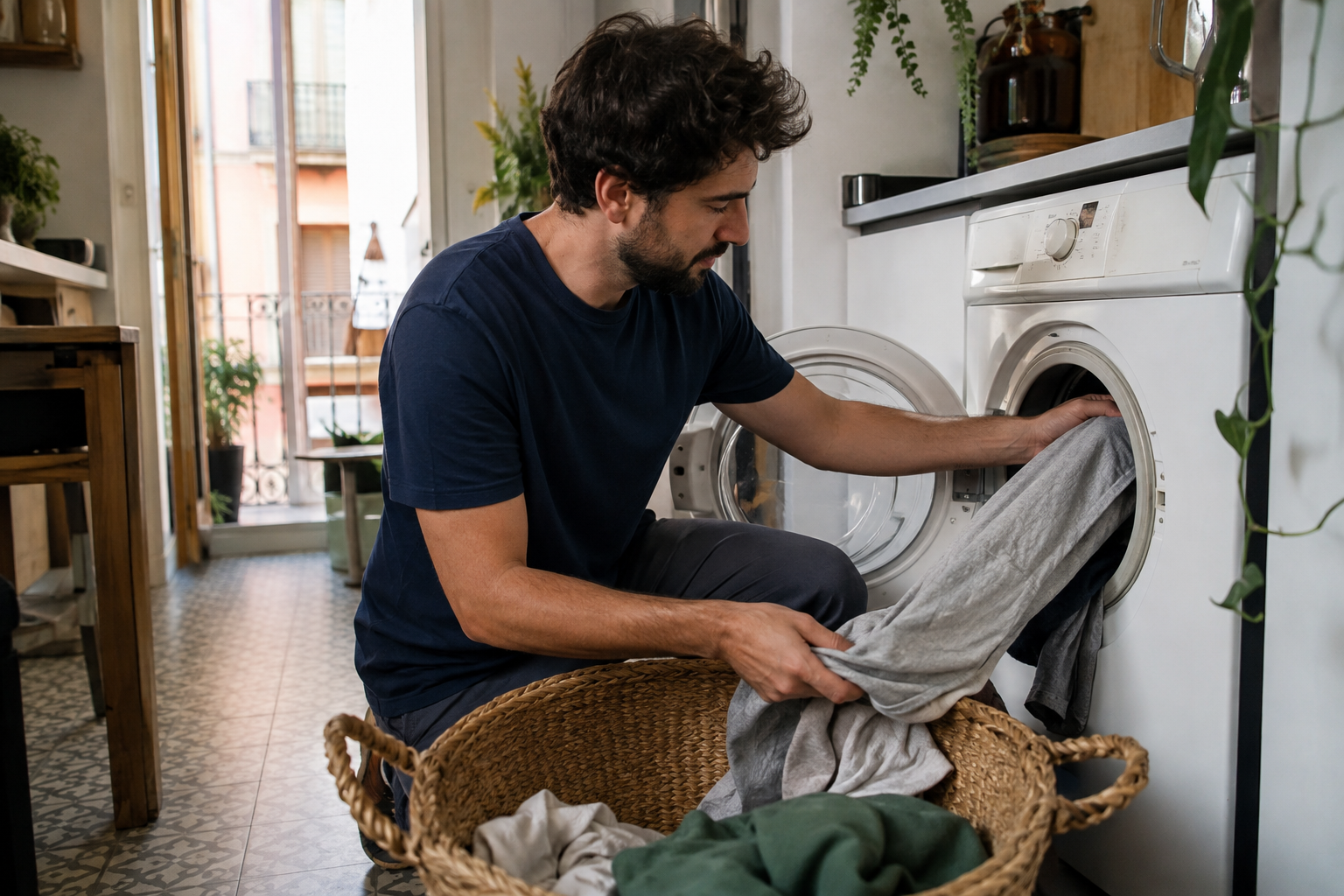
The beginning brought the usual flutter of doubt, since a lifetime of hot washes and tumble drying had left me quietly convinced that cold water and half the detergent could not possibly get things properly clean. Those first loads were where my skepticism lived.
I doubted the cold water most. My deepest worry was that washing in cold water simply would not clean my clothes, a fear rooted in the belief that heat was doing essential work, so I approached those first cold loads braced for grubby, disappointing results. The anxiety was concentrated entirely on whether cold could truly get things clean. I had grown up with the firm conviction that hot water was doing the real work, that heat was what lifted dirt and killed whatever needed killing, and that cold was a poor substitute you settled for only with delicates. Letting go of that belief felt oddly difficult for something so mundane, a measure of how deeply these inherited assumptions run. I loaded those first cold washes half expecting to have to redo them, braced for the small failure that would prove the old way right after all.
The results quietly reassured me. To my surprise, the clothes came out of those first cold washes perfectly clean, looking and smelling exactly as they should, which began to unsettle my long-held assumptions, so the feared failure simply did not appear. Modern detergents are designed to work well in cold water, and my clothes were living proof. This turned out to be the crux of the whole cold-water question. The formulas have quietly improved over the years, and the enzymes that do most of the cleaning now work perfectly well at low temperatures, so the case for hot water has weakened without most of us noticing. My grandmother’s insistence on a hot wash made sense for the products of her day, but clinging to it now simply spends energy heating water for no real benefit. Once I saw my own laundry come out clean and fresh from a cold cycle, the habit lost its last hold on me.
Learning to Love the Line

The part of the experiment I expected to find most inconvenient, drying everything on a line, turned out to be the part I came to enjoy the most, in ways I had not anticipated at all. The line changed more than my laundry.
Line drying was slower but better. Air drying does take longer than a machine and requires a little planning, yet the clothes emerged fresh, sun-scented, and gentler for the lack of tumbling heat, so the small inconvenience came with real rewards. There is a particular freshness to line-dried laundry that no machine reproduces, and I grew rather fond of it. There is a small daily pleasure in hanging out a load of washing, a few quiet minutes in the fresh air that feel more like a pause than a chore. Bringing it in later, dry and warm from the sun and smelling faintly of outside, is one of those humble domestic satisfactions I had never experienced with a machine. What I had expected to resent as an inconvenience turned into a part of the day I mildly looked forward to, which was not at all what I had signed up to discover.
It was kinder to my clothes. Without the harsh heat and friction of a dryer, my clothes seemed to fare better, with less of the wear a tumble dryer inflicts over time, so the gentler method appeared to be extending their life. The grey lint a dryer collects is really your clothes being quietly worn away.
What Half the Detergent Revealed
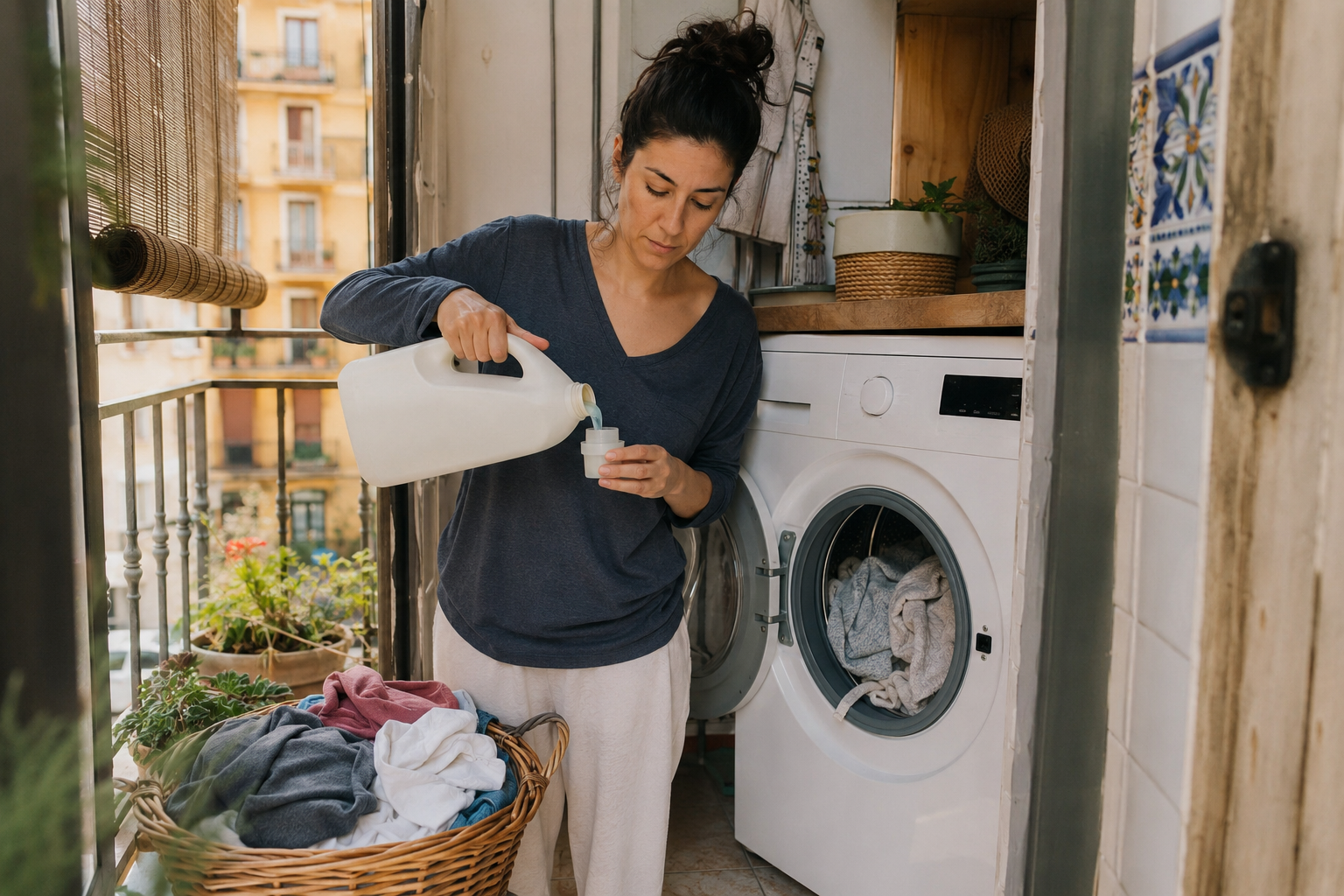
One of the most striking discoveries of the month concerned detergent, and just how much of it I had been pouring away without any benefit, a small revelation with a satisfying edge. I had been wasting product for years.
Half was plenty. Using roughly half my usual detergent, my clothes came out just as clean, which made it plain that I had been habitually using far more than the job required, so much of my old detergent use had simply been waste. The recommended amounts and my own heavy hand had led me to use double what was truly needed.
Less product, cleaner rinse. Beyond the saving, using less detergent meant it rinsed away more completely, leaving no residue, so the reduction improved the result rather than harming it. It was a rare case where doing less produced a genuinely better outcome, not merely an equal one. Detergent is easy to overdose precisely because more feels safer, as though a heavier pour must mean cleaner clothes, when in fact the excess simply fails to rinse out and lingers in the fabric. Scaling back left my washing softer and free of that faint stiffness and residue I had never quite registered as a problem until it was gone. It was a small but genuine lesson in how our instinct that more must be better can quietly work against us.
The Costs and the Savings
By the end of the month, the practical effects on my household were clear enough to tally, and they landed firmly on the positive side of the ledger, with only minor trade-offs. The economics were plainly favorable.
The savings were real. Skipping the dryer and halving detergent meant markedly less electricity and product, which added up to a real reduction in running costs over the month, so the Spanish approach was simply cheaper. These were not dramatic sums, but they were steady and ongoing, the kind of small saving that compounds quietly over a year. The tumble dryer is one of the hungrier appliances in a home, and simply not running it made a visible difference, while the detergent lasted twice as long as before. Taken together over months, the reduced spending was the sort of quiet economy that never announces itself but truly adds up, achieved without the slightest sense of going without.
The only cost was a little planning. The one real trade-off was that line drying requires forethought, since clothes are not ready in an hour and bad weather demands a rethink, so the method asks for a little organization in return for its savings. This proved a minor adjustment rather than a real hardship, and one I got used to quickly. Within a week or two it had become second nature to put a wash on in the morning so it could dry through the day, and to glance at the sky before deciding what to launder. On the rare wet day, an indoor rack or a slightly longer drying time handled it without drama. The forethought the method asks for is modest, the kind of small rhythm a household falls into naturally, and it never once felt like the burden I had feared it might be.
What the Month Taught Me

The lasting lesson of my month of Spanish laundry is that the hot, heavy, dryer-dependent routine I had always followed was largely unnecessary, and that a gentler, cheaper approach cleaned my clothes just as well while treating them better and costing less. Almost everything I had assumed was essential turned out to be optional.
What made the experiment so satisfying was discovering that the easier, lighter way was not a compromise but in several respects an improvement, cleaning as well, saving money, extending the life of my clothes, and giving them a freshness I had not known I was missing. Doing less, it turned out, produced a better result across the board, which is a rare and pleasing thing to find. Usually simplifying something means accepting a slightly worse outcome in exchange for the ease, but here the ease and the improvement arrived together, hand in hand. That is what made the month stick with me rather than fading like most experiments, and why several of these habits are simply how I do laundry now.
So if your laundry routine runs on the hot-water, tumble-dry, heavy-detergent habits many of us inherited, you might consider borrowing a page from the Spanish household and trying a gentler month of your own. Wash cold, hang your clothes in the air, use less detergent, and see whether, like me, you find that the easier way cleans just as well, costs less, and leaves everything fresher. You may discover, as I did, that a whole country has quietly been doing this chore better all along, and that joining them costs you nothing but the loss of a few unnecessary habits.

About the Author: Ruben, co-founder of Gamintraveler.com since 2014, is a seasoned traveler from Spain who has explored over 100 countries since 2009. Known for his extensive travel adventures across South America, Europe, the US, Australia, New Zealand, Asia, and Africa, Ruben combines his passion for adventurous yet sustainable living with his love for cycling, highlighted by his remarkable 5-month bicycle journey from Spain to Norway. He currently resides in Spain, where he continues sharing his travel experiences with his partner, Rachel, and their son, Han.