
Somewhere in a country restaurant in Andalusia right now, a pan of potatoes is cooking very slowly in a generous pool of olive oil, softening rather than crisping, mingling with green pepper and onion and garlic until the whole thing turns meltingly tender and fragrant. This is patatas a lo pobre, poor man’s potatoes, and despite the humble name and the handful of cheap ingredients, it is, to my mind, the finest side dish in all of Spanish cooking. It takes the plainest things imaginable, potatoes and peppers and onions, and through nothing more than good olive oil and a little patience turns them into something so deeply savory and satisfying that it can quietly steal the show from whatever it was meant to accompany. It is truly peasant food at its most triumphant.
The beauty of patatas a lo pobre is that its greatness comes entirely from technique, not from any luxury in the ingredients. There is nothing expensive or fancy here, just the everyday contents of a modest kitchen, transformed entirely by the simple decision to cook them slowly and gently in plenty of good olive oil until they surrender completely. This is the genius of so much traditional Spanish cooking, coaxing extraordinary flavor from ordinary things, and few dishes embody it as perfectly as this one.
Here is what patatas a lo pobre actually is, why the slow, gentle cooking is the whole secret, and exactly how to make Spain’s best side dish at home. There is a real recipe below, the traditional Andalusian method, so you can bring this humble marvel to your own table. Once you taste those soft, oil-slicked potatoes shot through with sweet pepper and onion, you will understand why the poorest-sounding dish in Spain is one of the most beloved.
Humble Food from Andalusia
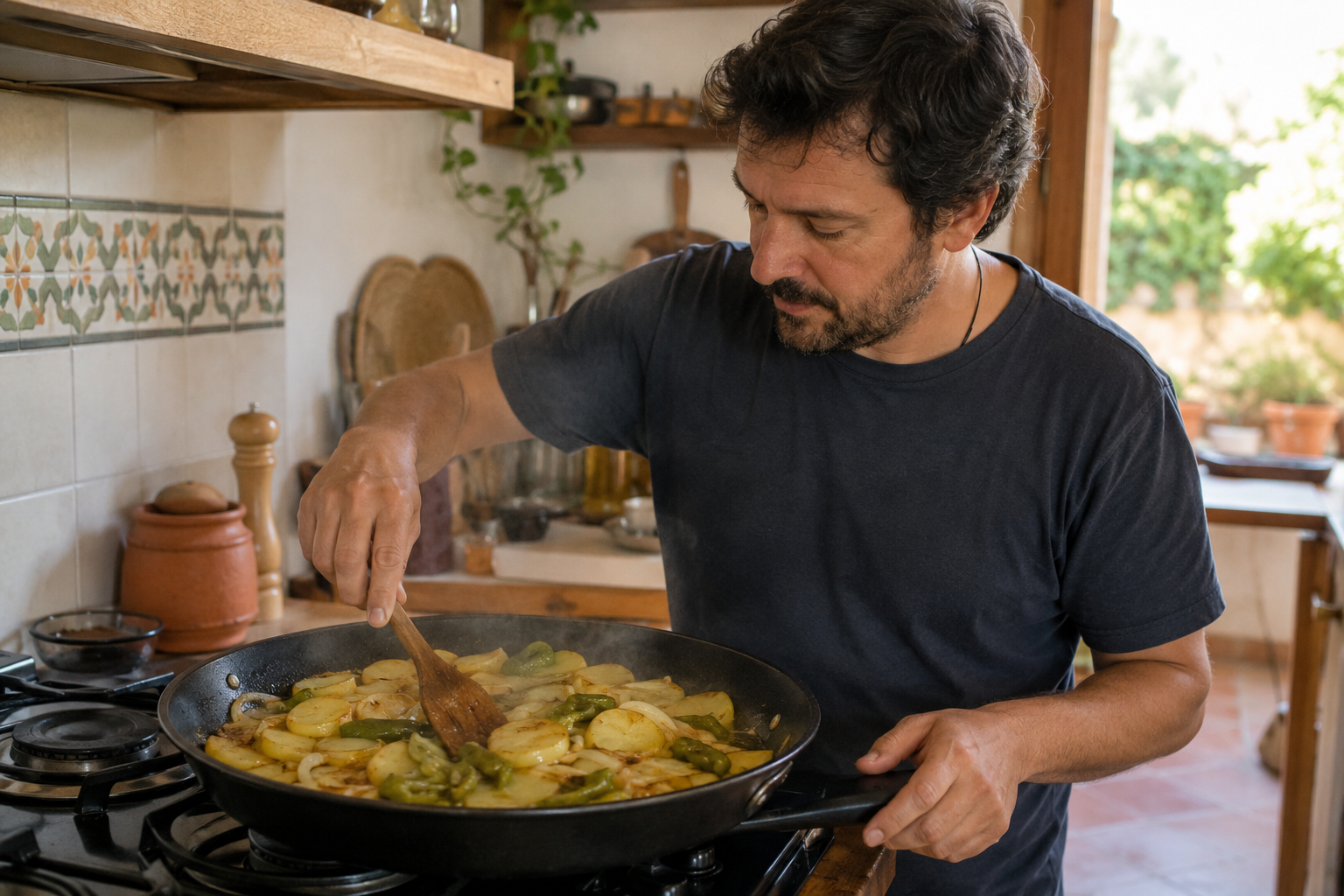
To understand patatas a lo pobre, it helps to know where it comes from and what it has always meant, because its identity as humble, honest food is central to its charm. This is a dish of the Spanish south, born of thrift and made beloved by flavor.
Its home is Andalusia. Patatas a lo pobre is a classic of Andalusian cooking, particularly around Granada in the south of Spain, where it has long been a staple of home kitchens and country restaurants alike, so it carries the sunny, olive-oil-rich character of southern Spanish food. It is the kind of dish you find in a rustic venta out in the countryside, eaten by families on a lazy weekend afternoon.
The name tells its own story. Poor man’s potatoes earned its name honestly, as a dish of the peasantry made from the cheapest and most available ingredients in harder times, potatoes and onions and peppers being humble and easy to come by, so it was food born of necessity rather than plenty. That it went on to become a cherished classic loved by everyone, rich and poor alike, is a testament to how good simple food can be when made with care. There is a pattern here that repeats throughout Spanish cooking, and indeed throughout the food of most countries, in which the dishes born of hardship become, in time, the ones people love most deeply. Necessity forced cooks to make the very most of almost nothing, and the techniques they perfected in doing so produced food of real depth and character. Patatas a lo pobre is a perfect example, a dish that never needed wealth to be wonderful, only skill and good oil and time.
The Secret Is Slow and Gentle
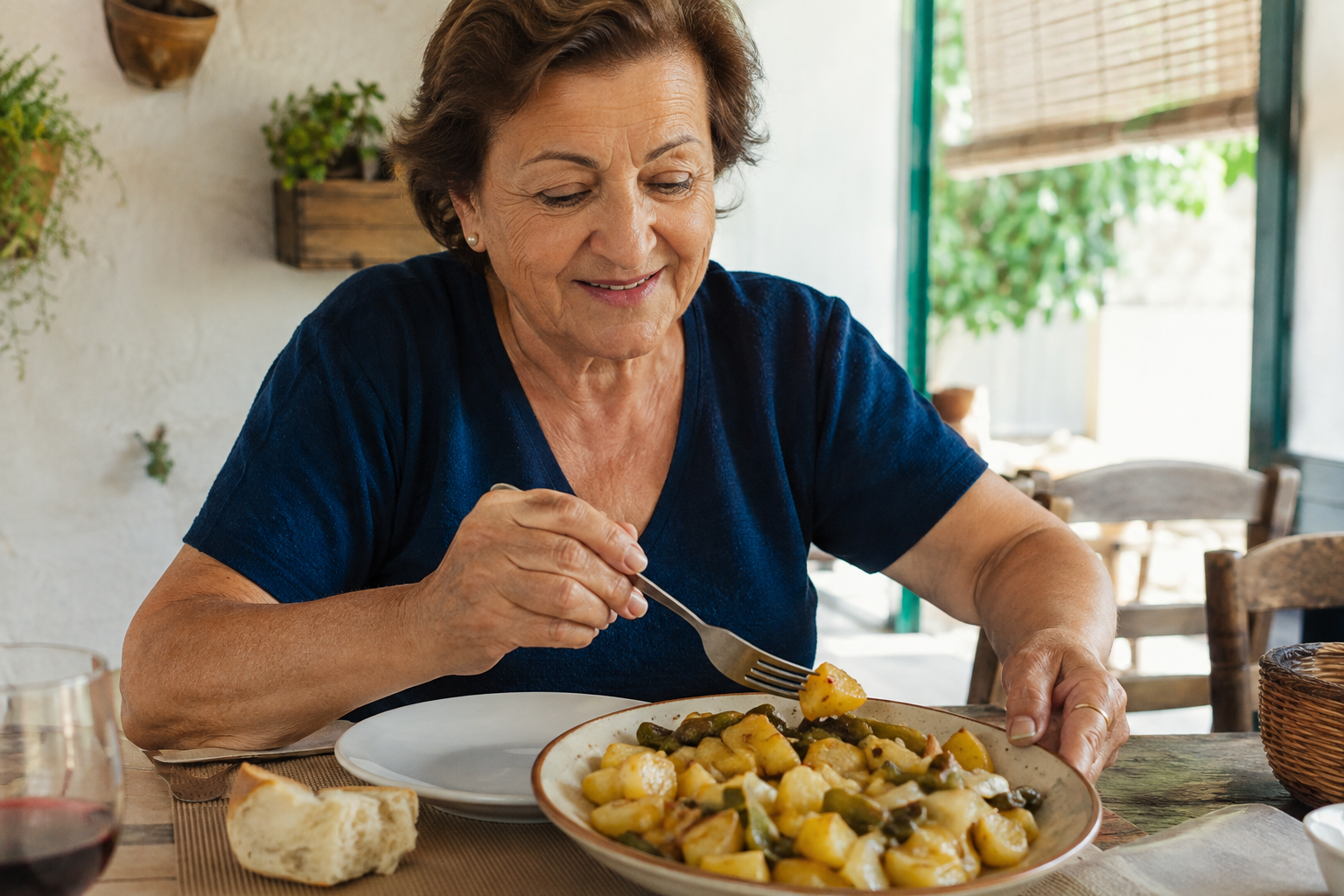
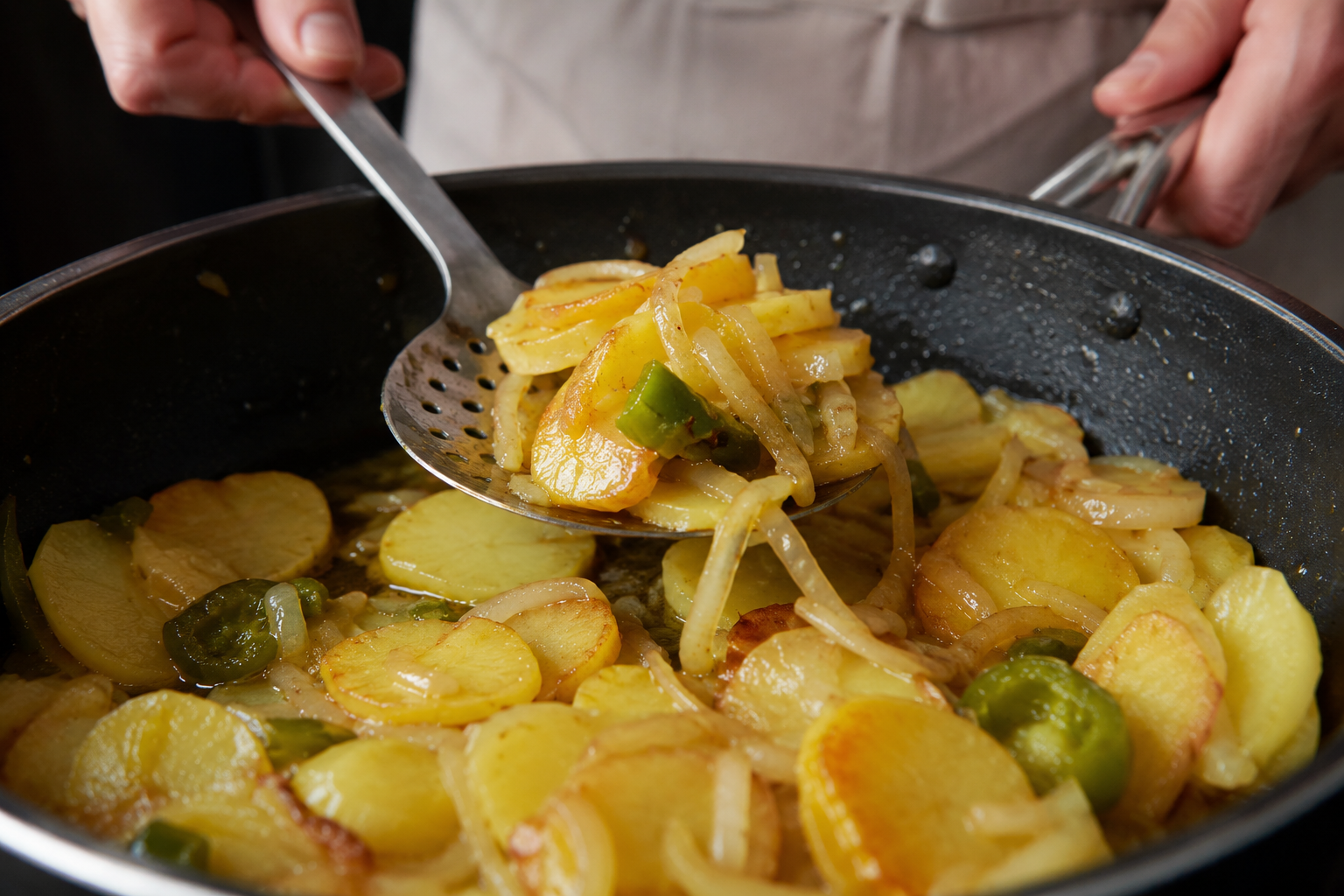
Here is the single most important thing to understand about patatas a lo pobre, the thing that separates the real dish from a plate of ordinary fried potatoes: the potatoes are cooked slowly and gently in olive oil until soft, deliberately not fried crisp and brown. This is the whole technique, and getting it right is everything.
The goal is softness, not crunch. Unlike chips or fried potatoes, which are cooked hot and fast to crisp them, patatas a lo pobre are cooked low and slow in plenty of olive oil until meltingly tender and almost confit-like, gently poaching in the oil rather than frying, which gives them their characteristic soft, silky texture. You are essentially cooking the potatoes gently in oil until they yield completely, not searing them.
This means resisting the urge to rush or brown. Throughout the cooking you keep the heat moderate and move the potatoes carefully so they soften without taking on much color, because the moment they start to crisp and brown you have made a different dish, so patience and a gentle hand are the real skills here. The reward for that patience is potatoes so tender and flavorful they seem to melt, infused throughout with the taste of good olive oil. This is worth stressing because it is the single most common way the dish is gotten wrong, especially by cooks accustomed to making crisp roast or fried potatoes. The instinct to turn up the heat and get some color on them is strong, and it is exactly the instinct to resist here. A proper patatas a lo pobre is soft all the way through, closer in texture to the inside of a good baked potato than to a chip, and that softness, far from being a shortcoming, is the entire delicious point of the dish.
Why Olive Oil Matters So Much
Because the whole dish is essentially potatoes and vegetables cooked in olive oil, the oil itself is not a minor detail but a defining ingredient, and understanding that changes how you approach the recipe. This is a dish where the olive oil is a flavor, not just a medium.
You need to be generous with it. Patatas a lo pobre requires a good amount of olive oil, enough to cook the potatoes slowly and coat them, because the oil is doing the cooking and carrying much of the flavor, so this is not a dish in which to be stingy with the bottle. The potatoes drink in the oil as they soften, taking on its richness and fruitiness, which is a large part of what makes them so good.
The quality matters as much as the quantity. Since the olive oil so thoroughly flavors the finished dish, using a good extra virgin olive oil makes a real difference, lending its fruity, peppery character to every soft slice of potato, which is exactly why Spanish cooks, blessed with wonderful local oil, treat it as central here. Much of the excess oil is drained off at the end, but the flavor it leaves behind is the soul of the dish. Some cooks worry about the amount of oil involved, but it helps to remember that most of it is not eaten, only used as the gentle medium in which the potatoes cook. What clings to the finished potatoes is a modest fraction of what went into the pan, and the oil that drains away can even be saved and reused. The generosity with oil during cooking is not extravagance but method, the very thing that gives the dish its silky texture and depth.
The Vegetables and the Andalusian Finish
Beyond the potatoes and the oil, a small cast of vegetables gives the dish its depth, and a classic finishing touch lifts it in the Andalusian style. These are what turn plain oil-cooked potatoes into patatas a lo pobre.
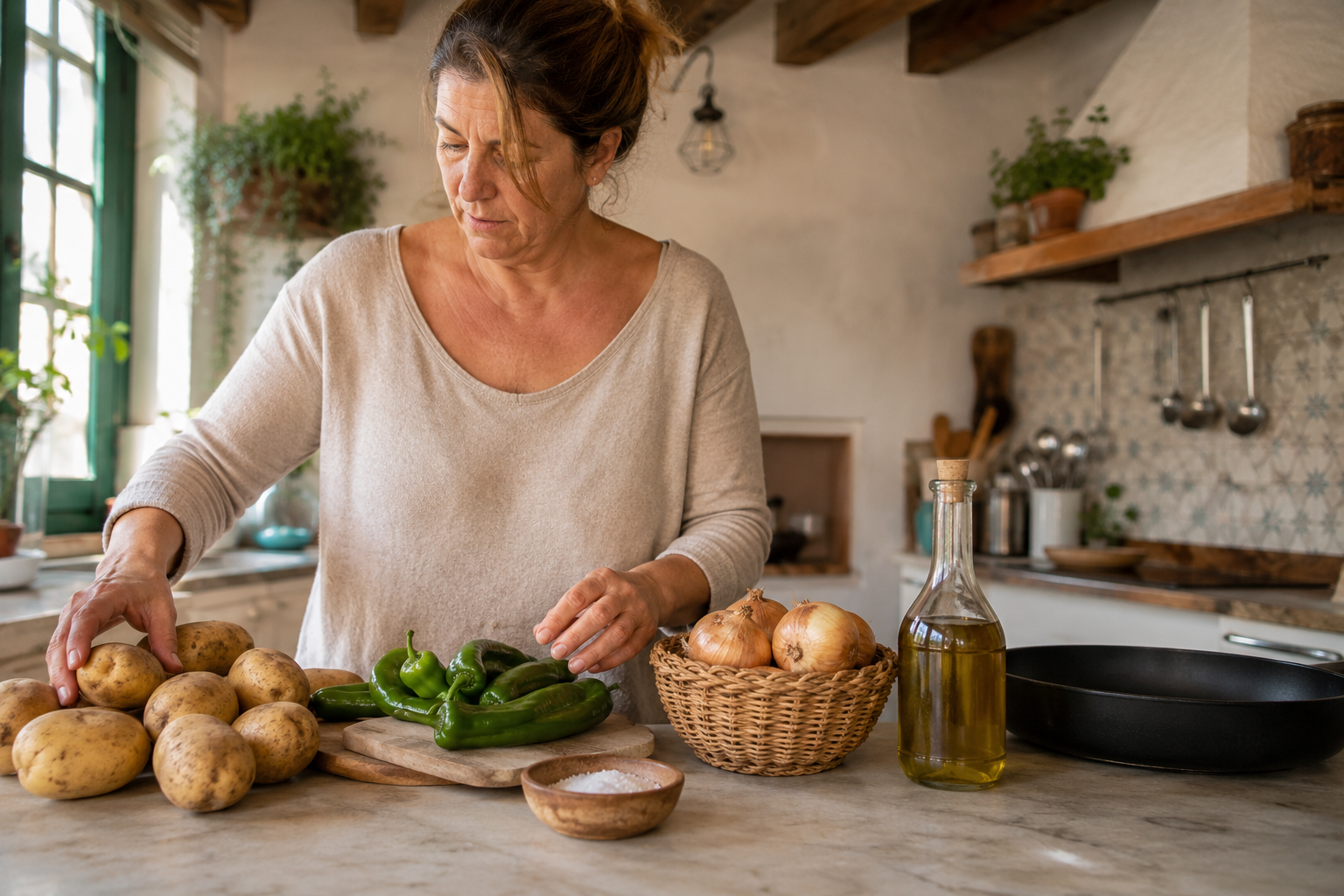
The supporting vegetables are simple but important. Green pepper, onion and garlic are the traditional companions to the potatoes, added to soften alongside them and lend their sweetness and aroma, with green bell pepper the most classic choice, though red peppers are a common variation, so the potatoes are never alone but always mingled with these gentle aromatics. Together they create a sweet, savory tangle far greater than the sum of its humble parts. The peppers soften and grow sweet, the onion melts into near-invisibility, and the garlic perfumes the whole pan, so that by the end the individual vegetables have half-dissolved into a single, unified, gently sweet mass clinging to the tender potatoes. It is this melding, rather than any one ingredient standing out, that gives the finished dish its rounded, comforting flavor.
Then there is the finishing touch that marks the Andalusian version. Traditionally, right at the end, off the heat, the dish is often finished with a splash of vinegar and sometimes a little parsley, which cuts through the richness of all that oil with a welcome brightness and lifts the whole plate, so a small hit of wine vinegar at the finish is a classic and worthwhile touch. It is optional, and not every cook uses it, but that little sharpness against the soft, rich potatoes is a lovely thing. Cooks argue gently about it, as they do about every beloved traditional dish, some insisting the vinegar is essential and others leaving it out entirely, and both camps make a fine plate of potatoes. That kind of variation is the sign of a living recipe, one that every household and every venta makes slightly differently, adjusting the peppers or the garlic or the finish to their own taste.
The Recipe
Here is the traditional patatas a lo pobre. The only real skill is patience, cooking the potatoes gently so they soften without browning. This makes a generous side dish for four.
Patatas a lo Pobre (Spanish Poor Man’s Potatoes)
serves four as a side, about forty minutes
Ingredients:
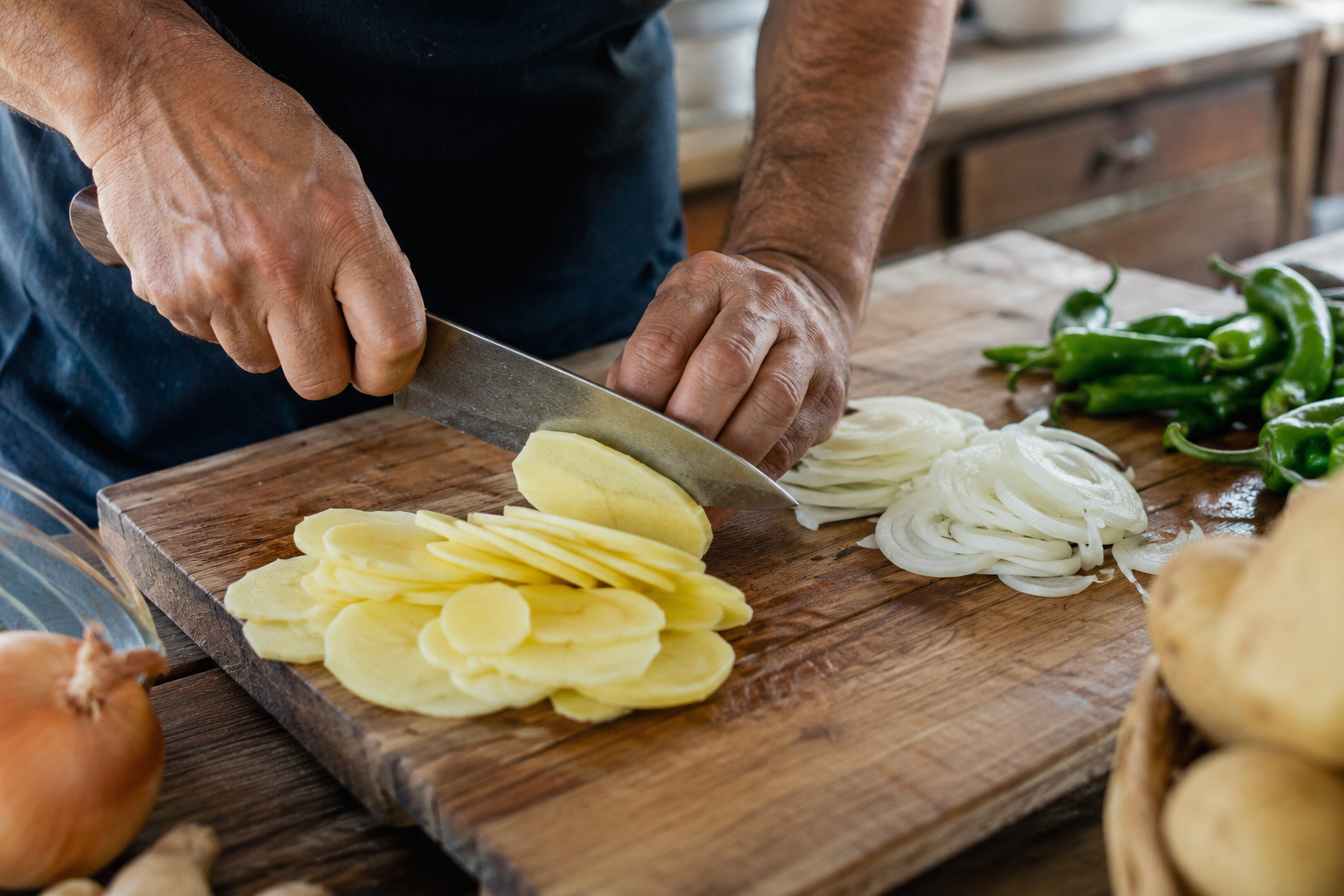
- Potatoes, waxy variety, about two pounds, peeled and thinly sliced
- Olive oil, a generous amount, enough to nearly cover the potatoes as they cook
- Onion, one large, sliced
- Green pepper, one, sliced into strips
- Garlic, three or four cloves
- Salt, to taste
- White wine vinegar, a splash, optional
- Fried eggs, to serve, optional
Method:
- Heat a generous amount of olive oil in a large, deep frying pan over medium-low heat.
- Add the sliced potatoes with a pinch of salt, and cook gently, stirring often, so they soften slowly without browning.
- After the potatoes have begun to soften, add the onion, green pepper, and garlic, and continue cooking gently.
- Cook everything slowly, stirring now and then, until the potatoes are meltingly tender and the vegetables are soft, about thirty minutes in all, keeping the heat low enough that nothing crisps or browns much.
- Drain off the excess olive oil, tilting the pan or lifting the vegetables out with a slotted spoon.
- Season with salt, and if you like, stir in a splash of wine vinegar off the heat for brightness.
- Serve hot, either as a side dish or topped with a fried egg for a simple meal.
That is the whole thing, a plate of soft, savory, olive-oil-rich potatoes from the humblest ingredients and a little patience.
Serving Spain’s Best Side
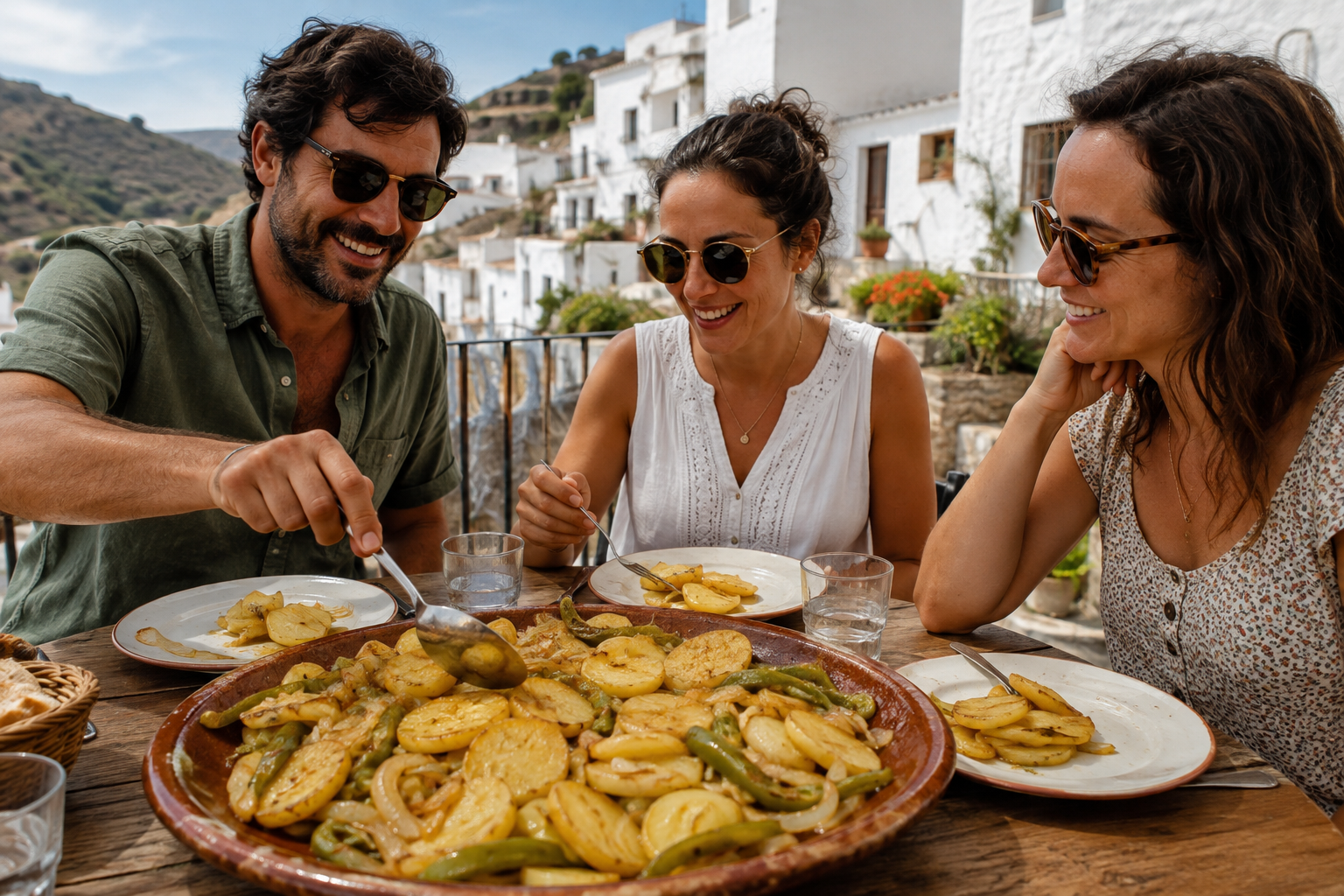
Part of what makes patatas a lo pobre so wonderful is how versatile it is, sliding effortlessly into almost any meal, which is a large part of the case for calling it Spain’s best side dish. It goes with nearly everything.
Its classic role is as a companion to meat and fish. Patatas a lo pobre is a superb side alongside roasted or grilled meats, chicken, or fish, its soft richness complementing almost any main, so it earns its place at the center of a Spanish table again and again. It is the sort of side people remember more fondly than whatever it was serving.
But it is happy on its own too. Topped with a fried or poached egg, patatas a lo pobre becomes a satisfying light meal, the runny yolk mingling gloriously with the soft potatoes, and it also makes a lovely tapa to share, so it moves easily from side dish to main to bar snack. For a heartier version, some add chorizo and other sausage to make a more substantial dish, but even in its plainest form it is a joy.
The Poor Dish That Eats Rich
The lasting wonder of patatas a lo pobre is how thoroughly it defies its humble name, delivering from the cheapest and simplest ingredients a dish so rich in flavor and so deeply satisfying that it outshines far grander fare. It is proof, once again, that great cooking is about technique and care far more than expensive ingredients, and that the poorest-sounding dish can be one of the most delicious.
What makes it worth adding to your repertoire is that combination of humility and greatness. Few side dishes are this cheap and easy to make yet this reliably wonderful to eat, which is exactly why it has remained a beloved staple of Spanish tables for generations, equally at home beside a Sunday roast, under a fried egg, or shared as a tapa. Once you learn to make it, you will reach for it constantly. It becomes, in time, one of those reliable dishes you can almost make without thinking, the thing you turn to when you have potatoes and an onion and not much else, and want to eat well anyway. That reliability is part of its greatness, because the best home cooking is not the food you make on special occasions but the food you return to again and again on ordinary days. Patatas a lo pobre is exactly that kind of food, humble and dependable and quietly superb.
So the next time you want a side dish that will quietly outshine the main, make a pan of patatas a lo pobre and cook it with the patience it deserves. Slice your potatoes, warm plenty of good olive oil, and let everything soften slowly together into tender perfection, finishing with a splash of vinegar and perhaps an egg on top. You will be making the humblest dish in Spain, the one named for poverty, and discovering, as generations of Spaniards already have, that it eats far richer than almost anything else you could put on the plate.

About the Author: Ruben, co-founder of Gamintraveler.com since 2014, is a seasoned traveler from Spain who has explored over 100 countries since 2009. Known for his extensive travel adventures across South America, Europe, the US, Australia, New Zealand, Asia, and Africa, Ruben combines his passion for adventurous yet sustainable living with his love for cycling, highlighted by his remarkable 5-month bicycle journey from Spain to Norway. He currently resides in Spain, where he continues sharing his travel experiences with his partner, Rachel, and their son, Han.