
Many travelers assume that reaching Spain’s best beaches requires a rental car, that without one you are stranded in your resort town, cut off from the coves and coastal towns just down the shore. It is one of the most persistent and most mistaken beliefs in Spanish travel. Spain has a quietly excellent network of coastal buses, run by a handful of regional companies whose names most visitors never learn, that connect the beaches and seaside towns up and down the country’s famous costas, cheaply, comfortably and often scenically. Once you know these networks exist and how to use them, the whole coast opens up, and the rental car, with its parking headaches and its cost, becomes entirely optional.
The reason so few tourists discover these buses is simply that no one tells them. The big rental agencies are everywhere, the resort brochures assume you will drive, and the regional bus companies do not market themselves to foreign visitors, so their networks remain a kind of open secret known to locals and to the small number of travelers who have learned to look. Yet these buses are frequent, inexpensive and pleasant, and they reach a great many beaches that the rental-car crowd pays dearly to visit.
Here is how to reach Spanish beaches without a car, the coastal bus networks that make it possible, how they work in practice, and the real limits of what they can and cannot do. This is a practical guide for the car-free traveler rather than an exhaustive timetable, and services change, so always check current schedules, but understanding that these networks exist and how to navigate them can free you from the rental car entirely and let you reach the Spanish coast on your own terms.
The Networks Nobody Tells You About

The heart of car-free coastal travel in Spain is a set of regional and intercity bus companies that most tourists have never heard of, each covering its own stretch of coast with routes connecting the seaside towns. These are not glamorous brands, but they are the key that unlocks the whole coast for anyone without a car.
The largest and most useful to know is ALSA, Spain’s major intercity bus operator, which runs extensive long-distance and regional routes reaching coastal towns across the country. ALSA is the backbone of Spanish bus travel, the company most likely to connect a major city or airport to the coastal town you are aiming for, so it is the first name to learn and the one whose network reaches the widest. Wherever you are going on the Spanish coast, an ALSA route very often forms part of the journey.
Beyond ALSA, each coastal region has its own local specialists. On the Costa del Sol, Avanza runs routes connecting the towns along that famous southern coast, while on the Costa Brava in the northeast, operators such as Moventis-Sarfa and Sagalés run frequent services between Barcelona and the beach towns, covering the coast densely, so each stretch of shore has its own regional operator worth knowing. Learning which company serves the particular coast you are visiting is the first step to using these networks well. A few minutes spent finding that name, and the address of its website or app, does more to open up the coast than any amount of studying maps, because it hands you the actual timetables and routes rather than guesswork. Once you have the right operator, the rest of the planning falls into place quickly.
How the Coastal Costas Connect

Understanding how these buses stitch the coast together helps you plan, because the pattern is fairly consistent across Spain’s different coastal regions. Typically, a larger city or transport hub serves as the gateway, from which buses fan out along the coast to the various seaside towns, so you travel from the hub outward to your beach destination.
The Costa del Sol shows the pattern clearly. There, the city of Málaga acts as the hub, with a local train, the Cercanías, running along the western coast to towns like Torremolinos, Benalmádena, and Fuengirola, while buses from companies like ALSA and Avanza reach the places the train does not, particularly the eastern coast toward Nerja and the towns beyond, so between train and bus the whole coast is covered. The train handles one stretch and the buses handle the rest, and together they leave few beaches unreachable.
The Costa Brava works similarly from Barcelona and Girona. From these hubs, the regional bus companies run services out to the string of beautiful beach towns along that coast, from the larger resorts to smaller coves, so a traveler based in or arriving through these cities can reach a wide range of Costa Brava beaches by bus. Each Spanish coast has its own version of this hub-and-spoke arrangement, and once you grasp it, planning a car-free beach trip becomes a matter of finding the hub and the route out to your beach.
The Local Beach Bus Nobody Finds

Here is the piece that most trips up visitors and that, once understood, unlocks the smaller and often loveliest beaches: many of the best beach spots are reached not by a single direct bus but by a two-step journey, first an intercity bus to the nearest town, then a small local bus down to the beach. This second, local leg is the part tourists so often miss.
The Costa Brava offers a perfect example. To reach a gorgeous cove like Calella de Palafrugell, you take a bus to the town of Palafrugell, and then catch a separate small local bus down to the beach, a short connection you can often pay for in cash right on the bus, so the beach that seemed unreachable is in fact just one easy local hop from the town. Without knowing about that little local bus, a visitor might assume the cove was inaccessible, when in truth it is simply one connection away. This is precisely the knowledge gap that keeps so many travelers tethered to a rental car. They look at a map, see that no single bus runs directly to the beach they want, and conclude they must drive, never realizing that the town nearby is well served and that a modest local shuttle covers the last short stretch. The two-leg journey looks daunting on paper and is trivial in practice, and learning to expect it rather than fear it is what turns the whole coast car-free.
This two-step pattern is the secret to the smaller beaches all along the coast. Many coves and beach areas sit a little below or beyond the main coastal towns, connected to them by these short local shuttle buses that do not appear on the tourist radar, so learning to look for the local bus from the town to the beach is what opens up the quieter, more beautiful spots. The intercity buses get you to the towns, but the humble local bus gets you to the sand.
What the Buses Are Actually Like
Anyone imagining a grim, unreliable bus experience should set that worry aside, because Spain’s coastal buses are generally modern, comfortable and pleasant to ride. Far from being a hardship to be endured, the bus is often a truly nice way to travel the coast, and in some ways nicer than driving it yourself.
The comfort is real. Modern Spanish coastal buses typically have air conditioning, comfortable seats, and often WiFi and restrooms on the longer routes, so a bus journey along the coast is a relaxed and civilized affair rather than something to dread. In the fierce summer heat, an air-conditioned bus is a particularly welcome thing, sparing you the sweaty struggle of a hot rental car and unfamiliar roads.
There is also the pleasure of the ride itself. Because these routes hug the coast, the journey often comes with beautiful sea views, so riding the bus becomes part of the enjoyment rather than merely a means to an end, and sitting on the seaward side of the bus rewards you with a scenic trip. Freed from watching the road, you can simply gaze at the Mediterranean, which is a small luxury the driver never gets to enjoy.
The Advantages of Leaving the Car
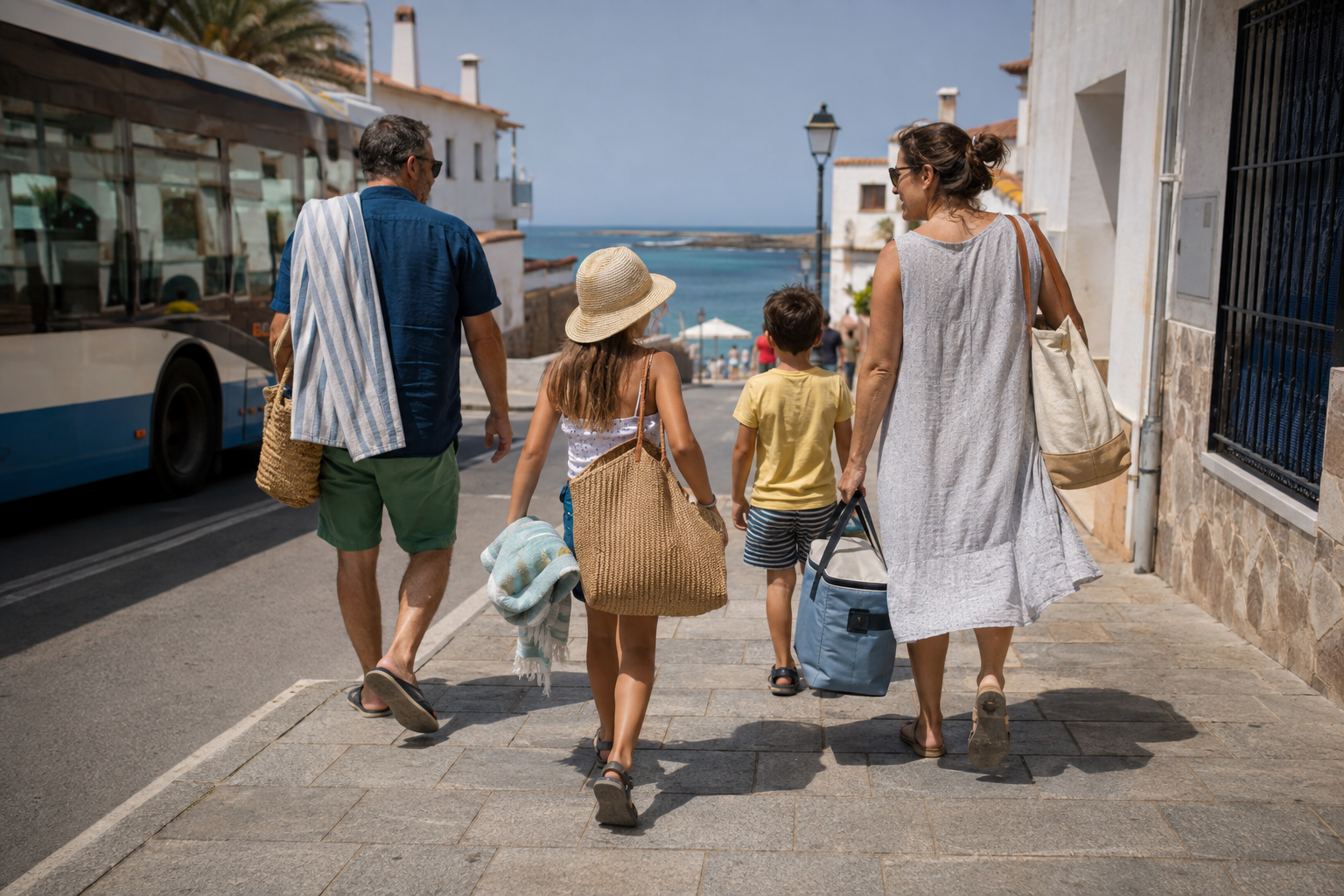
Once you realize how well the buses work, the case for skipping the rental car entirely becomes surprisingly strong, because going car-free on the Spanish coast carries real advantages beyond simply saving the rental fee. The savings alone are significant, since bus fares are cheap while rental cars, fuel and parking add up quickly, but the benefits go well beyond money.
The freedom from hassle is perhaps the biggest gain. Traveling by bus means no navigating unfamiliar roads, no stressful searches for parking in crowded coastal towns, no worry about narrow streets or aggressive traffic, and no need to stay sober for the drive back, so a great deal of the friction of a beach day simply disappears. The coastal towns of Spain are notoriously difficult to park in during summer, a headache the bus rider never faces at all.
There is a quiet pleasure in it too. Letting the bus do the work leaves you free to relax, read, nap, or enjoy the view, to have a leisurely glass of wine with lunch without a second thought, and to arrive at the beach unfrazzled rather than tense from driving, so the whole day feels more like a holiday. Going car-free is not merely a budget compromise but, for many, a distinctly better way to experience the coast.
The Honest Limits
Now for the necessary honesty, because while these networks are excellent, they are not perfect, and pretending otherwise would leave you frustrated. The coverage is very good in the developed, urbanized coastal areas, but it thins out considerably in more rural and remote stretches, where buses can be infrequent and connections awkward.
The rural gaps are real. In the more remote parts of the coast and the smaller inland villages, bus service can be sporadic, with long waits between departures and connections that require patience and planning, so reaching the most out-of-the-way spots by bus is decidedly harder and slower than the well-served main towns. For those remote corners, the car-free traveler needs realistic expectations and a willingness to build the trip around the timetable rather than the other way around.
Planning is therefore essential. Because schedules vary and some routes run infrequently, checking timetables in advance on the bus companies’ websites or apps, and building your day around the actual departure times, is the key to car-free coastal travel working smoothly, so a little preparation makes the difference between a relaxed trip and a long wait at a bus stop. The buses reward the traveler who plans and can frustrate the one who simply turns up expecting frequent service everywhere.
Making Car-Free Coastal Travel Work

Putting it all together, reaching Spain’s beaches without a car is entirely achievable for anyone willing to learn the networks and plan a little, and the payoff is a cheaper, more relaxed, and often more scenic coastal holiday. The approach is to identify the regional bus company serving your coast, find the hub city, and map the route to your beach, including any local connection.
A few habits make it reliable. Learning the name of the relevant bus operator, checking current timetables on their site or app before you set out, planning for the two-step journey to smaller beaches with their local shuttle buses, and combining buses with trains and even coastal ferries or the beautiful coastal walking paths where they exist all turn the car-free approach into a smooth and flexible way to explore. The coastal footpaths in particular pair wonderfully with buses, letting you ride to one town, walk a scenic stretch to the next, and catch a bus back.
The mindset that makes it work is flexibility and a little patience. Accepting that you travel on the bus’s schedule rather than your own, allowing extra time for connections, and choosing well-served towns as your bases while treating the remotest coves as occasional adventures rather than daily commutes all keep the experience pleasant, so you work with the network’s strengths and around its limits. Approached this way, the Spanish coast is remarkably open to the car-free traveler.
The Coast Without the Car

The lasting truth about Spanish beaches is that the rental car so many travelers assume they need is, along most of the coast, entirely optional, because a network of regional buses that tourists rarely discover already connects the beaches and seaside towns for a fraction of the cost and none of the hassle. Learning that these buses exist, and how to use them, quietly transforms what is possible for the traveler who would rather not drive.
What makes this knowledge so valuable is how much it opens up for so little. For the price of learning a few bus company names and checking a few timetables, you gain the freedom to reach a great many of Spain’s beaches without a car, saving money, avoiding the stress of driving and parking, and often enjoying a more scenic and relaxed journey into the bargain, all on networks the rental-car crowd never even notices. The coast was accessible all along, to anyone who knew where to look.
So the next time you plan a trip to the Spanish coast and assume you must rent a car, think again, and look instead for the buses. Find the company that serves your stretch of shore, learn the hub and the routes, watch for the little local bus that runs down to the smaller beaches, and check the timetables before you go. Do that, and you will reach the sand cheaply and calmly while others sit in traffic hunting for parking, having found the coastal bus networks that were waiting, unnoticed, all along.

About the Author: Ruben, co-founder of Gamintraveler.com since 2014, is a seasoned traveler from Spain who has explored over 100 countries since 2009. Known for his extensive travel adventures across South America, Europe, the US, Australia, New Zealand, Asia, and Africa, Ruben combines his passion for adventurous yet sustainable living with his love for cycling, highlighted by his remarkable 5-month bicycle journey from Spain to Norway. He currently resides in Spain, where he continues sharing his travel experiences with his partner, Rachel, and their son, Han.