
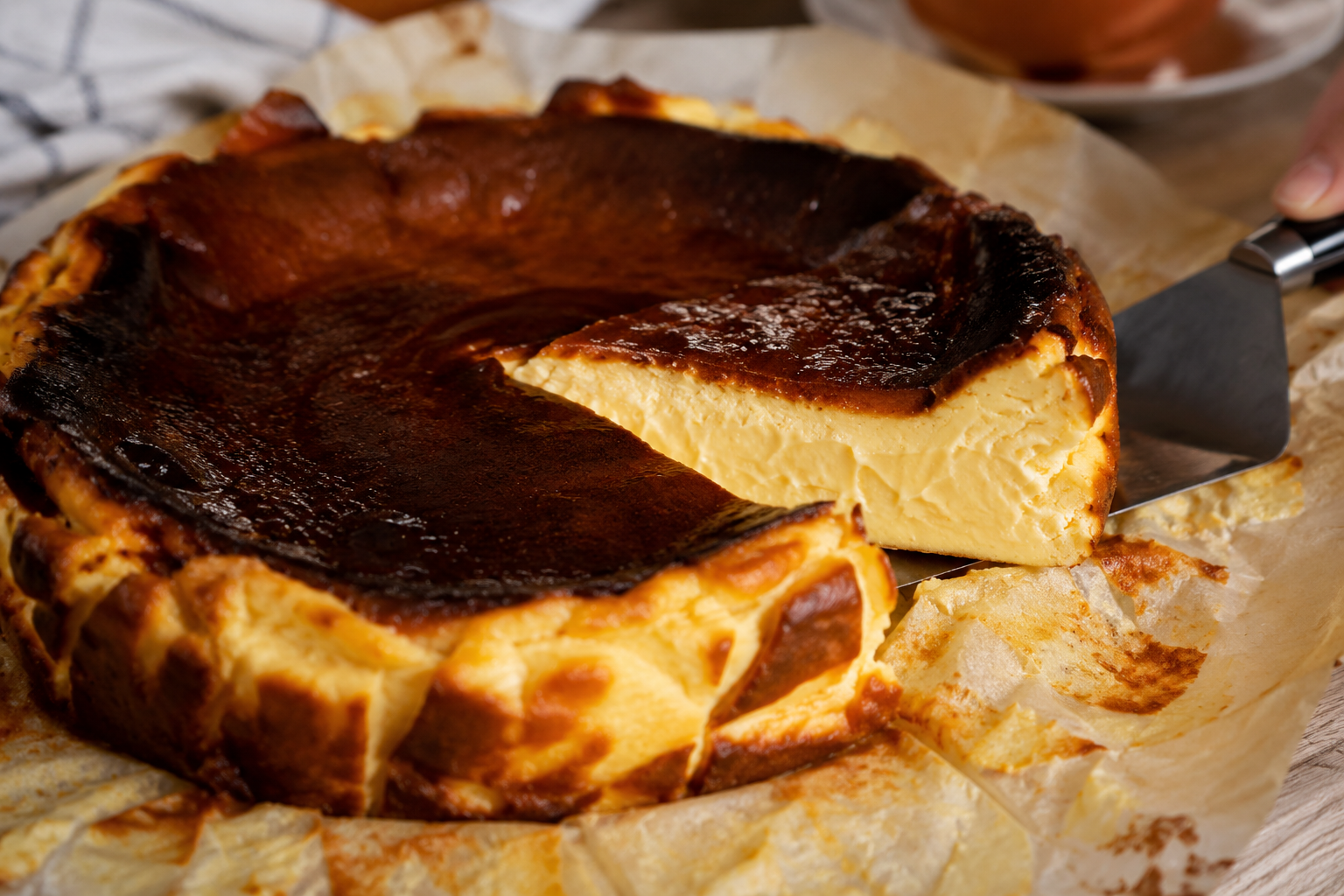
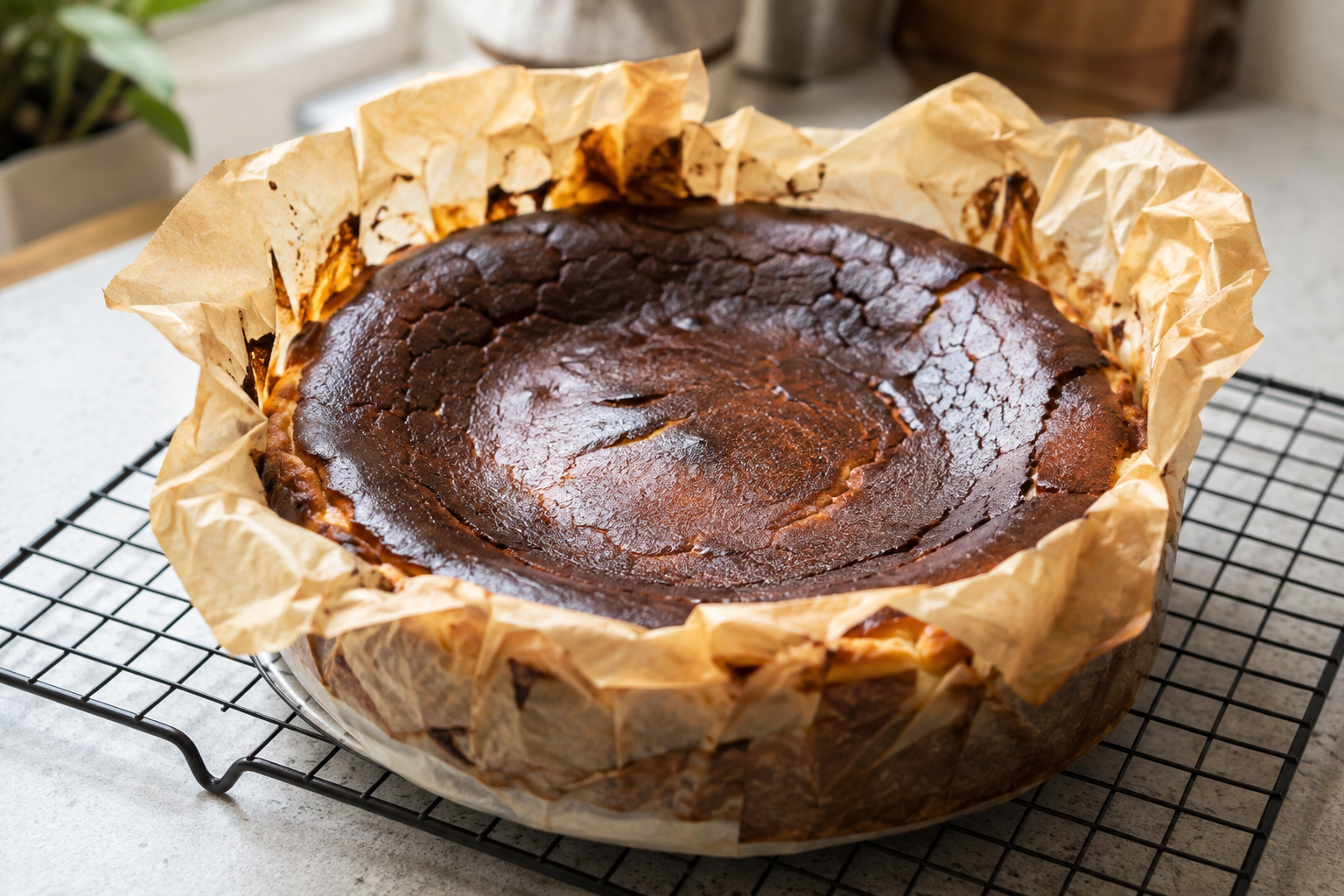
Somewhere in the world right now, someone is pulling a cheesecake out of the oven with a top so dark it looks ruined, a deep, cracked, almost black surface that would make any American baker assume they had destroyed it. They have not. That scorched top is the entire point, the signature of the Basque burnt cheesecake, a dessert that broke every rule of what a cheesecake was supposed to be and became, in the space of a few years, one of the most beloved sweets on earth. It has no crust, needs no water bath, uses only a handful of ingredients, and is deliberately baked until its surface caramelizes almost to burning, and behind it all lies a small bar in San Sebastián that invented it and still, in a sense, guards the original.
The Basque burnt cheesecake, known in Spain as tarta de queso, is that rare thing, a truly modern classic, invented within living memory yet already as iconic as desserts many centuries older. Where the American cheesecake is dense, pale and built on a graham cracker crust, the Basque version is its rebellious opposite, crustless and rustic, with a dark caramelized exterior giving way to a center so soft it verges on molten. That dramatic contrast, between the bitter, burnished top and the pale, custardy middle, is what makes it unforgettable, and what turned a bar dessert in the Basque Country into a global phenomenon.
Here is the story of where the Basque burnt cheesecake came from, why it is burnt on purpose, what makes it so different from the cheesecake you know, and exactly how to make it at home. There is a real recipe below, based closely on the famous original, so you can bake this modern legend in your own kitchen. Once you taste that caramelized top against the silky center, you will understand why the world fell so hard for a cheesecake that looks, to the uninitiated, as though something went terribly wrong.
The Bar That Started It All
The story begins at a bar called La Viña, on a narrow street in the old town of San Sebastián, the beautiful coastal city in Spain’s Basque Country. The bar had been in the Rivera family since the 1950s, and when Santiago Rivera took it over, he set about creating a dessert for the menu, which is where this whole story of the world’s most famous burnt cheesecake truly begins.
The invention itself, as the story is told, was a happy accident. Sometime around the late 1980s or 1990, Rivera was experimenting with a cheese tart and left it in a very hot oven longer than intended, and when he pulled it out the top was deeply caramelized, almost black, while the center remained alarmingly soft and liquid. Rather than throw it away, he tasted it, and the extraordinary contrast between the bitter, burnished exterior and the mild, creamy, almost molten interior convinced him he had stumbled onto something special.
He put it on the menu, and the rest is history. The cheesecake became so associated with La Viña and with San Sebastián that food lovers began making pilgrimages to the little bar for a single slice, packing inside to taste the dessert whose towers of caramelized cakes lined the counter, and over the following decades word spread outward until the whole world knew it. What began as an experiment in one small bar grew into a dessert made in kitchens across the globe. Its rise was startlingly fast once the wider world noticed. For decades it was a beloved local secret, known to those who visited San Sebastián and little celebrated beyond it, until the age of social media discovered its photogenic scorched top and sent it around the planet almost overnight. Within a few years it went from a Basque bar counter to home ovens in every country, one of those rare dishes whose fame arrives suddenly after a long, quiet life. The internet loved it, but the Basque had loved it first.
Why It Is Burnt on Purpose
The most important thing to understand about the Basque cheesecake is that its scorched appearance is entirely deliberate, the defining feature rather than a mistake, and it is achieved by baking the cake at a high temperature until the top caramelizes deeply. Where a traditional cheesecake is coddled at a low, gentle heat to keep it pale and smooth, the Basque version is blasted with heat to force the very browning that other cheesecakes carefully avoid.
The transformation on top is a piece of delicious chemistry. That dark surface is the result of caramelization and the Maillard reaction, the same browning processes that give a seared steak or a piece of toast their flavor, taken deliberately further than ordinary baking would allow, so the top develops a deep, slightly bitter, complex flavor that plays against the sweetness beneath. The near-burnt top is not just for looks but for taste, adding a smoky, caramel depth that a pale cheesecake entirely lacks.
Meanwhile, the inside stays soft on purpose too. The high heat sets the outside quickly while leaving the center underbaked and custardy, so that a properly made Basque cheesecake wobbles when it comes out of the oven and firms only to a soft, creamy set as it cools, giving that signature molten middle. The whole magic of the dish lies in this contrast, engineered by the hot oven, between a firm, dark exterior and a barely set, spoonably creamy interior.
How It Differs From American Cheesecake
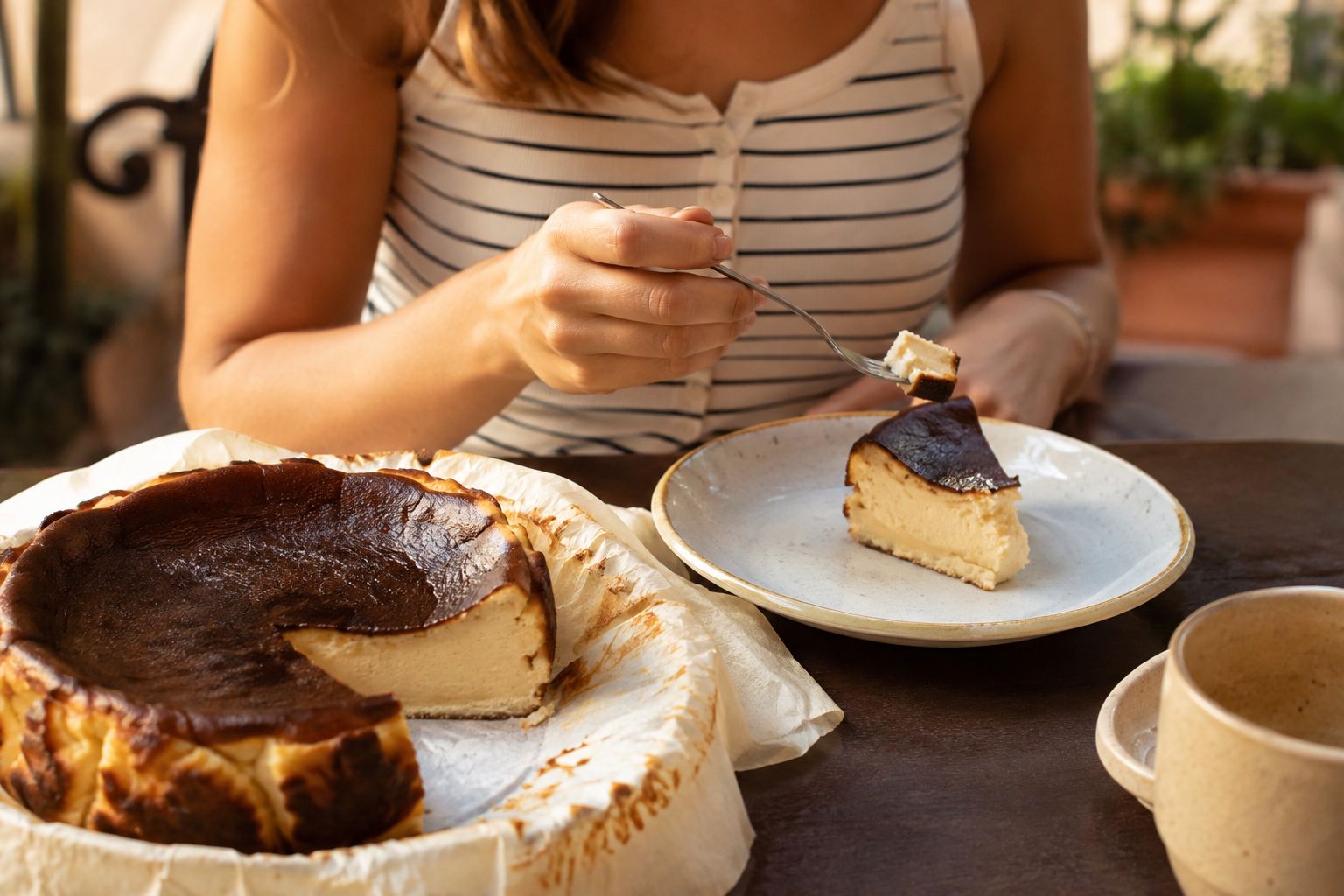
For anyone raised on American-style cheesecake, the Basque version is almost a different dessert, and understanding the differences makes clear why it feels so novel. The most obvious is the crust, or rather the absence of one, since the Basque cheesecake is entirely crustless, with the caramelized edges forming a natural crust of their own where the batter meets the hot pan.
The texture and method differ just as sharply. American cheesecake is famously dense and firm, baked slowly and often in a water bath to keep it from cracking or browning, whereas the Basque cheesecake is lighter, creamier and almost custard-like, baked fast and hot with no water bath at all, embracing exactly the cracks and browning the American version fights to prevent. It is a far more forgiving and rustic dessert, made without the fuss that surrounds its American cousin.
Even the flavor and eating experience are distinct. Where American cheesecake is uniformly sweet and firm, the Basque one offers a play of contrasts, the caramelized, faintly bitter top against the sweet, creamy interior, closer in spirit to a flan or a crème caramel than to a dense New York slice. It is a cheesecake for people who might not even think they like cheesecake, which is part of why it has won over so many.
The Original That Is Still Guarded
Part of the mystique of the Basque cheesecake is that, for all its fame, the exact original recipe from La Viña has never been definitively published, so every version made around the world, however delicious, is really a close approximation of a formula the bar has kept to itself. The world fell in love with the dessert without ever officially being handed its precise recipe.
This has given rise to a kind of gentle culinary detective story. Devoted cooks and writers have studied the original obsessively, watching what footage exists of Rivera making it and comparing countless versions, working to reverse-engineer the exact proportions and technique behind the La Viña cake its particular character, with some coming impressively close. The result is a family of excellent recipes that orbit the original without any single one being confirmed as the true article.
There are even small debated details that hint at the guarded original. Some who have studied it closely note that certain common assumptions about the recipe, such as the addition of salt, may not match what La Viña really does, small differences that fuel the sense that the true version retains a few secrets, so the original keeps a little mystery even as the world bakes its imitations. That aura of an authentic version just out of reach is part of the dessert’s romance. There is something fitting about a dessert this democratic keeping one small secret to itself. Anyone can make a wonderful version with five ordinary ingredients, and yet the definitive original remains anchored to a single bar in a single city, which is exactly as it should be. It means the cheesecake belongs to the world and to San Sebastián at once, freely shared yet never entirely given away, and that a slice at La Viña itself will always be worth the trip.
The Recipe
Here is a Basque burnt cheesecake recipe based closely on the celebrated original, requiring only a handful of ingredients and very little work, since almost all the magic happens in the oven. The one essential is to bake it hot enough and long enough to get that deeply caramelized top.
Basque Burnt Cheesecake (Tarta de Queso) makes one cake, serves eight to ten, best made a day ahead
Ingredients:
- Cream cheese, two pounds, at room temperature
- Sugar, one and a half to two cups
- Eggs, five, at room temperature
- Heavy cream, two cups
- Flour, one third cup
Method:
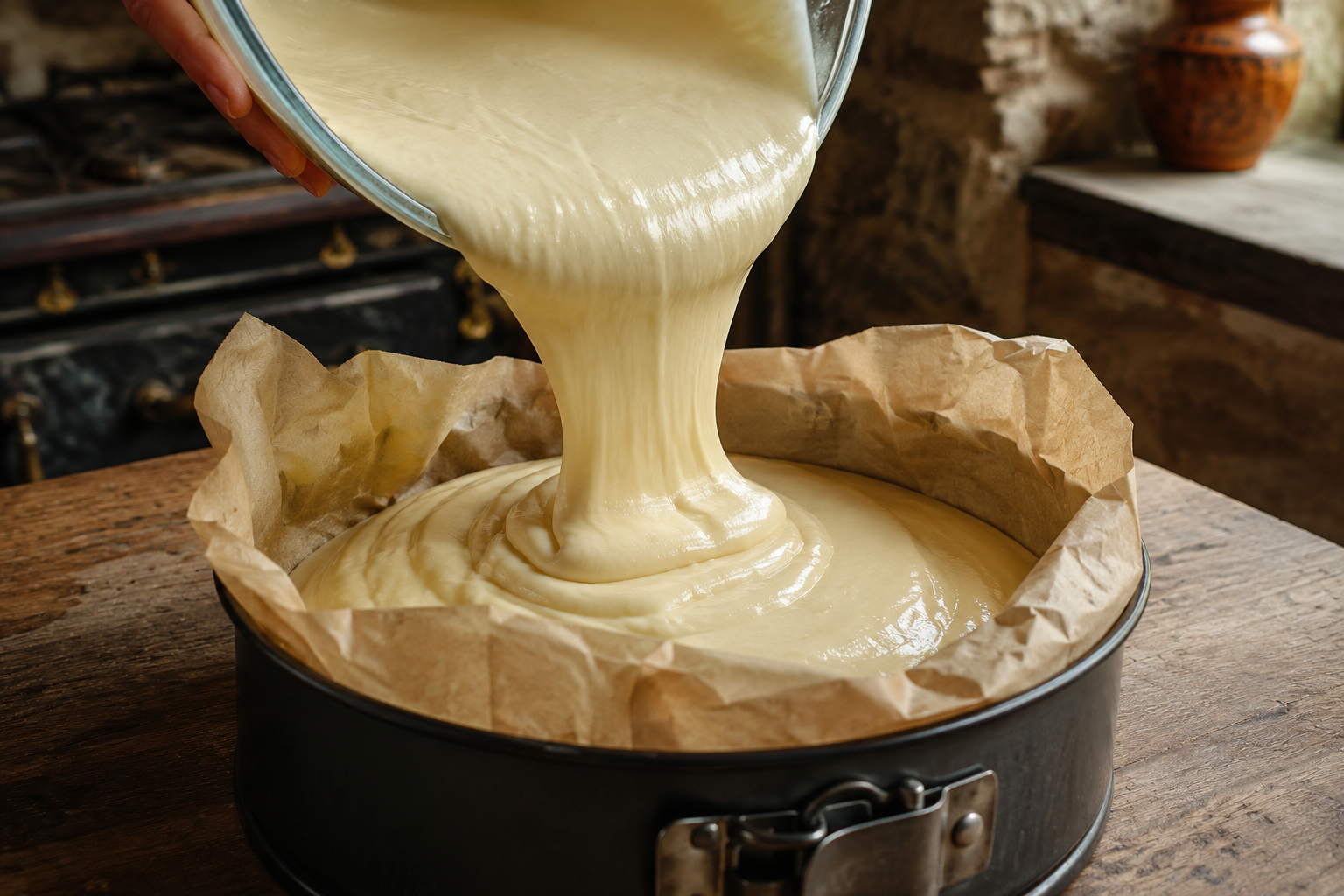
- Preheat the oven to a high heat, around 400 to 425 degrees Fahrenheit, and line a springform pan with parchment paper, crumpling it first and leaving plenty overhanging the sides.
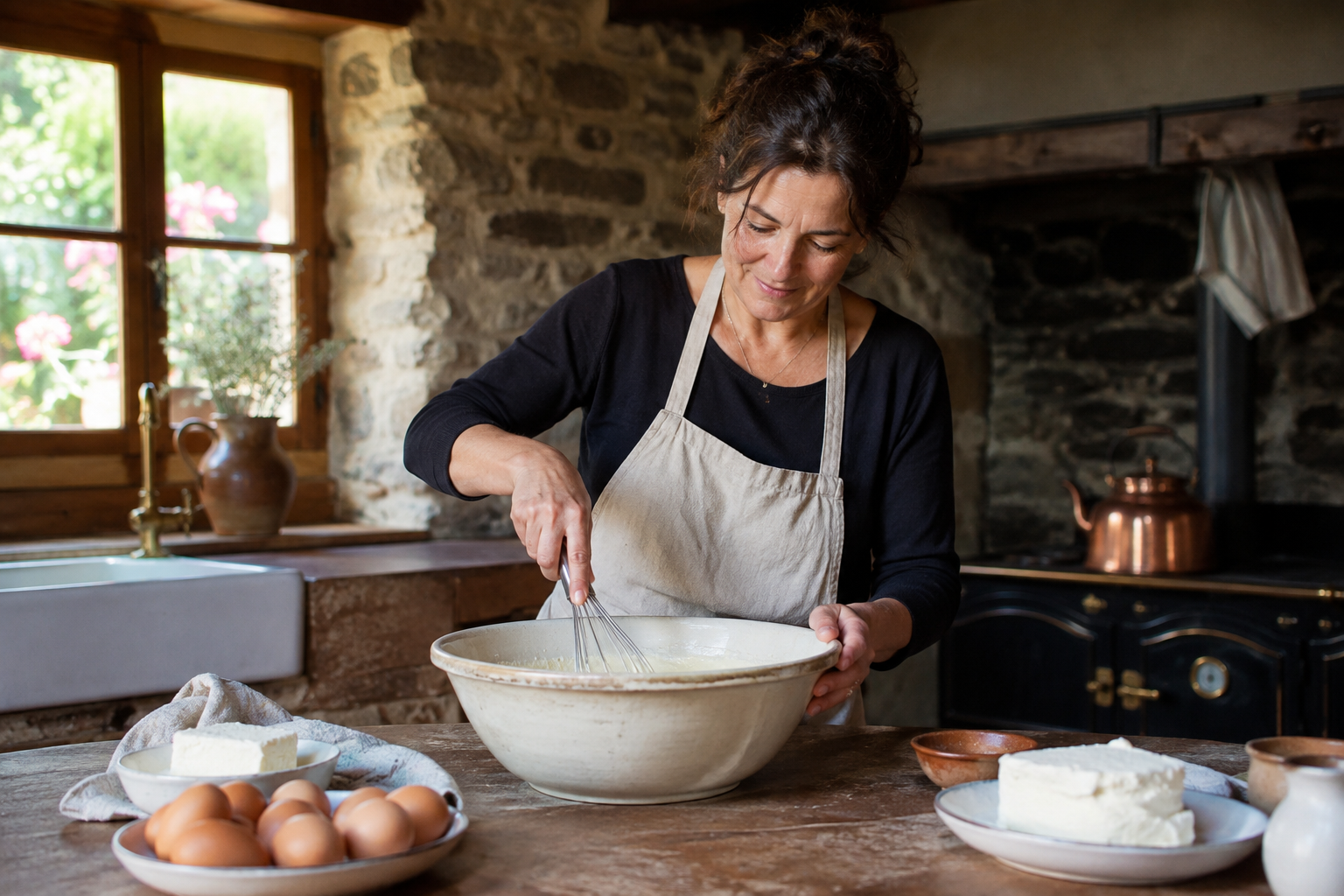
- Beat the cream cheese and sugar together until completely smooth and creamy.
- Add the eggs one at a time, beating well after each, until fully incorporated.
- Pour in the heavy cream and mix until smooth, then sift in the flour and mix gently just until combined.
- Pour the batter into the lined pan and bake for about fifty to sixty minutes, until the top is deeply browned, even darkened, and the cake is puffed but still wobbly in the center.
- Remove it from the oven and let it cool completely, during which it will sink and set to a soft, creamy consistency.
- For the best result, refrigerate it overnight before serving, as it improves markedly with a rest.
That is the entire process, about ten minutes of actual work and a hot oven, producing a dessert that looks and tastes like far more effort than it took.
Getting It Right
A few points make the difference between a good Basque cheesecake and a great one. The most important is not to fear the dark top, since the deep, almost burnt caramelization is the whole character of the dessert, so you should bake it until the surface is deeply browned and even a little blackened at the edges rather than pulling it early out of nervousness.
The wobble is your other essential guide. The cake should come out of the oven still jiggly and soft in the center, because it continues to set as it cools and an overbaked Basque cheesecake loses its signature creamy, custardy middle, so trust that a wobbly center is correct and will firm to perfection rather than staying raw. Underbaking the center slightly is the goal, not a fault.
Two smaller points round it out. Using room-temperature ingredients helps everything blend into a smooth batter without lumps, and the crumpled parchment, left deliberately rough, gives the cake its characteristic rustic, folded sides while making it easy to lift out. None of this is difficult, which is part of the dessert’s appeal, but attending to the dark top, the wobbly center, and the overnight rest is what turns a good version into a great one.
How to Serve It
The Basque cheesecake is best served simply, because it needs very little to shine. A slice on its own, showing off the contrast between the dark top and the pale, creamy interior, is a beautiful and complete dessert, and many purists would say it wants no adornment at all beyond perhaps a dusting of nothing more than its own caramelized edge.
Its traditional accompaniment, though, is worth knowing. In its Basque homeland, a slice is classically enjoyed with a glass of sherry, especially the rich, sweet Pedro Ximénez, whose raisiny depth complements the caramelized cheesecake beautifully, so if you want to serve it truly in the San Sebastián spirit, pour a small glass of sweet sherry alongside. It is a pairing that feels indulgent and authentic at once.
Temperature and timing matter to the experience as well. The cheesecake is at its best after an overnight rest in the refrigerator, then brought closer to room temperature before serving so the center regains its full creaminess, which means a little planning rewards you with the ideal texture. Served this way, cool but not cold, with or without a glass of sherry, it delivers the full effect that made it famous.
A Modern Classic Worth Baking
The lasting appeal of the Basque burnt cheesecake is how much drama and pleasure it delivers from so little, a handful of ingredients and a hot oven producing a dessert that looks striking, tastes extraordinary, and asks almost nothing of the baker in skill or effort. It is proof that a great dish need not be complicated, and that sometimes the boldest move, in this case burning the top on purpose, is exactly the right one.
What makes it worth adding to your repertoire is that it is both impressive and remarkably easy, the rare showpiece that a nervous baker can pull off, since there is no crust to blind-bake, no water bath to fuss with, and no need to fear cracks or browning, which are here the whole point. Few desserts this striking are this forgiving to make, which is a large part of why the world embraced it so completely.
So the next time you want to bake something that will stop people in their tracks, make a Basque burnt cheesecake and let the oven scorch its top without flinching. Beat together your few ingredients, pour them into a crumpled parchment shell, bake it hot and dark, and chill it overnight, then serve a slice of that caramelized, creamy marvel with a glass of sherry. You will be baking a dessert born in a single San Sebastián bar, whose exact original may still be quietly guarded, but whose glorious idea now belongs, deliciously, to the whole world.

About the Author: Ruben, co-founder of Gamintraveler.com since 2014, is a seasoned traveler from Spain who has explored over 100 countries since 2009. Known for his extensive travel adventures across South America, Europe, the US, Australia, New Zealand, Asia, and Africa, Ruben combines his passion for adventurous yet sustainable living with his love for cycling, highlighted by his remarkable 5-month bicycle journey from Spain to Norway. He currently resides in Spain, where he continues sharing his travel experiences with his partner, Rachel, and their son, Han.