
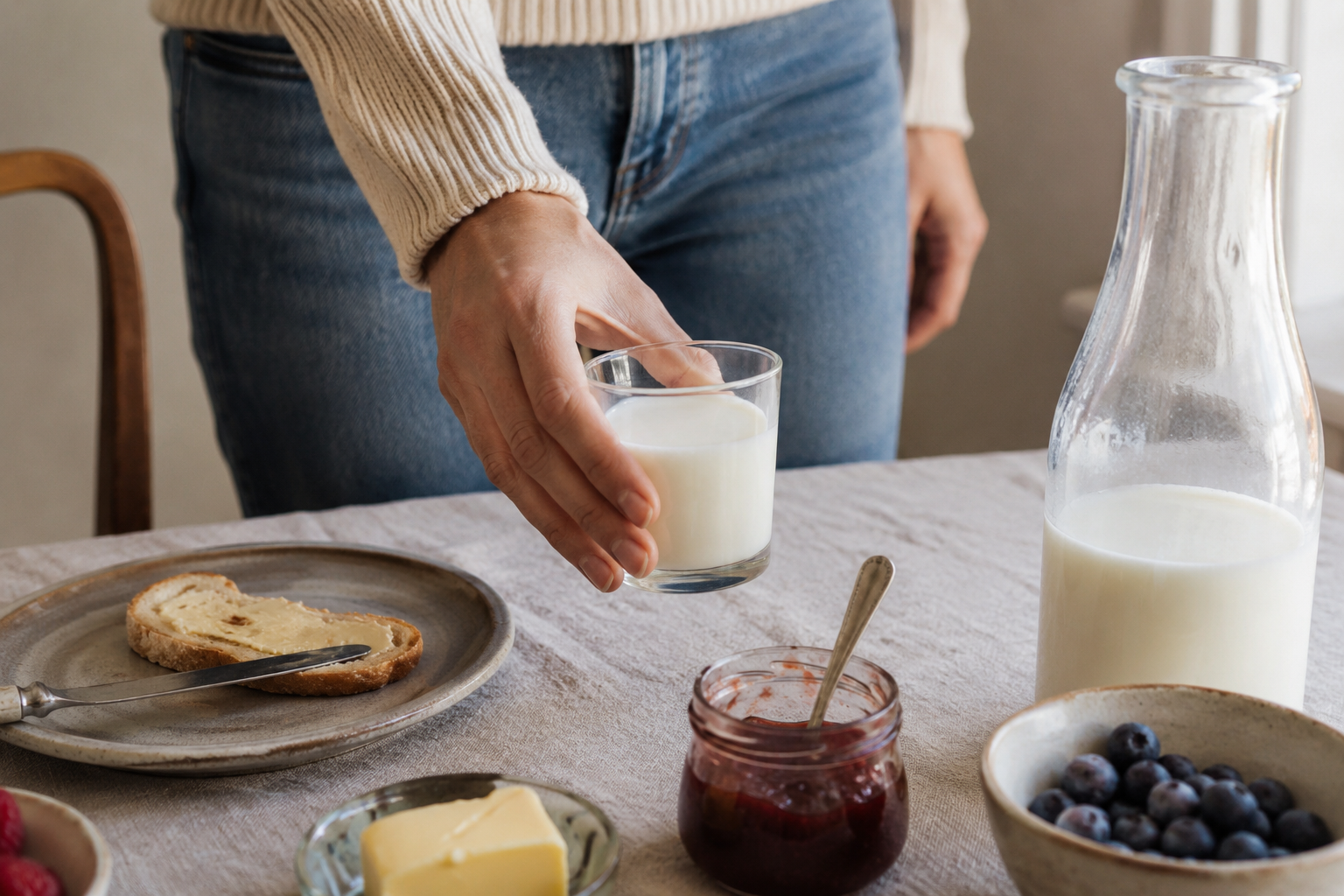
It started with a simple question I could not answer. Standing in front of the milk in a supermarket, I realized I had no idea whether the cows that produced it had been given a synthetic growth hormone, because nothing on the carton told me. In Europe, where I live, this is not a question anyone has to ask, because the hormone in question is banned. In America, it is allowed, widely used, and, crucially, not required to be disclosed on the label. So I decided to spend thirty days drinking only milk produced the way European milk is produced, without that hormone, and to learn the story that American cartons do not tell.
What I found over those thirty days was less dramatic and more interesting than I expected. This is not a tale of a miracle transformation or a sudden health revelation, because the truth about this hormone is more complicated and more contested than the scary version suggests. What the experiment really revealed was something about transparency, about how much or how little a food label tells you, and about the quiet difference between a system that bans something and one that permits it without a word. That turned out to be the more interesting story all along.
Here is what I learned drinking European-style milk for a month, what this synthetic hormone really is, why Europe banned it and America did not, what the science does and does not say, and why the labeling gap is the part that truly matters. This is a personal account and a look at the facts rather than medical or dietary advice, and I am not a scientist, but the story of what is and is not in your milk, and what you are allowed to know about it, is worth telling straight.
The Hormone Behind the Question
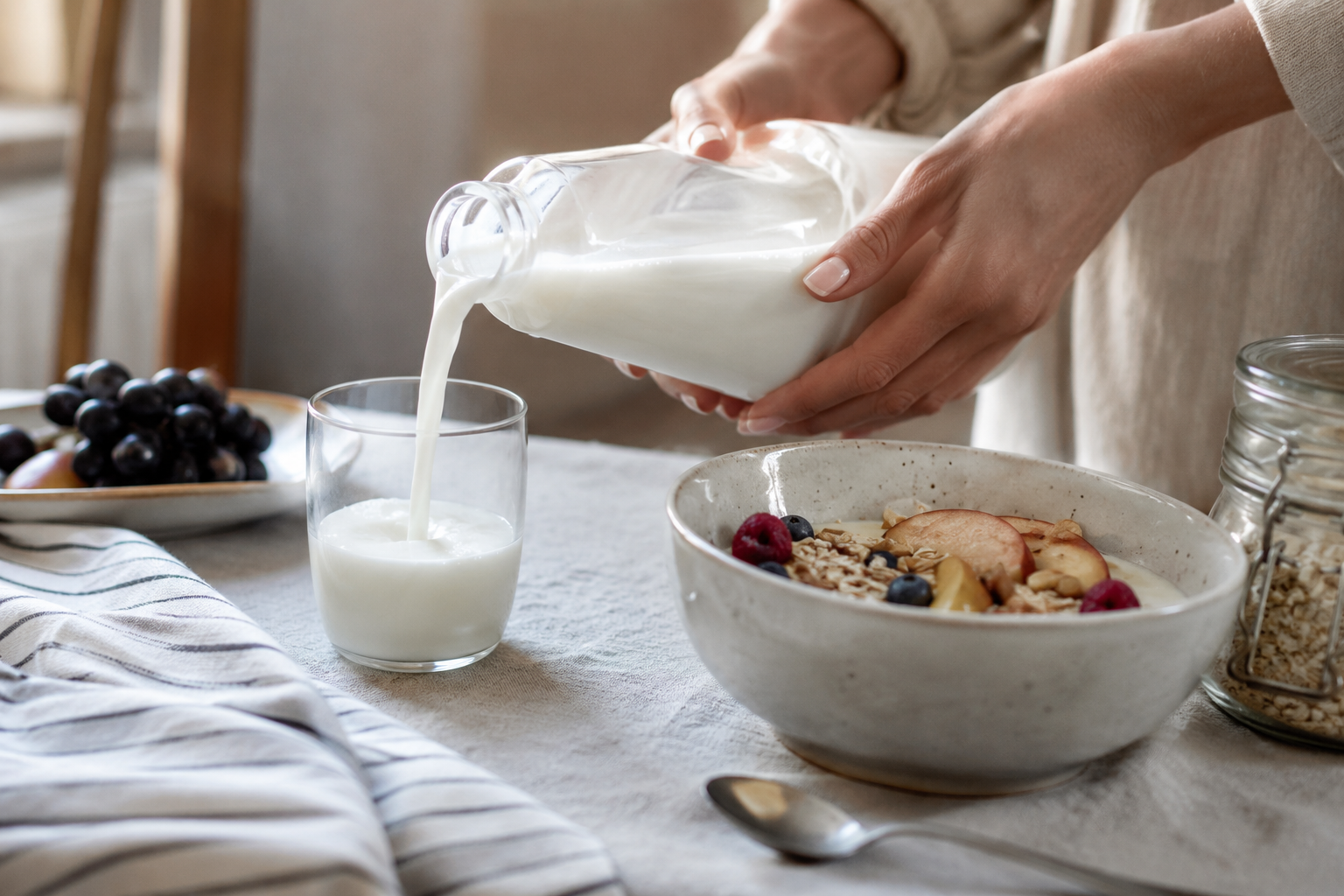
The hormone at the center of all this goes by an alphabet of names, most commonly rBST, for recombinant bovine somatotropin, also called rBGH, or recombinant bovine growth hormone. It is a synthetic version of a hormone cows produce naturally, manufactured in a lab and injected into dairy cows to make them produce more milk, and it does exactly that, raising a cow’s milk output by roughly ten to fifteen percent.
Its history in America is specific and well documented. The synthetic hormone was approved for American dairy cows in 1993, and it went on to become a common tool in the United States dairy industry, used to boost production across a large share of the country’s herds. For decades, then, a meaningful portion of the milk and dairy on American shelves has come from cows treated with it, blended invisibly into the general supply, indistinguishable to anyone standing in a store.
The key word there is invisibly. Because the milk of a treated cow is chemically almost identical to the milk of an untreated one, and because American regulators do not require disclosure, there is generally no way for a shopper to know from a standard carton whether the hormone was involved, which is exactly the gap that sent me looking for milk produced the older, European way. The hormone is present in the system but absent from the label. That absence is not an accident or an oversight but a deliberate regulatory choice. American authorities concluded that because the milk of treated and untreated cows is not meaningfully different by their measures, no disclosure was warranted, which is a defensible position on its own terms and also, for a shopper who would simply like to know, a frustrating one. The label tells you the fat content and the vitamins added, but on this one question it stays silent, and silence, when a shopper would rather know, is its own kind of answer.
Why Europe Said No

Europe took a very different path with this hormone, and understanding why is central to the whole story. The European Union banned this synthetic hormone in dairy cows, a prohibition that also applies across Canada, Japan, Australia and New Zealand, leaving the United States as the notable outlier among major developed nations in permitting it.
The reasons behind the European ban are worth stating accurately, because they are often misrepresented. The ban was justified primarily on grounds of animal welfare rather than proven human harm, with regulators pointing to evidence that the hormone increases the incidence of a painful udder infection called mastitis in treated cows, along with other stresses on the animals, which in turn tends to raise antibiotic use in the herd. The concern that carried the day in Europe was chiefly about the cows.
This is an important nuance that the alarmist version of the story tends to skip. Europe’s ban was not primarily a declaration that the milk is dangerous for humans to drink, but a decision rooted heavily in animal welfare and a general precautionary caution, and various scientific bodies that examined the human safety question did not find the milk itself unsafe to consume. The European position is better understood as we would rather not, on balance, for the animals’ sake and out of caution, than as this will hurt the people who drink it. I want to be careful here, because this is exactly the point where the story usually gets distorted. It is tempting to read a European ban as proof that Europe knows something dangerous that America is hiding, and sometimes that framing is deserved, but in this particular case the evidence does not support the dramatic version. The ban is real and the reasoning behind it is real, but the reasoning is more about cows and caution than about a demonstrated threat to human health.
What the Science Actually Says

Here the truth needs care, because the human health story around this hormone is deeply mixed and contested rather than settled in either direction. The most responsible summary is that the science has not established that milk from treated cows is harmful to human health, and major regulators including those who approved it consider it safe to drink, while some researchers have raised questions that remain unresolved.
The main scientific concern that gets raised involves a related growth factor. Milk from treated cows can contain somewhat higher levels of a compound called IGF-1, a growth factor that occurs naturally in milk and in our own bodies, and because higher levels of IGF-1 in the blood have been associated in some studies with certain cancers, a concern was raised about whether the hormone-treated milk might carry a risk. This is the thread that alarming accounts tend to pull on hardest.
But the evidence there is far from conclusive, and this must be said plainly. Research on whether drinking this milk meaningfully raises IGF-1 in the human body or translates into any real increase in disease risk has been mixed and inconclusive, and a number of reviews have found no clear link between cow’s milk consumption and the cancers of concern, so the fair position is that a possible risk has been raised but not demonstrated. Anyone telling you the science is settled, in either direction, is overstating it.
What I Actually Noticed
So what happened over my thirty days of drinking only European-style, hormone-free milk? The truthful answer is the one an honest account must give even when it is undramatic: I did not notice any dramatic change in how I felt, and I did not expect to, because nothing in the credible science predicted that I would.
The experiment was never really about a physical transformation. Given that the milk of treated and untreated cows is so similar, and that the human health question is unresolved rather than a clear danger, it would have been surprising and a little suspicious if I had suddenly felt transformed by the switch, and I did not. The change I was making was real in principle but subtle in any effect on my body, and I am not going to invent a revelation that did not occur.
What did change was something quieter and more mental. Knowing exactly how my milk was produced, and choosing it deliberately, gave me a sense of informed connection to my food that I had not had when I was simply grabbing whatever carton was there in ignorance, and that turned out to be the real texture of the experiment, less a physical shift than a shift in awareness. The value was in the knowing, not in some transformation of the body. This is worth being clear about, because so much writing about food promises the body a revolution that a month rarely delivers. I felt the same as ever, slept the same, and my milk tasted like milk. What was different was internal in a different sense: I had stopped outsourcing a decision I had never realized I was making, and had started choosing, on purpose, something I had previously accepted by default. That is a smaller thing than a health transformation, but it is not nothing.
The Part That Actually Matters

If the health story is contested and my physical experience was undramatic, what is left is the part that truly does matter, which is transparency. The real issue the whole experiment kept returning to was not whether the hormone is dangerous, but that in America you are generally not told whether it was used, and are therefore denied the ability to make an informed choice one way or the other.
This is the heart of it for me. Whatever one concludes about the safety science, there is a strong case that people ought to know how their food was produced and to choose accordingly, and the European approach, by banning the hormone outright, means European shoppers never face the question, while the American approach permits the hormone and does not require it to be disclosed, leaving shoppers in the dark. The gap is not really about milk chemistry, it is about the right to know.
There is a hopeful wrinkle to the American side of this, though, that deserves mention. In response to consumer demand, many major American retailers and brands have voluntarily moved to hormone-free milk for their store brands and products, so a great deal of American milk is in fact already produced without the hormone, even though the labels do not always make it obvious, which means an American shopper who cares can often find hormone-free options with a little looking. The market, in other words, has partly done what the labels do not.
How to Find It Yourself
For anyone who, like me, would simply prefer to choose milk produced without the synthetic hormone, the practical news is that it is quite findable in America once you know what to look for. Rather than searching for what is not disclosed, you look for the positive labels that dairies who skip the hormone use voluntarily to distinguish their products.
The labels to look for are specific phrases. Milk produced without the hormone is often marked with wording such as made without artificial growth hormones, or from cows not treated with rBST, or similar voluntary statements, and organic milk is produced without the hormone as well, so choosing certified organic is a reliable route to hormone-free milk. These labels are the mirror image of the disclosure that is missing, telling you what was not used since the law does not require telling you what was.
A small caveat keeps this honest. Because the milk of treated and untreated cows cannot be easily distinguished by testing, these voluntary labels rest on the practices and assurances of the producers rather than on a chemical test of the carton, and American regulators have at times required that such labels carry a note observing that no significant difference has been shown between the two kinds of milk. Still, for a shopper who wants to choose the European-style product, these labels are the practical tool, and they work.
What the Carton Doesn’t Say

The lasting lesson of my thirty days was not about my health, which did not noticeably change, but about how much a food label can quietly leave out. I went looking for a dramatic story about a dangerous hormone and found instead a more grown-up story about transparency, animal welfare, and the difference between a food system that bans a practice and one that permits it in silence. That story is less frightening than the scary version, and in some ways more thought-provoking.
What I take from it is a simple, moderate conclusion rather than a crusade. The synthetic hormone in American milk is not the proven poison that alarmist accounts suggest, and switching my milk did not transform my body, but the fact that American labels do not tell you whether it was used is a real gap in a consumer’s right to know, and choosing hormone-free or organic milk is an easy, reasonable way to opt out of the question if it bothers you. That is a measured takeaway, and a true one.
So if you have ever stood in front of the milk and wondered what you were really buying, you are asking a fair question, and in America it is a harder one to answer than it should be. You cannot always tell from the carton how your milk was made, but you can look for the voluntary labels and the organic seal that point to the European way, and you can make an informed choice. The rBST story American labels do not tell is, in the end, less about danger than about knowledge, and knowledge, even undramatic knowledge, is worth having. A month of European-style milk did not change my body, but it did change what I pay attention to when I shop, and that small shift has quietly outlasted the thirty days.

About the Author: Ruben, co-founder of Gamintraveler.com since 2014, is a seasoned traveler from Spain who has explored over 100 countries since 2009. Known for his extensive travel adventures across South America, Europe, the US, Australia, New Zealand, Asia, and Africa, Ruben combines his passion for adventurous yet sustainable living with his love for cycling, highlighted by his remarkable 5-month bicycle journey from Spain to Norway. He currently resides in Spain, where he continues sharing his travel experiences with his partner, Rachel, and their son, Han.