
An American out for drinks with a group does an instinctive piece of mental accounting all evening long. They had two beers, someone else had three, a couple of people shared a plate, and when the tab comes there is a small flurry of phones and calculators and figuring out who owes what, each person carefully paying for exactly what passed their lips. To a European watching this, the whole performance looks faintly absurd, because they have a completely different way of handling the same evening, one that involves no itemizing, no calculators, and often no splitting at all. It is called the rounds system, and once you understand it, the American way of paying for a night out starts to look like unnecessary hard work.
The rounds system, and the wider culture of taking turns to treat that surrounds it, is one of the quiet pleasures of European social life, a way of sharing the cost of good times that runs on trust and reciprocity rather than arithmetic. Instead of everyone paying precisely for their own consumption, people take turns covering the whole group, confident that it evens out over time, which turns the fraught moment of the bill into a warm gesture rather than a math problem. Understanding how it works, and how to participate gracefully, is one of the keys to fitting into European social life.
Here is how the rounds system works, the related custom of insisting on treating the whole group, why Europeans find it better than itemized splitting, and how to take part without causing offense. This is a look at social custom rather than a rigid rulebook, and practices vary by country, region and circle, but grasping the underlying logic of taking turns rather than splitting hairs transforms how you experience a European night out.
How the Rounds System Works
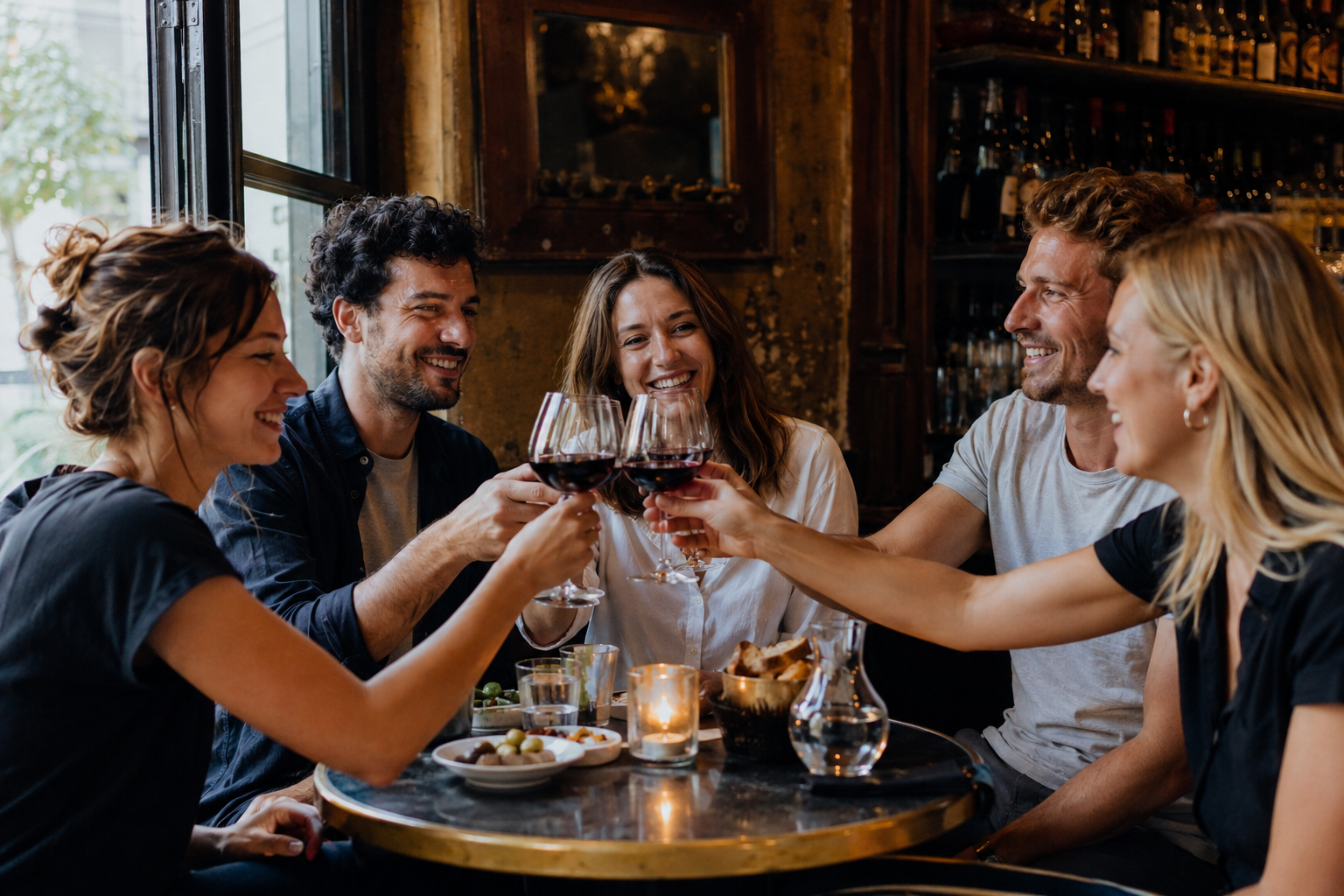
At the heart of it is a beautifully simple idea, that in a group at a bar, rather than each person buying their own drink, one person buys a round for everyone, and then the next person buys the following round, and so on around the group. Each round, one member of the group steps up and covers drinks for the whole party, so that over the course of an evening everyone takes a turn treating the others, and the costs roughly balance out without anyone ever counting.
The mechanics run on an unspoken understanding. When it is your turn, you buy for everyone without hesitation or complaint, and when it is someone else’s turn, you let them, so the drinks flow all night on a rotating basis of generosity, each person’s turn coming round naturally as the previous round empties. Nobody tracks the exact amounts, because the whole point is that across many evenings, it comes out fair enough.
This is why the system depends on rough equivalence rather than precise accounting. The rounds work because the amounts are broadly similar and the reciprocity is assumed, so a small difference in who drank what or which round cost a little more simply does not matter, absorbed into the general give and take of the group. The system trades the false precision of itemizing for the easy fairness of taking turns, and in doing so removes the entire apparatus of calculating who owes what. There is a real efficiency hidden inside the apparent looseness. An American group can spend ten minutes at the end of a night sorting out who owes what, phones out, doing sums, transferring small amounts back and forth, whereas a European group simply finishes its drinks and leaves, the reckoning already handled invisibly by the rounds along the way. What looks like the more casual system is in fact the one that spares everyone the fuss.
The Unwritten Rules of Rounds
Simple as it sounds, the rounds system has its own etiquette, and knowing the unwritten rules keeps you on the right side of it. The most important is that you must always buy your round, because the one social sin the system cannot forgive is the person who accepts round after round from others but somehow never steps up to buy one of their own, the freeloader who breaks the trust the whole thing runs on.
Timing and attentiveness matter too. A good participant keeps a loose awareness of whose turn it is and steps in to buy when the round is theirs, ideally offering before being prompted, since the graceful player of the game anticipates their turn rather than waiting to be reminded. Watching the glasses and moving to the bar as they empty, at the right point in the rotation, is the mark of someone who understands the rhythm. Getting this slightly wrong is one of the commoner newcomer stumbles, and it usually errs on the side of hesitation. The uninitiated guest, unsure of the custom, hangs back and lets others buy, meaning to be polite, and only realizes too late that hanging back reads as exactly the opposite. The safer instinct, when in doubt, is to offer to buy a round early, since eagerness to treat is never held against you while reluctance quietly is.
There is also the matter of matching the group. Because rounds work best when everyone is drinking at roughly the same pace and level, the system runs smoothest when the group is reasonably matched, and a considerate member keeps in step rather than ordering the most expensive thing on every round someone else buys while choosing the cheapest on their own. The spirit is generosity and rough equality, and playing it in that spirit, buying without stinting and drinking without exploiting, is what keeps the whole graceful machine running.
Invitar, the Fight to Pay
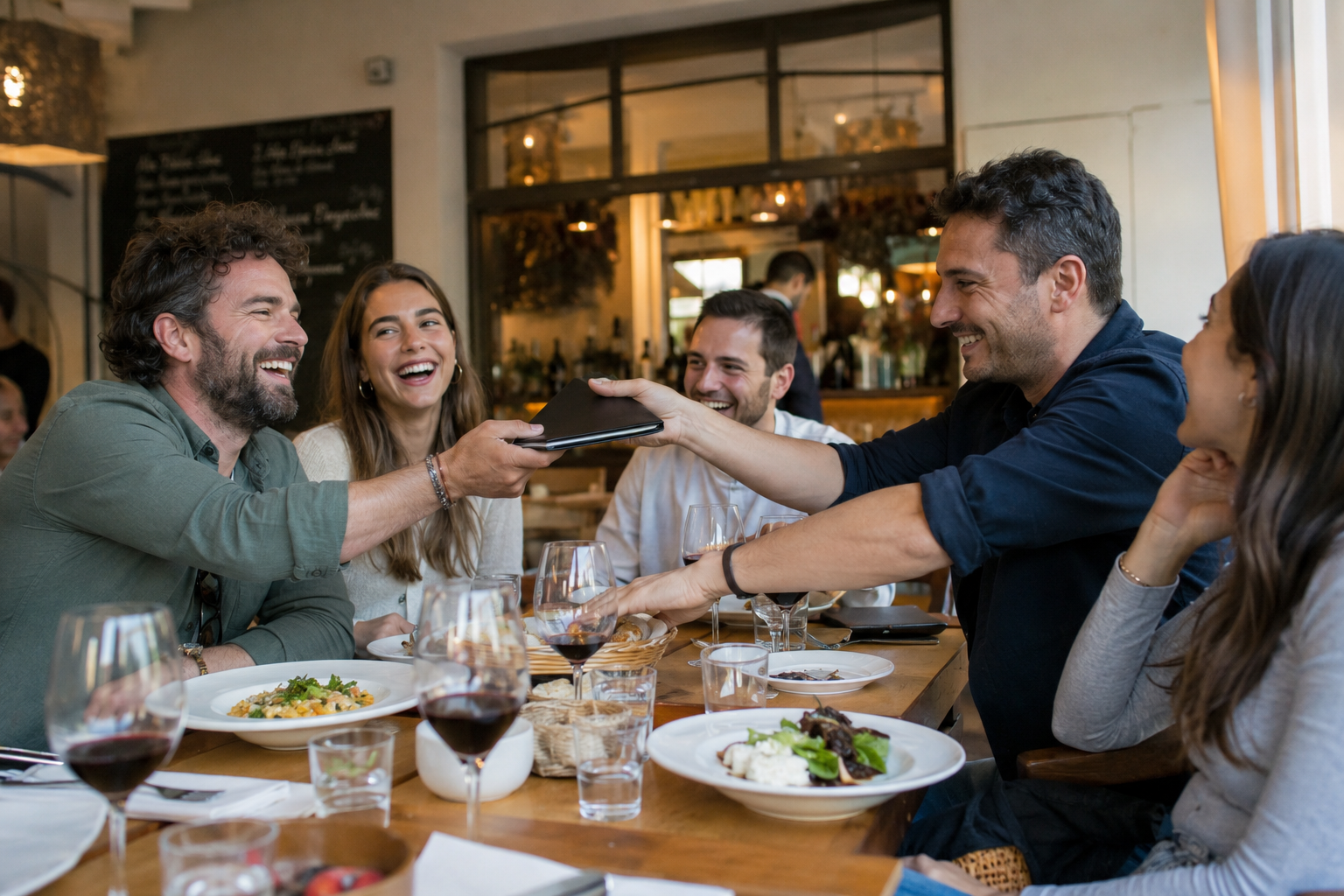
Related to the rounds system, and just as foreign to American instincts, is the custom of insisting on treating others, captured in the Spanish word invitar, to invite or to treat. Where an American might feel awkward about someone else paying, in Spain and much of Europe it is common and warm for one person to declare that a meal or a round is on them, saying something like the Spanish te invito yo, meaning it is my treat.
This produces a scene that baffles newcomers, the friendly fight to pay. Rather than the American negotiation over who owes what, Europeans often compete for the honor of paying, two friends each insisting they will cover the bill, a small, warm-hearted tussle that is the opposite of the reluctant American reaching for the check. Far from being reluctant to pay, people vie for the privilege, because treating others is a pleasure and a mark of generosity rather than a burden.
The key to navigating this is knowing how to respond when someone treats you. When a friend insists on paying, the gracious move is usually to let them rather than protest too hard, since arguing too much over the bill is itself considered bad manners, while making clear that the next one is on you. You accept the treat warmly, and you reciprocate later, either by grabbing the next bill or by quietly getting them a drink another time, which keeps the generous cycle turning. The thing to avoid is turning the acceptance into a prolonged protest, since the American reflex to insist on paying your own way, however well meant, can spoil the gesture. A brief, warm thank you and a clear promise to get the next one honors the treat far better than a stubborn refusal, which risks implying you would rather not be in the other person’s debt at all. Graceful acceptance is its own form of generosity.
Why Itemizing Feels Cold
To understand why Europeans prefer this system, you have to see how the itemized American approach looks through their eyes, which is to say a little cold and transactional. When each person pays precisely for their own consumption, calculating their exact share down to the drink, the meal becomes a kind of financial transaction, everyone settling their individual account, which drains the warmth from what is meant to be a shared social occasion.
The rounds and treating systems carry a different meaning entirely. Taking turns to buy for the group, or insisting on treating friends, expresses trust, generosity and the sense that the group is a unit rather than a collection of individuals settling debts, so the act of paying becomes a gesture of care rather than a reckoning. The message of a round is we are together in this, whereas the message of an itemized split can feel like each of us is on our own.
This is why the precise American approach can even read as slightly ungenerous abroad. Insisting on paying only for exactly what you consumed, refusing to let the amounts blur into the give and take of the group, can come across as distrustful or mean-spirited in a culture built on rounds and treating, even though the American means only to be even-handed. The two systems encode different values, precise individual fairness on one side, warm collective trust on the other, and the European side finds its own version by far the more pleasant way to share an evening.
The Trust That Makes It Work

The rounds system rests on a foundation of social trust that is worth appreciating, because it only functions among people who expect to see each other again. The whole thing works because of an assumption of ongoing relationship and reciprocity, the confidence that if you treat someone today they will treat you another day, which requires a degree of trust and continuity that a one-off transaction between strangers would lack.
This is why the system flourishes in stable social circles. Among friends, colleagues and communities who drink and eat together regularly, the rounds and treats even out reliably over time, so no single evening needs to balance because the relationship itself does the balancing across many evenings, which is exactly the kind of enduring social fabric these customs both rely on and reinforce. The system is a small engine of connection, binding a group through repeated mutual generosity.
It also explains where the system strains. Among strangers, in very large groups, or where people will not meet again, the assumption of reciprocity weakens and the rounds system can break down, which is why it is a custom of friends and regulars rather than of chance gatherings. Understanding this tells you when to expect it and when not to, and reminds you that participating well means being the kind of reliable, reciprocating person the system is built for. It also quietly explains why tourists so often misread the whole thing. A visitor passing through, who will never see these people again, has no place in a system built on repeated reciprocity, so what feels natural to them, paying precisely for their own, is not wrong for their situation, only out of step with the locals around them. The rounds belong to those who stay, which is part of why joining in signals that you intend to.
When the System Shifts
The rounds and treating customs are the tradition, but it is worth knowing that European habits around the bill are not frozen and do shift with circumstance, so a newcomer should stay alert to the actual situation. In many settings, especially among younger people or for a straightforward meal, simply splitting the bill equally, without itemizing, is entirely normal and common, a middle path between the rounds and the American calculator.
This equal split is its own established custom. Dividing a shared bill evenly among everyone, so that each pays the same regardless of exactly what they ordered, is widespread and unremarkable across Europe, and it shares the spirit of the rounds system, prioritizing ease and rough fairness over precise itemizing. It is the natural approach for a shared meal of dishes passed around the table, where itemizing would be impossible anyway.
Practicalities are shifting things too, which is worth noting. Card payment and the occasional restaurant reluctance to split a bill across many cards can complicate the old cash-based ease of these systems, so in practice a group may settle up in various ways, one person paying and being reimbursed, or splitting where possible. The underlying spirit, though, endures, that the goal is warm, easy sharing rather than cold precision, however the mechanics are handled on a given night.
Sharing the Cost, Sharing the Evening

The deeper lesson of the rounds system and the culture of treating is that Europeans have found ways to handle the cost of socializing that strengthen the social bond rather than straining it, turning the awkward business of payment into an expression of generosity and trust. Where the itemized approach makes each person a separate account to be settled, the rounds and treats make the group a unit that takes care of its own, which is a warmer and more connected way to share a table or a bar.
What makes these customs worth adopting, or at least understanding, is how much more pleasant they make the end of an evening. Instead of the small deflating scramble of calculators and exact change, there is the easy flow of rounds bought in turn and treats offered freely, the confidence that it all comes out fair over time, and the warmth of a group that shares rather than divides, which is simply a nicer note on which to close a night out. The system replaces anxiety with generosity, and a chore with a small ritual of friendship.
So when you find yourself out with Europeans and the drinks begin to flow, resist the urge to track your consumption and reach for your calculator. Buy your round when it comes to you, let others buy theirs, accept a treat graciously and return it later, and trust that across the evening and the friendship it will all balance out. You will find, as Europeans have long known, that sharing the cost of good times through rounds and generosity rather than arithmetic does not just settle the bill more easily but makes the whole evening warmer, and turns the simple act of paying for drinks into one more small expression of being, for tonight and many nights, part of the group.

About the Author: Ruben, co-founder of Gamintraveler.com since 2014, is a seasoned traveler from Spain who has explored over 100 countries since 2009. Known for his extensive travel adventures across South America, Europe, the US, Australia, New Zealand, Asia, and Africa, Ruben combines his passion for adventurous yet sustainable living with his love for cycling, highlighted by his remarkable 5-month bicycle journey from Spain to Norway. He currently resides in Spain, where he continues sharing his travel experiences with his partner, Rachel, and their son, Han.