
You did everything right. You have a proper American will, drawn up by a lawyer, leaving your estate exactly as you and your spouse intend. Then you retire to Spain, buy a lovely home near the coast, and settle into your new life, never imagining that the careful document sitting in a drawer back home may not do what you think it does. Because here is the trap that catches so many American retirees in Europe, and that they so often discover only when it is far too late to fix. When you die as a resident of a country like Spain, it may not be your American will and your American wishes that govern your estate, but the forced inheritance laws of your new country, which can override your intentions entirely.
This is the cross-border estate problem, and it is one of the least understood and most consequential surprises of retiring abroad. The heart of it is that many European countries have inheritance rules profoundly different from the American ones, rules that reserve large portions of your estate for specific relatives whether you like it or not, and that can apply to you as a resident regardless of what your American will says. The good news is that there is a way to protect yourself, but only if you know about it and act while you can.
Here is why your American will may not work in Europe, how European forced-heirship laws can override your wishes, the legal tool that lets you take back control, and why this is a problem to solve before you die rather than one for your heirs to discover after. This is general information rather than legal advice, cross-border estate law is deeply complex and highly individual, and anyone in this situation needs a qualified lawyer, but understanding the shape of the problem is the first and most important step.
The Will You Think Protects You
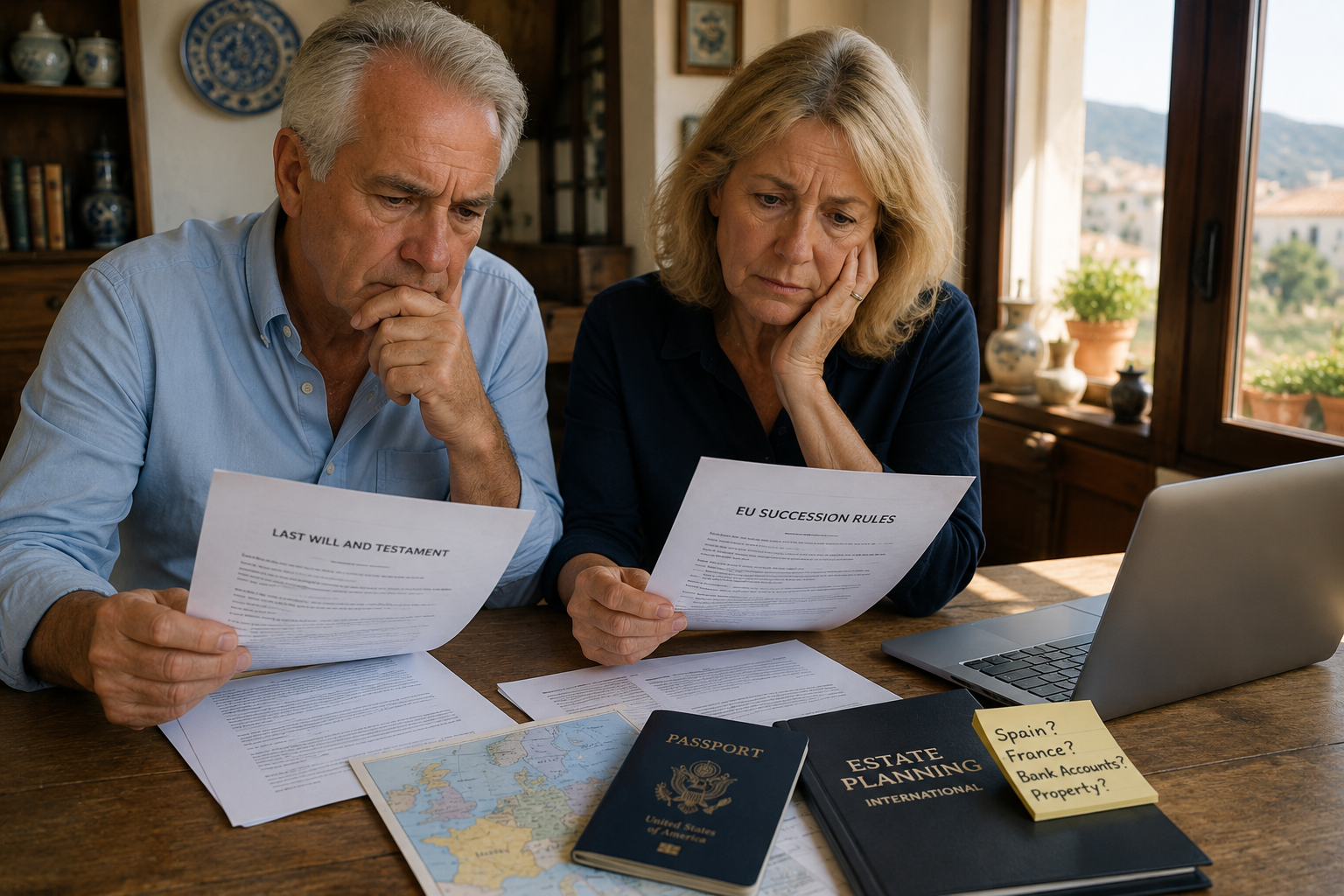
Start with the false sense of security, because it is the dangerous part. Americans place great faith in the will, and rightly so at home, where the principle of testamentary freedom means you can generally leave your estate to whomever you wish. Your American will reflects that freedom, distributing your assets according to your own wishes, and you reasonably assume it will be honored wherever you happen to live.
That assumption is the problem. A will is a legal document that operates within a particular legal system, and an American will is written for the American system, which may have limited or no force over an estate governed by the laws of another country. When you become a resident of a European country, your estate may fall under that country’s succession laws rather than your home state’s, and your American will, however carefully drawn, may not carry the authority you expect it to.
The result is a gap between what you intend and what the law will do, and it is a gap most people never see coming. You believe your wishes are secured by a document you paid a lawyer to prepare, when in fact, as a resident abroad, those wishes may be quietly overridden by a foreign legal system you never studied and never chose. The will in the drawer feels like protection, but across a border it can become a piece of paper the law declines to fully follow. It is worth being precise about what does and does not carry over, because the picture is not that your American will becomes worthless. It remains a valid statement of your wishes and can still matter, particularly for assets back home, but its power over your estate in your country of residence may be sharply limited by that country’s own rules. The danger is not that the will vanishes but that it is quietly demoted, no longer the final word it was written to be.
How European Forced Heirship Works
The reason your wishes can be overridden lies in a concept largely foreign to American law, called forced heirship. Many European countries, unlike the United States, do not grant complete testamentary freedom, and instead reserve a fixed portion of every estate for certain close relatives by law, a reserved share that the deceased cannot freely give away to anyone else. Your children, in particular, may have a legal right to a chunk of your estate that you cannot override.
Spain is a clear example, and a common destination, so it makes the point well. Under Spanish succession law, a large share of an estate is reserved for forced heirs, the herederos forzosos, principally the children, with the reserved portion, the legítima, amounting to as much as two-thirds of the estate. You cannot simply disinherit these heirs or leave everything to your spouse or a charity, because the law guarantees them their share except in narrow circumstances.
This collides head-on with typical American intentions. An American couple commonly wishes to leave everything to the surviving spouse, with the children inheriting only after both parents are gone, an arrangement that feels natural and is easily done under American law. Under a forced-heirship system, that plan can be legally impossible, because the children have a reserved right to their portion immediately upon the first parent’s death, so the very structure most American couples want may be overridden by a law they did not know applied to them. The spouse tends to fare worst under these systems, which is exactly the reverse of the American expectation. Where American planning typically centers on protecting the surviving husband or wife, forced-heirship regimes often give the spouse a weaker position than the children, sometimes only a limited right to use certain assets during their lifetime rather than outright ownership. A couple who assumed the survivor would inherit everything can find the survivor inheriting surprisingly little.
Why It Applies to You

The natural objection is that these are foreign laws that surely cannot bind an American, and understanding why they can is essential. Across the European Union, cross-border inheritance is governed by a regulation commonly known as Brussels IV, which took effect in 2015 and set a single rule for determining which country’s law applies to an estate that crosses borders. That rule is the crux of the whole matter.
The default it sets is decisive. Under Brussels IV, the law that governs your entire estate is, by default, the law of the country where you were habitually resident at the time of your death, not the law of your nationality. So an American who has retired and settled in Spain is, by default, subject to Spanish succession law over their whole estate, forced heirship and all, precisely because Spain is where they habitually live. Your residence, not your passport, decides whose inheritance law rules.
This is the mechanism that quietly overrides the American will. Because you live in Spain, Spanish law applies to your succession by default, and Spanish law contains forced-heirship rules that your American will cannot simply set aside, so the document you trusted is subordinated to a foreign legal regime by virtue of nothing more than where you chose to spend your retirement. The very act of moving abroad, without any further step, can rewrite who inherits your estate. It is worth noting which countries this covers, since Brussels IV applies across nearly the whole European Union. The regulation binds every EU member state except Denmark and Ireland, so an American retiring to Spain, France, Italy, Portugal, Greece or almost anywhere else in the bloc falls under the same default habitual-residence rule. The specific forced-heirship provisions differ from country to country, but the underlying trap, that your residence determines the law, is consistent across the great majority of European retirement destinations.
The Tool That Takes Back Control

Here, thankfully, is the crucial good news, because the same regulation that creates the problem also contains its solution. Brussels IV does not force you to accept the law of your country of residence, since it allows you to make a choice of law, electing instead to have the law of your nationality govern your entire estate. This single provision is the key to the whole problem, and it is available to Americans.
The mechanism is a formal election you make in your will. Under the regulation, you can include an express clause declaring that you choose the law of your nationality to apply to your succession, and courts have confirmed that this choice is open to non-EU nationals, including Americans, who can elect the law of their home US state. With that clause in place, your estate is governed by American law rather than the forced-heirship rules of your country of residence, restoring your testamentary freedom.
The effect is to give you back control over your own estate. By electing your national law, an American in Spain can escape Spanish forced heirship and once again leave their estate according to their own wishes, to a spouse, to chosen children, to a charity, as their home-state law permits. The tool exists, it works, and it is precisely what stands between an American retiree and the unwelcome application of a foreign inheritance regime, but it only helps those who know to use it. There is an elegance to the arrangement that is worth appreciating. The same European regulation that would otherwise impose forced heirship on an unwitting American also hands that American the means to escape it, provided they take the deliberate step of writing the election into their will. Europe is not trying to trap foreign retirees, it has simply built a system with a default and an opt-out, and the whole game is knowing that the opt-out exists and reaching for it in time.
The Details That Trip People Up
Making the election correctly matters, though, and there are several traps that catch even the well-intentioned, which is exactly why professional help is essential. The most fundamental error is simply not making the choice at all, since without the express clause the default rule applies and your country of residence’s law, forced heirship and all, governs by default. Silence is not neutral here. Silence hands your estate to the local law.
Other mistakes are more subtle but just as damaging. Having multiple wills in different countries that contradict one another can create chaos, assuming your home-country will automatically covers your foreign assets can leave a gap, and failing to have the choice-of-law clause properly drafted and, ideally, notarized can undermine it, so the details of how the election is made are as important as making it. This is delicate legal work that rewards precision and punishes the amateur.
There is also a vital distinction that surprises many, which concerns tax. The choice-of-law election governs which country’s succession law applies, meaning who inherits, but it does not change which country’s inheritance tax applies, so even after electing your national law, the local inheritance taxes of your country of residence generally still apply to the estate. Controlling who inherits and controlling how the inheritance is taxed are two separate problems, and solving one does not solve the other, which is a further reason expert local advice is indispensable.
Why It Is Discovered Too Late
The cruelest feature of this whole problem is its timing, because it is so often discovered only after death, when nothing can be done. The person whose estate is affected is, by definition, no longer around to fix it, and the discovery falls instead on grieving heirs who learn, in the middle of their loss, that the deceased’s wishes cannot be carried out because the necessary legal step was never taken. By then the window has closed.
This is what makes the problem so insidious compared with other expat surprises. A driving-license rule or a visa deadline announces itself while you are alive to deal with it, but the cross-border estate trap stays silent for as long as it matters least and reveals itself only when it is too late to remedy, leaving a family to untangle a mess the deceased never knew they had created. The absence of any warning is the whole danger.
It is also, mercifully, entirely preventable, which is the reason to act. Everything about this problem can be solved in advance by a competent lawyer while you are alive and well, through a properly drafted will with the correct choice-of-law election and coordinated estate planning across the countries involved. The difference between a family protected and a family blindsided is simply whether the retiree addressed this before it was too late, which is wholly within their power to do.
Solving It Before It Solves You

The lesson of the cross-border estate problem is that retiring abroad quietly changes the legal rules governing your death, and that the American will you trusted may no longer do the job you drew it up to do. This is not a reason to fear moving to Europe, but a reason to add estate planning to the list of things you sort out when you go, alongside the visa and the healthcare and the residency, rather than assuming your existing arrangements will simply follow you across the ocean. They may not.
The path through it is clear and manageable for anyone who acts in time. Get proper cross-border legal advice when you settle abroad, make sure your will contains the choice-of-law election that keeps your own national law in control of your estate, coordinate your wills and your planning across the countries where you hold assets, and address the separate question of inheritance tax with a local expert. None of this is beyond an ordinary retiree who takes it seriously and hires the right help.
So if you are retiring to Europe, or already have, do not let your estate plan be the thing you discover was broken only after you are gone. Understand that your American will may not carry the authority you assume, that your new country’s forced-heirship laws may apply to you by default, and that a simple, powerful legal tool exists to keep control in your own hands, if you use it in time. The cross-border estate problem is one that punishes only the unprepared, and the whole of the solution lies in dealing with it now, while it is still yours to solve, rather than leaving it as a painful surprise for the people you most wanted to protect.

About the Author: Ruben, co-founder of Gamintraveler.com since 2014, is a seasoned traveler from Spain who has explored over 100 countries since 2009. Known for his extensive travel adventures across South America, Europe, the US, Australia, New Zealand, Asia, and Africa, Ruben combines his passion for adventurous yet sustainable living with his love for cycling, highlighted by his remarkable 5-month bicycle journey from Spain to Norway. He currently resides in Spain, where he continues sharing his travel experiences with his partner, Rachel, and their son, Han.