

Most of the sugar in a modern diet is invisible. It is not the sugar you spoon into coffee or the obvious sweetness of a dessert, but the sugar hidden inside foods that do not taste especially sweet at all, the bread, the sauce, the yogurt, the salad dressing, the loaf that seems savory and is quietly loaded. This is the sugar you cannot taste, and how a food label helps or fails to help you find it turns out to differ in fascinating ways on the two sides of the Atlantic, in ways that upend the usual assumptions.
The common belief is that European food labels are transparent while American ones hide the truth, and like many tidy stories about Europe and America, it is more complicated and more interesting than that. On one specific and crucial point, the disclosure of added sugar, it is the American label that reveals more and the European one that shows less. On another, the simple at-a-glance warning on the front of the pack, Europe leads and America is only now catching up. The full picture is a study in two different philosophies of how to tell people what is in their food.
Here is where the hidden sugar in your food really hides, what American and European labels each show and bury, and how to read either one to find the sugar you cannot taste. This is general consumer information rather than medical or nutritional advice, labeling rules are changing on both continents, but understanding what each label is really telling you is a useful skill.
The Sugar Hiding in Plain Sight
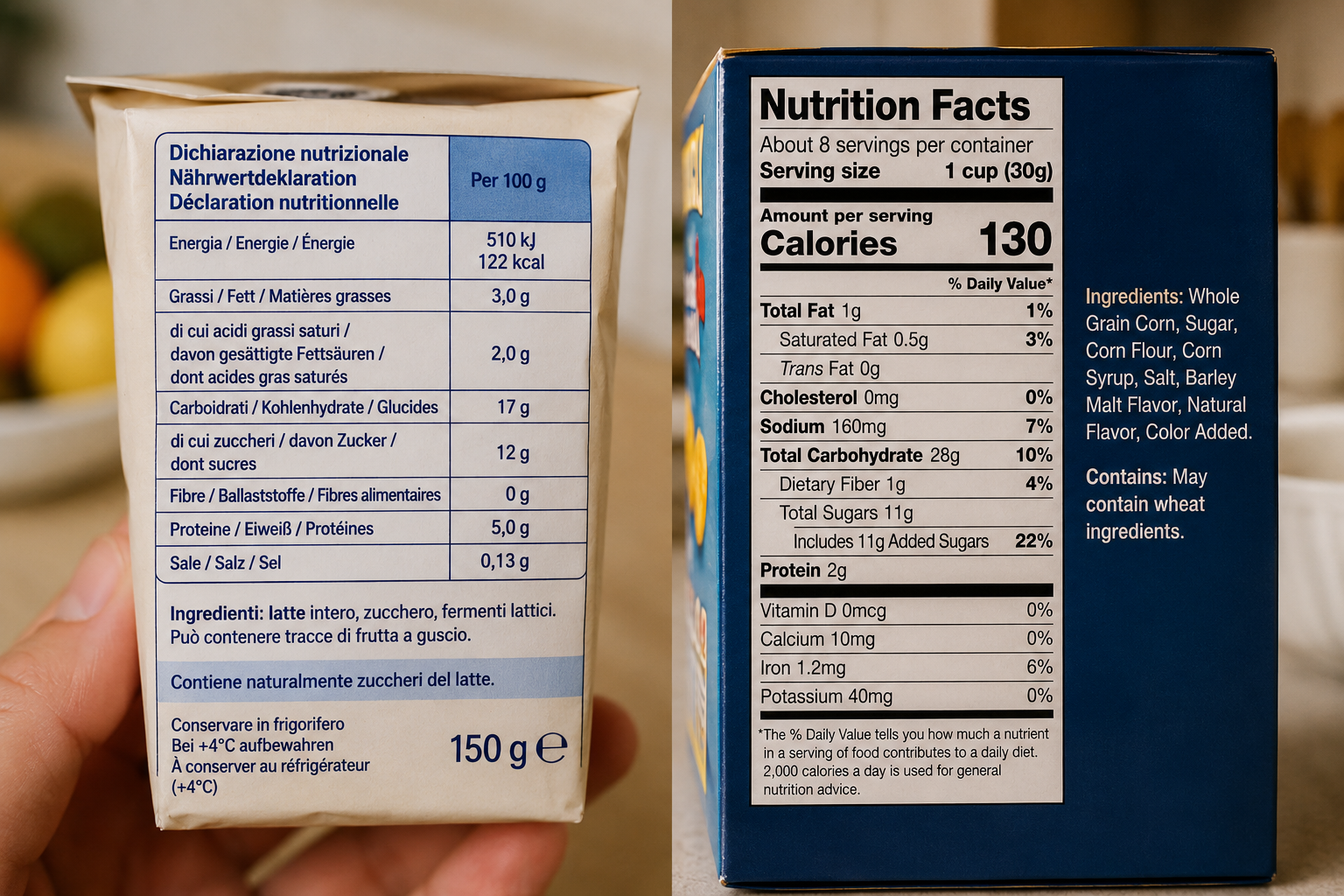
Start with the problem the labels are trying to solve, which is that added sugar is everywhere and mostly disguised. Food manufacturers add sugar to an astonishing range of products that no one thinks of as sweet, from bread and crackers to pasta sauce, soup, cured meats, salad dressings and countless savory processed foods, where it improves taste, texture and shelf life. Much of the sugar people consume arrives this way, unnoticed, inside food that does not announce it.
This is what makes hidden sugar such a real problem. Because it is buried in savory foods and dissolved invisibly into things that taste of other flavors, a person can consume a great deal of added sugar across a day without ever feeling that they ate anything sweet, which is exactly why it escapes attention. You cannot taste your way to an accurate sense of how much sugar you are eating, and that is where labels are supposed to help. The savory foods are the real trap, because sweetness at least warns you. A slice of cake is upfront about what it is, and you can decide accordingly, but a jar of pasta sauce or a loaf of sandwich bread gives no such warning while sometimes carrying a startling amount of added sugar. It is the sugar in the food that does not taste sweet, hiding behind salt and savory flavors, that slips past a person unnoticed day after day.
The distinction that matters most here is between two kinds of sugar. There is the sugar that occurs naturally in whole foods, the sugar in an apple or a glass of milk, which comes bundled with fiber, nutrients and water, and there is the added sugar stirred into processed food during manufacturing, which brings sweetness and calories and little else. The trouble is that on a basic ingredient list these two can be nearly impossible to tell apart, and that is the problem that better labeling sets out to fix. A good label, in principle, does the tasting for you, telling you in numbers or symbols what your tongue cannot, and turning an invisible ingredient into a visible one you can choose to accept or avoid.
What the American Label Reveals
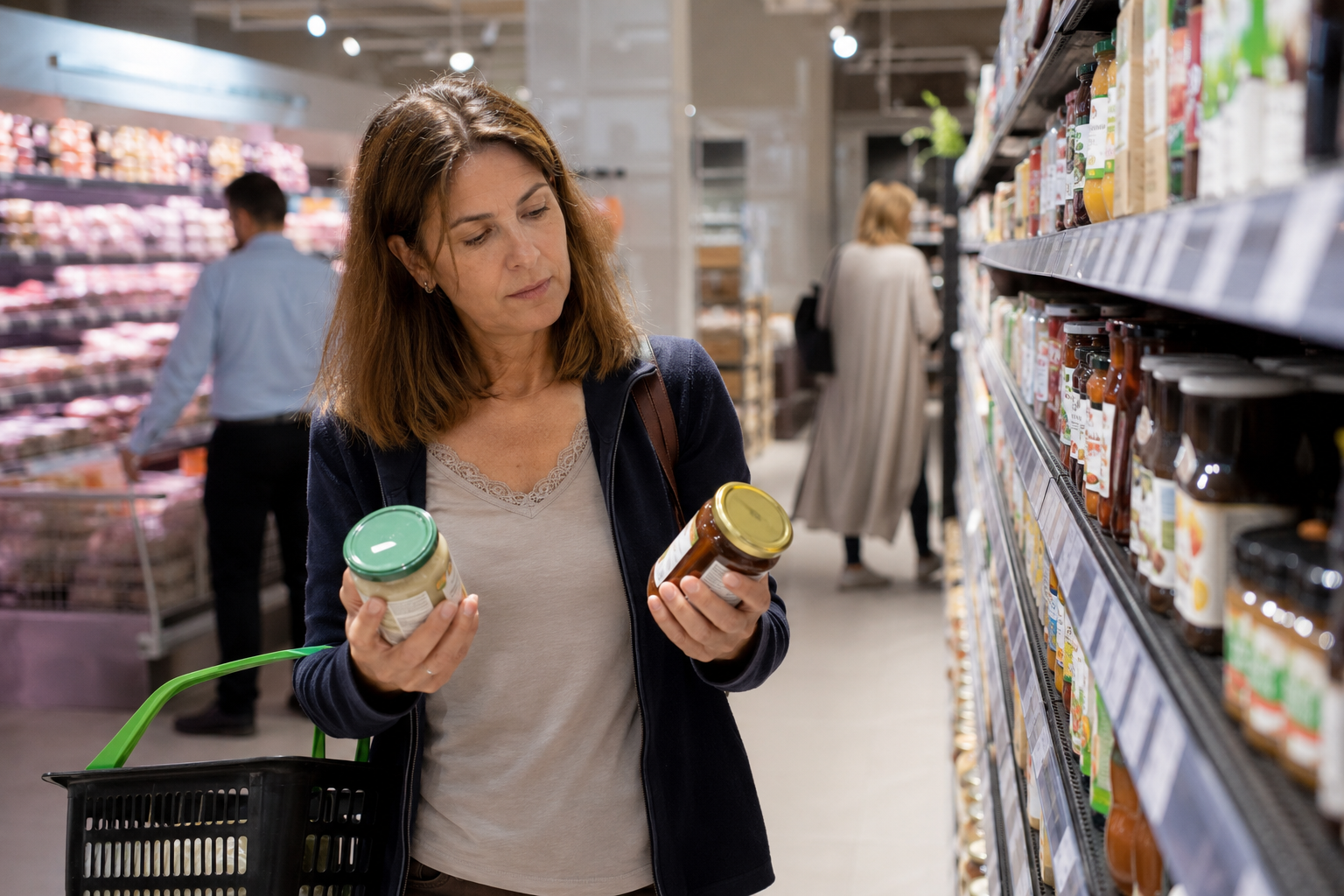
Here the tidy story falls apart, because on the single most important point the American label is the more revealing of the two. Since a major update to the Nutrition Facts panel, American labels are required to break out added sugars as their own separate line, listed distinctly beneath the total sugars, so that a shopper can see at a glance exactly how much sugar was added to a product during manufacturing as opposed to occurring naturally.
This is a genuinely powerful piece of information, and it directly targets the hidden-sugar problem. The added-sugars line tells you precisely the thing that matters and that you cannot taste, separating the sugar a manufacturer chose to add from the sugar that came with the fruit or milk, and it even shows that added sugar as a percentage of a recommended daily maximum. A savory-tasting product with a surprisingly high added-sugars number is exposed on the spot, its hidden sweetness laid bare in black and white.
The requirement did not appear by accident. It followed years of public health concern about excessive added sugar in the American diet and its links to disease, and it was designed specifically to arm consumers against the invisible sugar in processed food. Whatever else one says about American food, its back-of-pack label now carries a level of detail about added sugar that much of the world, including Europe, does not require, which is precisely the opposite of the usual assumption. This is worth sitting with, because it cuts against a strong instinct. The reflex to assume that anything European must be the more wholesome and transparent option is understandable given the reputation of European food culture, but on this narrow, specific and important point it simply does not hold. The label that best answers the question of how much sugar was added is the American one, and pretending otherwise helps no one shop more wisely.
What the European Label Buries
Turn the European label over and, on this specific point, you will find less. Under EU rules the mandatory nutrition panel lists total sugars, usually phrased as carbohydrate of which sugars, but it does not require a separate declaration of added sugars, lumping the naturally occurring and the added together into a single number. The one figure that best exposes hidden sugar, the added-sugars line, is simply not there.
This means the European back-of-pack label leaves a real gap exactly where the American one is strong. A shopper reading a European nutrition panel can see the total sugar in a product but cannot easily tell how much of it was added during manufacturing versus how much came naturally with the ingredients, which is the very distinction that matters for the hidden-sugar problem. On this measure the European label buries what the American label reveals.
It is a real and somewhat surprising shortcoming in a food culture often praised for its transparency, and it shows that no system is uniformly ahead. The reasons are partly technical, since separating added from natural sugar is truly difficult to verify and enforce, and partly political, but the practical result for a shopper is the same. If you want to know how much sugar was added to a European packaged food, the mandatory label alone will not reliably tell you, and you must fall back on reading the ingredient list.
Where Europe Pulls Ahead
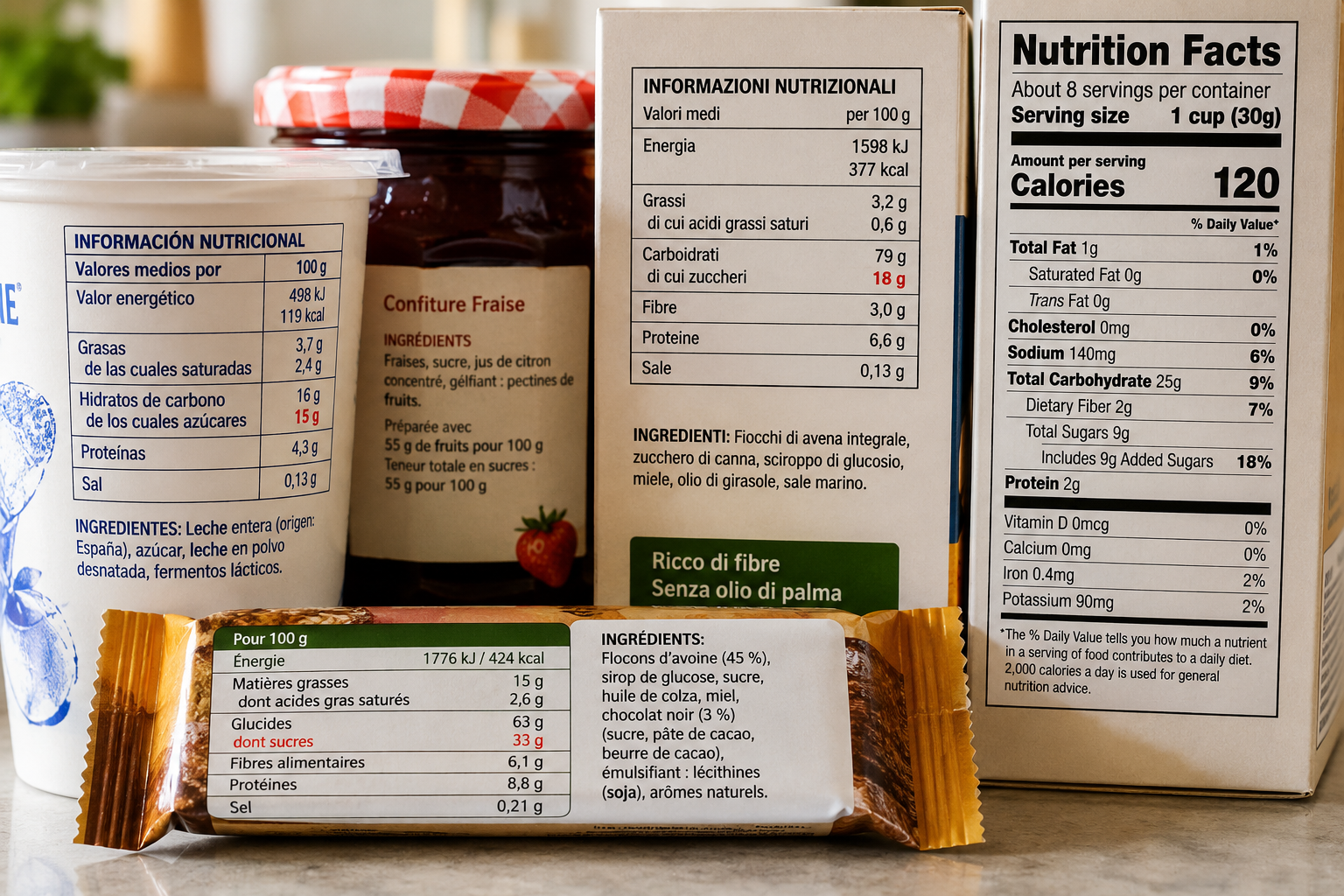
But the story does not end there, because the two systems compete on a second front entirely, and here Europe leads decisively. While the American strength lies in the detail on the back of the pack, the European strength lies on the front, in the simple, interpretive, at-a-glance labels that many European countries put right on the face of the package where nobody can miss them. This is a different philosophy of labeling altogether.
The front-of-pack schemes are designed for speed and instinct rather than study. France’s Nutri-Score grades a product with a single color-coded letter from green A to red E summarizing its overall nutritional quality, the British and Irish traffic light system marks fat, sugar and salt in green, amber or red, and the Nordic Keyhole symbol flags healthier choices, all of them meant to convey at a glance, without any reading of numbers, whether a food is a better or worse choice. A product loaded with hidden sugar tends to earn a red mark or a poor grade that a rushed shopper can hardly miss.
This is where Europe clearly helps against invisible sugar in a way America has lacked. A busy person who would never turn a package over and study an added-sugars figure will still register a red sugar light or a red E on the front, and that instant, intuitive signal catches the hidden sugar that a detailed back-panel might, in practice, never get read. The American system assumes an engaged reader. The European front-of-pack system assumes a hurried one, and hurried is what most shoppers really are.
Two Philosophies of Telling the Truth
Step back and the real difference is not that one continent is honest and the other is not, but that they have chosen two different ways of being honest. The American approach favors detail and disclosure, packing a precise, quantified account of added sugar onto the back of the pack for the consumer willing to read it, trusting people to inform themselves from thorough data. It is transparency as full information.
The European front-of-pack approach favors interpretation and speed, distilling a food’s quality into a simple symbol on the front that requires no expertise and no effort to grasp, trusting that a clear signal will guide better choices than a wall of numbers most people ignore. It is transparency as instant guidance. Each philosophy has real strengths, and each has a real blind spot, the American detail going unread and the European simplicity glossing over specifics like the exact added-sugar figure.
The truth is that the ideal label would combine them, and both systems are drifting toward the other. America has moved to require the detailed added-sugars line and is now considering its own front-of-pack scheme, while Europe leads on the front label but lags on added-sugar detail, and the whole landscape is shifting as each continent borrows the other’s strengths. Neither has it perfect, and the smart shopper learns to use whatever the label in their hand does offer.
Correcting a Common Myth
Because the assumption runs so deep, it is worth stating the correction plainly, since a lot of well-meaning advice gets this exactly backwards. It is often claimed that European food labels expose added sugar while American ones conceal it, and on the specific question of the added-sugars figure, the reverse is true. The American Nutrition Facts panel breaks out added sugars as a required, separate, quantified line, and the standard European nutrition panel does not.
This matters because the myth can lead people to trust the wrong thing. A shopper who believes the European label is automatically more revealing about added sugar may study a European panel expecting to find a figure that is not there, while dismissing the American label that does carry it. Getting the direction right lets you use each label for what it truly does well rather than what you assumed it did.
None of this makes one continent’s food healthier than the other’s, which is a separate question entirely. Labeling is about disclosure, not about what is in the food, and a country can have excellent labels on poor food or poor labels on good food. The point is narrower and purely practical, which is knowing what information each label really gives you so you can find the hidden sugar wherever you happen to be shopping.
The larger lesson is to be skeptical of tidy contrasts between European virtue and American failing, because reality is usually a patchwork. On added-sugar disclosure the United States is ahead, on front-of-pack simplicity Europe is ahead, and on both the systems are changing quickly. The truth about food labeling, like the sugar itself, is often hiding just beneath the surface of the story everyone repeats.
How to Find the Hidden Sugar Yourself

Whatever label you are holding, you can learn to find the sugar you cannot taste, and it is a skill worth having on either continent. On an American label, go straight to the added sugars line, since it tells you directly what you want to know, and treat a high number on a savory or supposedly healthy product as the red flag it is. On a European front-of-pack label, heed the color, letting a red sugar light or a poor Nutri-Score steer you as it is meant to.
The ingredient list is your universal backup, and it works anywhere. Sugar hides under dozens of names, so learn to spot them, the syrups and the words ending in ose, the cane juice and the concentrates and the maltodextrin, and remember that ingredients are listed in order of quantity, so a sugar of any name near the top of the list signals a lot of it. If several different sugars appear scattered through a list, that is a common trick to keep any single one from ranking too high, so add them up in your head and the true quantity often looks very different from the impression the list was designed to give.
Above all, the deepest defense against hidden sugar needs no label at all. The added sugar problem lives overwhelmingly in processed and packaged food, so the more your diet is built on whole, single-ingredient foods that carry no label at all, the vegetables and fruit and beans and unprocessed staples, the less hidden sugar you encounter in the first place. Labels are a tool for navigating processed food, and the surest way to avoid the sugar you cannot taste is to eat more of the food that never needed a label to be trusted. Read the label when there is one, and lean on the foods that do not come with one. The sugar you cannot taste is only a danger while it stays hidden, and between a good label and a plate of whole food, you have everything you need to bring it into the light.

About the Author: Ruben, co-founder of Gamintraveler.com since 2014, is a seasoned traveler from Spain who has explored over 100 countries since 2009. Known for his extensive travel adventures across South America, Europe, the US, Australia, New Zealand, Asia, and Africa, Ruben combines his passion for adventurous yet sustainable living with his love for cycling, highlighted by his remarkable 5-month bicycle journey from Spain to Norway. He currently resides in Spain, where he continues sharing his travel experiences with his partner, Rachel, and their son, Han.