
Last updated on September 7th, 2026 at 04:55 am
When the first real heat of the Madrid summer arrived, I did what any sensible person raised on air conditioning would do. I reached for the switch. Then I looked around at my neighbors, in a building and a city that has endured these summers for centuries, and noticed that most of them were doing something entirely different, something involving the shutters and the timing of windows and a kind of daily choreography of light and air. So I put away the remote and decided to spend the summer their way, and I learned that the old Spanish system for surviving the heat works astonishingly well.
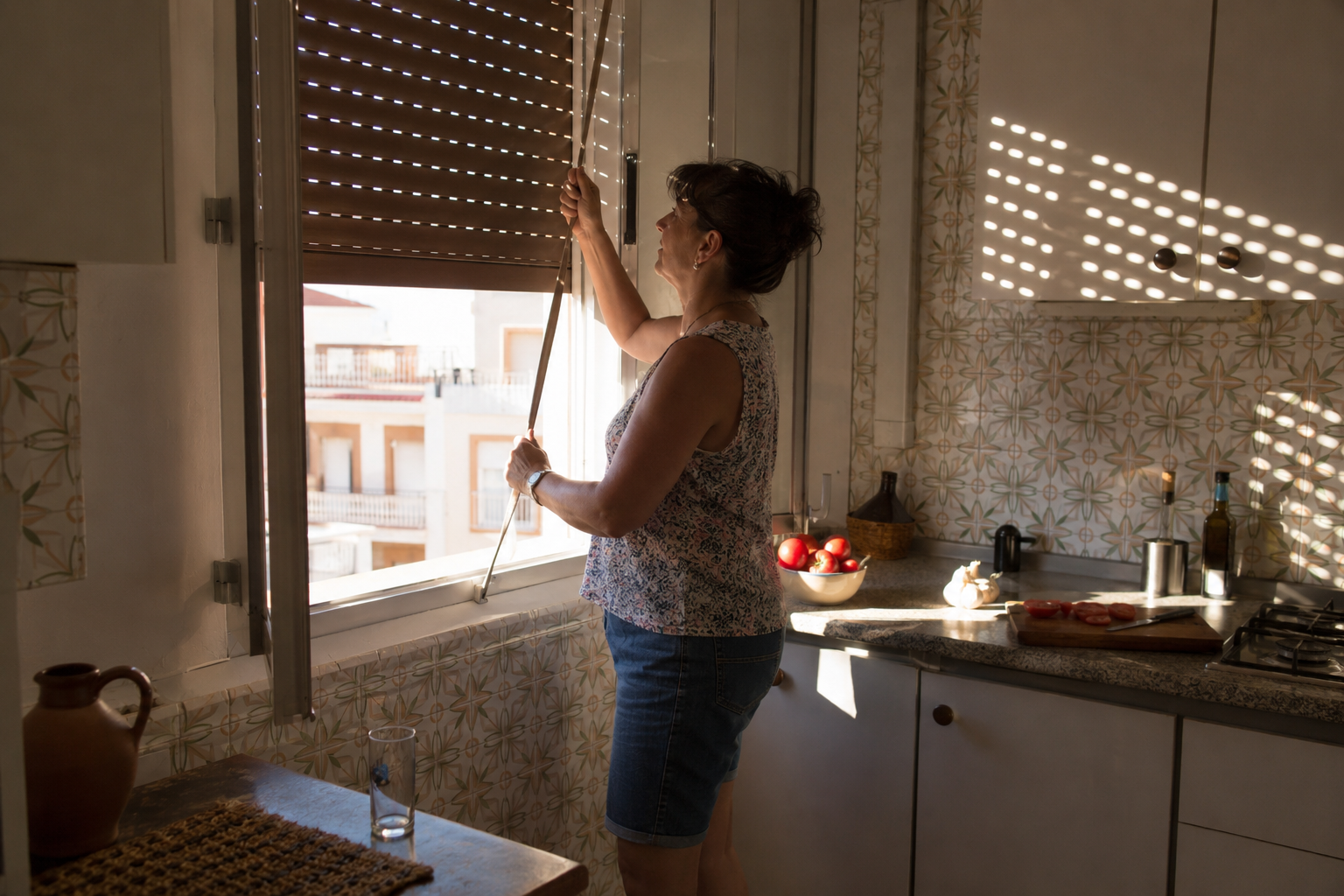
The centerpiece of it all is the persiana, the external rolling shutter that hangs outside every Spanish window, and the daily ritual of raising and lowering it that I came to think of as the persiana protocol. It is not a single trick but a whole method, a sequence of small disciplined actions performed at the right hours, and together they keep a home startlingly cool through the fiercest afternoons without a watt of electricity. My neighbors have been doing it their whole lives. I spent a summer learning it, and I am not sure I will ever go back.
Here is what the Spanish summer without air conditioning really taught me, how the persiana protocol works hour by hour, why it is so effective, and what I gained beyond a lower electricity bill. This is one household’s experiment rather than a promise that it will suit everyone or every climate, but in a hot, dry Madrid summer, in a building designed for it, the old way simply works.
The Shutter I Had Been Ignoring
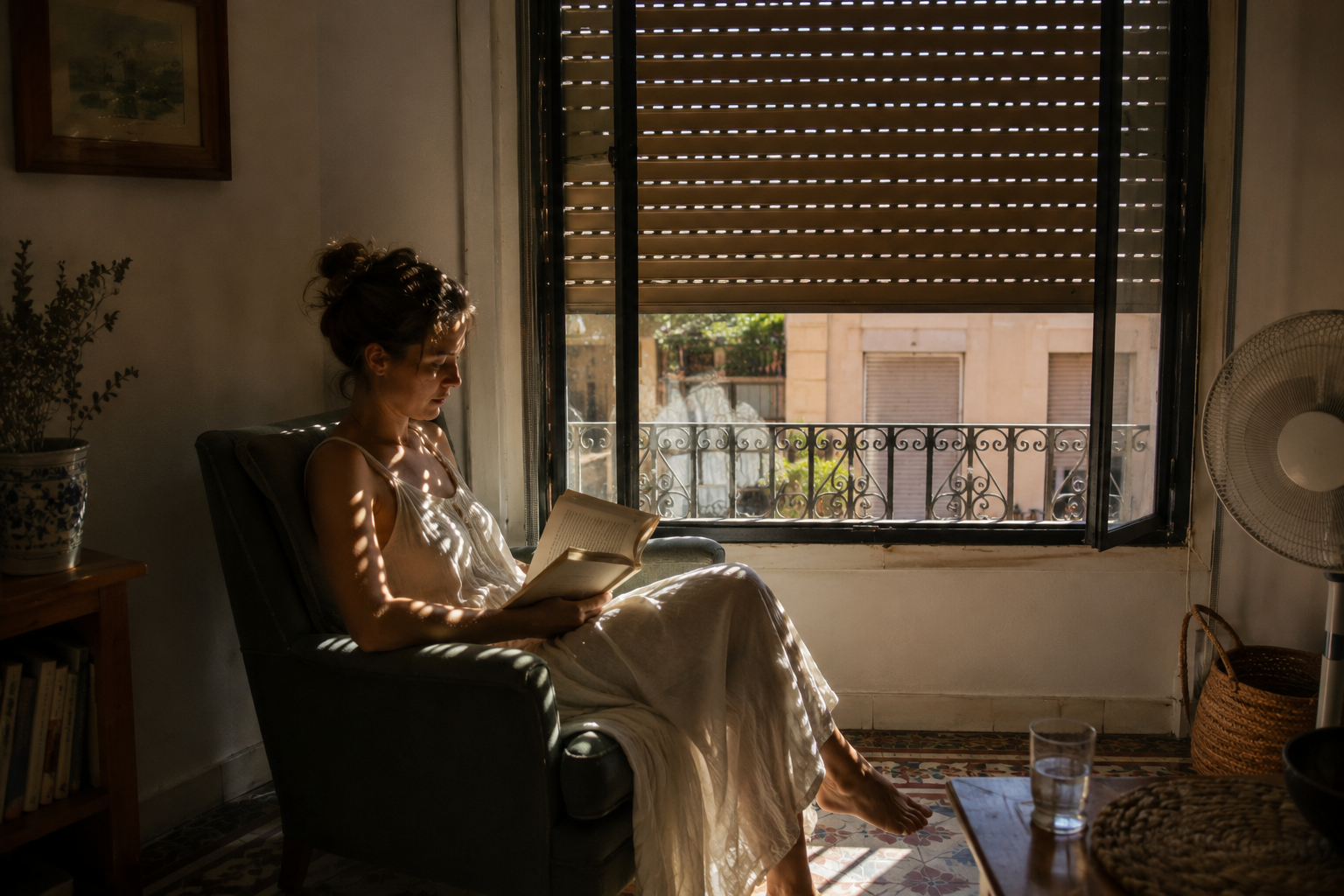
For my first weeks in Spain I had barely registered the persianas, treating them as quaint window dressing to be left half open and forgotten. It took watching my neighbors to understand that these shutters are the single most important tool in the Spanish summer, and that I had been ignoring the very thing the whole building was designed around. The persiana is not a curtain but a machine for managing heat.
What makes it work is that it sits on the outside of the glass. An interior blind stops light once the heat is already inside the room, but the external persiana blocks the sun before it ever reaches the window, stopping the heat at the wall rather than trapping it in the glass. Lowered fully against a blazing afternoon, it turns a room that would have baked into a cool, dim, cave-like refuge, and the difference between a room with the persiana down and one without is not subtle but stark, the difference between bearable and unbearable.
The genius is in how completely it seals out the day. A persiana rolled all the way down covers the entire window in solid slats, admitting almost no light and, crucially, almost no heat, so a room can be kept many degrees cooler than the street outside simply by shutting the sun out at the source. My neighbors understood this instinctively, treating the shutters not as decoration but as the first and most important line of defense, and once I saw it I could not unsee it. What struck me most was how deliberate my neighbors were about it, how the raising and lowering of the shutters was as much a part of their day as making coffee. An older woman across the courtyard lowered hers to precisely the same height each morning, judging the angle of the sun by long habit, and I came to realize I was watching a skill, passed down and practiced for a lifetime, that I had mistaken for mere decoration.
The Protocol, Hour by Hour
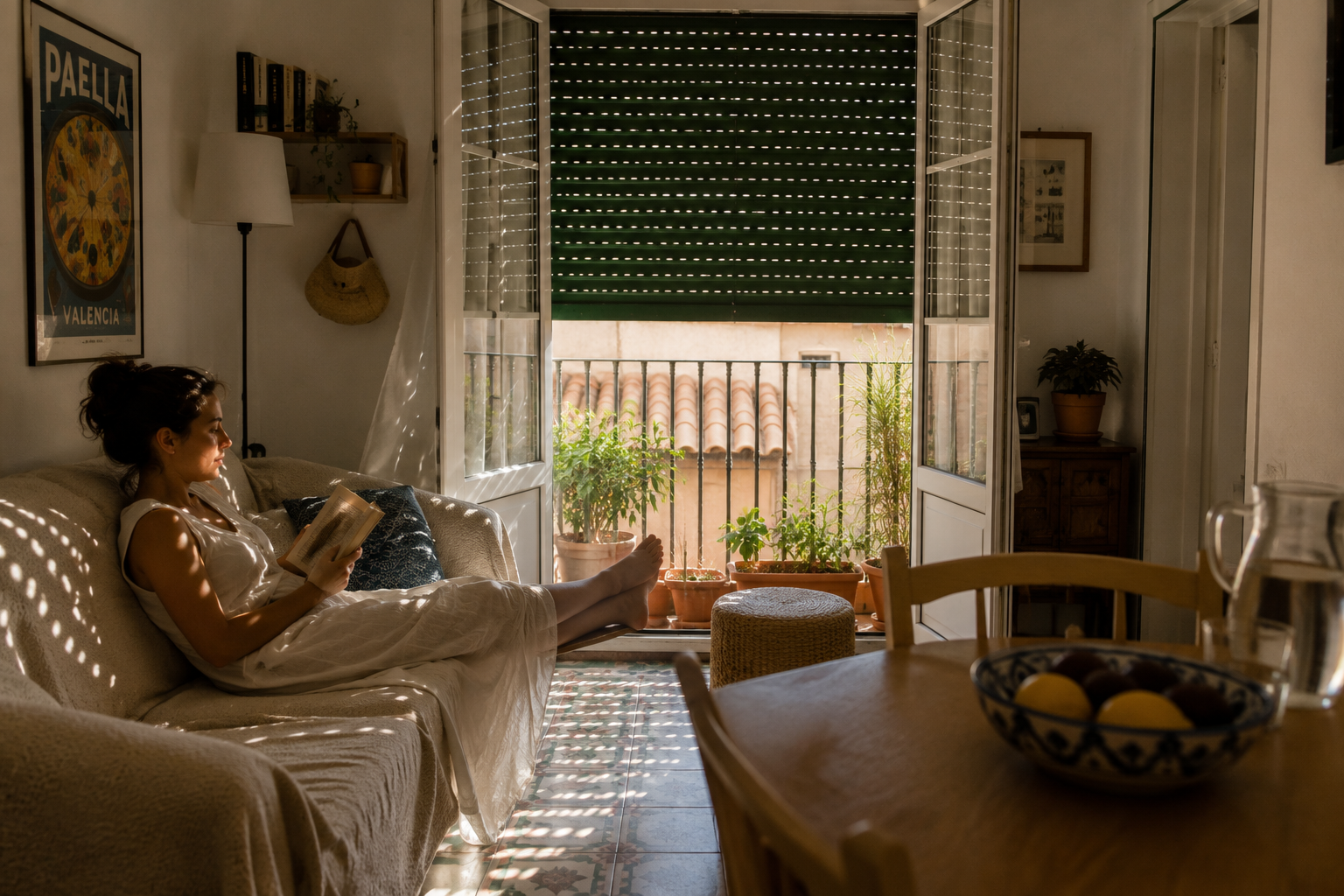
The persiana works only if you use it correctly, and correct use is a matter of timing, a daily rhythm that I slowly learned to follow. The whole method turns on a single principle, which is that you trap the cool of the night and lock out the heat of the day, and everything in the protocol flows from getting the sequence and the hours right.
The day begins early, and so does the work. In the cool of the early morning, before the sun has any power, you throw everything open, the windows and the persianas both, and let the cold night air pour through the house, flushing out any warmth and filling the rooms with coolness while you can. This is the moment to air the place, to create a through-draft if you can, and to bank as much of the night’s chill as the walls will hold.
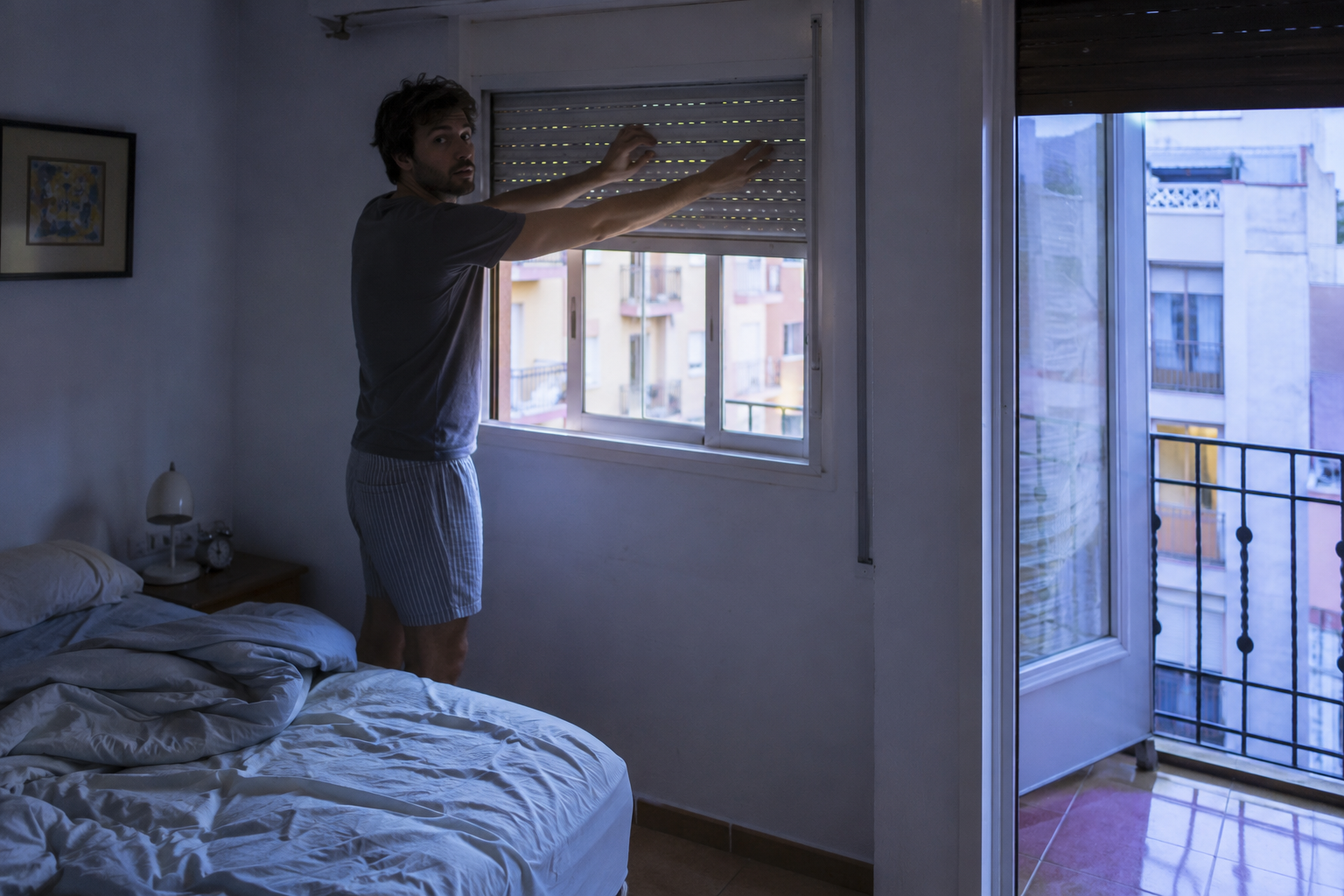
Then, as the morning heats up, you reverse it completely. Before the sun begins to bear down, usually by mid-morning, you close the windows to seal the cool inside and lower the persianas to block the coming heat, shutting the house up tight against the day. Through the blazing afternoon the home stays sealed and shaded, a cool dim refuge while the street bakes, and only in the evening, when the sun has dropped and the air outside finally cools below the temperature indoors, do you open everything up again to let the night back in. Open at night, closed by day. That is the whole of it, and it works. The discipline is the hard part, not the concept. The method fails the moment you leave a window open through the afternoon or forget to air the house at dawn, because a single lapse lets the day’s heat in and undoes hours of careful cool. What my neighbors had that I lacked at first was consistency, the automatic daily habit of doing the right thing at the right hour, and once I built that habit the house rewarded me for it.
Why It Works So Well
The effectiveness surprised me, and the reasons are worth understanding because they explain why this old method beats the instinct to simply blast cold air. The core of it is that the protocol works with the daily temperature swing rather than against it. In a dry climate like Madrid’s, the nights are markedly cooler than the days, and the persiana method is a way of capturing that nightly coolness and hoarding it through the heat of the afternoon.
The building itself is the other half of the system. Traditional Spanish homes are built of thick masonry with real thermal mass, materials that absorb and hold temperature slowly, so a house cooled overnight and then sealed against the day stays cool for hours because the heavy walls release their stored coolness gradually. The persiana protocol and the building work together, the shutters keeping the sun out while the mass of the structure holds the night’s chill, and neither works nearly as well without the other.
There is also the simple physics of blocking radiation at the source. Most of the heat that turns a room into an oven comes as sunlight pouring through glass, and stopping that sunlight outside the window, before it can enter and be trapped, prevents the heat from ever building up. The persiana is doing the most important job in the coolest possible way, refusing the heat entry rather than fighting it once it has arrived, which is why it accomplishes so much while using nothing at all. This is the part that shamed my air conditioner a little. The machine spends enormous energy removing heat that has already been allowed into the room, fighting a battle that never needed to be joined, while the persiana simply refuses the heat at the threshold and spends nothing.
The Rest of the Ritual
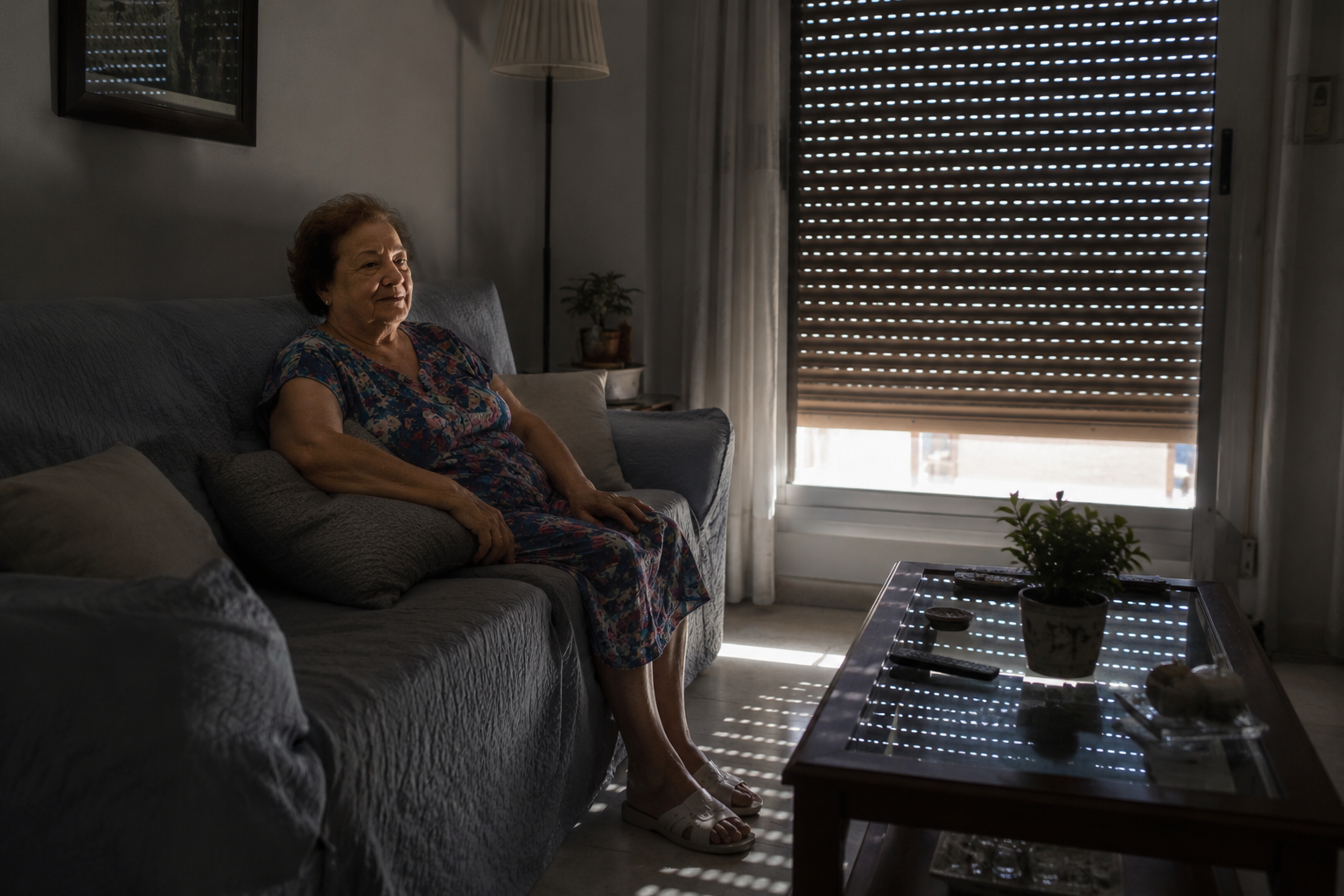
The shutters are the heart of it, but living without air conditioning taught me that the Spanish summer is a whole way of behaving, not just a way of managing windows. The persiana protocol sits inside a broader set of habits, and adopting the shutters without the rest of the lifestyle would only get me part of the way. The whole culture is arranged around the heat.
The daily rhythm shifts with the sun. Life moves to the cool ends of the day, the early morning and the late evening, while the fierce middle of the afternoon is for staying indoors in the shaded cool, resting, moving slowly, and doing as little as possible, which is the deep logic of the famous siesta hours. You do not fight the afternoon heat. You retreat from it, and you save your energy and your errands for when the air is kinder.
Small habits do the rest. You eat lighter and later, taking the main social meals in the cool of the evening when the city comes alive again. You use fans to move air rather than chill it, and you dress for the heat in loose light clothing. And you accept a little warmth as normal rather than demanding a chilled interior, letting your body adjust to the season instead of fighting to keep your home at winter temperatures. Together these habits made the heat not just survivable but, in a strange way, pleasant. It took me a while to understand that the whole culture is a single coherent response to the climate, not a collection of quaint customs. The late meals, the shuttered afternoons, the evening streets coming alive, the long lunch and the rest that follows, all of it is the accumulated wisdom of people who have lived with these summers for millennia and worked out, generation by generation, how to be comfortable in them. I had been treating symptoms. They had a system.
What I Was Afraid Of, and What Happened
I will be honest that I began the experiment braced for misery, convinced that without air conditioning I would spend the summer sweating and sleepless and miserable, counting the days until I could admit defeat. That is not what happened. Once I learned the protocol and trusted it, my home stayed comfortable through all but the most extreme days, cool and dim and calm while the street shimmered outside.
The adjustment was real but quick. The first days without the machine felt strange, and my body took a little while to accept a home that was pleasant rather than cold, but within a week or two I had acclimatized, and the moderate indoor warmth that had seemed intolerable at first became simply the temperature of summer. I stopped noticing it, and then I started to prefer it, the natural coolness of a well-managed house feeling somehow better than the artificial chill I was used to.
There were limits, and I should be truthful about them. On the very hottest nights, when even the darkness barely cooled, the method strained, and I understand why many Spaniards do now own air conditioning for exactly those peaks. But the number of days that truly required more than the persiana protocol was far smaller than I had expected, and for the great majority of the summer the old way was no hardship at all, simply how the house was meant to be lived in.
What I Gained Besides a Cool House
The obvious reward was the electricity bill, which stayed low all summer while friends who ran their air conditioning watched theirs climb, and that saving alone would have justified the experiment. But what surprised me was how much else I gained from living the summer the local way, benefits I had not gone looking for and did not expect.
There was a connection to the rhythm of the place that I had never felt with a thermostat. Living by the sun and the shutters, rising early to catch the cool, retreating in the afternoon, coming alive again in the evening, put me in step with the city and the season in a way that sealing myself into a chilled box never had. I was living in the summer rather than hiding from it, and the days had a shape and a sanity that the air-conditioned life had flattened away.
There was a physical ease too, an end to the jarring lurch between a frigid interior and a blazing street that leaves you never quite adjusted to either. Living closer to the natural temperature, my body settled into the season instead of being yanked between extremes, and I slept better in a house cooled by night air than I ever had in the dry chill of a machine. I felt, by the end, more at home in the heat than I had thought possible, and more connected to the way this country has always lived. That connection turned out to be the quiet heart of the whole experiment. By living the summer the way the place intended, I stopped experiencing the heat as an enemy to be defeated with machinery and started experiencing it as a season to be moved through with a little skill. The city and I were, for once, on the same schedule, and there was a contentment in that which no thermostat had ever given me.
The Protocol Anyone Can Try
By the end of the summer I was a convert, not to suffering through the heat but to a smarter and gentler way of handling it, and the beauty of the persiana protocol is that its logic travels even where the exact shutters do not. The core method is simple enough for anyone to adopt in a hot dry climate, and it costs nothing but attention.
The essence fits in a sentence. Open the house wide in the cool of the night and early morning to let the coolness in, then close the windows and shut out the sun before the day heats up, keeping the home sealed and shaded through the afternoon, and open it all again when evening brings the cool back. Where you lack external shutters, heavy curtains and closed windows and shades do a weaker version of the same job, and the timing matters more than the equipment.
What I learned, in the end, was that my neighbors were not simply enduring the summer without the comfort I assumed they lacked, but living in cool, calm homes through the worst of the heat by means of a method so old and so ingrained that they barely thought about it, a method that used nothing, cost nothing, and worked better than I would ever have believed. The persiana protocol is not a quaint relic to be replaced by a machine. It is a genuinely brilliant piece of everyday wisdom, and after a summer of living it, I would not want to give it up. The switch stays off. The shutters come down. And the house stays cool, the way it always has.

About the Author: Ruben, co-founder of Gamintraveler.com since 2014, is a seasoned traveler from Spain who has explored over 100 countries since 2009. Known for his extensive travel adventures across South America, Europe, the US, Australia, New Zealand, Asia, and Africa, Ruben combines his passion for adventurous yet sustainable living with his love for cycling, highlighted by his remarkable 5-month bicycle journey from Spain to Norway. He currently resides in Spain, where he continues sharing his travel experiences with his partner, Rachel, and their son, Han.