
Every few months the €1 house story circles the internet again, and every time, a certain kind of reader asks the obvious follow-up question. Italy sells crumbling houses for a euro, so where are Spain’s? The answer is that Spain has no such scheme, has never really had one, and does not appear to want one. What Spain has instead is stranger and, for a certain kind of buyer, considerably more interesting.
Spain sells whole villages. Not a house in a village, but the village itself, the stone houses and the barns and the granary and the threshing floor and the land around them, listed as a single property with a single price. There are thousands of these abandoned hamlets scattered across the country, hundreds are on the market at any given time, and the cheapest of them cost less than a garage in Madrid.
Here is why Italy has €1 houses and Spain does not, how the Spanish village market really works, and what you are really buying when you buy a hamlet. This is general information rather than legal or financial advice, and rural Spanish property is a specialist purchase, so anyone serious needs Spanish legal and technical advice long before any money moves.
Why Italy Has €1 Houses and Spain Doesn’t
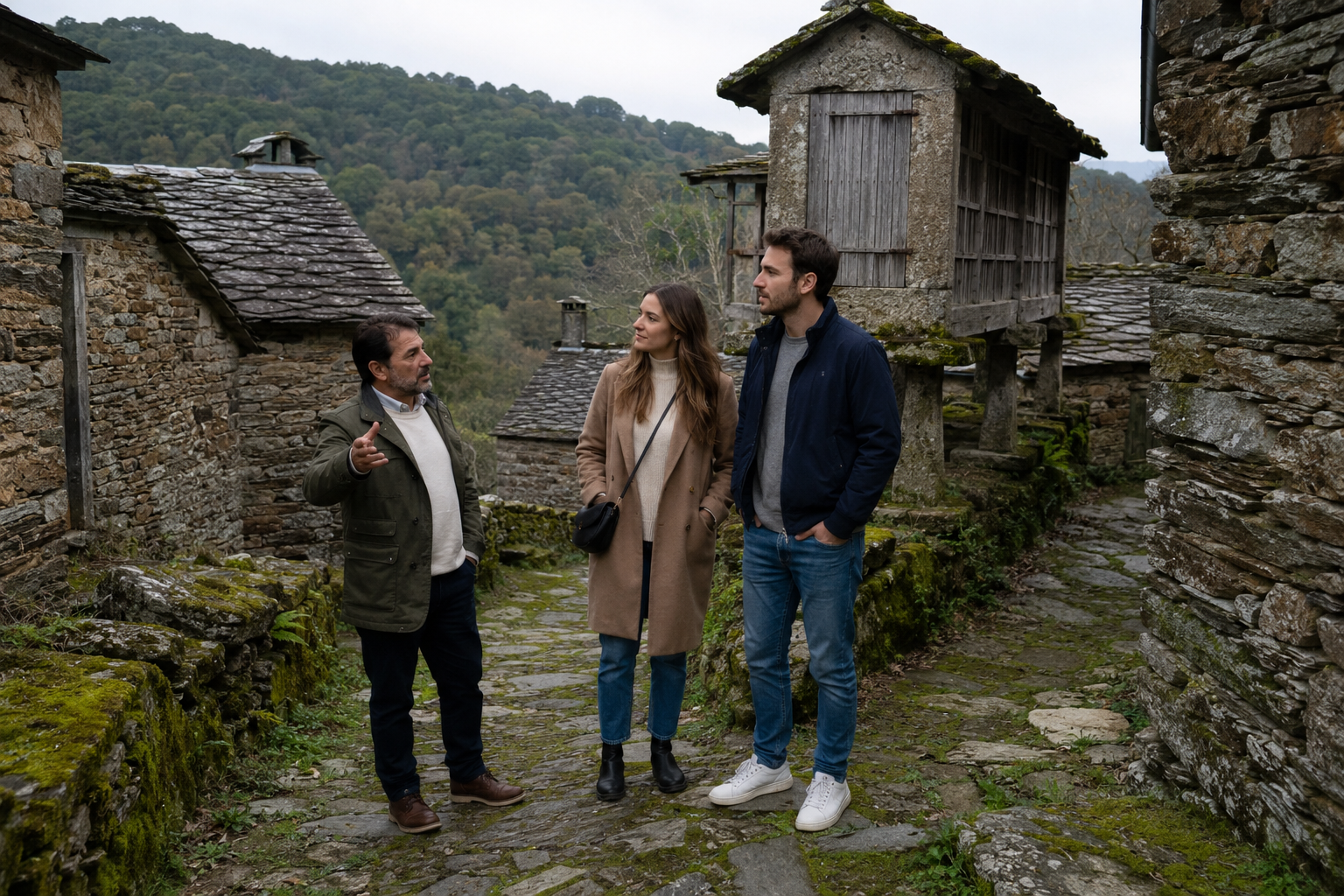
The difference comes down to ownership, and it is more mundane than it sounds. Italy’s €1 schemes are run by municipalities, which act as brokers between private owners who no longer want a derelict building and buyers willing to restore it, with the town setting the terms, holding the deposit and enforcing the deadline. It is a public program built on private property, and it works because Italian towns chose to build the machinery.
Spain never built that machinery. Its depopulation problem is at least as severe, but the response has been left largely to the market, and the property in Spain’s empty villages is simply owned by families, heirs and occasionally banks who sell it, when they sell it, through ordinary channels at ordinary prices. There is no national €1 brand because there is no national program, and no Spanish town has turned the symbolic sale into a global marketing campaign the way Sambuca did. There are scattered exceptions at the margins, individual Spanish villages that have offered cheap housing or grants to attract families, but nothing that adds up to a movement with a name and a price tag that fits in a headline.
What Spain has instead is scale and privacy of ownership, which produce a different product. When a hamlet empties completely and its buildings pass to a scattered family, what eventually comes to market is not one house among neighbors but the entire settlement, because there are no neighbors left. Italy sells you a house in a living town. Spain sells you a dead one, entire, with the road and the water source included. That distinction runs through everything that follows. The Italian buyer joins a community and inherits its rules, its neighbors and its deadlines. The Spanish buyer inherits silence and a free hand, which is either the better deal or the far more daunting one, depending entirely on what you were hoping to find at the end of the track.
La España Vacía
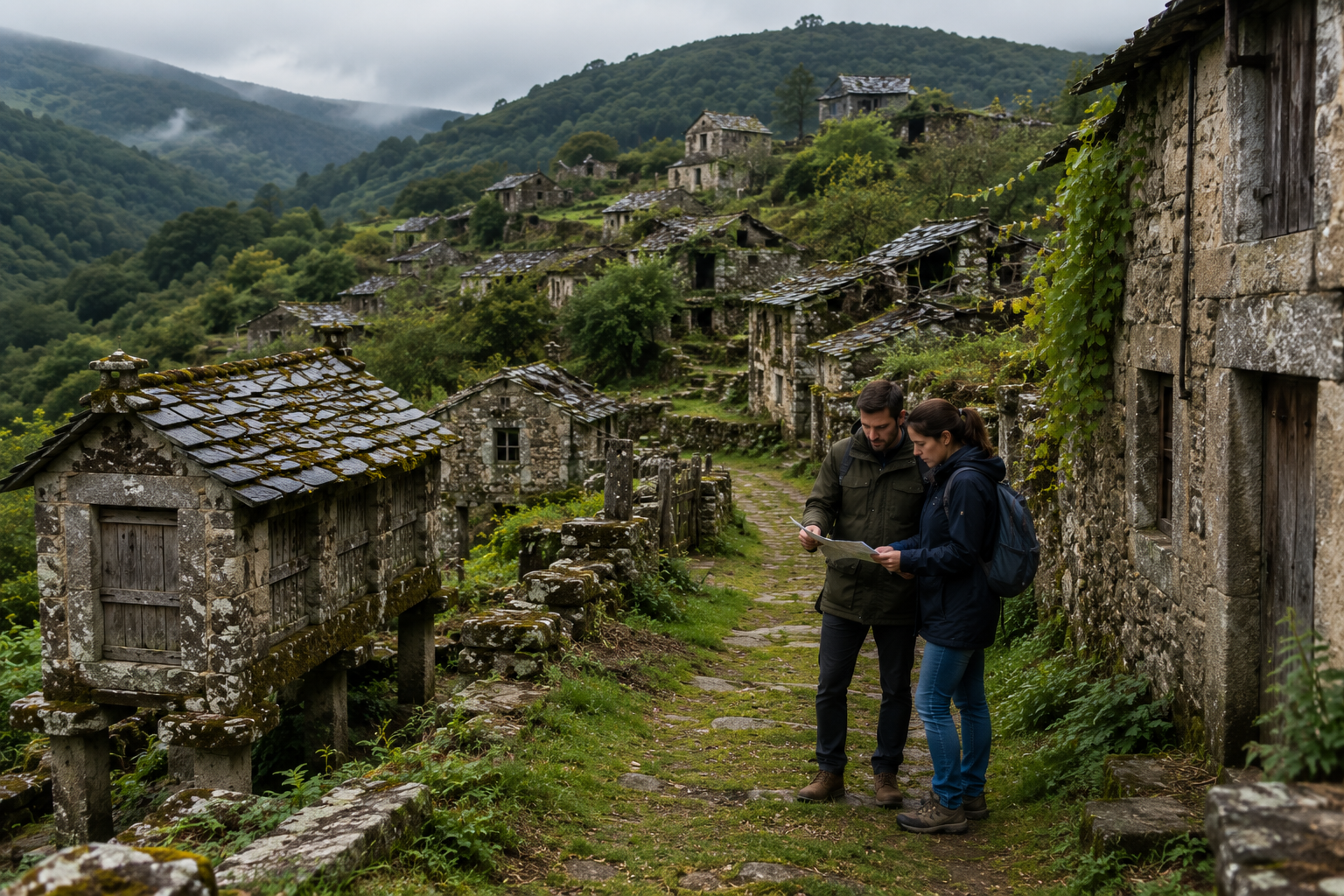
The backdrop is a demographic story Spain has a name for, La España Vacía, the Empty Spain. Across the second half of the twentieth century the rural interior drained into Madrid, Barcelona and the coasts, leaving vast stretches of the country with some of the lowest population densities in Europe and a landscape dotted with settlements that simply stopped.
The numbers are startling in a way the Italian ones are not. Estimates commonly put the number of abandoned villages in Spain at around 3,000, with some counts running higher, and around 2,000 more villages are reported to have a single resident left. These are not ruins from antiquity but places that had families, a school and a bar within living memory, and whose last inhabitants left within the last few decades.
The geography concentrates in the green north. Most of the abandoned hamlets sit in Galicia and Asturias, the wet, wooded, mountainous regions of the northwest where the land is beautiful, the plots are small and the young left for the cities. Others are scattered through Teruel, Cuenca and the foothills of the Pyrenees. The emptiness is not the dry, dramatic emptiness of the meseta but a green, overgrown one, where the forest simply comes back. Galicia in particular is nothing like the Spain of the postcards. It rains, it is deeply green, the coast is wild Atlantic rather than Mediterranean, and the landscape of stone houses, hórreos and small fields looks closer to Ireland than to Andalucía. For an American whose picture of Spain is sun and sangria, the region that holds most of these villages is a genuine surprise.
What an Entire Village Costs
The prices are the part that stops people. Reporting on the Galician market has put entry prices for a whole hamlet as low as around €39,000, less than a quarter of what a modest flat costs in most Spanish cities, and specialist listings have shown villages from roughly €18,000 upward. In cities like Madrid and Barcelona, where a flat under €120,000 is close to extinct, Galicia offers an entire village for the same money or less.
The listings make the arithmetic concrete. A hamlet in Lugo has been offered with six stone buildings, including a main house of 140 square metres with a renovated roof, on a plot of 13,000 square metres with meadows and pine and eucalyptus, its own spring, and a valley view, reduced to around €73,000. A property in Ourense with two adjoining two-storey houses, one habitable, plus gardens and an old bread oven, has been listed near €59,000.
The scale runs upward from there. A village in Burgos with as many as fifty possible houses, land and fincas has been offered at around €400,000, which is to say that for the price of a small apartment in a good Madrid neighborhood you can buy a settlement with dozens of buildings. What you are buying, at every price point, is not a home but a piece of geography with structures on it. It is worth noticing what the prices imply about the market. When entire settlements sell for less than a small flat, the buildings are effectively being valued at nothing and the land at very little, which is a precise measurement of how thoroughly the demand has gone. Nobody is competing with you for these places, and that is exactly why they are affordable.
Where the Villages Are Sold
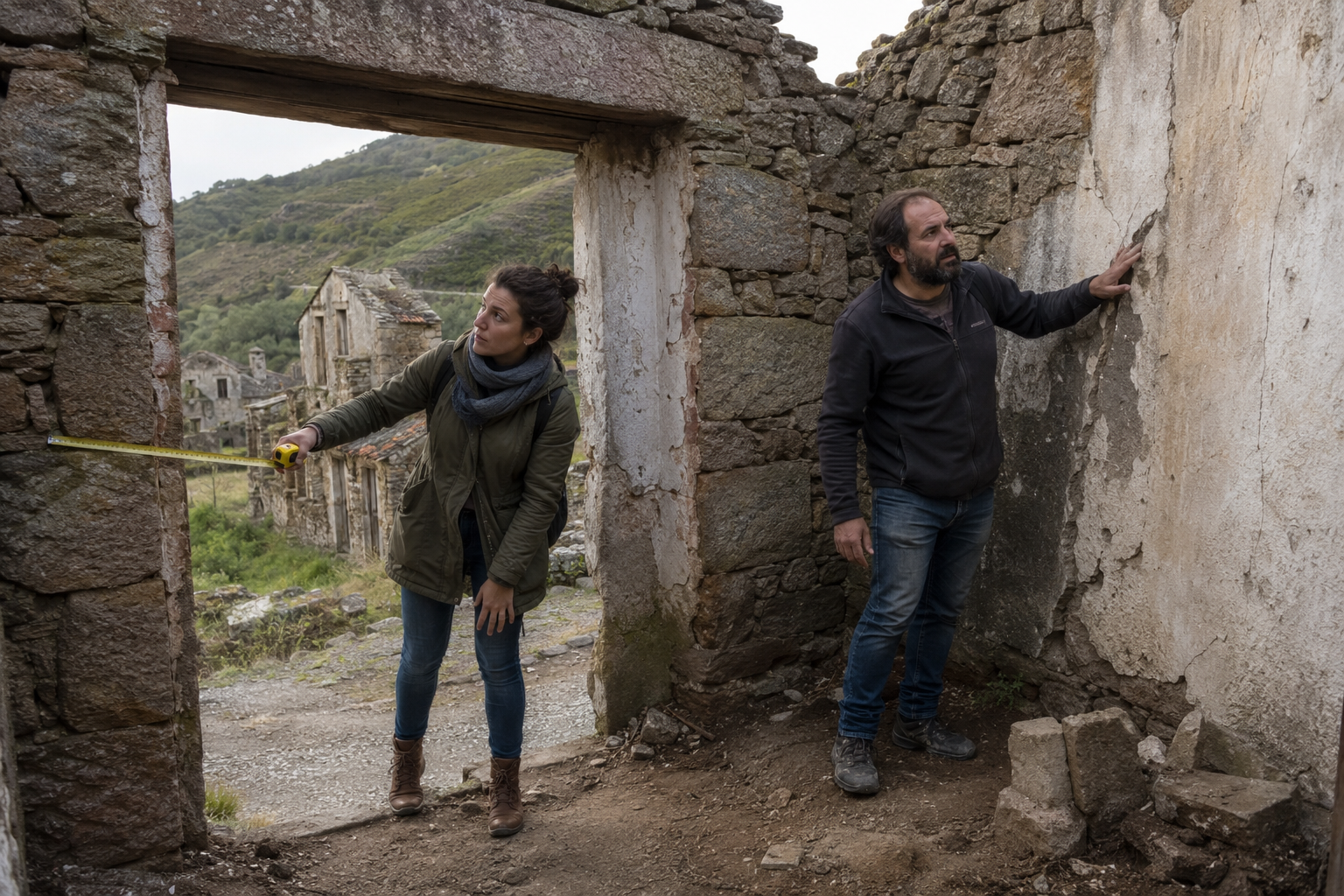
There is no municipal portal for any of this, which is the practical consequence of the market being private. The listings live with specialist agencies, above all Aldeas Abandonadas, the estate agency that has effectively made this market visible, gathering hamlets that would otherwise sit unsellable with scattered heirs and putting them in front of buyers who did not know such a thing was possible.
The inventory moves. Reporting in 2025 put the agency’s listings at around 106 properties across Spain, of which 31 were in Galicia, a smaller share than a couple of years earlier, and the decline was attributed not to weak demand but to faster sales combined with the slow, painstaking work of getting these villages to market at all. Other rural portals list dozens more. The thinness of that inventory tells its own story. A country with thousands of abandoned villages has only a hundred or so on the market at any moment, because the obstacle is rarely the buyer and almost always the paperwork, the heirs and the sheer difficulty of assembling a sellable title out of a settlement that was divided among families generations ago.
The buyers have changed too, which is the interesting part. The agency’s director has described a shift from foreign investors and nostalgic descendants of emigrants toward Spaniards from Barcelona, Madrid and Seville, many of them young, who would rather buy a whole village and restore it slowly than sign a thirty-year mortgage on a suburban flat. International interest continues alongside, with Americans among those arriving on the recommendation of foreigners who bought in years earlier.
The Incentives Spain Does Offer
If Spain has no €1 house, it is not because the country is indifferent to its emptying interior. The response has simply taken a different shape, aimed at people rather than buildings. Regional and municipal governments across the depopulated zones have experimented with grants for families who move in, payments for babies born in shrinking villages, subsidised housing for new residents and support for anyone willing to open a business where the last shop closed.
The logic is the mirror image of Italy’s. An Italian town starts from the building, offering the ruin for a euro and hoping a resident follows, while a Spanish region tends to start from the resident, offering money or a home to a family and hoping the buildings fill. Both are chasing the same thing, which is a school with enough children in it to stay open.
Broadband has quietly become part of the pitch. Rural Spain’s connectivity has improved substantially, and the villages that were unthinkable for a working adult a decade ago are now viable for anyone who can do their job over a connection, which is exactly the population that finds a €39,000 hamlet interesting in the first place. The agency reporting notes government incentives and improving digital connectivity as part of why the romantic gamble is starting to look sensible.
What none of this has produced is a headline as good as Italy’s. There is no Spanish equivalent of the €1 auction, no viral mayor, no CNN segment that sent a thousand Americans to a single hill town, and the Spanish market has grown instead by word of mouth among buyers who found it for themselves. The country with the emptiest interior in western Europe has, oddly, the quietest marketing.
What You Are Really Buying
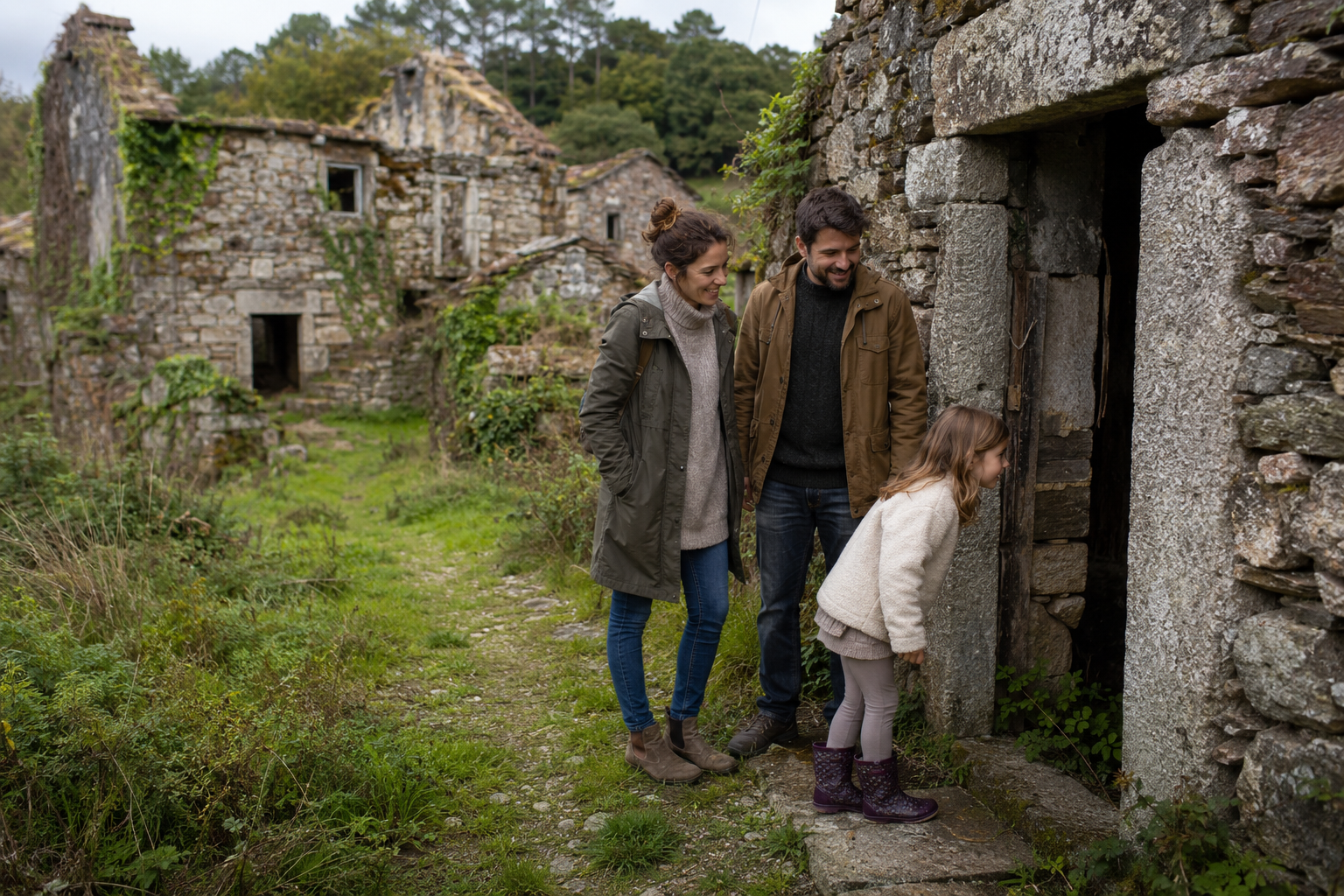
The romance needs a cold paragraph, and here it is. A €39,000 village is cheap because it is worth roughly that, and what you acquire is a set of stone shells, often roofless, without services, at the end of a track, in a place people left because there was no work. The buildings are not restored. There may be no mains water beyond a spring, no meaningful mobile signal in some cases, and the nearest anything may be a long drive. The absence of a scheme cuts both ways here. No town hall is enforcing a deadline over your head, and equally no town hall is helping, guiding, grant-funding or standing behind the transaction. You are a private buyer purchasing private rural property in a foreign country, entirely on your own account.
The legal side is where the real work sits. Most of these hamlets are on land classified as suelo rústico, rural land, which carries strict limits on what you can build, rebuild or convert, and turning a ruin into a tourism business on rústico land is a specialist legal project rather than a formality. Around 70% of buyers are reported to be planning tourism ventures, and the zoning is the first thing that will meet them.
Then there is the ownership tangle. Sometimes a single family or a bank holds the whole hamlet, which is the clean scenario, but more often a village is split among dozens of heirs scattered across Spain or living abroad, and a single holdout owner of one small cottage can complicate the entire purchase. Confirming that every building in the photograph is truly part of the deal is not a detail. It is the deal.
The Case For Doing It Anyway
For all that, the proposition is genuinely remarkable, and it is worth stating why people keep saying yes. You are buying land, buildings, water and privacy at a price that has no equivalent anywhere in western Europe, in a green and beautiful country with functioning healthcare and infrastructure a reasonable drive away, in a region where the food is superb and the culture is deeply intact. Compare it squarely with the alternatives and the case gets stronger. The same money buys a studio flat in a Spanish city, a deposit on a suburban house in America, or a €1 ruin in Sicily plus a three-year deadline and a contract. Against that field, several stone buildings and a dozen hectares of Galician valley is not obviously the least sensible way to spend it.
The self-contained quality is what the buyers talk about. A Galician hamlet is not a house but a small ecosystem, with stone houses and barns and a granary, a private water source and hectares of land, which means an owner can build something whole rather than merely live somewhere. That is why the ventures tend toward agrotourism, retreats, multi-generational compounds and farms rather than simple second homes.
And the motivation, increasingly, has little to do with investment. The agency’s director puts it in terms that would be recognizable to any American priced out of a city, which is that people are looking for a different way of living, would rather buy something with potential and restore it over time than be chained to a bank for thirty years, and want to live by their own rules without depending on anyone else. A village is what that looks like when you can actually afford it.
So the honest answer to the question is that Spain never needed a €1 house, because it had something the Italian schemes cannot offer. Italy hands you one building in a town that still has a bar and a butcher, and a contract that says restore it in three years or lose your deposit. Spain hands you the bar, the butcher’s, the houses, the land and the silence, with no deadline, no deposit and no town hall watching, for the price of a modest car. There is no scheme, no program and nobody helping. There is just a listing, a track through the trees, and a village with your name on the deed, waiting to see what you do with it. Whether that is freedom or folly depends on the person reading the listing, which is perhaps why Spain never bothered to advertise.

About the Author: Ruben, co-founder of Gamintraveler.com since 2014, is a seasoned traveler from Spain who has explored over 100 countries since 2009. Known for his extensive travel adventures across South America, Europe, the US, Australia, New Zealand, Asia, and Africa, Ruben combines his passion for adventurous yet sustainable living with his love for cycling, highlighted by his remarkable 5-month bicycle journey from Spain to Norway. He currently resides in Spain, where he continues sharing his travel experiences with his partner, Rachel, and their son, Han.