
Last updated on September 7th, 2026 at 04:58 am

Walk into a Spanish supermarket, head for the milk, and you will not find it in a chilled cabinet. It sits on an ordinary dry shelf, stacked in cartons at room temperature, next to the coffee and the sugar. To an American shopper this looks alarming, even a little unsafe. To a Spaniard it is completely normal, and the milk is perfectly fine.
This is one of the sharpest small differences between how Europe and the United States handle an everyday food. Most of Europe drinks UHT milk, sold and stored warm until you open it. America drinks fresh, refrigerated milk that spoils within days. Both are safe, both are ordinary at home, and the split between them is a neat little story about technology, taste, and habit.
The Milk on the Shelf
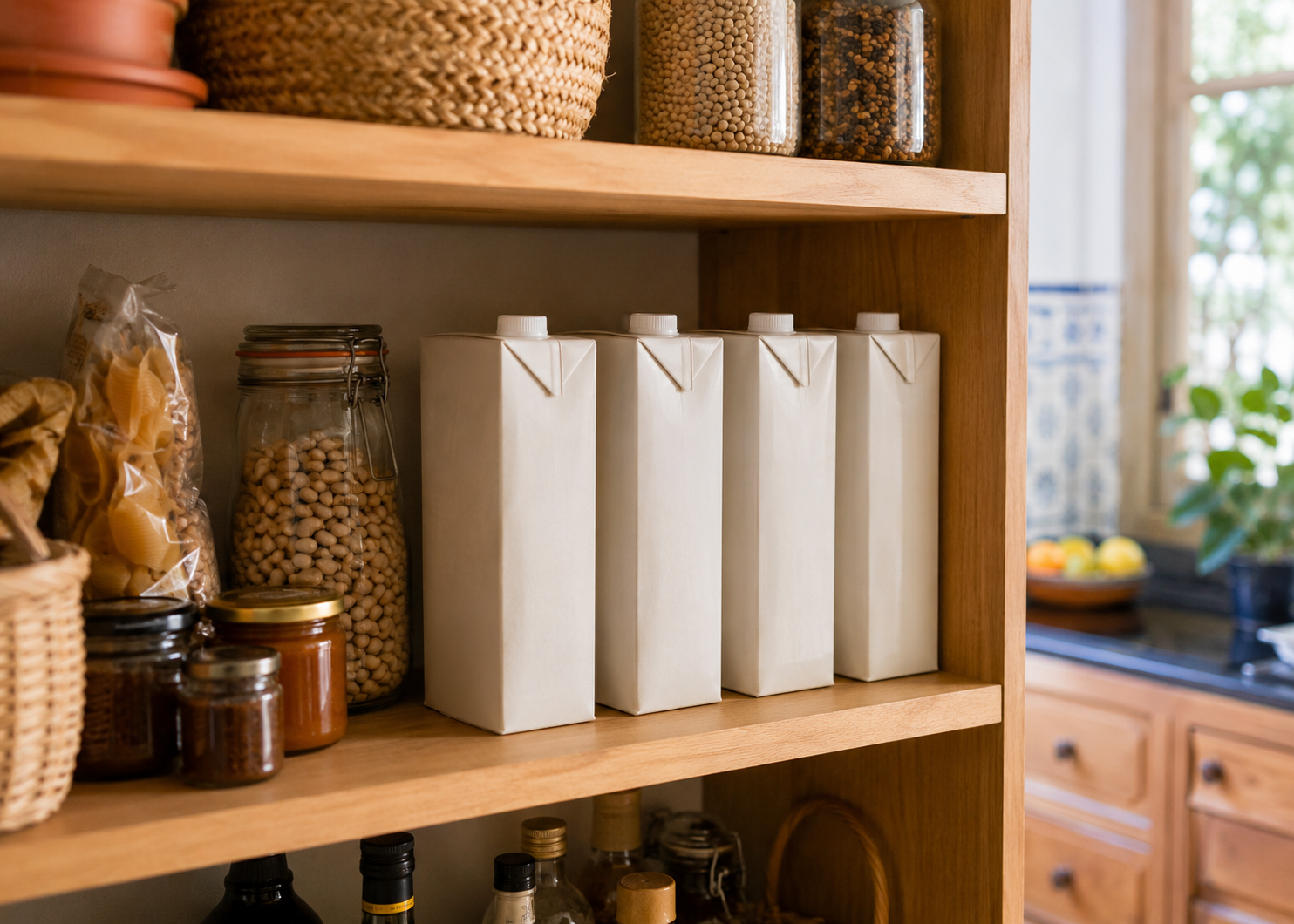
In a Spanish shop, the dairy aisle is arranged around the assumption that milk does not need a fridge. Cartons of leche entera, semidesnatada, and desnatada, whole, semi-skimmed, and skimmed, are stacked on regular shelving, often in shrink-wrapped six-packs, at whatever temperature the store happens to be.
The packaging is the giveaway. Rather than the translucent plastic jugs of an American store, European milk usually comes in an opaque, laminated carton, the familiar Tetra Pak style, designed to keep out light and air. That carton, not the fridge, is doing the preservation work. Sealed and unopened, it will sit safely in a cupboard for months.
The refrigerator only enters the picture after opening. Once you break the seal, UHT milk behaves like any other milk and needs to be chilled and used within a few days. A Spanish kitchen keeps opened cartons in the fridge just as an American one does. The difference is entirely about the unopened state: in Spain, the store shelf and the home pantry are perfectly acceptable places to keep milk you have not yet started.
The brands are household names. In Spain, cartons of Pascual, Central Lechera Asturiana, or the supermarket’s own line fill entire aisles, all of it UHT, all of it sold warm. A Spanish shopper choosing milk is picking between fat levels and brands, not between fresh and long-life, because for most of them long-life simply is what milk is.
What UHT Actually Does
The reason all this works is a processing method called UHT, short for ultra-high-temperature, sometimes labelled ultra-heat-treated. It is a more aggressive version of pasteurisation, and it changes what milk can do.
Ordinary pasteurisation heats milk enough to kill most harmful bacteria. UHT goes much further, heating the milk to around 140°C, roughly 284°F, for just two to four seconds, then cooling it rapidly. That brief blast of extreme heat destroys virtually all bacteria and the spores they leave behind, effectively sterilising the milk rather than merely reducing its bacterial load.
Heat alone is not enough, though. The sterilised milk is then sealed into aseptic packaging, sterile airtight cartons filled in a sterile environment so nothing can recontaminate the contents. The combination of sterile milk and sterile packaging is what makes the product shelf-stable. An unopened UHT carton stays good for six to nine months at room temperature, no refrigeration required, which is why it can travel long distances, sit in a warehouse, and wait patiently on a shelf until someone buys it.
How America Does It Differently
American milk is made another way, and that single choice explains the chilled cabinet. The United States and Canada rely overwhelmingly on HTST pasteurisation, high-temperature short-time, a gentler process than UHT.
HTST heats milk to about 72°C, roughly 161°F, for fifteen to twenty seconds. That is hot enough to kill most dangerous bacteria and make the milk safe, but not hot enough to sterilise it completely. Some harmless bacteria and spores survive, and given time and warmth they will multiply and spoil the milk. The method is cheap and efficient, able to process enormous volumes quickly, which suits a country that drinks milk by the gallon.
The trade-off is fragility. HTST milk must be kept cold from the moment it leaves the dairy, through the truck, the warehouse, the store cabinet, and the home fridge, an unbroken cold chain. Even then it lasts only about seven to ten days after opening. The American shopper’s chilled gallon and the Spanish shopper’s shelf carton are the same basic liquid, treated by two different philosophies: one that keeps milk fresh and brief, another that makes it durable and long.
The scale of American milk drinking locks that system in place. A country where families buy milk by the gallon and children drink several glasses a day needs a constant, fast-moving supply, and the cold chain that keeps HTST milk fresh is already built into every shop and home. Having invested in refrigeration everywhere, America had little reason to adopt a technology designed to work without it.
Why UHT Won Europe

If UHT is so convenient, why did Europe embrace it while America did not? The answer is a mix of history, geography, and habit, and none of it is really about the milk itself.
Much of it traces to the decades after the Second World War, when reliable refrigeration and cold-chain logistics were not yet universal across a rebuilding Europe. Shelf-stable milk that could reach shops and homes without a continuous chain of refrigeration solved a real problem. The technology arrived at the right moment, helped enormously by the Swedish company Tetra Pak, whose aseptic carton, developed in the 1950s and 1960s, made packaging and distributing UHT milk cheap and practical across the continent.
Habit and lifestyle did the rest. European kitchens and refrigerators tend to be smaller than American ones, and European shopping has traditionally meant frequent trips to nearby shops rather than a weekly haul, both of which favour milk you can store in a cupboard. Crucially, Europeans historically drank less milk straight and used more of it in coffee and cooking, and leaned more on cheese, yoghurt, and butter for their dairy. Milk as an occasional ingredient, rather than a daily beverage guzzled by the glass, fits a shelf-stable carton far better than a cold gallon.
There was also less cultural weight on milk as a drink to begin with. In the wine-and-coffee cultures around the Mediterranean, a glass of cold milk was never the fixture at the table that it became in American households, so nobody was defending a daily ritual when the shelf carton arrived. It simply slotted into a role, the splash in the morning coffee, the base for a béchamel, that never demanded fridge-fresh flavour in the first place.
Why It Lost America
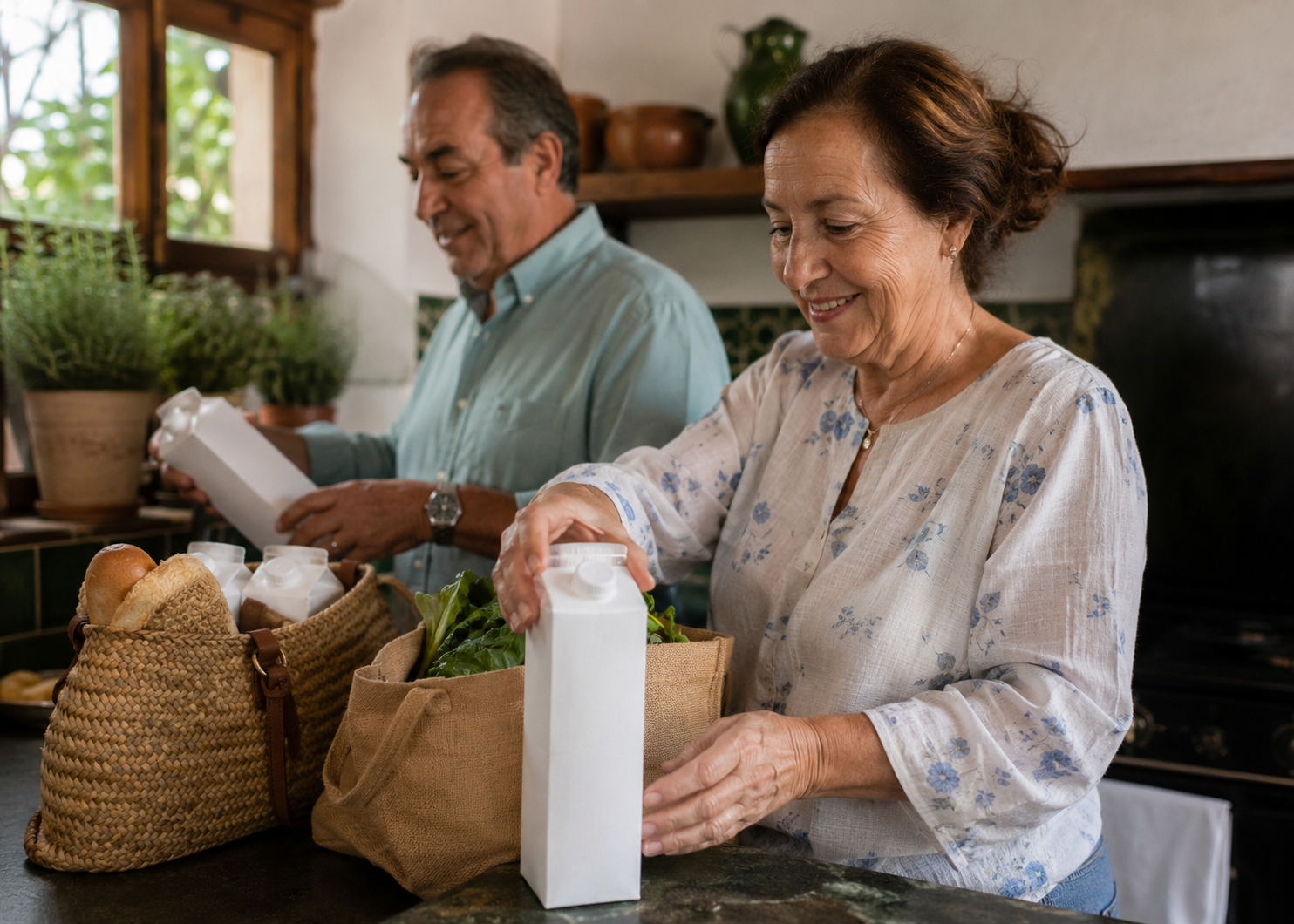
Across the Atlantic, every one of those factors pointed the other way, and UHT never took hold. The most basic reason is how Americans drink milk: cold, straight, and in large quantities, especially children, for whom a tall cold glass has long been a daily staple.
When milk is a beverage you pour and drink chilled all day, the qualities of UHT matter less and its drawbacks matter more. Chief among them is taste. The intense heat of UHT processing caramelises a little of the milk’s natural sugar, giving it a faintly cooked flavour that regular drinkers of fresh milk tend to notice and dislike. To a palate raised on cold HTST milk, UHT can taste subtly off, and that first impression has proved very hard to shift.
The market tested this directly and lost. The Italian dairy giant Parmalat pushed hard to sell shelf-stable UHT milk in little boxes to American consumers in the early 1990s, and it never caught on. Americans remained attached to the idea of fresh milk and to the reassuring ritual of pulling a cold jug from the refrigerator. UHT does exist in the United States, mostly as the small cartons in children’s lunch boxes and as some organic brands, but it never displaced the chilled gallon, and Americans keep even their UHT-processed organic milk in the fridge out of sheer habit.
The organic corner holds a quiet irony. Much of the premium organic milk Americans buy is in fact UHT-treated to extend its shelf life, yet it is still displayed in the chilled cabinet and carried home to the fridge, because a warm shelf would unsettle the very shoppers paying extra for it. The processing crossed the Atlantic. The shelf never did.
The English-Speaking Exception
It is tempting to frame this as Europe versus America, but the real divide runs a little differently. The countries that cling to fresh, refrigerated milk are mostly the English-speaking ones, and much of the rest of the world sits closer to the Spanish shelf.
Alongside the United States and Canada, the United Kingdom and, to a large extent, Australia also prefer fresh milk kept cold, which is part of why British and American visitors react to European shelf milk in the same startled way. Across most of continental Europe, and in large parts of Asia, Latin America, and Africa, shelf-stable UHT is the default rather than the exception. By some counts, around seven in ten European milk drinkers choose the shelf carton over the chilled bottle.
Seen globally, then, it is the cold gallon that is unusual, not the warm carton. The American fridge is the outlier on a world map, a habit specific to a handful of wealthy, high-refrigeration, largely English-speaking cultures rather than a universal standard. Spaniards buying milk off a dry shelf are doing the ordinary thing. It only looks strange from inside the small club of countries that decided milk must always be cold.
Does It Really Taste Different?
The taste question is where the argument gets personal, and it deserves an honest answer rather than national pride in either direction. Yes, UHT milk does taste slightly different from fresh, and the difference is real, not imagined.
The high heat burns off a small amount of the milk’s natural lactose sugar and alters some proteins, producing a mildly cooked or caramelised note that fresh milk lacks. People who grew up drinking one are quick to detect the other. An American often finds European UHT milk faintly strange on the first sip, while many Europeans find American fresh milk unremarkable precisely because it is what they would expect milk to taste like anyway.
That said, the gap is easy to overstate. In coffee, tea, cereal, or cooking, which is how most milk is actually consumed, the difference all but vanishes. Once a UHT carton is opened and chilled, and especially once it is poured over hot coffee, few people could reliably tell it apart from fresh. Modern UHT processing has also narrowed the flavour gap considerably from the harsher versions of decades past. For the vast majority of everyday uses, the taste objection is more about expectation than about any real defect in the milk. There is a generational element, too. Younger Spaniards who have only ever known UHT carry no fresh-milk baseline to miss, so for them the shelf carton is not a substitute for anything, but simply what milk tastes like.
The Energy and Waste Argument

There is a modern angle to all this that is quietly turning UHT from a European quirk into a point in its favour. Keeping milk cold from farm to fridge consumes a great deal of energy, and shelf-stable milk sidesteps most of it.
UHT milk needs no refrigeration through processing, transport, storage, or shelving, only after a carton is opened at home. That removes a long, energy-hungry cold chain from the equation, and the extended shelf life means far less milk is thrown away unsold or spoiled. In an era increasingly focused on energy use and food waste, a product that stays good for months without a fridge starts to look less like a compromise and more like an advantage.
None of this is simple, and the aseptic carton has its own recycling challenges, since its layers of paper, plastic, and aluminium are harder to separate than a plain plastic jug. But the broad case is real enough that some observers wonder whether Americans, so far immovable on the subject, might one day warm to shelf-stable milk for the same practical reasons Europe did. Plant-based milks already sit happily on American shelves in exactly these cartons, which may slowly soften the old resistance to warm dairy in a box.
The pandemic nudged the idea along as well. When shoppers everywhere suddenly wanted to stock up and shop less often, a milk that keeps for months in the cupboard looked newly sensible even to people who had never once considered it. Old habits are sticky, but the practical case for shelf-stable milk has rarely been easier to make.
So Is It Safe? And Should You Switch?

For an American encountering Spanish shelf milk for the first time, the two real questions are simple, and the answers are reassuring. Is it safe to drink milk that has been sitting warm on a shelf? Absolutely. UHT processing sterilises the milk and aseptic packaging keeps it that way, so an unopened carton is safe at room temperature for months, and once opened it keeps in the fridge like any other milk. The warm shelf does none of the harm an American shopper instinctively fears.
Should a visitor or a new resident in Spain bother hunting for the refrigerated fresh milk that some supermarkets do stock in a chilled corner? That is purely a matter of taste. Plenty of expats do exactly that for a while, chasing the familiar flavour, before quietly giving up and buying whatever carton is nearest, because in coffee and cereal it makes no real difference. Others come to prefer the sheer convenience of a cupboard full of milk that never goes off before they get to it.
The deeper point is that neither system is right or wrong. They are two sensible answers to the same problem, shaped by different histories and different ways of eating. The milk on the Spanish shelf is not a lesser product or a health risk. It is simply milk, solved a different way, and once the initial surprise passes, most newcomers stop noticing the shelf at all.

About the Author: Ruben, co-founder of Gamintraveler.com since 2014, is a seasoned traveler from Spain who has explored over 100 countries since 2009. Known for his extensive travel adventures across South America, Europe, the US, Australia, New Zealand, Asia, and Africa, Ruben combines his passion for adventurous yet sustainable living with his love for cycling, highlighted by his remarkable 5-month bicycle journey from Spain to Norway. He currently resides in Spain, where he continues sharing his travel experiences with his partner, Rachel, and their son, Han.