
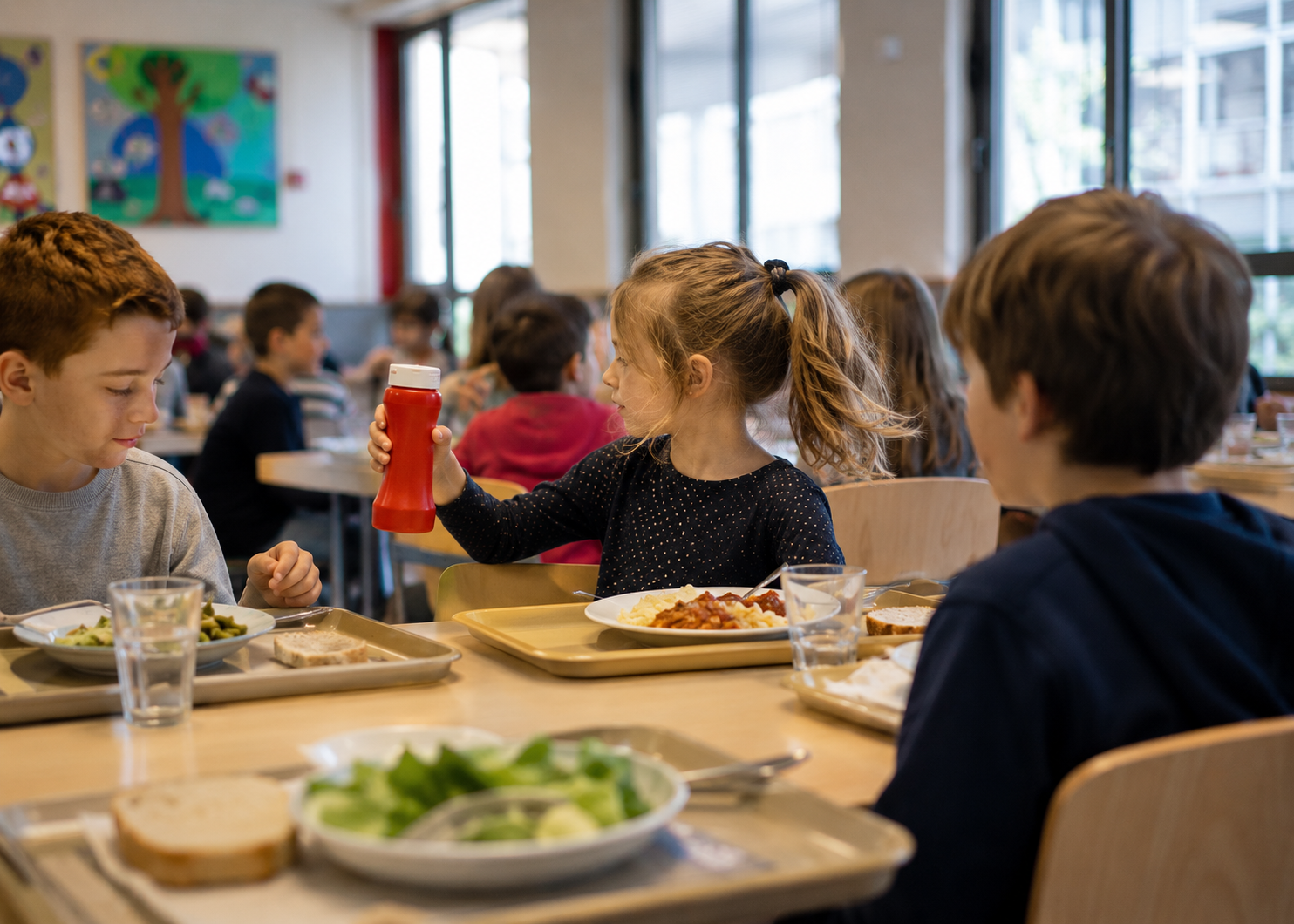
Picture a French school canteen at lunchtime. A child carries a tray toward a table with a plate of veal stew or a piece of roast fish on it, and reaches, out of habit, for the ketchup. There is no pump, no squeeze bottle, no little sachet waiting on the counter. The ketchup is not banned outright, but it is not there for the taking either, and it will not be arriving with the veal. This is French school food policy at work, and it is one of those rules Americans hear about and simply refuse to believe.
The story gets told, usually with delight or outrage, as France banning ketchup. That is not quite what happened. What France actually did in 2011 was pass a nutrition rule for school meals that limited ketchup, and several other sauces, rather than forbidding them. The reality is more careful and more interesting than the headline, and it says a great deal about how France thinks about food, children, and culture.
What the 2011 Rule Actually Says
The measure is a real piece of French law, an official decree known as the Arrêté du 30 septembre 2011, concerning the nutritional quality of meals served in schools. It came into force at the start of the school year that autumn and applies to school and college cafeterias across the country.
The key provision is not a prohibition on ketchup itself. Its Article 2 states that salt and certain sauces, specifically mayonnaise, vinaigrette, and ketchup, must not be freely available, and are instead to be served according to the dish being eaten. In plain terms, that means no self-serve condiment stations, no pump dispensers, no bowls of ketchup that children can pour over everything. A portion of sauce is provided by staff when a particular dish actually calls for it.
So what was restricted was not ketchup as a substance but free, unlimited access to it. The difference matters. A French schoolchild can still, in principle, eat ketchup at school, but only with a dish that suits it and in a controlled amount, rather than smothering an entire tray at will from an open dispenser. Bread and water, by contrast, remain freely available under the same rule. The regulation is a limit on how and when, not an outright ban on whether.
Where the Rule Came From

The 2011 decree did not appear from nowhere. The recommendations behind it had been sitting in government reports for years, part of a longer French campaign against the drift of children’s diets toward sugar, salt, and fat.
France had already been tightening the screws on junk food in schools for some time. Vending machines selling sweets and sugary drinks were removed from French schools back in 2005, well ahead of many other countries, and national nutrition programmes had been steering schools toward healthier menus throughout the 2000s. Government researchers had recommended the specific rules on sauces and fried food several years before they became law. The 2011 decree simply took long-standing advice and made it binding.
What changed that year was the force behind the guidelines. For a long time, nutritional recommendations for school canteens existed but were widely ignored, applied loosely or not at all depending on the town and the caterer. The decree turned suggestions into obligations, with the requirement to keep records so inspectors could verify that a canteen was actually following them. The ketchup limit was less a sudden brainwave than the enforcement, at last, of advice France had been giving itself for a decade.
It Was Never Just About Ketchup
The framing of a French war on ketchup misses a crucial fact: the rule was never aimed at ketchup alone, and it was not really an attack on an American import. The same restriction fell on sauces that are pillars of French cuisine itself.
Mayonnaise and vinaigrette, both thoroughly French and both loved, were limited in exactly the same way as ketchup. All three were pulled from free self-service and made available only per dish, on the same reasoning: children left to their own devices will drown their food in fatty or sugary sauces, and the point was to stop that regardless of the sauce’s nationality. Vinaigrette is about as French as a sauce can be, and it got the same treatment.
This detail undoes the popular story almost entirely. If the rule had been about protecting French identity from foreign condiments, it would not have gone after mayonnaise and vinaigrette. That it did shows the measure was a broad nutritional policy about fatty sauces in general, with ketchup simply the most famous name on the list and the one that made international headlines. The war-on-ketchup version is a better story. It is just not an accurate one.
It is worth adding that ketchup drew the headlines for a simple reason: it is the sauce most strongly coded as American, and a French rule touching it made for an irresistible culture-clash narrative abroad. Mayonnaise and vinaigrette limits do not travel as international news. But inside the decree, all three sat side by side as fatty sauces to be portioned rather than poured, with no special hostility reserved for the foreign one. The nationality of the ketchup was the journalists’ angle, not the lawmakers’.
The Once-a-Week Fries Rule

Ketchup did not disappear from French canteens, but it did become closely tied to one thing, and that pairing points to another part of the same decree. The rule most people associate with ketchup is that it may effectively be served with French fries, and French fries alone.
The catch is that the same regulation limits how often fries themselves can appear. Under the nutritional rules, fried potato dishes may be served no more than once a week in school cafeterias. Since ketchup is served with the dishes it suits, and in the canteen that mainly means fries, the practical effect is that a child’s ketchup opportunity narrows to roughly once a week, when the fries come around.
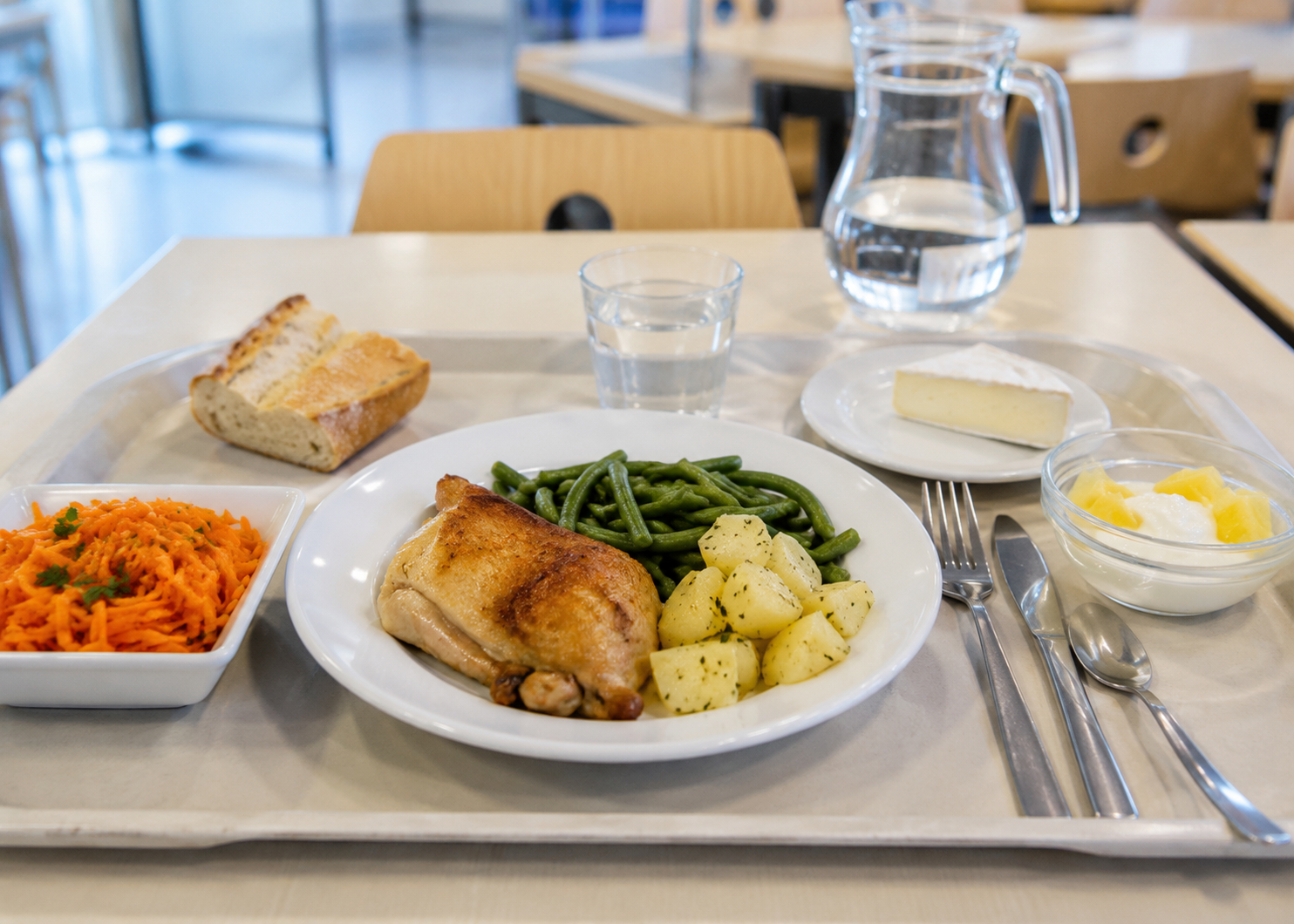
The decree reaches well beyond sauces and fries. It requires canteens to offer a set number of dishes, commonly four or five, each day, to serve more fresh fruit and vegetables, and to keep records of what has been served so health officials can check compliance. Bread and water must be freely available and unlimited. Taken together, these rules rebuild the school lunch as a genuinely balanced meal, with the ketchup limit as only its most quotable clause.
The Two Reasons Behind It
France gave two distinct justifications for the rule, and understanding both is the key to understanding why a country would legislate about a condiment at all. The first reason is straightforwardly nutritional.
Officials pointed out that ketchup is not, whatever anyone pretends, a vegetable, and that it carries a significant load of sugar, often from corn syrup. A child masking every dish in a sweet, fatty sauce is both eating badly and learning bad habits, and the agriculture minister of the time, Bruno Le Maire, argued that French schools had a public-health duty to set a better example. Making the nutritional rules obligatory and enforceable, rather than merely advisory, was the government’s answer.
The second reason is the one Americans find harder to credit: culture. French officials openly said the goal was also to teach children to appreciate the actual taste of traditional French dishes, rather than reducing everything to a uniform tomato flavour. If a child covers veal stew or a proper roast in ketchup, the reasoning went, they never learn what the dish is supposed to taste like, and they cannot carry that heritage forward. The canteen was framed as having an educational mission as much as a nutritional one, a place where the next generation learns to eat like the French, so they can hand those recipes down in turn.
To an outsider these two reasons can seem to blur together, but the French treated them as genuinely separate goods. One is about the body and the other is about belonging, and the rule was meant to serve both at once. A canteen that fed children healthily but taught them nothing about their own food culture would, by this logic, have done only half its job. That double ambition, health and heritage in the same lunch tray, is precisely what an American reading of the rule tends to miss.
Why Americans Refuse to Believe It

When this rule surfaced in 2011, the American and international press seized on it, and the coverage set the tone that persists to this day. Outlets from the LA Times to Gawker ran with the idea of France declaring war on ketchup, casting it as a nation so precious about its cuisine that it would legislate against a child’s squeeze bottle.
The disbelief is understandable from an American vantage point, because it collides with two deep assumptions. One is that ketchup is harmless, ubiquitous, and none of the government’s business. The other is that free condiments are simply how a cafeteria works, a small everyday freedom nobody would think to regulate. The notion that a national government would formally restrict self-serve ketchup in schools sounds, to American ears, like satire or an urban legend.
Yet it is real, and the persistent American skepticism partly comes from the exaggeration in the original coverage. Because the story was told as a total ban, and because a total ban does sound absurd, the whole thing became easy to dismiss as a tall tale. The accurate version, that France limited free access to ketchup and other fatty sauces as part of a broader school-nutrition law, is both true and far less ridiculous. The rule Americans do not believe is not the rule France actually passed.
The Bigger French Approach to School Food
The ketchup limit makes far more sense once you see the institution it sits inside, because French school lunch is unlike its American counterpart in almost every respect. It is treated as a serious meal and a part of a child’s education, not a refuelling stop.
A typical French school lunch is a multi-course, sit-down affair: a starter, a hot main with a vegetable, a cheese course, and often a fruit or dessert, eaten at a table over a real break rather than gulped in fifteen minutes. Menus are planned for nutritional balance and variety, sometimes published for parents to see, and designed to introduce children to a wide range of real dishes. The canteen is understood as a place where taste is formed and table manners are learned, an extension of the classroom rather than an interruption of it.
In that context, a rule limiting free ketchup is not the strange overreach it first appears. It is one small consistent piece of a system that treats feeding children well as a public responsibility and a cultural project. A country that plans a cheese course into a nine-year-old’s lunch is not going to leave an open ketchup dispenser next to it. The condiment rule is odd only when torn out of the culture that produced it.
How American School Lunch Compares
The French rule lands so strangely on American ears partly because the United States has spent its own decades arguing about school food and arriving at very different answers. The contrast is illuminating.
America has its own notorious episodes in this arena, most famously the recurring political fights over whether ketchup, or later pizza sauce, could count as a vegetable in school-meal nutrition math. In the 1980s a budget-driven proposal to classify ketchup as a vegetable serving became a national embarrassment and was withdrawn. Decades later, a similar row erupted over counting the tomato paste on a slice of pizza toward the daily vegetable requirement. Where France moved to limit ketchup, American debates have at times moved to reclassify it as produce.
The underlying philosophies could hardly be further apart. The American cafeteria, shaped by tight budgets, enormous scale, and a culture of consumer choice, tends toward abundant free condiments and quick, familiar food. The French canteen treats lunch as a slow, structured, culturally freighted meal. Neither system is simply right, but the ketchup rule marks the gap precisely. One country asked how to stop children drowning their food in sauce; the other, at moments, asked how to count the sauce as a vegetable.
What Came of It
More than a decade on, the rule remains in force, and the debate around it has settled into something quieter than the initial uproar. The limits on free sauces and once-a-week fries are simply how French school canteens operate now, absorbed into the routine rather than fought over daily.
Whether it decisively changed how French children eat is hard to measure, and honest observers admit as much. Palates are shaped by families and whole food cultures, not by a single school regulation, and plenty of French teenagers still love ketchup and fast food when they are outside the canteen. What the rule did achieve was to make the school meal itself more balanced and to plant a clear public statement about what children should be offered during the day. Its influence is as much symbolic as measurable.
There is also a quiet lesson in how undramatic the aftermath turned out to be. The rule that generated headlines about a war on ketchup simply became, within a year or two, an unremarked feature of French school life, no more controversial than the requirement to serve vegetables. The gap between the international uproar and the domestic shrug is telling. What looked from abroad like an eccentric assault on a beloved condiment was, at home, just another sensible line in a long tradition of taking children’s meals seriously.
That symbolism is really the point, and it is why the story endures. The ketchup rule captured, in one small and quotable law, a genuine French conviction: that food is culture, that taste is taught, and that even a school lunch is worth taking seriously enough to legislate. Americans may find it hard to believe, but the disbelief itself is the most revealing part. It marks the exact spot where two countries draw the line between a private habit and a public good, and France drew it right through the ketchup.

About the Author: Ruben, co-founder of Gamintraveler.com since 2014, is a seasoned traveler from Spain who has explored over 100 countries since 2009. Known for his extensive travel adventures across South America, Europe, the US, Australia, New Zealand, Asia, and Africa, Ruben combines his passion for adventurous yet sustainable living with his love for cycling, highlighted by his remarkable 5-month bicycle journey from Spain to Norway. He currently resides in Spain, where he continues sharing his travel experiences with his partner, Rachel, and their son, Han.