
There is a line in the Spanish calendar that most people moving to the country never notice until it has already cost them money. Spend more than 183 days in Spain during a single calendar year and you become a Spanish tax resident, and a Spanish tax resident owes Spanish tax on their worldwide income, not just the money they earn in Spain. Your American pension, your rental income back home, your investment dividends, all of it comes into view of the Spanish tax authority the moment you cross that line.
The line is not drawn from the day you arrive. It is drawn against the calendar year, January to December, and that single detail is the whole reason a well-informed retiree pays attention to which month they land in. Arrive in the wrong half of the year and a full-time stay triggers worldwide taxation for a year you barely spent in the country. Arrive in the right half and you buy yourself the better part of a year before Spain has any claim on your foreign income at all.
Here is how the 183-day rule works, why July is the pivot point, and the catch that stops it from being a free lunch. None of this is tax advice, and anyone planning a move should sit down with a Spanish tax professional before booking a flight, but understanding the mechanics first makes that conversation far more useful.
The Rule in One Sentence

The core of it is simple. Under Article 9 of Spain’s personal income tax law, known as Ley 35/2006, an individual who spends more than 183 days on Spanish territory during a calendar year is classified as a tax resident. The Spanish tax agency, the Agencia Tributaria, which everyone calls Hacienda, then treats that person as liable for IRPF, the personal income tax, on their entire worldwide income.
The consequences of that classification are large. A Spanish tax resident is taxed on a progressive scale that runs from roughly 19 percent up to 47 percent, applied not to their Spanish earnings alone but to their global income from every source. A non-resident, by contrast, pays Spanish tax only on income that arises inside Spain, such as rent from a Spanish flat, while their foreign pensions and investments stay outside Hacienda’s reach entirely.
For an American retiree, that is the difference between Spain taxing the Social Security check and the retirement-account withdrawal, or Spain ignoring them completely. The gap between resident and non-resident status can reshape the entire financial picture of a retirement rather than shift it by a few euros, which is why the day count deserves to be taken seriously rather than treated as fine print.
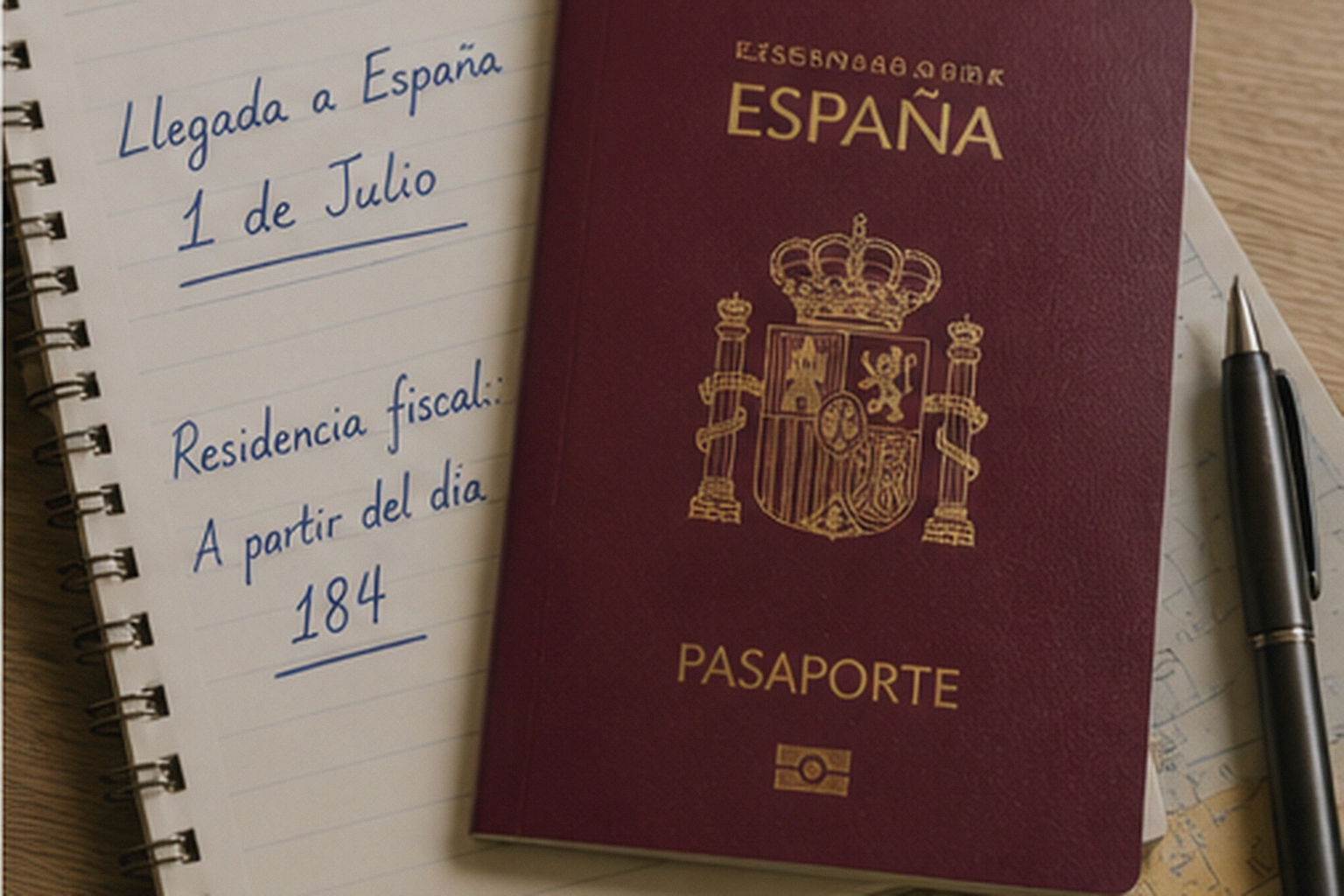
The threshold is worded precisely. The law says more than 183 days, which means 184 days trips it and 183 does not. Any part of a day spent on Spanish soil counts as a full day, including the day you fly in and the day you fly out, so the arithmetic is less generous than a casual reading suggests.
Why the Calendar Year Is Everything
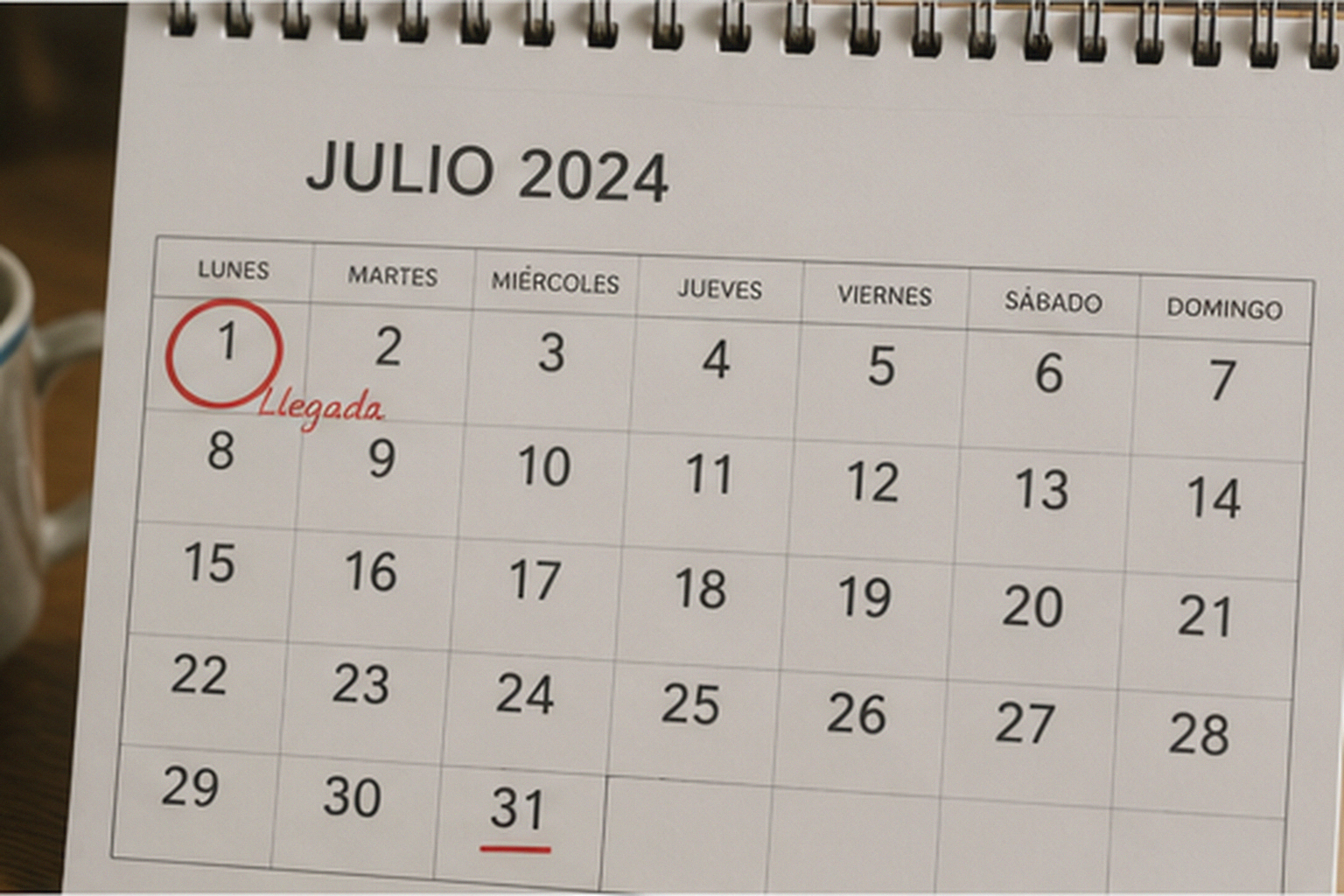
The detail that catches people out is that Spain measures residency against the fixed calendar year, not against a rolling twelve months from the date they moved. The clock does not start when you arrive and run for a year. It starts every January 1st, stops every December 31st, and then resets to zero.
Work through what that means in practice. If you arrive in Spain on the first of August, you will spend roughly 150 days in the country before the year ends on the 31st of December. That is comfortably under the 183-day threshold, so you do not become a Spanish tax resident for that first partial year, no matter that you fully intend to live there permanently from then on. Your worldwide income stays beyond Spanish taxation for those months.
Then the calendar flips. On the first of January your day count restarts at zero, and if you stay in Spain through the following summer you will cross 183 days somewhere around early July and become a full tax resident for that second year. The residency does not backdate to your arrival. It attaches to the calendar year in which you crossed the line, and everything before that belongs to a year in which you were simply not resident at all.
This is where a common piece of internet folklore goes wrong. People imagine they can dodge residency indefinitely by leaving the country for a few weeks here and there to reset the count. They cannot. Hacienda adds up cumulative days across the whole calendar year, and short holidays abroad do not erase the days already spent in Spain. The calendar-year mechanic helps you only at the front end, in the year you arrive, not as an ongoing trick to be replayed forever.
Why July Is the Pivot
Put the calendar math together and a specific date emerges as the hinge of the whole approach. A standard year has 365 days. To spend 183 days or fewer in Spain before December 31st, you need to arrive with 183 days or fewer left in the year, which lands you at roughly the 2nd of July. Arrive on or after that date and you finish the year under the threshold, a non-resident for that first year. Arrive before it, in the first half of the year, and a full-time stay pushes you over the line and makes you resident for the entire year.
That is the timing move experienced advisers quietly build into a client’s plan. A retiree who can choose when to make the move, and most retirees can, benefits from arriving in the second half of the year rather than the first. Landing in July, August, or September rather than February means the first stretch of life in Spain unfolds while foreign income is still invisible to Hacienda, and Spanish worldwide taxation only begins with the clean start of the following January.
The value of that is real money and real breathing room. It buys time to sell a house back home, to take a large one-off pension distribution, or to reorganize investments in a window when Spain has no claim on the proceeds, all before residency and its worldwide reach kick in. For a move that involves shifting a lifetime of assets across an ocean, a tax-quiet first half-year on the Spanish side is worth planning around.
A worked example makes the stakes concrete. Take a couple who sell their American home in August and land in Spain on the 10th of September. They spend 112 days in the country that year, well under the line, so the capital gain on the house is taxed only by the United States, not by Spain. Had they instead arrived in April, the identical sale would have fallen inside a Spanish tax-resident year, and Hacienda would have wanted its share of the gain on top of the American bill. Same house, same price, a very different tax outcome decided by the month of the move.
None of this is evasion, and that distinction matters. Timing your arrival to fall in a particular tax year is the same ordinary planning that governs when to sell a stock or trigger a pension payment. You are not hiding anything from anyone. You are choosing the date you start a legal clock that the law itself is designed to have you start on a date of your choosing.
The Catch That Voids the Trick

Here is the part the breezier guides leave out, and it is important enough to keep in one place. The 183-day count is not the only route into Spanish tax residency. Spanish law has a second and a third test, and either can pull you in even in a year you spent well under 183 days in the country.
The main one is the centre of economic interests. If Spain becomes the main base of your activities or the core of your economic life, Hacienda can treat you as resident regardless of the day count. There is also a family presumption: if your spouse and dependent minor children live permanently in Spain, the law presumes you are resident too, unless you prove otherwise. And sporadic absences, the short trips abroad, still count as days in Spain unless you can show you were genuinely tax resident somewhere else during them.
For most retirees living on foreign passive income, the day count is still the test that governs, because their economic centre, the pensions and the investments, remains firmly in their home country and they run no Spanish employer or business. For that profile, arriving after July really does defer residency, and the approach works as described. But it is not a universal loophole. A younger person moving a business to Spain, or a couple whose children start Spanish school in September, may be resident on the other tests no matter what the calendar says.
One clarification saves a lot of confusion. Registering with your town hall, the empadronamiento, and getting your foreigner identity number, the NIE, do not by themselves make you a tax resident. Those are immigration and administrative steps. Tax residency is a separate question decided by the day count and the economic tests, and it is entirely possible to hold the paperwork without yet owing a euro of worldwide tax.
How Spain Counts Your Days
Because so much rides on the day count, it is worth knowing how Hacienda tallies it, since the method is stricter than most people assume. Any portion of a day on Spanish soil counts as a whole day. Arrive at eleven at night and that day is a full day, and leave at two in the morning and the departure day counts too. There is no half-day arithmetic and no grace for travel days.
The sporadic-absences rule is the sharp edge. If you are plainly living in Spain and take a three-week holiday elsewhere, Hacienda will still count those three weeks toward your Spanish total unless you can prove you were a tax resident of another country during them. The burden of proof sits on you, not on the tax agency, which means casual trips abroad do not quietly shrink your count the way people hope they will.
The practical consequence is that anyone near the line should keep records. Boarding passes, entry and exit stamps, and a simple log of days in and out of the country are the evidence that settles a dispute, and there are phone apps built to track exactly this for people who split their year across borders. In a close case, the person who can document their movements to the day is in a far stronger position than the one relying on memory, and the tax agency is not obliged to give the benefit of the doubt.
Transit sits slightly apart from all this. Passing through a Spanish airport in the international zone without formally entering the country does not add a day, but the moment you clear passport control and step into Spain proper, the clock is running. When in doubt, the safe assumption is that a day touching Spain is a day counted.
What Tax Residency Brings With It
Once the line is crossed, a set of obligations follows that are worth knowing in advance. The central one is the annual income tax return, Modelo 100, which a resident files by the 30th of June for the previous calendar year, declaring worldwide income and settling the IRPF due on it.
Two further filings surprise people. A resident with foreign assets, bank accounts, securities, or property, worth more than €50,000, about $59,000, in any one category must declare them each year on Modelo 720, an information return notorious for the heavy penalties attached to getting it wrong. Some regions also levy a wealth tax on worldwide assets above a threshold, though the rules vary sharply by region, and the Madrid region has effectively eliminated it.
For Americans there is a second layer, because the United States taxes its citizens on worldwide income no matter where they live. That raises the prospect of being taxed twice on the same money, which the US-Spain tax treaty exists to prevent, generally by letting tax paid in one country offset tax owed in the other. It does not make the filing disappear. A US retiree in Spain files in both countries and leans on the treaty and on foreign tax credits to avoid genuine double taxation, which is why expat-specialist advice tends to pay for itself here.
One regime is worth mentioning only to set it aside. The special impatriate scheme known as the Beckham Law, which lets certain new arrivals be taxed as non-residents, is built for people relocating to Spain for employment. It does not apply to a retiree living on passive income, so it is not part of the retiree’s toolkit despite showing up in a great deal of general expat advice.
Timing the Move, Then Getting Advice
The practical takeaway is clear even where the law behind it is not. If you have any flexibility in when you move to Spain, and you are living on foreign pensions and investments rather than moving an active business or enrolling children mid-year, arriving in the second half of the calendar year defers Spanish worldwide taxation until the following January. The single most valuable date in the plan is your arrival date, and pushing it past the start of July can be worth a full year of tax quiet on your foreign income.
The caution matters as much as the tactic. The day count is only one of three residency tests, the family and economic-interest rules can override it, and the penalties for filing Spanish returns wrongly are steep. This is precisely the kind of situation where a few hundred euros spent on a Spanish tax adviser, a gestor or a specialist, pays for itself many times over, because the details of your particular assets and household decide whether the July move helps you or not.
Spain remains one of the most rewarding places in the world to retire, and its tax system is not a reason to stay away. It is simply a system with a clear line running through the calendar, and the retirees who fare best are the ones who see the line before they reach it, choose the date they step over it, and take proper advice on everything that follows.

About the Author: Ruben, co-founder of Gamintraveler.com since 2014, is a seasoned traveler from Spain who has explored over 100 countries since 2009. Known for his extensive travel adventures across South America, Europe, the US, Australia, New Zealand, Asia, and Africa, Ruben combines his passion for adventurous yet sustainable living with his love for cycling, highlighted by his remarkable 5-month bicycle journey from Spain to Norway. He currently resides in Spain, where he continues sharing his travel experiences with his partner, Rachel, and their son, Han.