
The produce section is the first place a visiting American gets it wrong, and it happens within thirty seconds of walking in. Someone reaches for a tomato with a bare hand, gives it the practiced supermarket squeeze, and a nearby shopper glances over. In much of Europe that squeeze is the tell.
The rule is simple and almost never posted. You do not touch the fruit and vegetables with your bare hands. You use the thin plastic glove or the little bag hanging beside the bins, and you reach for it before you pick anything up.
That is rule one, and there are eight more waiting between the entrance and the car. None of them are hard. All of them are invisible until you break one, which is the trouble with unwritten rules in a country that assumes everyone already knows them.
The Glove Is Not Optional, and Nobody Will Tell You
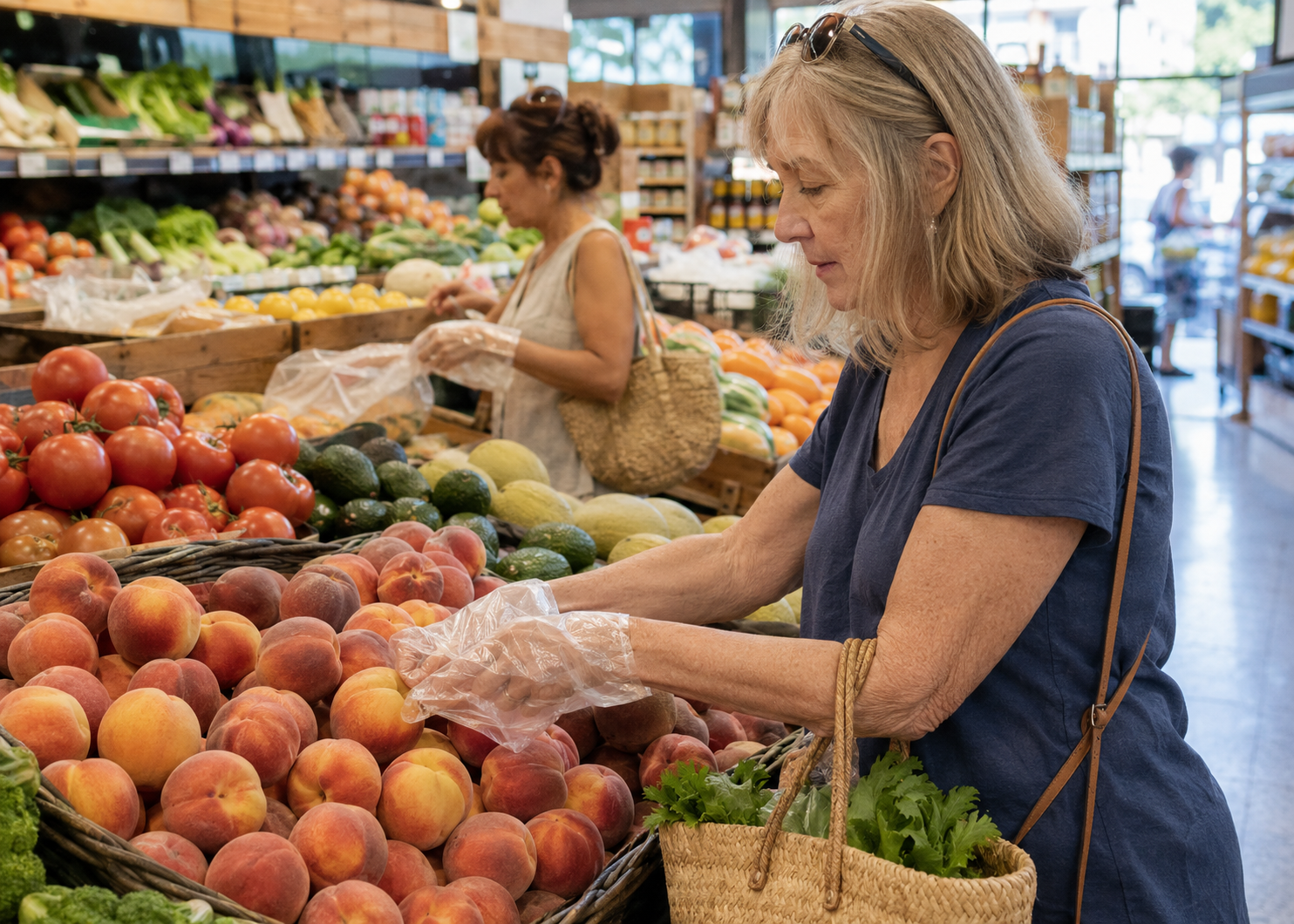
At the Mercadona near us in Getafe, the produce bags sit on a roll at the end of each bin, and beside the citrus there is a box of clear plastic gloves the size of a sandwich bag. You pull one on, or you pull a bag over your hand like a mitten, and then you handle the peaches. Nobody instructs you. You are simply expected to have noticed.
Bare-handed pawing reads the way licking your fingers at a buffet reads. It breaks no rule you could point to. It just marks the person as someone who has not shopped here before.
The habit goes deepest in Germany and Italy, where the glove or sleeve is close to universal, and it runs through Spain as well, though it softened after the pandemic pushed the practice everywhere at once and then relaxed. In a Carrefour or a Lidl you will still see locals reach for the bag on reflex, before they have even decided what they want.
There is a small mercy in it. Once the bag is on your hand you can squeeze and sniff a melon as carefully as you like. The man ahead of you will smell six of them before he commits to one. You just do the same thing through a layer of plastic.
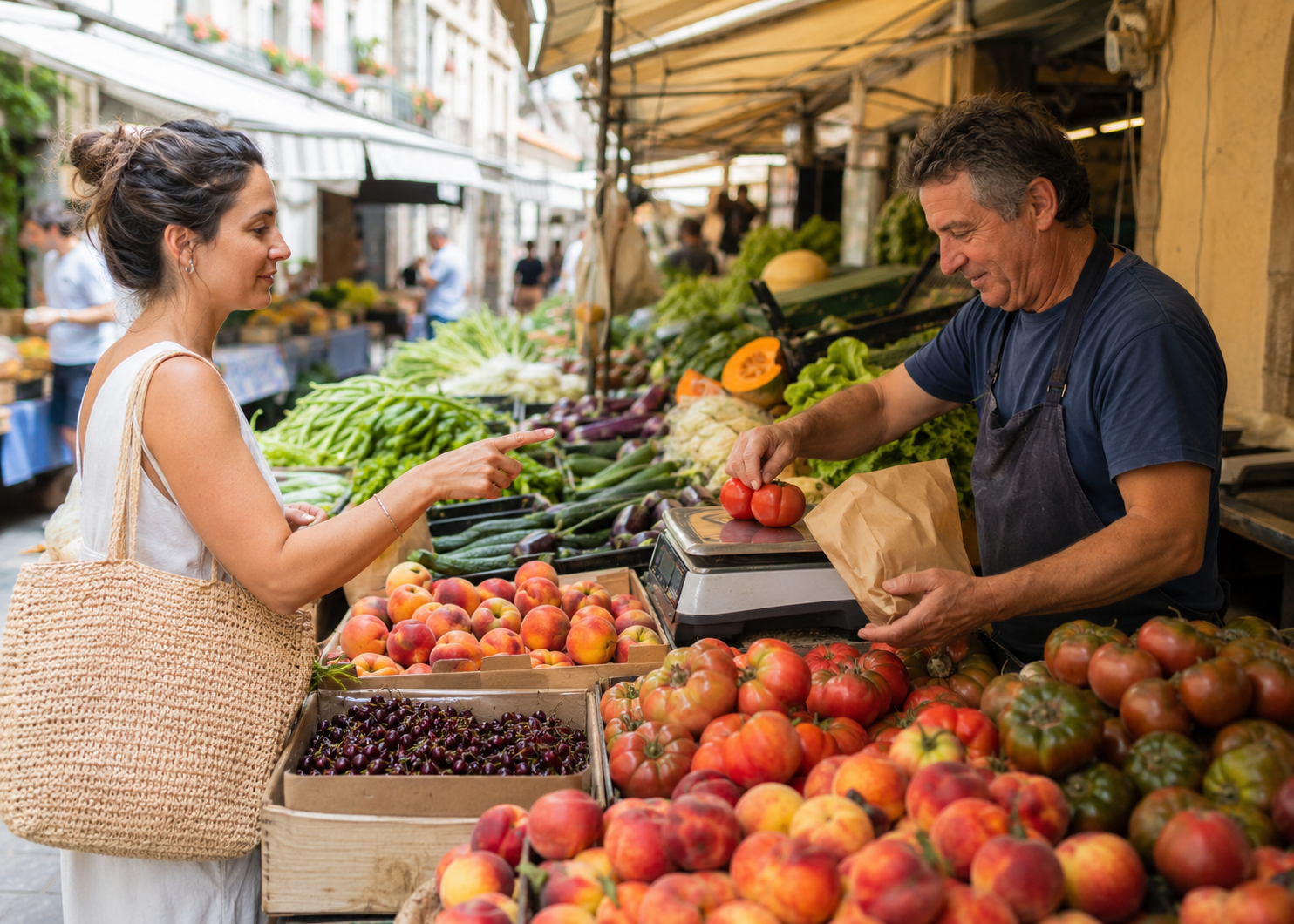
The open-air markets play by a stricter version of the same idea. At a puesto in a Sunday market you often do not touch the produce at all. You point, you say how much you want, and the vendor picks it out and weighs it for you. Reaching in and rummaging through someone’s tomatoes there is worse manners than the supermarket version, not better.
Weigh It Yourself or Walk Back for It
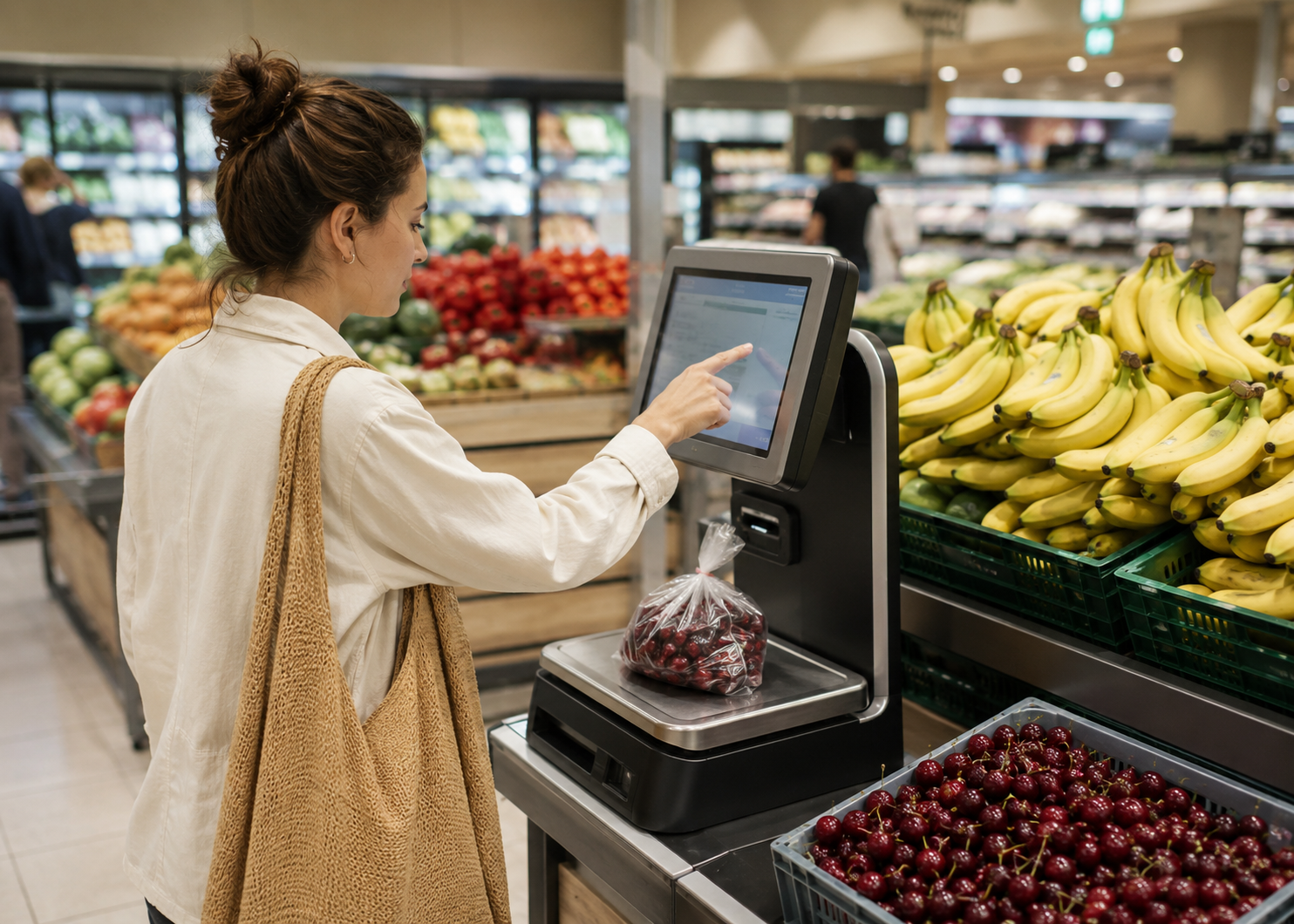
In a lot of European stores the price on the shelf is per kilo, and nobody at the register is going to weigh your bananas for you. There is a scale in the produce section, a báscula, with a keypad or a touchscreen showing little pictures of the fruit.
You set your bag on it, press the matching picture or punch the code number printed on the bin, and it prints a barcoded sticker. That sticker is what the cashier scans. No sticker, no price.
The classic mistake is loading a cart with loose produce, rolling it all the way to the till, and watching the cashier lift a bag of cherries with nowhere to scan it. Then you are sent back across the store to the scale while the line waits behind you. It happens to nearly every newcomer exactly once, and once is usually enough to fix the habit for life.
Some stores hand you a way around it. A few Carrefour and Dutch Albert Heijn branches give loyalty-card holders a handheld scanner, so you weigh and bag as you move and skip the belt entirely. Where that exists it is the fastest way to shop in the building.
Not every store works the same way, and this is the point where the whole list needs a caveat. Mercadona weighs at the register, so the scale question never comes up. Lidl and Aldi mostly sell produce by the piece or in pre-weighed packs, so there is nothing to sticker. Plenty of Carrefour and Alcampo branches make you do it yourself and will send you back if you forget. The rules on this page are the common pattern across Western Europe, not a law that holds in every aisle, and the honest advice is to watch what the person in front of you does before you assume anything.
The Cart Wants a Euro
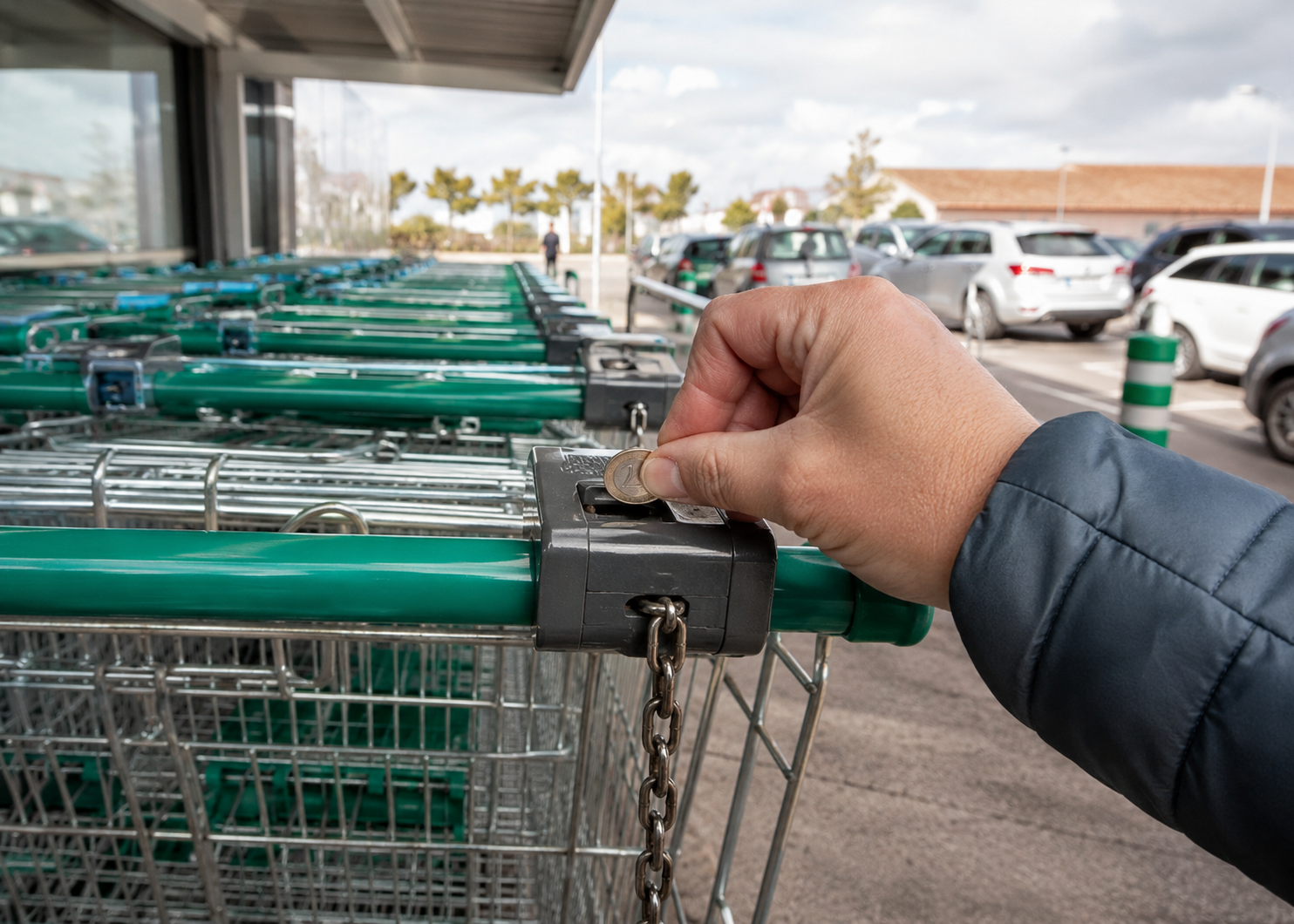
The carts are chained together in a line outside the door, and the chain does not release until you feed a coin into the slot on the handle. In Spain that is usually a €1 coin, sometimes 50 cents, roughly a dollar either way.
You get the coin back when you return the cart and click it into the next one in the row. The deposit exists for a single reason, which is that nobody abandons a cart in the middle of the parking lot when there is a euro riding on walking it back.
Aldi and Lidl run this same system in the United States now, which is part of why some American shoppers grumble about them. In Europe the coin cart is universal, every chain from the cheapest to the fanciest, and it has been that way for decades.
The people who shop here keep a coin tucked in the car door or a small plastic token clipped to a keychain for exactly this moment. Stores will often hand you a free token if you ask at customer service. If you have neither, and you only need a few things, grab one of the handbaskets stacked by the entrance instead. No coin needed, and nothing to walk back.
The Eggs Are Not in the Fridge
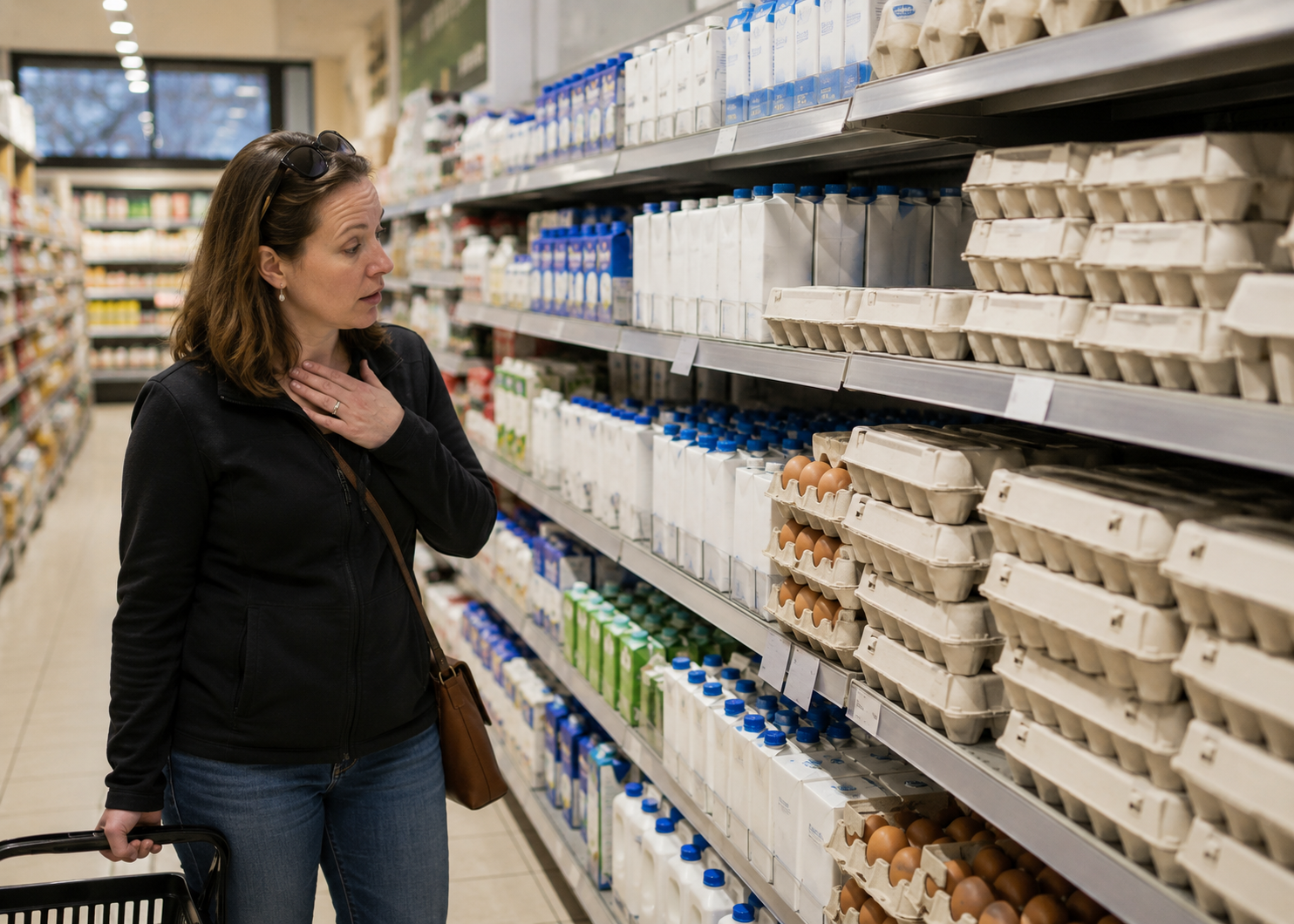
Somewhere around the third aisle an American reaches for milk and finds it on a dry shelf, warm, in a cardboard carton, sitting there like a box of pasta. The eggs are a few steps away, also unrefrigerated, stacked out in the open air.
This is not a store cutting a corner on food safety. European eggs are not washed the way American eggs are, so they keep the natural coating that seals the shell and stay safe at room temperature for weeks. American producers wash that coating off, which is exactly why an American egg then has to be kept cold. The same food, stored in opposite places, for a reason that traces back to one step at the packing plant.
Eggs come by the half-dozen or the full tray of thirty, priced by the docena and sold straight off the shelf at room temperature. A good dozen runs about €2, a little over two dollars. You carry them home warm and leave them on the counter, the way a grandmother would have, and they keep for a couple of weeks without complaint.
The milk is usually UHT, heated briefly to a temperature that lets it sit sealed on a shelf for months. Once you open it, into the fridge it goes like anything else. Cold fresh milk exists too, in the refrigerated case, but the shelf-stable carton is the default across most of Spain.
What does sit in the cold case will reward the detour. The yogurt section runs the length of a wall, the butter comes in a dozen kinds, and the cheese counter in a decent Carrefour is bigger than the wine aisle of an American supermarket. There is almost always a small shelf labeled for American products too, stocked with peanut butter and pancake mix at startling prices.
You Bag Your Own, and You Bag It Fast
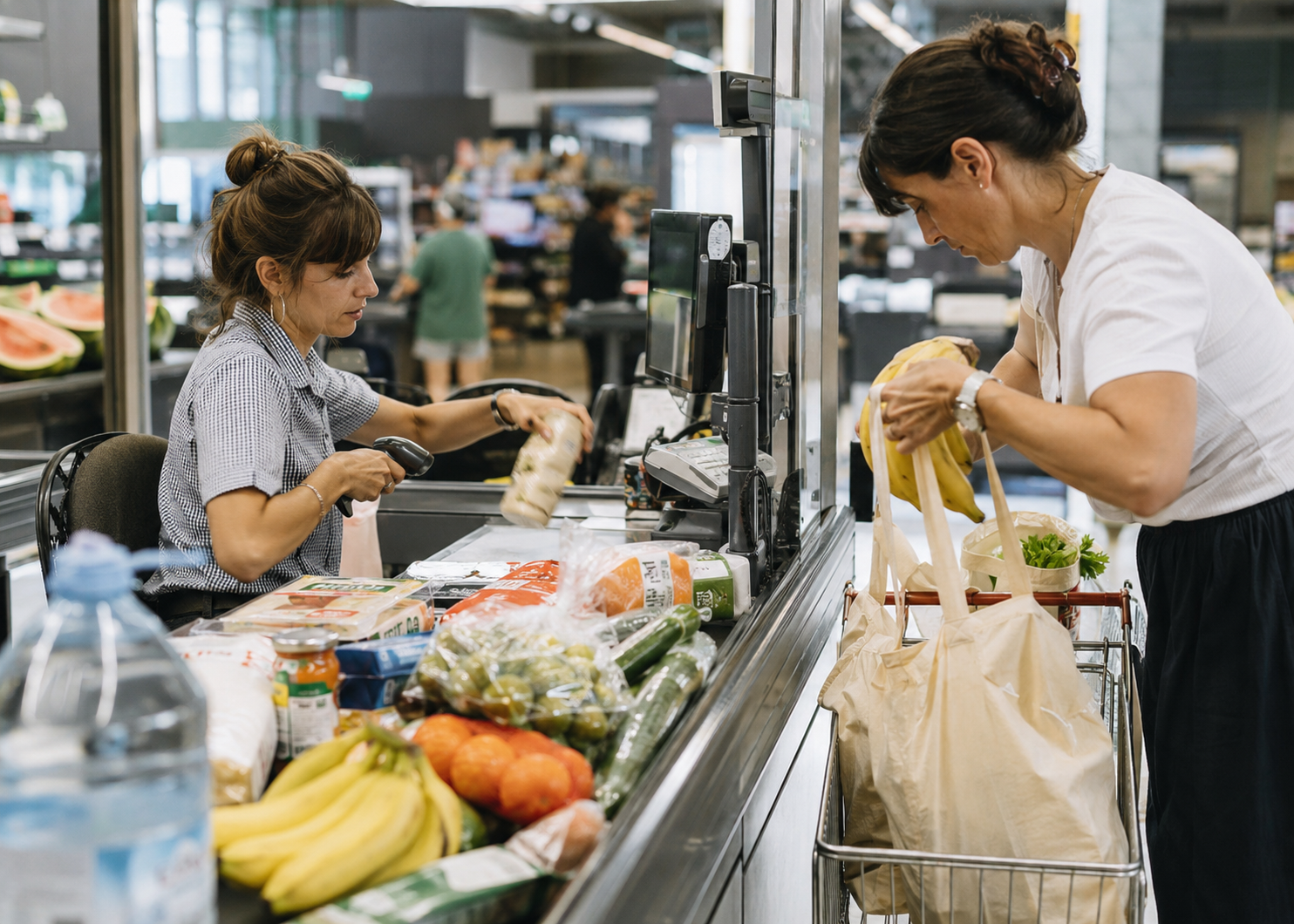
There is no bagger at the end of the belt. The cashier scans, everything piles up at the bottom of the ramp, and getting it into bags is entirely your job. So is doing it at speed.
Spanish cashiers usually sit rather than stand, and they scan at a pace that assumes you are ready to keep up. The groceries come down faster than you expect. If you are still fishing for your wallet when the last item lands, you feel the person behind you, and you feel it as heat on the back of your neck.
The move that saves you is to have a bag open and waiting before the first beep, and to pack straight off the belt as it fills. Then drop the divider bar behind your things so the next shopper can start loading their own. That little plastic bar is not decoration. Placing it is how you signal, without a word, that you understand how the line works.
Lidl and Aldi are the extreme case. Their cashiers are timed and move through a full cart in what feels like ninety seconds, and there is no hope of neat bagging at that speed. The trick every regular knows is to skip bagging at the register entirely: throw everything loose back into the cart, pay, roll clear of the till, and then repack in peace at the counter most stores keep off to the side. Pay first, then sort yourself out after. This is not rudeness. It is rhythm, and once you match it the whole thing runs faster than the American way ever did.
The Bag Costs Money and So Does Forgetting One
Since 2018, Spanish law has required stores to charge for plastic bags, and a 2022 waste law tightened the rules further and priced even the flimsy ones at the produce counter. A checkout bag runs from a couple of cents to about 15 cents, roughly 5 to 20 US cents, and the sturdier reusable ones cost more.
It was never really about the money. Fifteen cents does not change anyone’s week. It is that pulling out your own folded bag is what the locals do, and buying a fresh plastic one every single trip marks you the way the bare-handed tomato does.
Most people here carry a cloth bolsa crushed into a pocket or a handbag, or keep a stack of them in the car door. The reusable ones the stores sell, the ones with a city print or a bright pattern, make genuinely useful souvenirs, which is worth knowing if you are visiting rather than staying for good.
Forget your bags entirely and the fix is small. You buy one at the till and move on. The world does not end. You do it once, feel briefly foolish, and remember the bag the next time, which is how the habit installs itself in about a week.
No Grazing, No Sampling, No Coffee in Hand
Walking the aisles with a coffee in hand, tearing open a bag of chips to eat while you shop, letting a child work through a pastry before anyone has paid for it, all of this reads badly in a European supermarket. Eating on the move is frowned on to begin with, and pairing it with shopping doubles the offense, most of all in France and Italy.
Free samples run on the same logic. Where a shop or a market stall does put something out to taste, taking a piece with no intention of buying is considered poor form, the sort of thing that gets the sample table quietly folded up and retired.
The idea underneath is that the food is not yours until it is paid for, and treating the store like your own kitchen crosses a line. It is a line Americans, raised on grazing the warehouse club on a Saturday afternoon, do not always see is there.
The one place people quietly bend it is the bakery. A torn-off corner of a warm barra disappears on the walk to the register often enough, and even that is done a little sheepishly, the wrapper held out at the till as proof of full intention to pay.
None of this is enforced. No one is going to stop you. You will simply be the one person eating in the cereal aisle while everyone around you waits until they are home, and in this culture that noticing is the whole of the correction.
Small Basket, Every Other Day
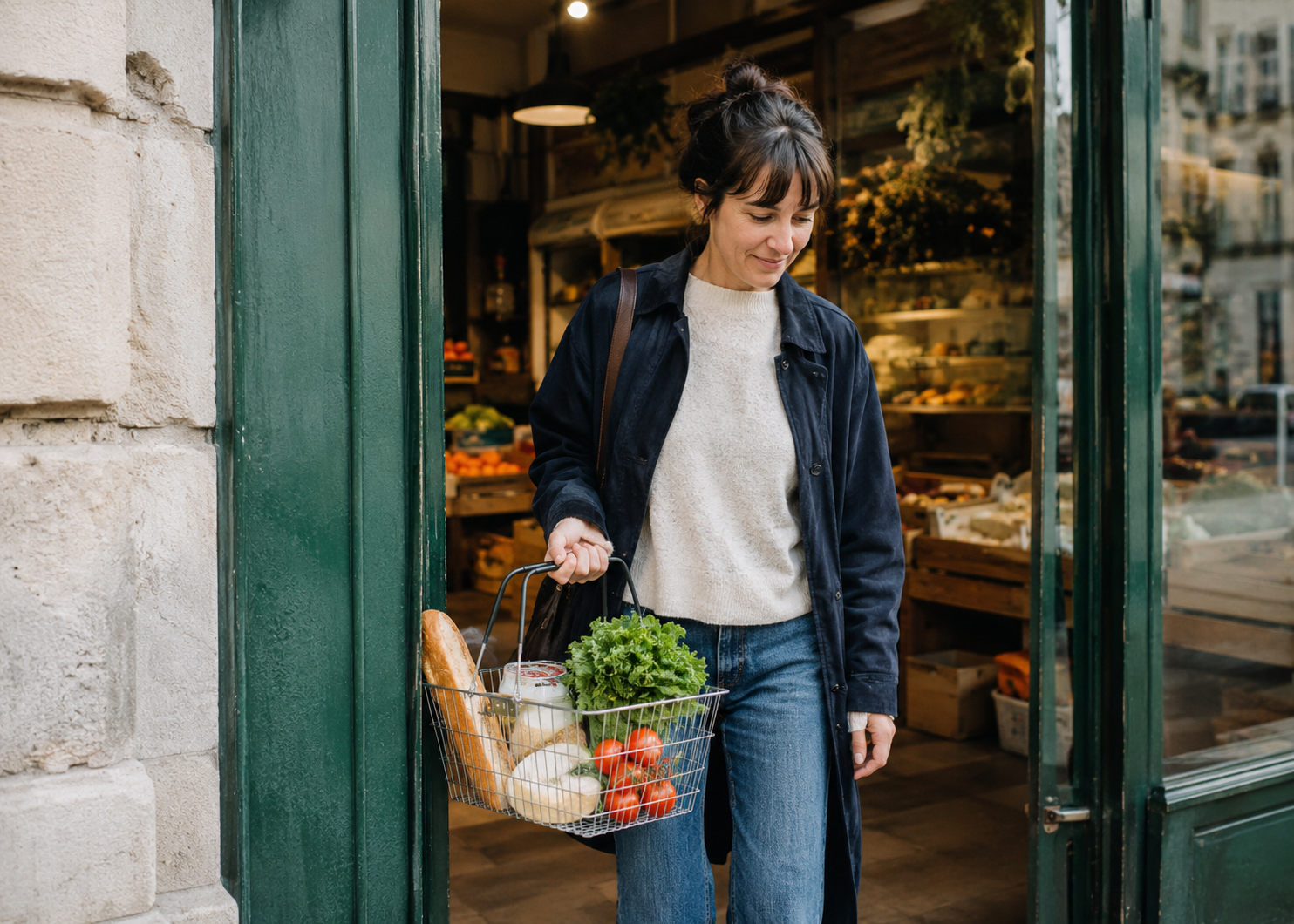
The American instinct is the big weekly haul, a cart loaded for seven days, maybe two carts before a holiday weekend. Do that here and you will draw a look that lands somewhere between puzzled and mildly concerned.
Europeans shop small and often. A basket, not a cart. Bread today and more bread on Thursday, because the good bread goes hard fast and nobody wants the hard kind when the fresh kind is a three-minute walk from the door.
Part of it is the kitchens. City flats in Madrid or Rome come with refrigerators an American would call dorm-sized, and there is simply nowhere to store a month of food even if you wanted to. Part of it is that the produce is bought to be eaten within a few days, not held in reserve.
The rhythm sounds like more work and turns out to be less. Many people still split the trip across shops, the supermarket for pantry basics and the panadería for the daily loaf, with the frutería and the carnicería picking up what the big store does badly. A short stop for a few fresh things beats one enormous expedition you have to plan your week around, and it is the single habit most expats say they carried home with them.
What You Buy, You Keep
The last rule shows up after you have already left the store. Return policies here are tighter than the American no-questions-asked standard, and outside of a clear fault the answer to “can I bring this back” is often a plain no.
You can return a broken appliance or a clearly defective product, and the larger chains publish their own policies for that. But the American habit of buying three sizes, trying them all at home, and returning two does not travel. Buy it, and in most cases you now own it.
Which brings the whole list down to two small objects. Keep a €1 coin and a folded cloth bag in your pocket or your car door, and you have quietly solved the cart, the checkout, and the walk back to the car in one move.
Do that, reach for the glove in the produce aisle, and weigh your own fruit before you leave the section, and you will move through a Mercadona or a Carrefour like someone who has lived here for years. Everything else you pick up by watching the person ahead of you in line, which is exactly how the locals learned it too.

About the Author: Ruben, co-founder of Gamintraveler.com since 2014, is a seasoned traveler from Spain who has explored over 100 countries since 2009. Known for his extensive travel adventures across South America, Europe, the US, Australia, New Zealand, Asia, and Africa, Ruben combines his passion for adventurous yet sustainable living with his love for cycling, highlighted by his remarkable 5-month bicycle journey from Spain to Norway. He currently resides in Spain, where he continues sharing his travel experiences with his partner, Rachel, and their son, Han.