
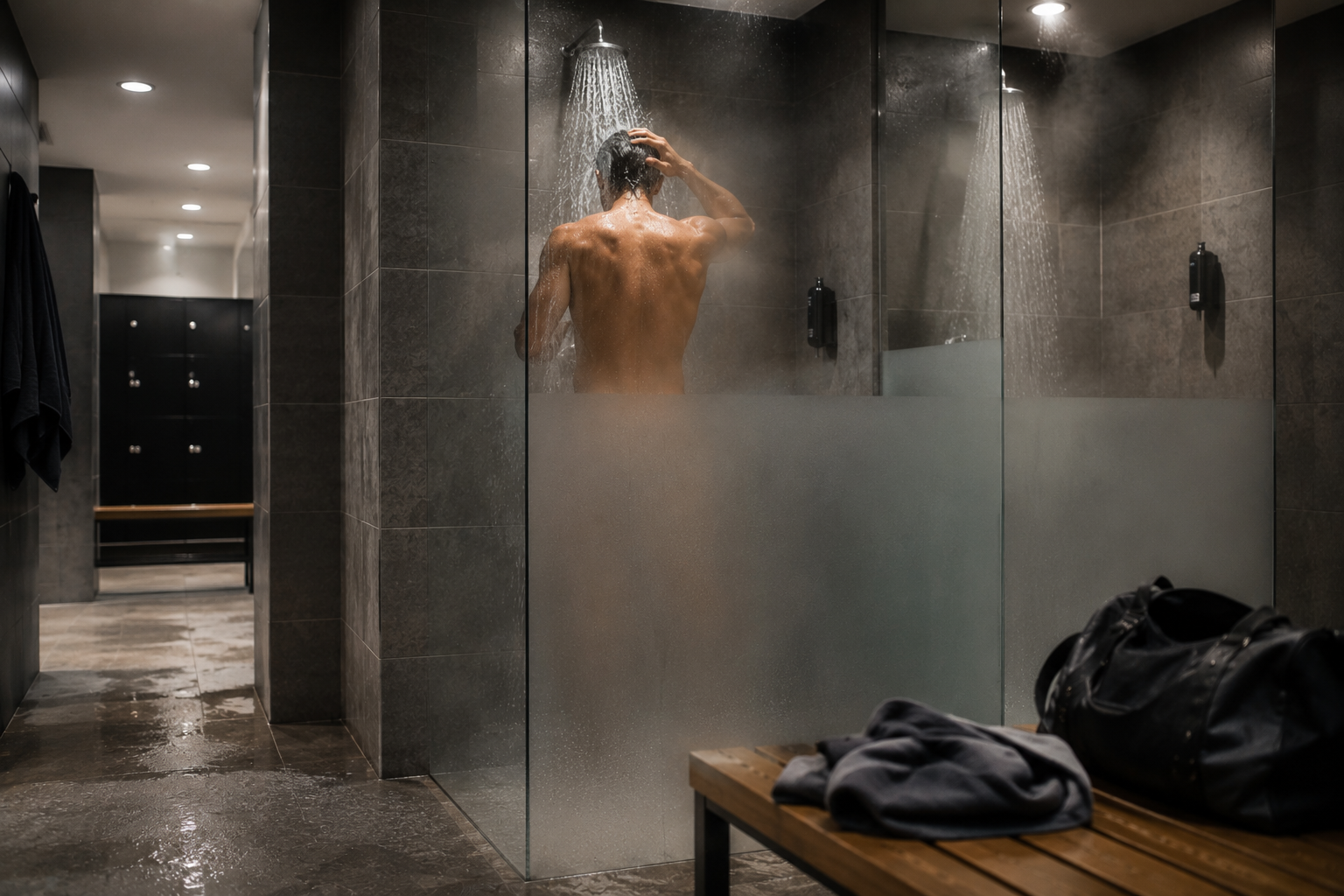
In the changing room of a gym in Munich, an American performs a small, familiar ballet. Towel clamped around the waist, he wrestles his underwear off underneath it, pivots to face his locker, and shimmies into fresh clothes without ever letting the towel drop, all while contriving never to be seen. Around him, the German men are simply getting changed, unhurried and unbothered, the way you might change a shirt in your own bedroom. He is the only one dancing.
This is the towel dance, the elaborate American ritual of getting changed in a locker room while revealing as little as humanly possible, and it is largely an American invention. Across much of Europe, people undress at the gym, the pool, and the spa with a casual matter-of-factness that startles Americans used to a whole choreography of concealment. The gap is not really about bodies at all. It is about what a body in a changing room is taken to mean, and the two cultures answer that question very differently.
The Towel Dance, Explained

For anyone who has not consciously noticed it, the towel dance deserves description, because it is so ingrained in American locker-room life that its performers rarely realise they are doing anything unusual. It is the set of manoeuvres by which an American changes clothes in a shared space while exposing as little skin as possible.
The moves are well practised. The towel is wrapped and gripped at the waist the moment the shower ends. Underwear comes off and goes on beneath it, in a blind, two-handed operation that would impress a stage magician. The body is angled toward the locker or the wall, away from the room. Some practitioners manage entire changes without the towel ever fully leaving them, treating any glimpse of themselves as a small failure. American gyms and pools support all this with an architecture of privacy: individual changing stalls, curtained cubicles, and partitions, so that the dance often does not even have to happen in the open.
The striking thing is how invisible this is to the people doing it. To an American, the towel dance is not a quirky ritual but simply the correct and only way to behave, the obvious respectful default. It is performed automatically, learned in school locker rooms and never questioned. Which is exactly why it is so disorienting to arrive in a place where nobody else is doing it, and where the effort you are putting into concealment suddenly stands out far more than your body ever would.
How Europeans Actually Change
Step into a same-sex changing room at a gym or pool in Germany, the Netherlands, or the Nordic countries, and the contrast is immediate. People simply undress. They take off their clothes, stand there, dry off, and put on new ones, openly and efficiently, without any of the concealment choreography an American takes for granted.
The towel, tellingly, is used for its literal purpose: drying the body. It is not deployed as a mobile privacy screen, held desperately in place through a costume change. When a European finishes a shower, they towel off in the open and get dressed, treating the whole sequence as the simple practical task it is. There is no angling toward the wall, no blind manoeuvring, no evident wish to be anywhere else. The changing gets done and everyone moves on with their day.
What makes this possible is not exhibitionism, which is a common American misreading, but the opposite: a complete lack of charge around the situation. Nobody is displaying anything, because nobody experiences a changing room as a place of display. It is a utilitarian space for a utilitarian act, and it is treated with about as much drama as tying one’s shoes. The efficiency is the point. Freed from the need to hide, a European changes in a fraction of the time and with none of the low-level stress that the towel dance quietly imposes.
Bodies Are Just Bodies
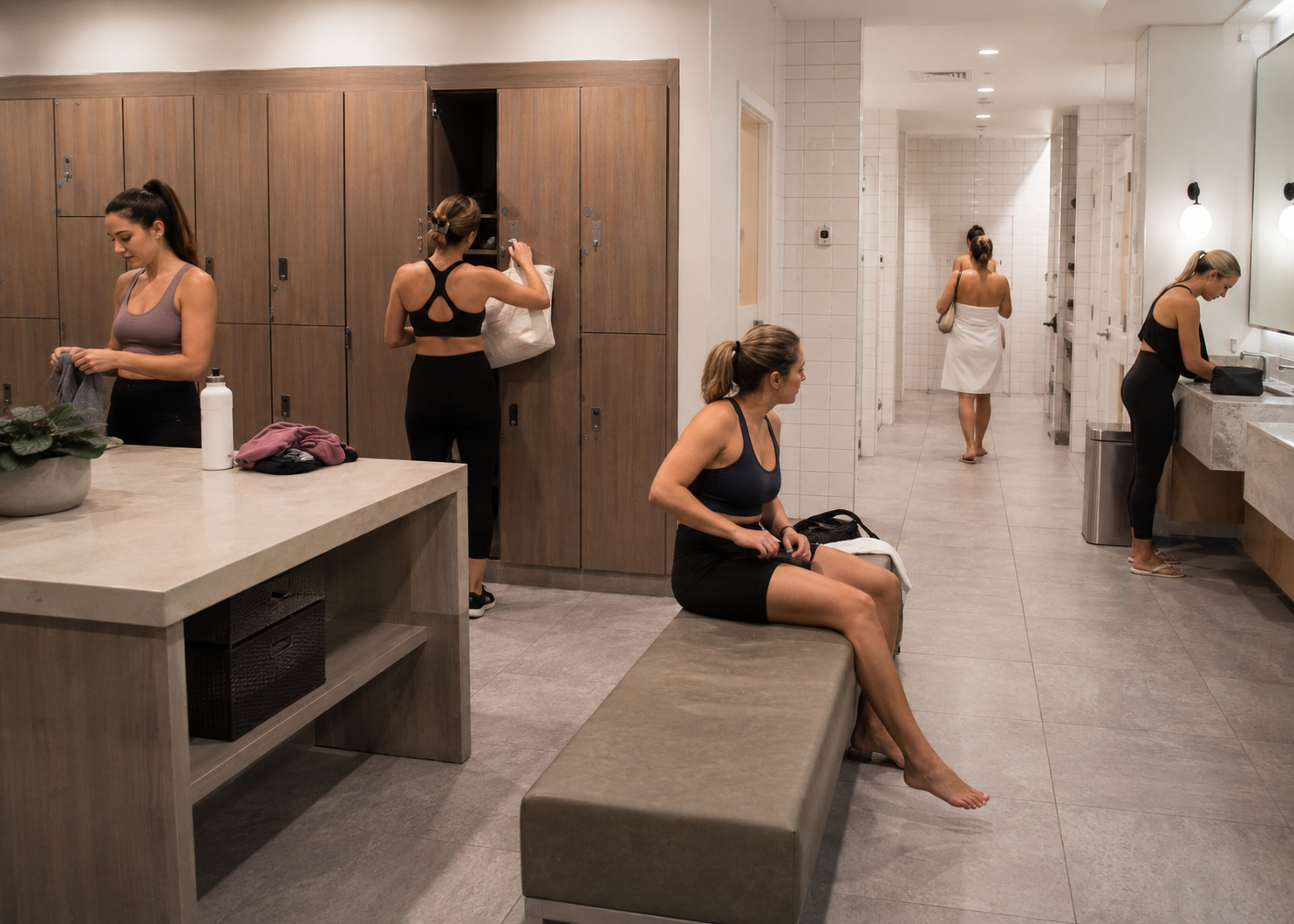
Underneath the behavioural difference sits a difference in meaning, and this is the real heart of it. The reason Europeans can change so casually is that, in this context, they do not read nudity as significant. A body in a same-sex changing room is simply a body, carrying no particular charge of embarrassment or sexuality.
This is the crucial insight that Americans often miss: the difference between the two cultures is not about exposure but about interpretation. American culture tends to assume that nudity must mean something, that it is inherently sexual, or vulnerable, or shameful, and so it must be carefully managed. Much of Europe assumes the reverse, that nudity in an ordinary practical setting means essentially nothing, unless the context specifically makes it otherwise. A person changing after a swim is not being sexual or brave or exposed; they are just a person changing after a swim.
Once you grasp that, the casualness stops looking like boldness and starts looking like simple realism. If a body in a changing room genuinely means nothing, then there is nothing to hide from and nothing to perform, and the towel dance reveals itself as a solution to a problem that, in this setting, does not exist. The European is not braver than the American; they have simply been spared the belief that made the dance necessary in the first place. They never learned to see the changing room as loaded, so they never learned to tiptoe through it.
Where the American Hang-Up Comes From
If casual changing is the more relaxed way to live, where did the American towel dance come from? The answer lies in a particular cultural inheritance, one that shaped how the United States came to think about the unclothed body. It is not a universal human instinct; it is a specific history.
The usual explanation traces American attitudes to nudity back to the country’s Puritan and broader Victorian roots, a religious and cultural heritage that treated the body as something to be covered and associated its exposure with sin, sex, or shame. That inheritance ran deep, and it hardened further through the twentieth century, as public life became more privatised and the body more firmly coded as something to conceal from strangers. The result is a culture in which even same-sex nudity, among people of the same age in a locker room, can feel fraught, and in which a great deal of architecture and behaviour exists to prevent it.
This history is why the American reaction is so strong and so automatic. The discomfort is not a considered position but a deeply trained reflex, absorbed young and rarely examined. It is worth naming plainly, because seeing that the towel dance is a cultural artefact, and a fairly local one, rather than basic decency, is the first step to understanding why the rest of the world does not share it. Other places inherited other attitudes, and those attitudes produced other, more relaxed norms. The dance is learned, which means it is not inevitable.
The Sauna Makes It Sharper

Nowhere is the contrast starker than in the sauna, where the European relationship with the body reaches its clearest expression, and where the practical logic behind it becomes explicit. In much of Northern and Central Europe, particularly Germany, Finland, and the Nordic countries, saunas are traditionally taken nude.
There is real reasoning here beyond mere comfort with the body. In the traditional sauna cultures, wearing a swimsuit is considered actively unhygienic, because synthetic fabric traps sweat, bacteria, and pool chemicals against the skin in the heat, and because a soggy suit interferes with the sweating and cooling the sauna is meant to produce. The etiquette that goes with nude sauna use is scrupulous about hygiene in its own way: in Germany you will see the principle summed up as Kein Schweiss aufs Holz, no sweat on the wood, meaning you must always sit on a towel so that your skin never touches the bench directly. The towel, once again, is a tool of cleanliness, not concealment.
This is not uniform across the continent, and the variation is worth knowing. The nude-sauna tradition is strongest in the German-speaking and Nordic regions; France, by contrast, is more private about nudity and generally expects swimwear, and other countries fall at different points on the spectrum. The safe approach for a visitor is to read the signs and watch what locals do, since a given sauna may be textile-free, swimsuit-required, or offer different hours for each. But in its heartlands, the nude, towel-on-the-bench sauna is the clearest possible statement of the European view: the body is unremarkable, and the rules that matter are about hygiene, not modesty.
What It Does to Body Comfort
Beyond the practicalities, there is a genuine argument that the casual approach produces something valuable, a healthier everyday relationship with one’s own body. When nudity in ordinary settings is unremarkable, people tend to grow up with less shame about how they look and more acceptance of the plain fact of having a body.
The logic is straightforward. In a culture where the unclothed body is seen matter-of-factly, in changing rooms and saunas, a person is regularly reminded that real bodies come in every shape, age, and size, and that none of it is a spectacle. That familiarity tends to breed ease rather than anxiety. By contrast, a culture that hides the body away can leave people with the sense that their own is uniquely flawed, since the only unclothed bodies they ever see are idealised ones on screens. The everyday, unglamorous reality of the changing room is, in its way, a corrective to that.
This does not mean the European approach is simply superior or that everyone must adopt it, and comfort levels are genuinely personal. But it does suggest that some of the American discomfort is self-inflicted, a cost of the very concealment meant to protect against it. The towel dance buys privacy at the price of a low, persistent self-consciousness, a sense that the body is something to be anxiously managed. The European ease offers a different bargain: a little less privacy, perhaps, in exchange for a lot less shame. Which is the better deal is a matter of what you are used to, but it is at least worth noticing that there is a trade being made.
It Is Not Only the Gym

The casual attitude on display in the changing room is not confined to it; it runs through a whole range of European settings, and recognising the pattern helps make sense of any one instance of it. The gym locker room is simply where a visitor tends to meet it first.
The same neutrality appears at the thermal spa, where adults move between pools and saunas in various states of undress without remark, and on many European beaches, where toplessness among women has long been an unremarkable option rather than a statement. It shows up in the shared changing areas of pools and the open showers of sports centres. In each case the underlying attitude is identical to the one in the locker room: the unclothed adult body, in a setting built for it, is treated as ordinary rather than charged, and the elaborate management an American expects simply is not there.
Seeing the pattern matters because it means the changing-room ease is not an isolated quirk to be puzzled over but one expression of a broad cultural stance. Once you understand that much of Europe genuinely regards the body in these contexts as unremarkable, every specific instance, the open changing, the nude sauna, the relaxed spa, stops being individually surprising. They are all the same idea, applied consistently across the places where bodies and water and heat happen to meet.
For the American Visitor

So what should an American actually do in a European gym or spa? The reassuring answer is that there is no obligation to abandon your own comfort level, and nobody will force a change of habit on you. If you want to keep doing the towel dance in a European changing room, you can, and the worst that will happen is that you may feel, and slightly look, like the only person working so hard at it.
The more useful move is simply to adjust your expectations and read the setting. In a same-sex changing room, expect the people around you to be casually undressed and understand that it means nothing; there is no need to be startled or to avert your eyes with any particular urgency. In a sauna or spa, look for signage and follow the local norm, whether that is nude with a seat towel or swimwear-required, since it varies by country and by venue. When in doubt, quietly watching what regulars do resolves almost any uncertainty within a minute. The one genuine misstep to avoid is wearing a sweaty swimsuit or, worse, workout clothes into a traditional nude sauna, which does read as a real breach.
Most of all, it helps to arrive without the assumption that undress must be freighted with meaning. The Europeans around you are not making a statement, testing you, or behaving provocatively; they are getting changed. Meeting their matter-of-factness with your own, even if you keep more covered than they do, is the whole of the etiquette. You do not have to join the ease to respect it, and understanding that it is ease, rather than boldness, is most of what a visitor needs.
The Dance Was Never Required
In the end, the towel dance turns out to be a cultural costume, not a law of nature. Americans perform it because they inherited a particular anxiety about the body, and much of the rest of the world does not perform it because they did not. Neither approach is simply right, but it is clarifying to see that the dance is a choice, however unconscious, rather than plain necessity.
For the traveller, the value is in the perspective. Watching a room full of people change without a flicker of the self-consciousness you were raised to feel is a small, useful jolt, a reminder that some of what feels like basic decency is really just local custom. You may prefer your own way, and that is entirely fine. But you can no longer quite believe it is the only way, and that loosening is itself a kind of gift that travel gives.
So the next time you find yourself alone in the towel dance while a European changing room carries on unbothered around you, consider dropping at least a little of the choreography. Nobody is watching, nobody cares, and the ease on offer is real. The body was never the problem; only the belief that it was. Set that belief down, even briefly, and getting changed becomes what it always could have been: the simplest thing in the world.

About the Author: Ruben, co-founder of Gamintraveler.com since 2014, is a seasoned traveler from Spain who has explored over 100 countries since 2009. Known for his extensive travel adventures across South America, Europe, the US, Australia, New Zealand, Asia, and Africa, Ruben combines his passion for adventurous yet sustainable living with his love for cycling, highlighted by his remarkable 5-month bicycle journey from Spain to Norway. He currently resides in Spain, where he continues sharing his travel experiences with his partner, Rachel, and their son, Han.