
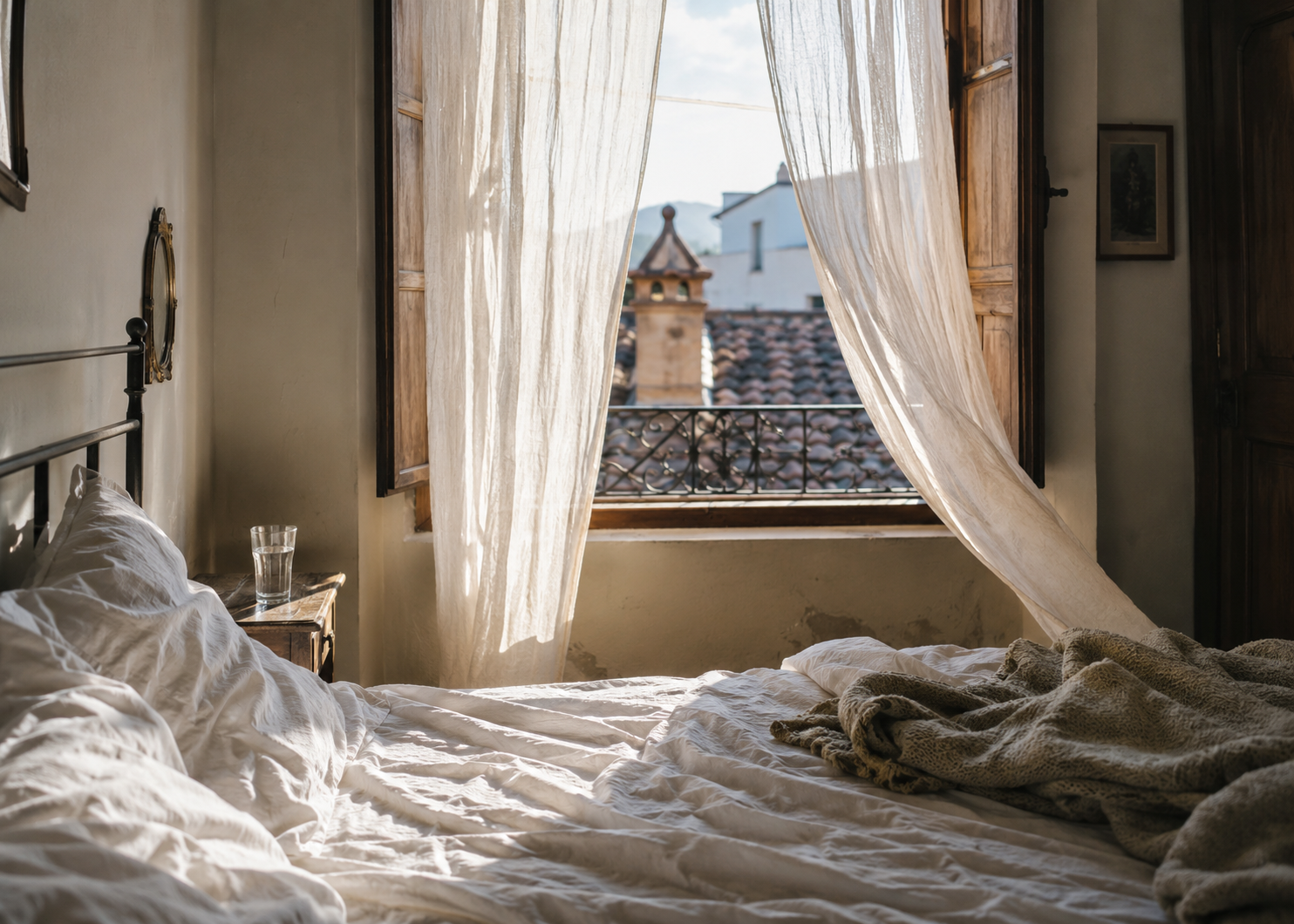
The American sleep economy is now worth tens of billions of dollars a year, and it shows. There are smart mattresses that cost as much as a used car, rings and watches that score your sleep each morning, weighted blankets, cooling pads, white-noise machines, mouth tape, blackout everything, melatonin gummies, magnesium powders, and a whole tier of clinics and apps promising to optimize the hours you spend unconscious. Americans are spending more on sleep than ever, and sleeping, by most measures, worse than ever.
Meanwhile, plenty of Italians sleep perfectly well without owning a single one of those things. They are not tracking their REM cycles or taping their mouths or spending a fortune on a bed that talks to an app. They just sleep, and a good deal of why comes down to ordinary daily habits that cost nothing at all.
We slept worse in the old life, with more gadgets and more worry about it, than we do now with none. Nothing was bought to fix it. The days simply changed shape, more daylight, more walking, slower evenings, and the sleep quietly followed.
Before going further, one honest caveat belongs right at the top, because this is health and the stakes are real. Some sleep problems are genuine medical conditions, and no lifestyle habit fixes them.
The Caveat That Has To Come First
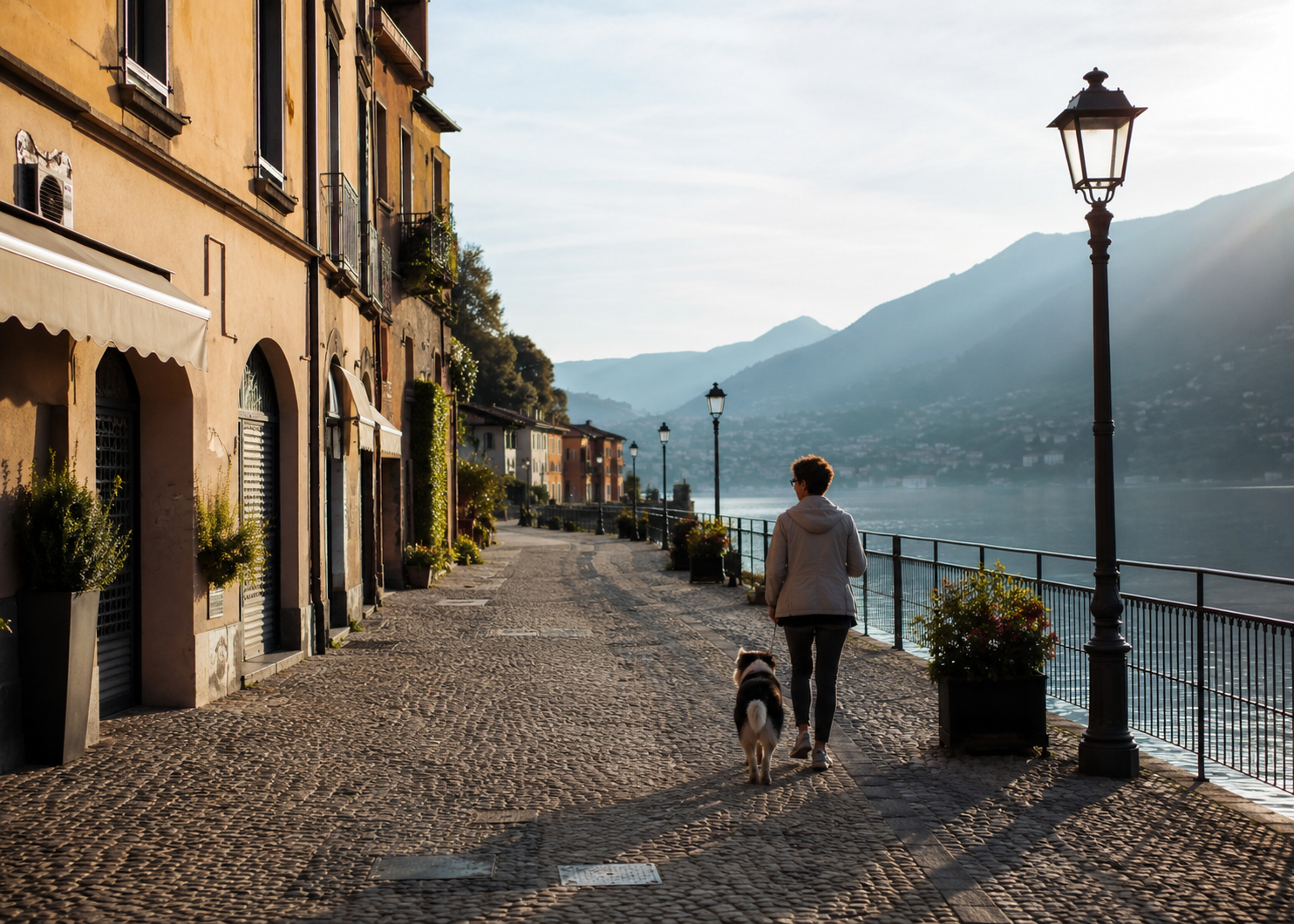
This piece is about ordinary poor sleep, the restless, wired, can’t-wind-down sleep that so many people fall into, and the free habits that genuinely help with it. It is not about clinical sleep disorders, and the difference matters enormously.
Conditions like obstructive sleep apnea, chronic insomnia, and restless legs are real medical problems that require real medical treatment. A walk after dinner does not fix sleep apnea, and no amount of good habits replaces a proper diagnosis when something is genuinely wrong. Sleep experts are blunt about this: the expensive mattress and the lifestyle tweak are both, in their words, just band-aids if you actually have apnea. If you snore heavily, stop breathing in the night, are exhausted no matter how long you sleep, or have struggled for months, that is a reason to see a doctor, not to read a lifestyle article.
With that firmly established, most everyday bad sleep is not a clinical disorder. It is the predictable result of a daily life that works against sleep, and that is exactly the part the free Italian habits address. So the rest of this is about ordinary sleep, honestly, with the serious stuff pointed toward the professionals who handle it.
What Italians Do Without Thinking About It
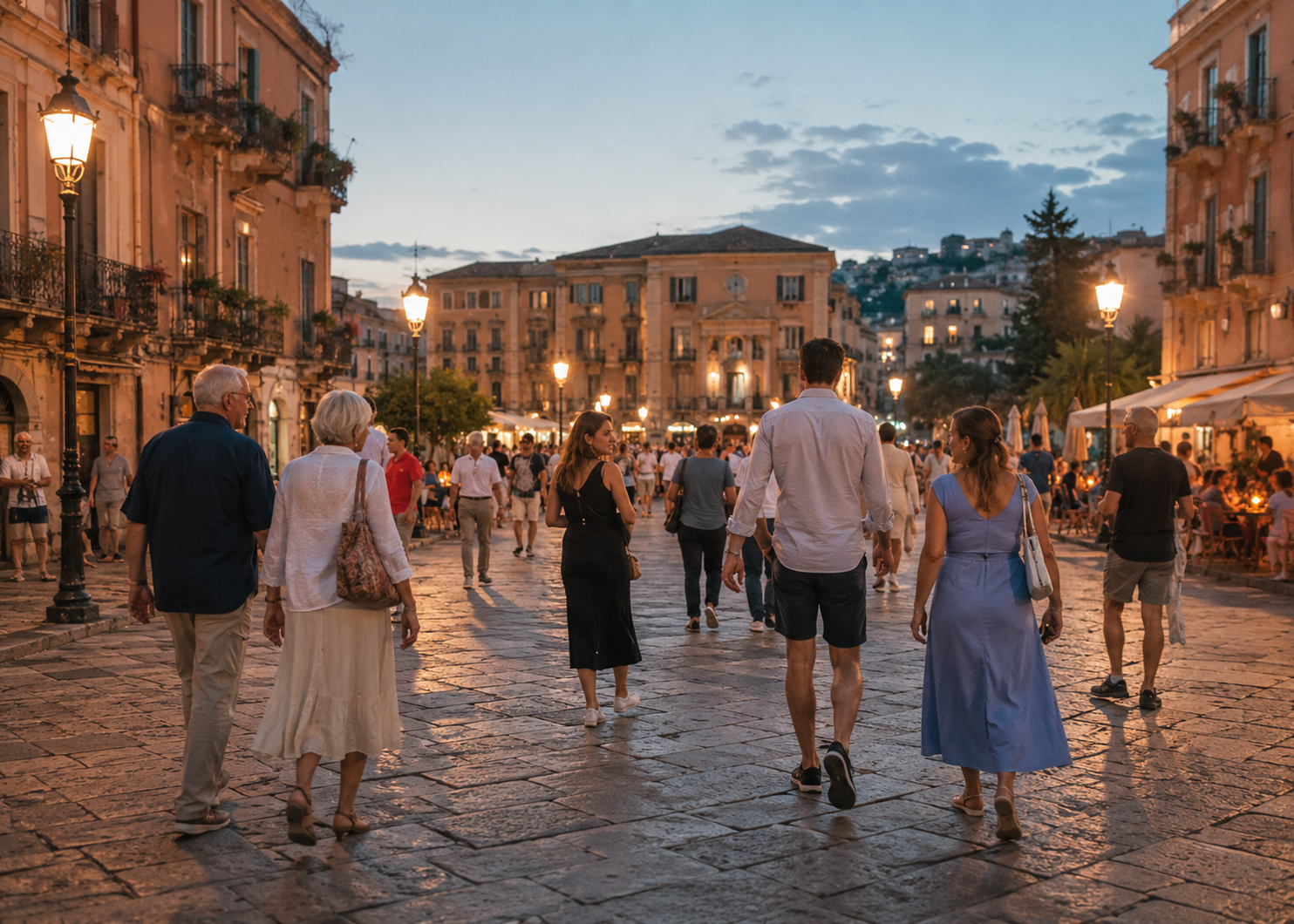
The Italian advantage is not a technique or a product. It is a set of ordinary daily habits that happen to align almost perfectly with what actually helps people sleep, none of which anyone in Italy thinks of as sleep hygiene.
They walk, every day, often after meals, getting both physical movement and exposure to natural daylight. They spend real time outdoors in the sun, which is the single most powerful signal the body uses to set its internal clock. They eat dinner as a slow, social occasion rather than a rushed refuel in front of a screen. They keep a fairly regular daily rhythm built around mealtimes. And they spend their evenings with people, talking, walking, decompressing, rather than alone and wired in front of a glowing device.
Every one of those is, by accident, a textbook sleep-supporting habit. The Italians are doing almost everything a sleep clinic would tell an ordinary poor sleeper to do, and they are doing it for free, without ever framing it as being about sleep. The good sleep is downstream of a day that was, without trying, structured in a way the body responds to.
Daylight Is The Free Miracle
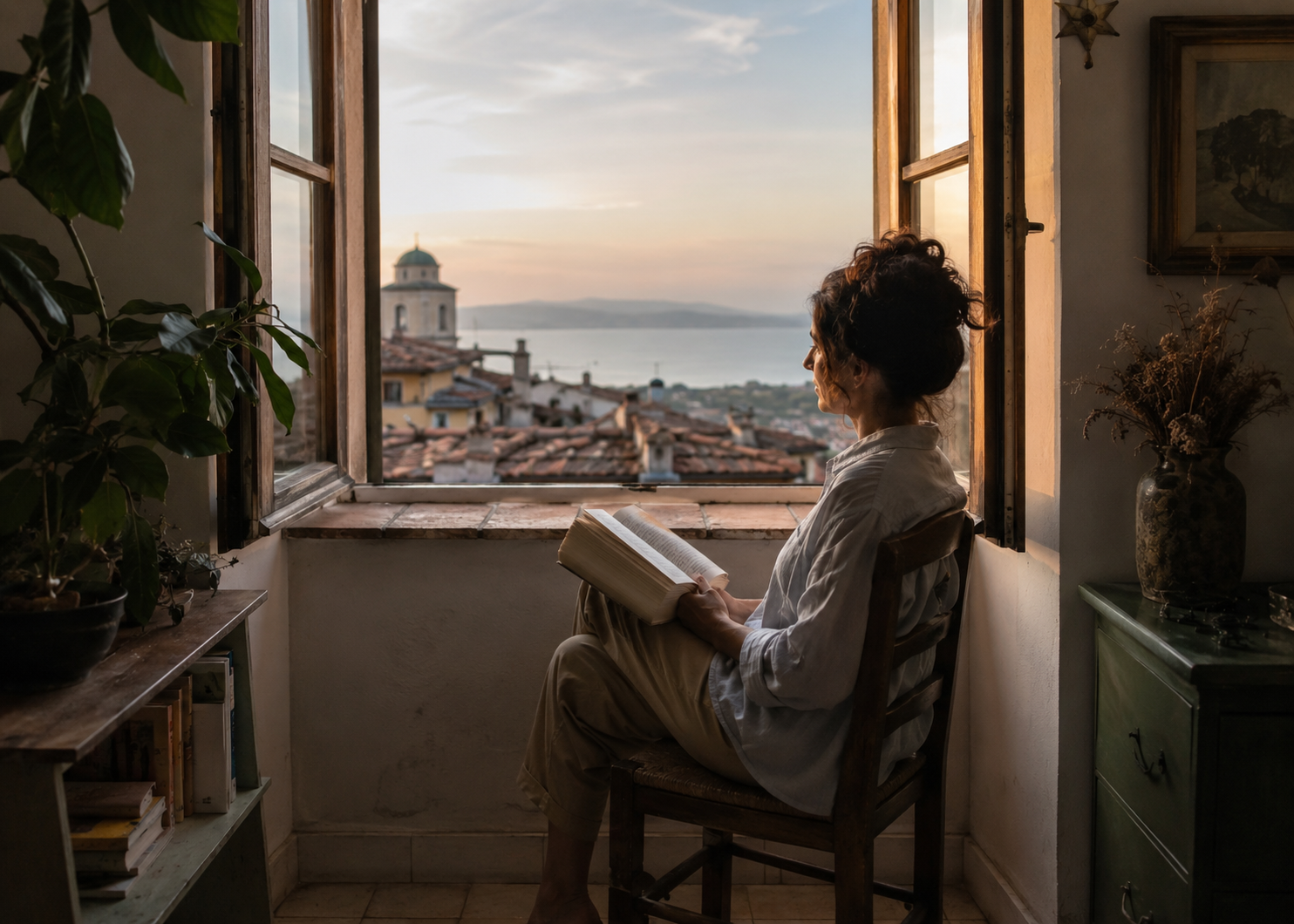
If there is one free thing that does the most work, it is light, and it is the one modern American life most thoroughly removes.
The human sleep cycle is governed by the body’s internal clock, and that clock is set, more than by anything else, by exposure to bright natural light during the day and darkness at night. Get strong daylight in the morning and through the day, and the body knows when night is coming and produces the sleep signals on schedule. Daytime light is not a mood thing. It is the master switch for the entire sleep system, and it is completely free.
The Italian who walks to the shops, sits outside for coffee, eats lunch by a window, and strolls in the evening is bathing in exactly the light signals the body needs, all day, without trying. The American who drives from a dim house to a fluorescent office to a dim house, then stares at a bright phone in bed at midnight, has scrambled the signal at both ends, too little light by day and too much by night. No mattress fixes that. The cheapest, most powerful sleep intervention in existence is getting outside during the day, and it is the one the sleep economy cannot really sell you.
The Body Wants A Rhythm, Not A Gadget
The second free thing is regularity, and it is just as undervalued. The body sleeps best when it runs on a predictable schedule, and Italian daily life is full of predictable rhythm.
Mealtimes are fairly fixed. The structure of the day is consistent. The evening has a recognizable shape, the walk, the dinner, the wind-down, that repeats night after night. That regularity quietly trains the body to expect sleep at a consistent time, which is one of the most effective things anyone can do for their sleep and which costs absolutely nothing.
The American pattern, by contrast, is often chaotic, irregular hours, meals at random times, screens late into the night, weekends that wreck the schedule. The body never learns when sleep is coming, so it never prepares for it properly. A gadget that scores your erratic sleep does nothing to make it regular, which is why the tracker so often becomes a source of anxiety rather than a solution. The fix the body actually wants is rhythm, and rhythm is free.
Stress Is The Hidden Sleep Killer
There is a quieter free factor underneath all the others, and it may be the most important of all. A body that is stressed does not sleep well, and the two cultures run at very different baseline levels of stress.
Sleep requires the nervous system to stand down, to shift out of alert mode and let go. Chronic stress keeps it switched on, flooding the body with the very signals that are supposed to fall away at night, which is why anxious, overworked, financially squeezed people so often lie awake exactly when they most need rest. You cannot will your way to sleep with an activated nervous system, and no gadget calms one down.
The Italian advantage here is structural and free. The social connection, the unhurried meals, the strong family bonds, the time spent with people rather than alone, all of it lowers the baseline level of stress the body carries into the night. A life with more connection and less grind arrives at bedtime calmer, and a calmer body sleeps. The American pattern of isolation, overwork, and constant low-grade financial fear does the opposite, delivering a wired nervous system to the pillow every night. The sleeplessness is often just the day’s stress refusing to switch off.
Why The Gadgets Mostly Disappoint
It is worth understanding why all that expensive sleep technology so often fails to deliver, because the reason is instructive.
Most sleep gadgets measure or tweak the surface of sleep without touching what actually causes bad sleep. A ring that tells you that you slept badly is not news at seven in the morning, and it does nothing about the cause. A cooling mattress helps at the margins but cannot overcome a day spent indoors and an evening spent on a screen. The products treat sleep as a technical problem to optimize, when ordinary bad sleep is usually a lifestyle problem to fix. There is a telling pattern in the stories of people who spend a thousand dollars chasing better sleep through gadgets and then find that what finally worked was the free, boring stuff: getting outside, keeping a schedule, putting the phone down.
This is not to say no product ever helps. Blackout curtains are genuinely useful, and a comfortable bed matters. But the expensive end of the sleep economy is largely selling optimization to people whose actual problem is a depleted daily routine, and you cannot buy your way out of that. The gadget is downstream of the same misunderstanding as the rest of the wellness industry, the belief that a purchased solution can substitute for a missing habit.
The Evening Is Where It Goes Wrong
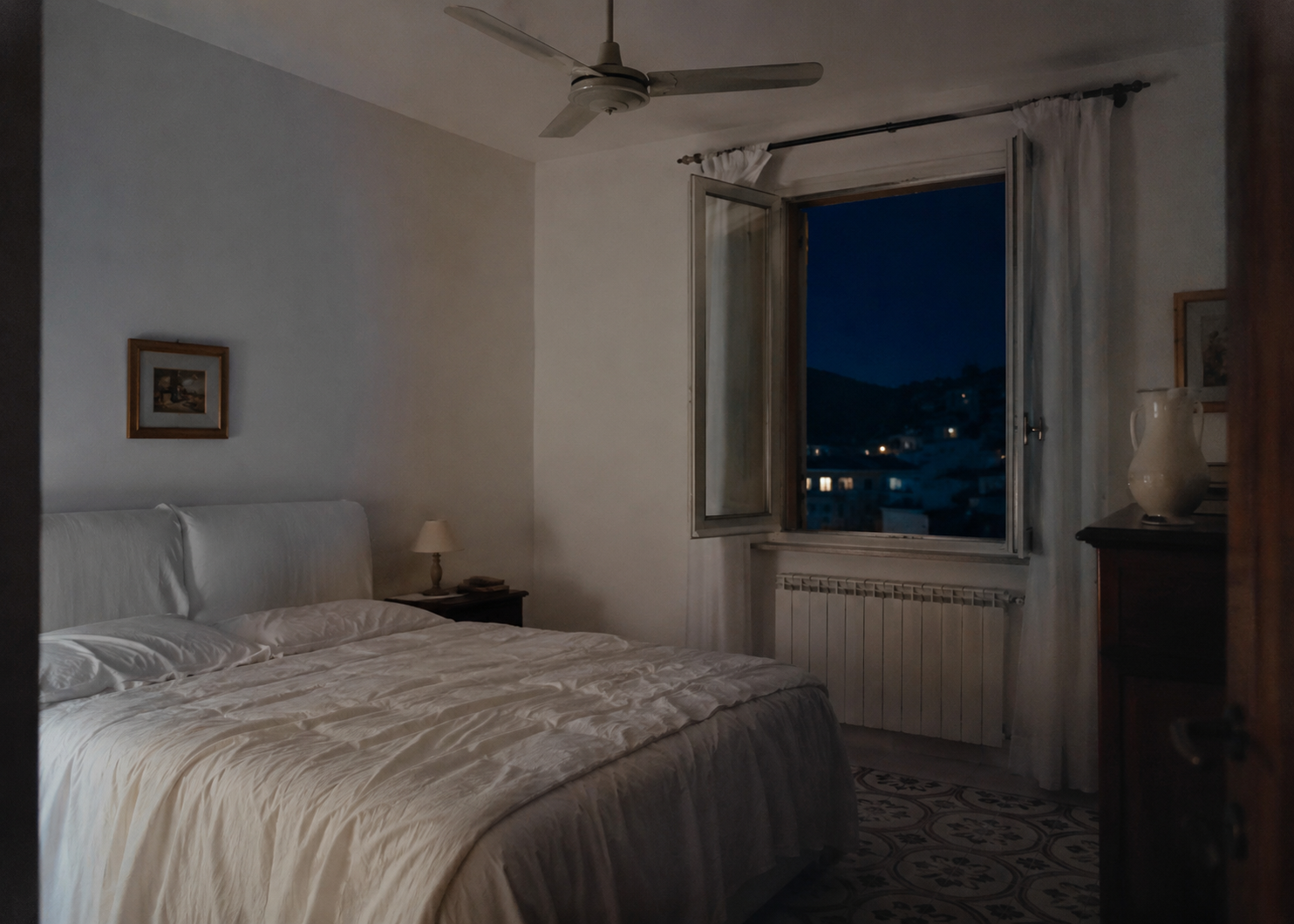
The American evening, specifically, is almost engineered to wreck sleep, and the Italian evening, almost by accident, is built to support it.
A common American night involves bright indoor light, a large late meal or late snacking, hours of stimulating screens, work bleeding into the bedroom, and a mind that never got a chance to wind down. Every one of those fights the body’s transition into sleep. The Italian evening, with its walk, its social meal, its slower pace and earlier disconnection from work, eases the body toward sleep instead of jolting it awake at the last minute.
The single worst modern habit is the bright screen in the dark bedroom, which tells the brain it is still daytime exactly when it should be preparing for sleep. Putting the phone down an hour before bed is free, and it outperforms most things you can buy. The Italian winding down with conversation rather than a glowing screen is, without meaning to, doing the most important thing of all, giving the brain the darkness and the calm it needs to let go of the day.
Italy Is Not Immune Either
Honesty requires a qualification, because it would be wrong to paint every Italian as a flawless sleeper in a country that has solved this. It has not.
Modern Italy has smartphones, late nights, work stress, and insomnia like everywhere else, and the traditional rhythms that support good sleep are fraying there too, especially in the cities and among the young. Plenty of Italians sleep badly, and the country has its own growing market for sleep aids. The point is not that Italians are a different species of sleeper. It is that the traditional Italian pattern, the daylight, the walking, the social meals, the calmer evenings, happens to be good for sleep, and that pattern still survives more intact there than in much of American life.
So this is a story about a way of living, not about a nationality. An American who adopts those habits will sleep better, and an Italian who abandons them will sleep worse, because the habits are what matter, not the passport. The traditional Italian day is simply a convenient, real-world example of what a sleep-friendly life looks like, which is why it is worth copying even if you never go near Italy.
What Actually Travels
You do not need to move to Italy, and most of the free habits port over fine, even into a busy modern life. The trick is to copy the daily structure, not the country.
Get outside in daylight, especially in the morning, every day. Move your body, ideally a walk, ideally after meals. Keep your sleep and meal times reasonably regular, even on weekends. Make the evening slower, with a real wind-down, and get the bright screens out of the last hour before bed. Eat dinner earlier and lighter when you can, and treat it as a stop rather than something done on the move. None of that costs anything, and together it addresses the actual causes of ordinary bad sleep far more effectively than any device.
The honest promise here is modest and real. These free habits will not cure a medical disorder, but they will meaningfully improve the ordinary restless sleep most people are actually dealing with, and they will do it for nothing. That is the whole offer, and it is a genuinely good one.
What Italians Are Really Doing
So what Italians do for free that Americans pay a sleep clinic for is, in the end, just living in a way the body was built to sleep well inside of. Daylight, movement, rhythm, a calm evening, real food at sensible times, and a wind-down that does not involve a screen, none of it bought, all of it effective.
The sleep economy exists because modern life stripped those things out and people went looking for replacements they could purchase. But for ordinary poor sleep, the replacements mostly do not work as well as the originals, which were free all along. The Italians did not crack a code or buy a secret. They simply kept a daily life that happens to produce good sleep as a side effect, and the rest of us, having lost that life, are paying a fortune trying to get its results back one gadget at a time. For genuine sleep disorders, see a doctor. For the ordinary kind, the cure was never for sale.

About the Author: Ruben, co-founder of Gamintraveler.com since 2014, is a seasoned traveler from Spain who has explored over 100 countries since 2009. Known for his extensive travel adventures across South America, Europe, the US, Australia, New Zealand, Asia, and Africa, Ruben combines his passion for adventurous yet sustainable living with his love for cycling, highlighted by his remarkable 5-month bicycle journey from Spain to Norway. He currently resides in Spain, where he continues sharing his travel experiences with his partner, Rachel, and their son, Han.