
After enough years and enough countries, the patterns start to separate from the noise, and one of the clearest is how differently the world handles the simple human problem of growing old and stopping work. Most of the developed world treats retirement as something a society provides, a pension you have earned by being a member of it, a floor below which the state does not let its elderly fall. America treats it as something an individual accumulates, a personal project of saving and investing against a future you are largely responsible for funding yourself. The difference sounds technical. Lived, on the ground, in the faces of old people in a dozen countries, it is enormous.
This is not a claim that the American way is simply wrong, since it has real strengths, the freedom, the upside, the ownership. It is an observation, drawn from seeing old age in many places, that America stands genuinely apart among wealthy nations in how much of the burden of retirement it places on the individual, and that the consequences of that choice are visible in ways Americans, having known only their own system, often cannot see until they stand outside it. Here is what the difference actually is, and what it does to the experience of growing old.
The Two Models, Plainly Stated

Start with the basic architecture, because the difference is structural before it is anything else.
Most wealthy countries run retirement primarily on a strong public pension, a state system funded through taxes and contributions across a working life that then pays a meaningful income in old age, enough in many countries to actually live on, so that the baseline expectation is that the state provides a real retirement income to those who spent their lives contributing. Private savings exist and supplement this, but the public pension is the foundation, the thing that catches everyone, and the result is that growing old in much of Europe means receiving a pension substantial enough to live with dignity regardless of how much you personally saved. The society has decided that a funded old age is a collective responsibility, discharged through the state.
America runs the opposite architecture. Its public pension, Social Security, is real but deliberately modest, designed as a partial floor rather than a full retirement income, explicitly intended to be supplemented by private savings, the 401k, the IRA, the personal investment accounts that Americans are expected to build themselves over a working life. The expectation is that you fund the bulk of your own retirement through decades of personal saving and investing, with Social Security as a base too thin to live well on alone, so that the quality of your old age depends heavily on how successfully you personally accumulated. The society has decided that a funded old age is largely an individual responsibility, discharged through private savings.
What The American Model Does Well
Fairness requires stating the American model’s genuine strengths, because they are real and they are why the system exists.
The American approach offers ownership and upside that the pension model does not. The money in a 401k or an IRA is yours, it is invested in markets that over long periods have grown substantially, and a disciplined, fortunate American saver can accumulate far more wealth than any state pension would provide, retiring wealthy rather than merely provided for. The system rewards saving, investing, and personal responsibility, gives individuals control over their own retirement assets, and allows the upside of decades of market growth to accrue to the saver, which for the successful is a genuinely better outcome than a flat state pension. There is real freedom in it, the freedom to build and control your own retirement, to leave wealth to your children, to do better than a system would have done for you.
The American model also avoids some of the strains the pension systems face, since a heavily state-funded retirement places enormous and growing demands on public finances as populations age, and several European systems face hard questions about their long-term sustainability that the more individualized American approach sidesteps by putting the burden on individuals rather than the state. So the American model is not simply inferior, it offers ownership, upside, control, and avoids loading the entire cost of an aging society onto the public purse, real advantages that its defenders rightly point to. The question is what it costs, and who bears that cost, which is where the comparison turns.
What It Costs, And Who Pays
The strengths come with a structural cost, and the cost falls on specific people in specific ways.
The American model works beautifully for the disciplined, the fortunate, and the well-paid, the people who could save substantially, whose investments did well, who arrived at retirement with a healthy account, and for them it delivers a richer old age than most pension systems would. But it works badly for everyone else, and everyone else is a large share of people, those who could not save enough on modest wages, whose savings were wiped or dented by a market crash at the wrong moment, who hit a medical catastrophe, who simply did not manage the difficult lifelong project of accumulation, and for them the thin floor of Social Security is what remains, an old age of genuine financial strain. The model concentrates good outcomes among those positioned to succeed at it and leaves the rest exposed in a way the pension systems do not.
The deeper cost is the anxiety and the individualization of risk that the American model imposes on everyone, even the successful. Because your old age depends on your own accumulation and your own investment outcomes, the risk sits on you, the worry about whether you saved enough, whether the market will hold, whether a long life or a health crisis will exhaust your savings, a private anxiety that the citizen of a strong-pension country, whatever its other problems, largely does not carry. The American retiree, even a comfortable one, often lives with a financial anxiety about outliving their money that is structurally absent where the state guarantees a floor for life, and that transfer of risk from the collective to the individual is the real and largely hidden cost of the American way.
What It Looks Like In Old Faces
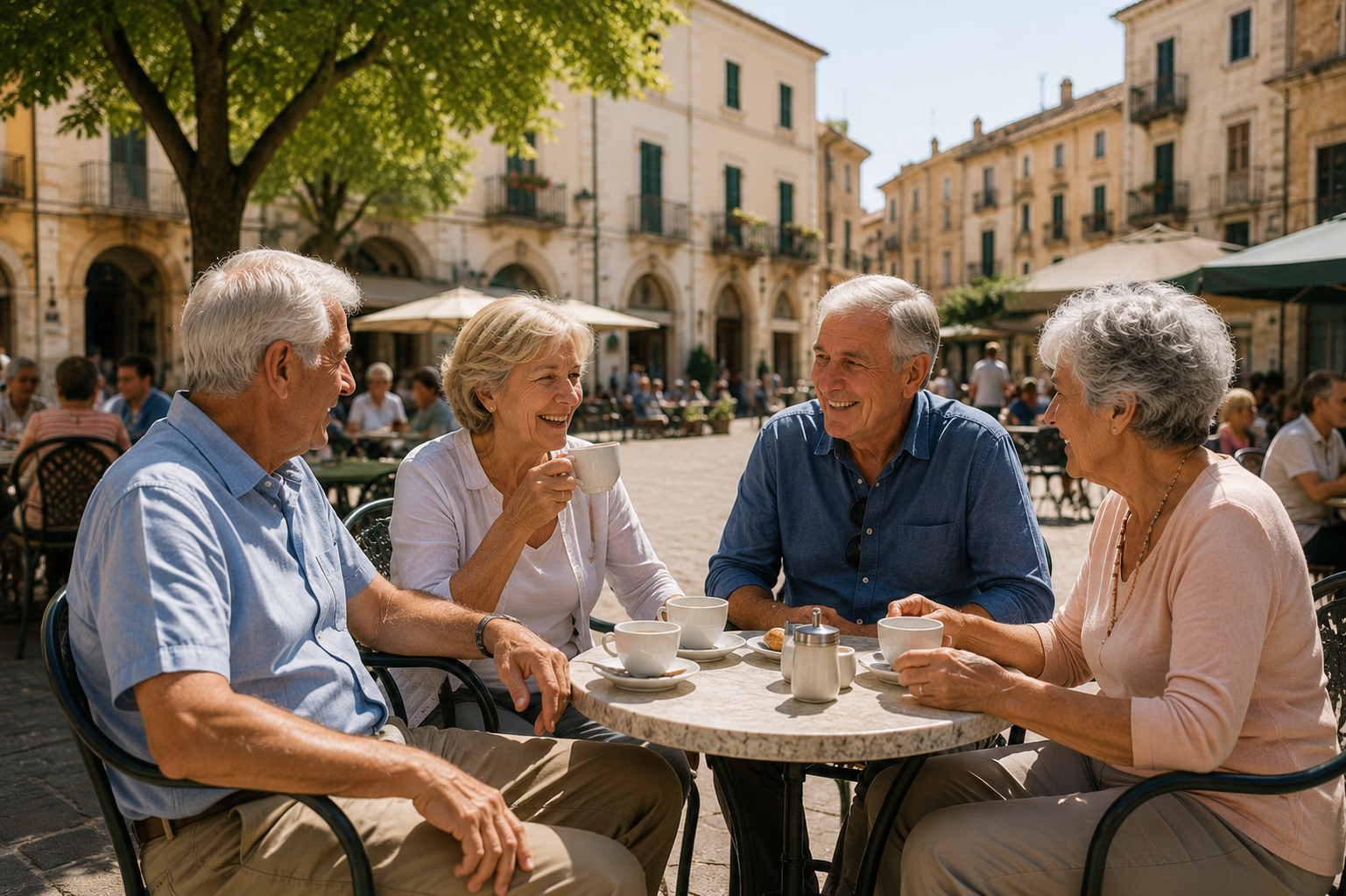
The abstraction becomes concrete in the actual experience of old people, and that is where the difference is most visible to an outsider.
In the strong-pension countries, there is a particular security visible in many old people, a freedom from financial fear about their basic old age, a sense that the pension will come whatever happens and the floor will hold, which shows up as a kind of ease, the old man in the cafe, the old woman in the market, secure in a guaranteed if modest income for life. It is not wealth, the pension is often modest, but it is security, the absence of the specific terror of running out, and that security shapes the texture of old age, allowing a focus on living rather than on the arithmetic of survival. The collective guarantee, whatever its costs to public finances, buys its elderly a freedom from a particular kind of fear.
In America, the picture is more divided, the comfortable retirees genuinely comfortable, often more so than their European counterparts, but alongside them a visible population of old people in financial distress, working into their seventies and beyond not for fulfillment but because they must, anxious about money, exposed by the system’s individualized risk in a way that is rarer where the state guarantees a floor. The American old age is more unequal, better at the top and worse at the bottom, and shot through even at its comfortable middle with the financial anxiety that the individualized model imposes. Standing outside the American system and looking back at it, this is what becomes visible, that America secured a better old age for some of its elderly at the cost of a worse and more anxious one for many others, a tradeoff most Americans cannot see because they have never known the alternative.
Why Americans Cannot See It
There is a reason this difference is invisible from inside America, and understanding it explains why the comparison is worth making.
Americans, having known only their own system, experience its arrangement as simply how retirement works, the natural order of things, rather than as one choice among several that societies make. The lifelong project of personal accumulation, the 401k, the anxiety about saving enough, the individual responsibility for funding old age, all of it feels not like a policy choice but like reality itself, the way growing old necessarily is, because they have no lived alternative against which to see it as a choice. It is only by standing outside, by seeing the old people of countries that chose differently, that the American arrangement becomes visible as an arrangement, a particular and unusual way of handling old age rather than the only way.
This invisibility matters because it shapes what Americans think is possible and what they assume about aging, accepting as inevitable a level of individual financial risk and anxiety in old age that the citizens of other wealthy countries would find strange and unnecessary. The American who discovers, late, that other societies simply guarantee their elderly a livable income for life often experiences a kind of vertigo, the realization that the anxiety they took for an unavoidable part of growing old was in fact a product of a specific choice their society made and others did not. Seeing the alternative does not make the American model wrong, but it does make it visible as a choice, and that visibility is itself valuable, since a choice can be examined and a law of nature cannot.
What This Means For An American Considering Europe
For the American actually thinking about retiring abroad, this structural difference has concrete implications worth drawing out.
The American retiring to Europe does not simply step into the European pension system, since that is built on a lifetime of local contribution they did not make, so they bring their own American retirement, the savings, the Social Security, the accumulated accounts, into a European setting. What changes is not that they suddenly receive a European pension but that they live in a society organized around security rather than individual accumulation, with the lower costs, the universal healthcare, and the social provision that the collective model provides, which can make their American savings stretch far further and remove some of the specific risks, especially the medical-catastrophe risk, that haunt American retirement. The European setting softens the American model’s hardest edges even for someone funding their retirement the American way.
The deeper draw, for many, is exactly the escape from the anxiety, the move to a society where growing old is treated as a collective responsibility rather than an individual gamble, where the healthcare will not bankrupt you and the social fabric assumes and provides for the elderly, and where even an American living on American savings can absorb some of that security by living within it. This is part of what so many Americans are really seeking when they look to Europe for retirement, not just lower costs or better weather but a different and less frightening relationship between old age and money, the security that their own society chose not to provide and that they can partly buy back by retiring into a society that did. Understanding the structural difference is understanding much of why Europe calls to the American retiree at all.
The Healthcare Piece That Changes Everything

One element deserves separating out, because it sits underneath the whole retirement comparison and may be the single largest difference of all.
In most wealthy countries, healthcare is universal and largely detached from personal wealth, so growing old does not carry the risk that a serious illness will consume your savings, because the society covers the care regardless, and this removes from old age one of its largest financial terrors. In America, healthcare even with Medicare leaves real exposure, the gaps, the long-term care that Medicare largely does not cover, the costs that can erode or destroy a lifetime of savings in a single extended illness, so the American retiree carries a medical-financial risk that the European retiree largely does not. This is not a small difference, since healthcare costs are among the largest and most unpredictable an old person faces, and the two models handle them in opposite ways, the collective absorbing them in one, the individual exposed to them in the other.
This healthcare difference compounds the retirement-savings difference, because the American who saved diligently for retirement can still see those savings destroyed by a medical catastrophe that a European system would have absorbed, meaning the American model exposes its elderly to risk twice over, once in the funding of ordinary retirement and again in the funding of health crises. The European model’s universal healthcare is, in a real sense, part of its retirement system, a guarantee that removes the largest single threat to an old person’s financial security, and the American model’s lack of it is part of why American old age carries the anxiety it does. For the American considering Europe, the healthcare security is often the largest single draw, the removal of the medical-bankruptcy fear that shadows American aging, and understanding it is central to understanding the whole comparison.

About the Author: Ruben, co-founder of Gamintraveler.com since 2014, is a seasoned traveler from Spain who has explored over 100 countries since 2009. Known for his extensive travel adventures across South America, Europe, the US, Australia, New Zealand, Asia, and Africa, Ruben combines his passion for adventurous yet sustainable living with his love for cycling, highlighted by his remarkable 5-month bicycle journey from Spain to Norway. He currently resides in Spain, where he continues sharing his travel experiences with his partner, Rachel, and their son, Han.