
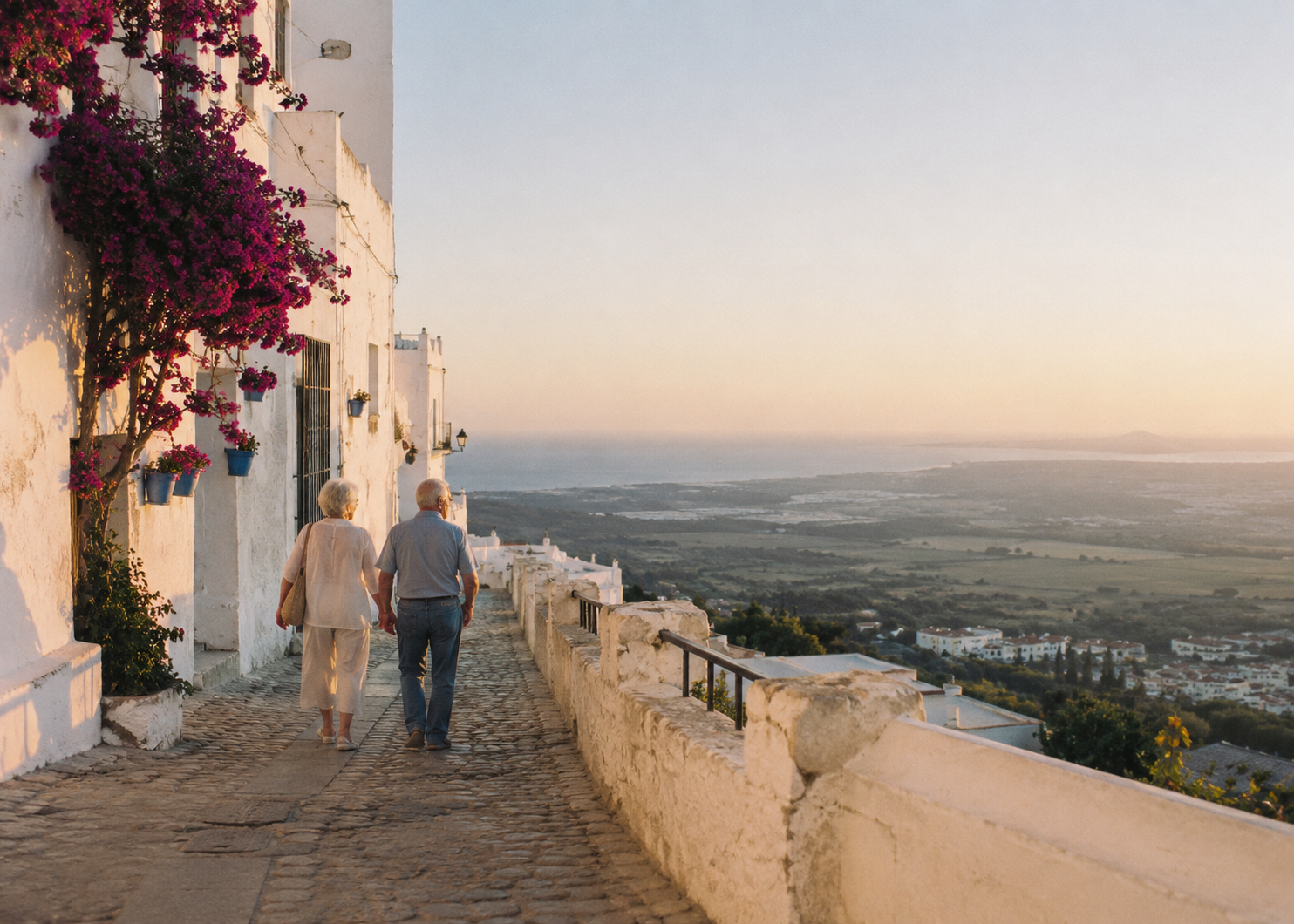
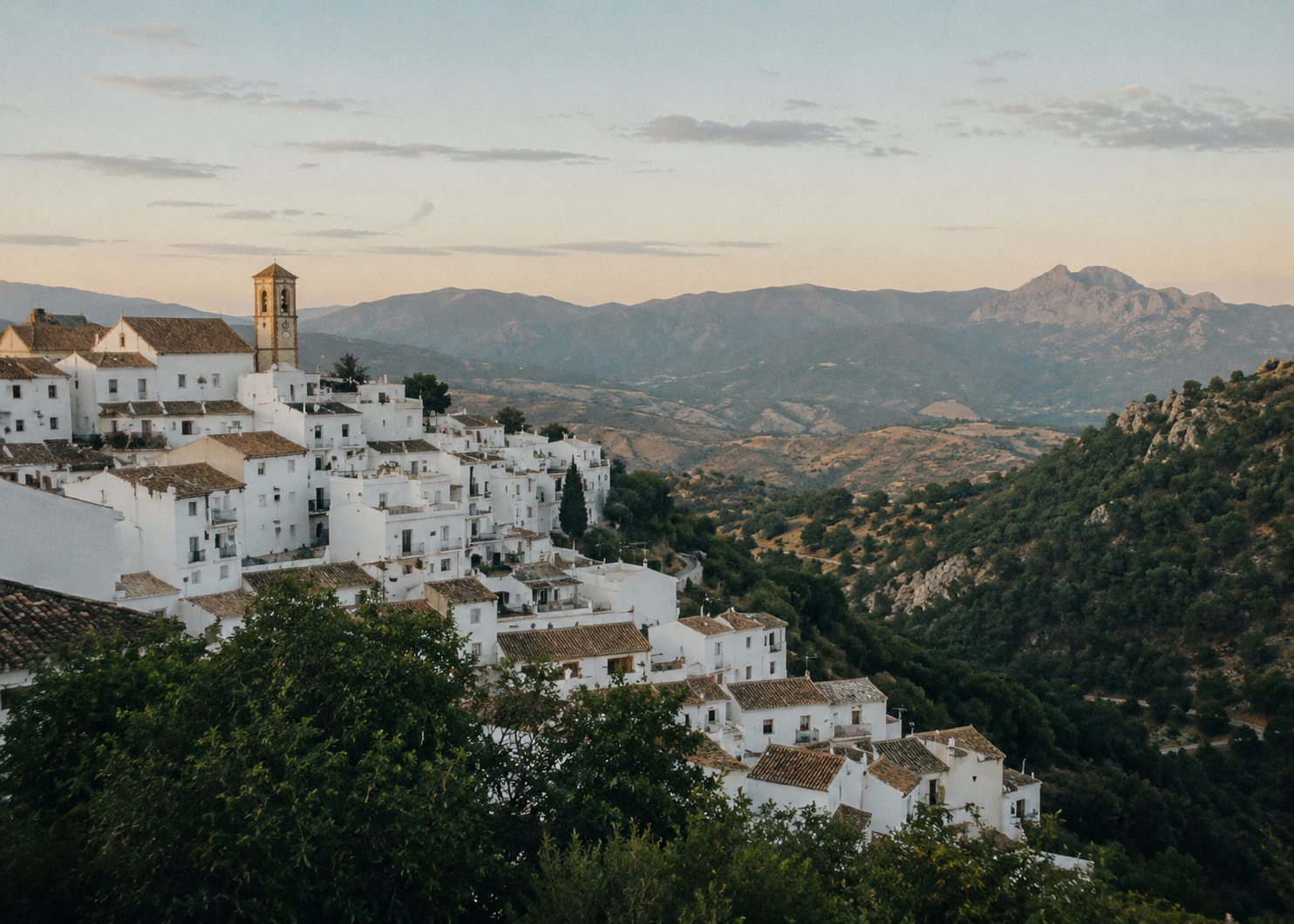
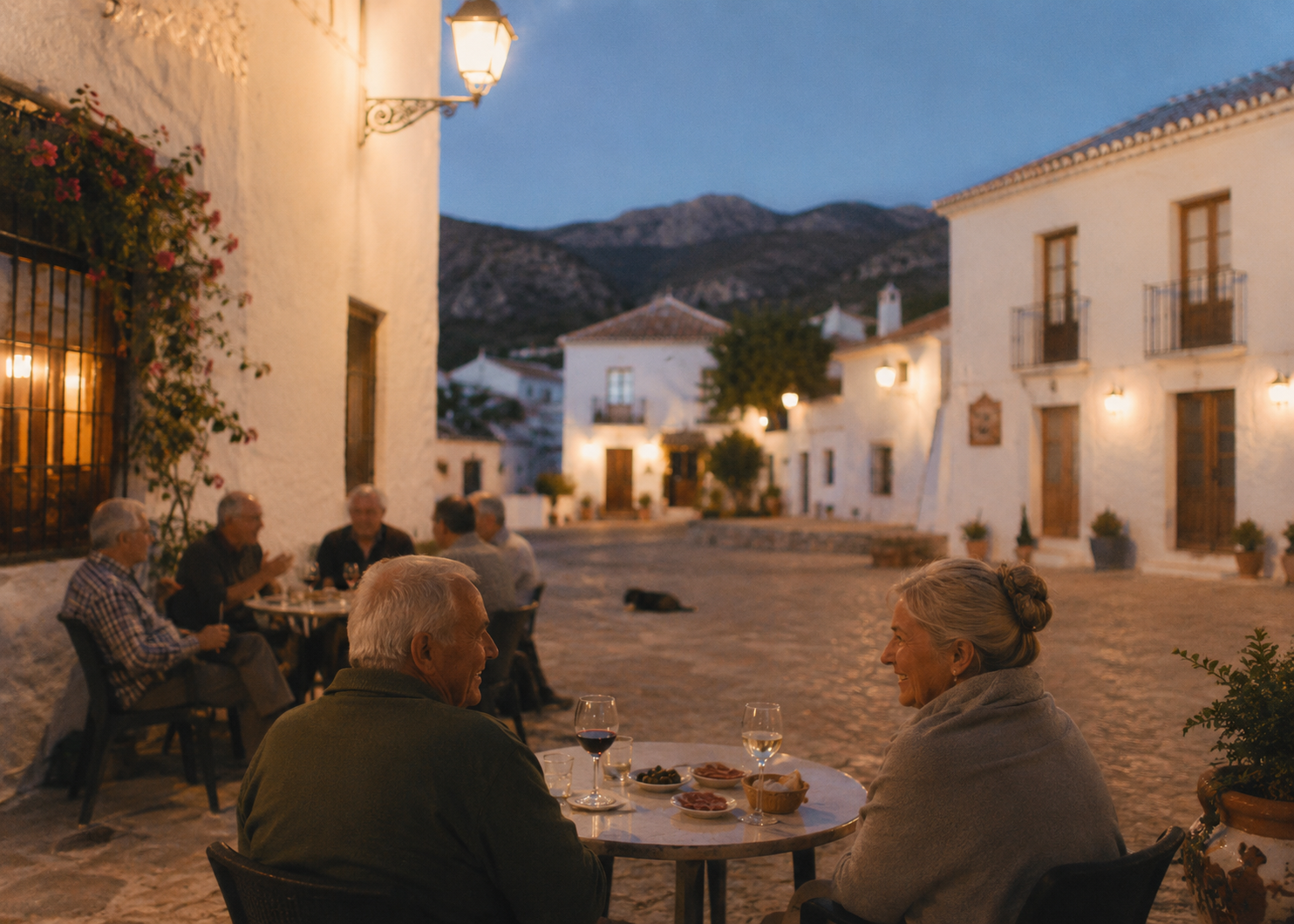
The bus from Ronda climbs for forty minutes, and then Grazalema appears. A spill of white houses pressed against a grey crag, red roofs, a church tower, swifts going mad over the plaza. It is eight in the evening in June and the temperature is pleasant. Down in Sevilla, two hours away, it is 41 degrees and the streets are empty until dark.
This is the part of Andalusia most Americans never consider, because most Americans researching southern Spain look at the coast and the famous cities. The pueblos blancos, the white villages strung through the sierras between Ronda and Cádiz and along the hills behind the Costa del Sol, offer something the famous places no longer can. Real rents around 700 euros. Summers that cool off at night. Streets built for feet, not cars. And almost nobody else’s countrymen. For a retiree who wants Spain without the crowds, these villages are the honest answer, provided you understand what they ask in return.
Why The Villages Stay Cooler
The secret is altitude, and it changes everything about an Andalusian summer.
Grazalema sits at roughly 800 meters. Zahara de la Sierra hangs above its turquoise reservoir at around 500. Ronda, the small city that anchors the whole region, sits at about 750. The Andalusian lowlands, Sevilla and Córdoba, are famously among the hottest places in Europe, ovens where summer afternoons regularly pass 40 degrees. The sierra villages get hot afternoons too. But altitude does its work at night. The evenings drop into genuine cool, the houses shed their heat, and you sleep with a blanket in August while Sevilla sweats.
Grazalema has a second oddity. It is, by rainfall, one of the wettest places in Spain, a quirk of the mountains wringing out the Atlantic clouds, which is why the village is wrapped in green when the lowlands have burned brown. The coastal-facing villages get a different mercy. Vejer de la Frontera, white and walled on its hill near the Atlantic, takes the sea wind all summer. The levante can blow hard enough to be annoying. It also means Vejer in July is livable in a way inland Sevilla simply is not. None of this makes the villages cold. It makes them survivable without air conditioning, which the lowland cities have not been for years.
The 700 Euro Question
The rents are real. The catch is not the price. It is the supply.
Long-term rentals in the inland villages commonly run in the 500 to 800 euro range for a good two-bedroom, with 700 buying something comfortable in most of them, often with a roof terrace and a view that would cost ten times that in Italy. Mijas, the white village above the Costa del Sol, has had two-bedroom apartments reported in the mid-500s in dollars. Property prices follow the same logic, with village houses still selling for sums that sound like typos to anyone who has priced the coast.
Here is the honest part. The constraint in the prettiest villages is finding a long-term contract at all, because tourism got there first. In a village like Frigiliana or Setenil, many of the best houses now earn more as holiday rentals than any long-term tenant could pay, so the long-term market is thin and moves by word of mouth. The fix is patience and presence. Rent something short-term, spend a month, talk to the woman at the panadería and the man at the ferretería, and the apartment that never appears on any website appears. This is how the villages work. The 700 euro rent exists, but it is found through people, not portals.
A Short Tour Of The Candidates
Each village has a personality, and matching it to yours matters more than any ranking.
Grazalema is the mountain one. Green, cool, serious hiking on the doorstep, a working village with its blanket factory and its own slow rhythm, and winters that are properly cold and wet by Andalusian standards. Zahara de la Sierra is the postcard, a white cascade under a Moorish castle above a reservoir you can swim in, small enough that you will know everyone within a year. Setenil de las Bodegas is the strange one, houses built into the overhanging rock, heavily daytripped at lunchtime, quiet by eight.
Arcos de la Frontera is the big one, a real town of around 30,000 draped along a cliff edge, with the services a retiree actually needs, supermarkets, clinics, a proper market, and enough life year-round that winter does not echo. Vejer de la Frontera is the stylish one, close to the Atlantic beaches of the Costa de la Luz, with the region’s best food scene and the prices creeping up to match. Frigiliana, in the hills behind Nerja, is the eastern option, ten minutes from the sea, polished, flowery, and the most discovered of the lot. The Alpujarras villages on the south flank of the Sierra Nevada, Pampaneira, Bubión, Capileira, are the remote ones, high, cheap, and beautiful, for people who mean it.
Walkable, With An Asterisk
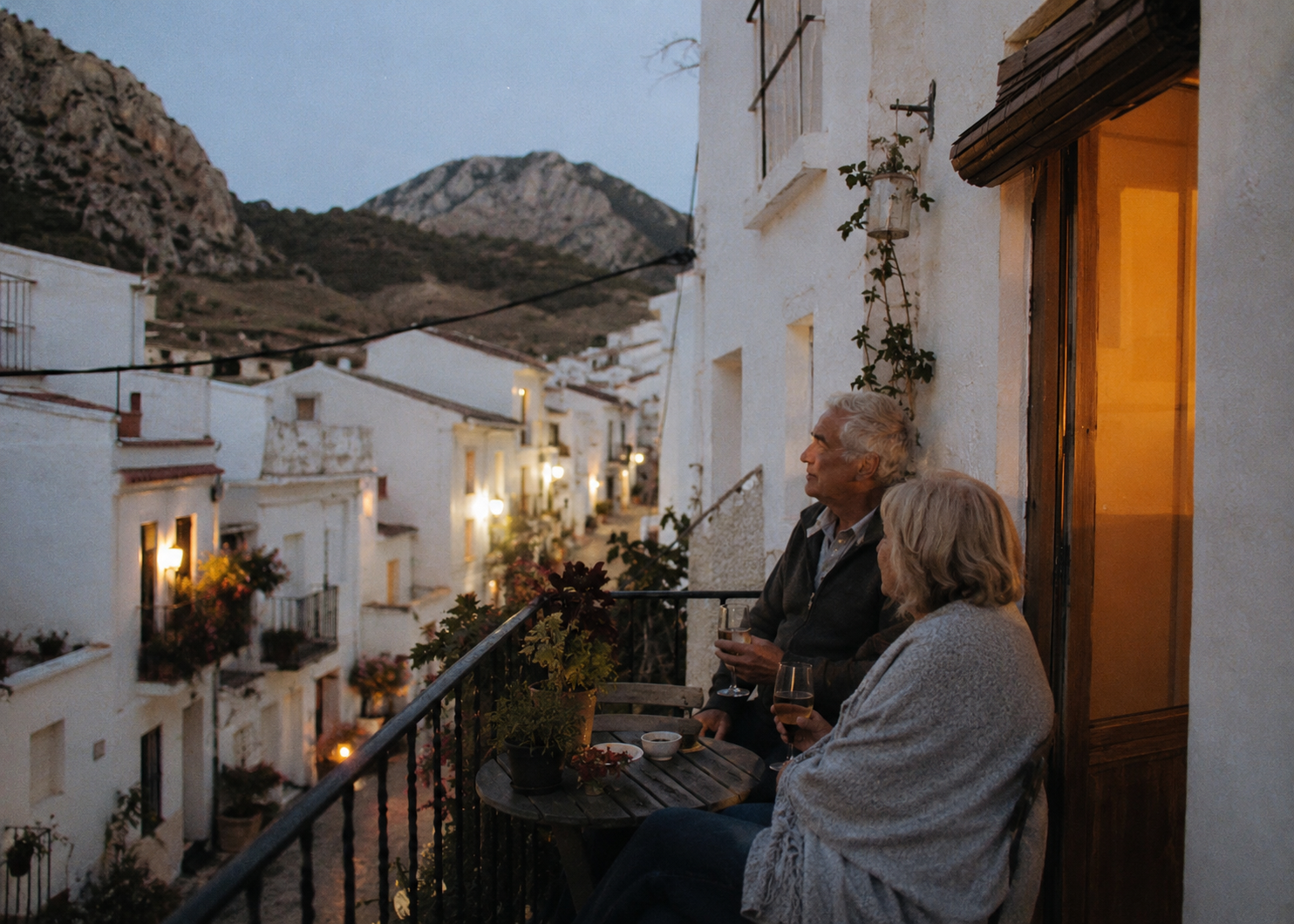
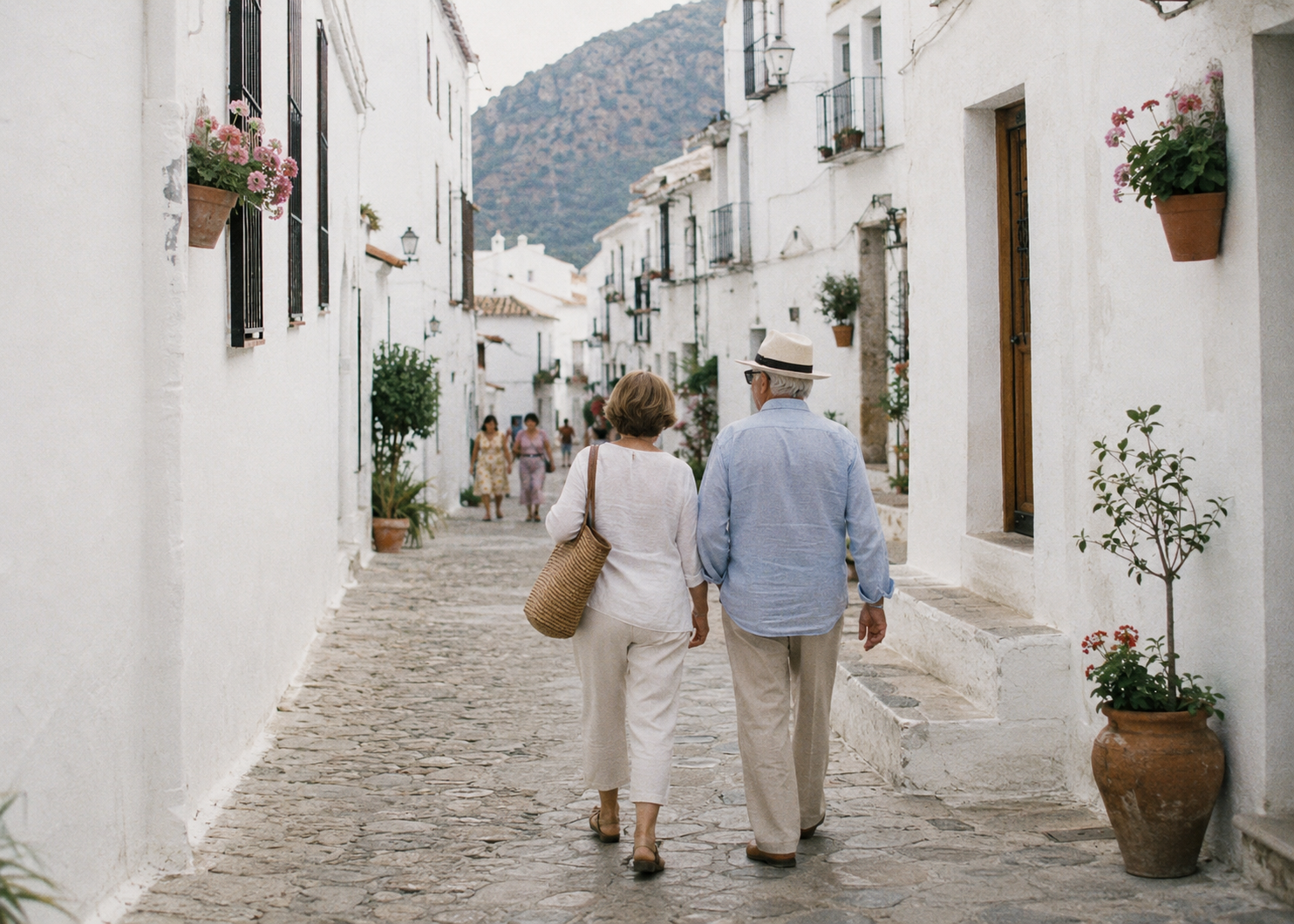
Everything in a white village is reachable on foot. Almost nothing is reachable on flat ground.
The villages were built on hills for defense, and they kept the geometry. Streets are cobbled, narrow, and steep, sometimes stepped, and a daily life in Zahara or Grazalema involves climbing that a daily life in a Florida suburb does not. For a healthy retiree this is the best news in the whole piece, since the hills are an exercise program nobody has to schedule, the same daily climbing that keeps the village’s own eighty-year-olds astonishingly fit. You will see them, women in their ninth decade carrying shopping up gradients that would alarm an American cardiologist.
For a retiree with bad knees, a hip on the schedule, or a partner with mobility trouble, the same geography is a serious problem, and it should be weighed honestly before any romance with the architecture. Some villages are gentler than others. Arcos has flatter modern quarters below the old town. Vejer has navigable stretches. But the classic white village is vertical, and anyone for whom stairs are already an enemy should think hard, visit in person, and walk the actual streets between the actual market and the actual house before signing anything. The walkability is real. So are the hills it comes with.
What The Crowds Actually Look Like
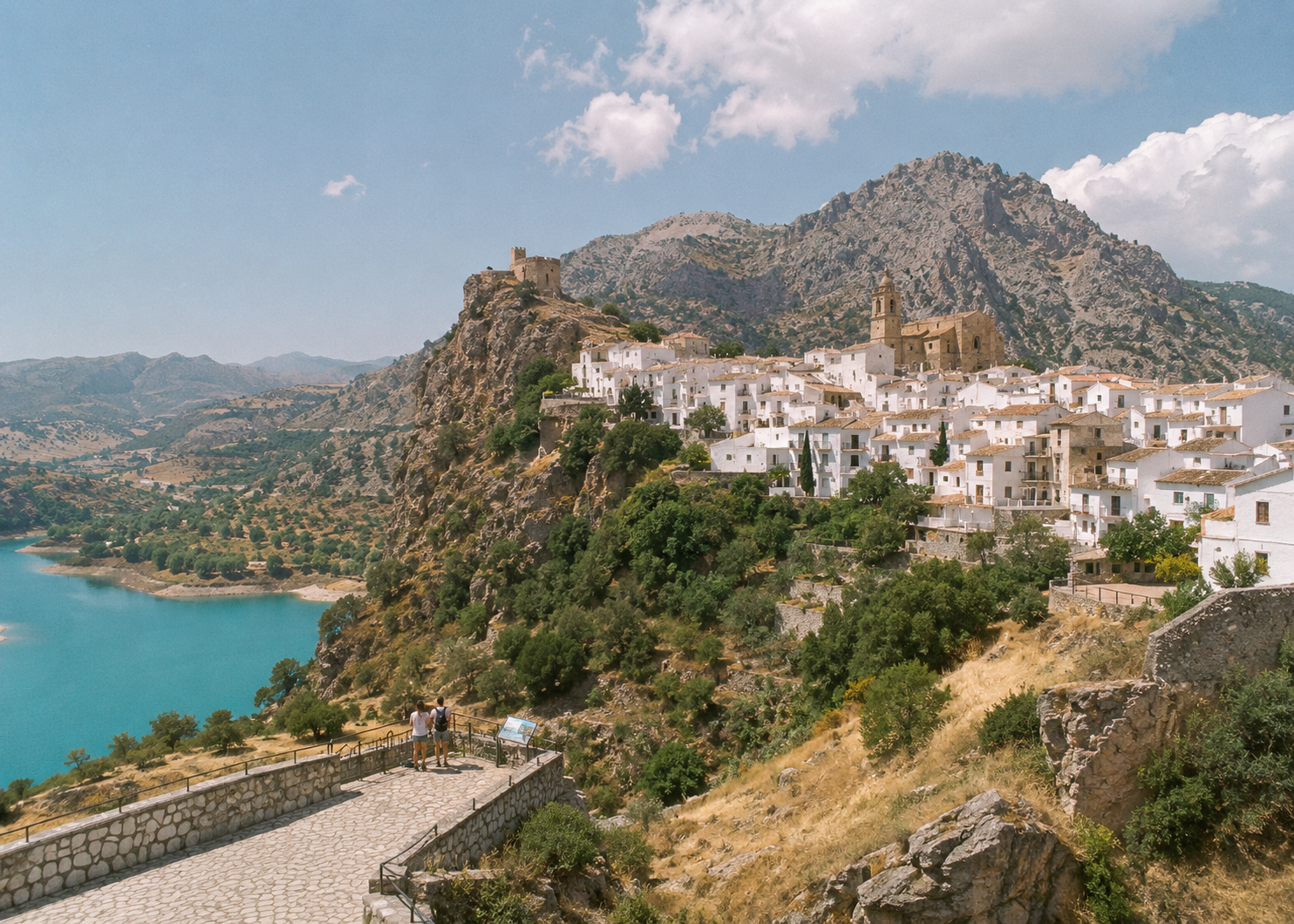
These villages are not undiscovered. They are undiscovered at the right hours.
Setenil at one in the afternoon in May is full of daytrippers photographing the rock houses. Frigiliana on an August Saturday is busy. The famous villages sit on bus-tour circuits out of Sevilla and the Costa del Sol, and the midday wave is real. Then, around six, the buses leave. The village exhales, the locals come out, the plaza fills with its own people, and the place a resident actually lives in reappears every evening. A retiree’s village is the seven a.m. village and the nine p.m. village, and those belong almost entirely to the people who live there.
Compare that with what the famous alternatives now offer. Barcelona is phasing out its tourist apartments entirely under crowd pressure. The islands have cracked down on rentals. Spain logged a record 97 million visitors in 2025, and the weight of them lands on a short list of places, which is exactly why the Ministry’s own strategy pushes visitors inland. The white villages take their daily sip of that flood and hand the place back each evening. For someone who hates crowds, that arithmetic, busy plaza at noon, empty plaza at night, is about as good as Europe gets in 2026.
The Price Of Admission
The villages are cheap in euros and expensive in adaptation, and both sides of that should be stated plainly.
Spanish is not optional here. In Madrid or on the coast an American can limp along in English for years. In Grazalema the butcher, the doctor, the neighbor, and the town hall operate in Spanish, full stop, and a retiree who will not learn is choosing isolation in a place too small to hide in. A car is close to essential, since the villages are served by thin bus schedules and the hospital, the airport, and the big supermarket are all a drive away. Healthcare deserves specifics. The villages have local clinics for ordinary needs, and the serious infrastructure sits in the anchor towns, Ronda’s hospital for the sierra villages, Cádiz and Jerez for the western ones, generally twenty to fifty minutes away. Good care exists. It is not downstairs.
And the expat scene is thin by design. There are foreign residents in Vejer and Frigiliana, a scattering elsewhere, but nothing like the coast’s ready-made English-speaking world. Whether that is a cost or the entire point depends on the retiree. The honest test is the one that applies to every move this blog covers. Spend real time first, a month minimum, in the actual season you fear, which here means August or, for the mountain villages, February, when the rain sets in and the village belongs to four hundred people and the wind.
What A Year There Actually Costs
Numbers concentrate the mind, so here is a realistic monthly sketch for a couple in an inland village, offered as ranges rather than promises.
Rent, 600 to 800 euros for a good two-bedroom, our 700 anchor. Utilities and internet, 120 to 180, with winter heating the variable, since village houses are built to shed heat, not hold it, and the mountain villages have real winters. Food, 400 to 550 for two people who shop the market and the weekly mercadillo, less if the neighbors keep handing you vegetables, which in a small village they will. A used car, fuel, and insurance, 200 to 300. Private health insurance for a pre-public-system couple in their sixties, 200 to 350 depending on age and cover. Eating out, the daily coffees, the menú del día at 12 to 15 euros a head, another 150 to 250 of pure pleasure.
Add it up and a couple lives well, not carefully, on roughly 1,700 to 2,400 euros a month, with the lower end entirely achievable in Grazalema or the Alpujarras and the upper end buying comfort in Vejer. Compare that against the coast, where the rent line alone can double, or against the American figures the couple left behind. The arithmetic is the quiet engine of the whole proposition. These are real prices for a real life, not a backpacker’s austerity, and they are why a modest retirement income that strained in the United States relaxes here.
The Village Year
A village is four different places across twelve months, and a resident should want all four.
Spring is the show. The whitewash goes on fresh after the rains, the hills turn green and then gold, the feria season starts and every village throws its own days of noise, horses, and dancing that have nothing to do with tourists. Summer is the split life, shuttered cool mornings, dead afternoons, and the long social night, plus the August homecoming, when the village’s emigrated children return from Barcelona and Germany and the population briefly doubles and every night is somebody’s reunion. A newcomer who has spent the year showing up belongs to this. One who hasn’t watches it through a window.
Autumn is the harvest, chestnuts in the sierra, the olive mills starting up, the first woodsmoke. Winter is the test. The buses thin out, the second homes close, rain sits on Grazalema for days, and the village contracts to its core of residents, the bar, the stove, the small rounds of daily life. This is the season that sends the unprepared home, and the season the prepared come to love, because it is when the village is most itself and a newcomer’s presence is most noticed and most counted. Anyone planning the move should see a February before signing for a life of them. The ones who like February stay forever.
One last practical note on buying. Village houses sell for sums that tempt people into skipping the rental year, and the temptation should be resisted. Rent first, always. The house that charms in a week reveals its damp wall, its impossible parking, and its rooster-owning neighbor over a winter, and Spanish purchase costs, the transfer tax and fees that add roughly ten to fifteen percent on top of the price, make a wrong purchase expensive to unwind. The village is not going anywhere. It has been on that crag for eight hundred years. Buy in year two, after the village has shown you which house, on which street, at which altitude of the hill, is actually yours.
None of this is financial or relocation advice, and rents, availability, and services vary village by village and year by year. Anyone considering a move should visit at length in the hardest season, confirm current rental and healthcare realities on the ground, and take proper visa and cross-border tax guidance before committing, since the village that photographs best in May is a different proposition in February, and the only reliable research is time spent there.

About the Author: Ruben, co-founder of Gamintraveler.com since 2014, is a seasoned traveler from Spain who has explored over 100 countries since 2009. Known for his extensive travel adventures across South America, Europe, the US, Australia, New Zealand, Asia, and Africa, Ruben combines his passion for adventurous yet sustainable living with his love for cycling, highlighted by his remarkable 5-month bicycle journey from Spain to Norway. He currently resides in Spain, where he continues sharing his travel experiences with his partner, Rachel, and their son, Han.