
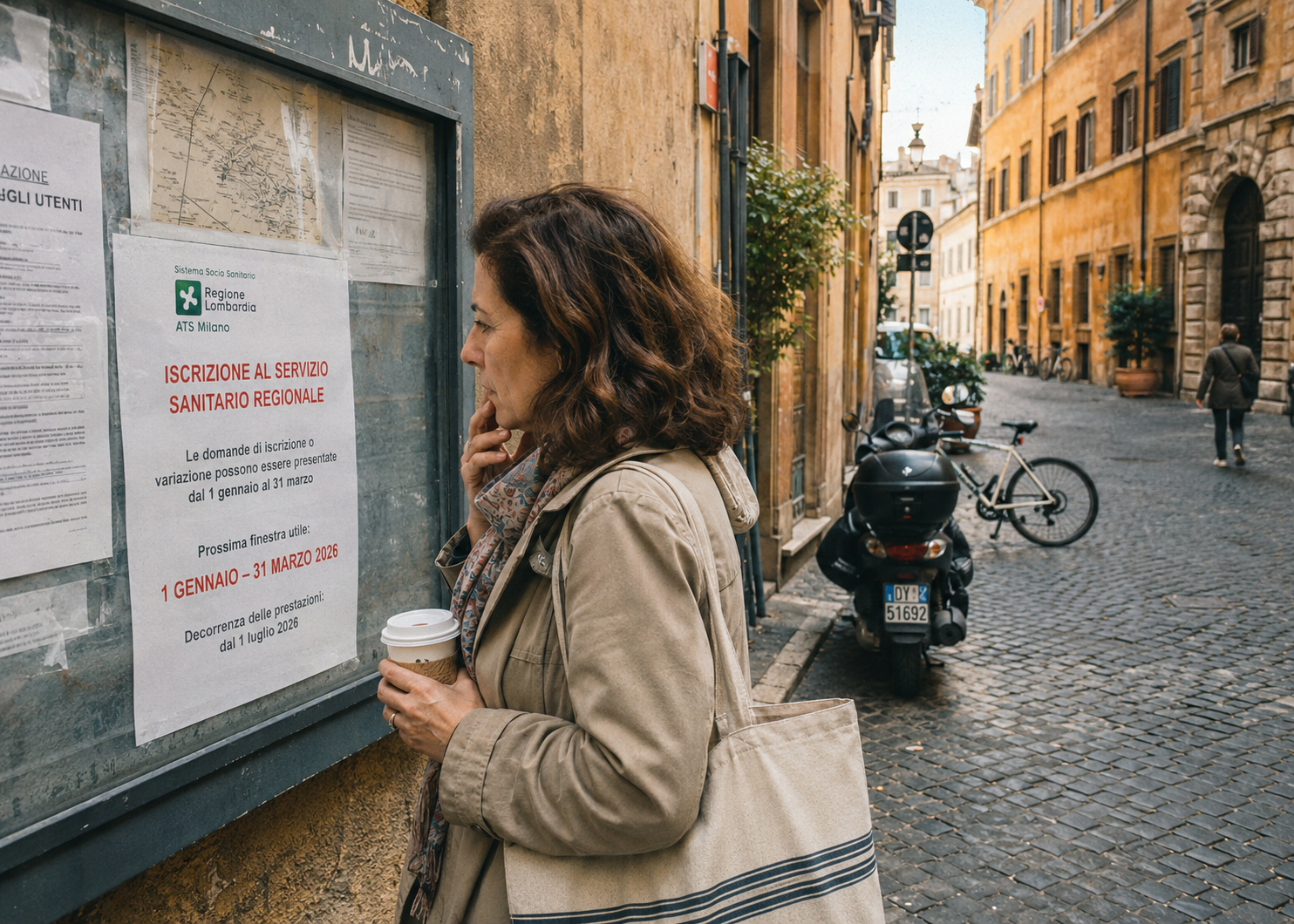
The Americans who move to Italy almost all arrive thrilled about the healthcare. They have read that Italy has an excellent public health system, that care costs a fraction of what it does at home, that the financial terror of American medicine simply does not exist here, and all of that is true. What they do not always understand is that getting into that system is its own process with its own rules and its own deadlines, and that a few specific mistakes in the first months can leave them locked out of public coverage until the next enrollment window comes around.
From Spain, where the bureaucracy of getting into a public health system follows a similar logic, the Italian version has some particular traps worth knowing before you arrive rather than after. The healthcare itself is genuinely good and genuinely affordable. The enrollment is genuinely bureaucratic, and the newcomers who struggle are almost always the ones who misunderstood the timing, the documents, or the type of enrollment they needed. Here are the three mistakes that cause the most trouble, and how to avoid each.
How The Italian System Actually Works
Before the mistakes, a quick map of the system, because the errors only make sense once you understand the structure you are entering.
Italy’s public health system is the Servizio Sanitario Nazionale, the SSN, a regional, tax-funded system that provides comprehensive care to residents, established on the principle that healthcare is a right rather than a product. You register with your local health authority, the ASL, in the region where you live, and registration assigns you a family doctor and issues a health card, the tessera sanitaria, that is your key to the whole system. Once you are in, the care is extensive and the costs are minimal, small copayments for some services and nothing for many others, a world away from American medicine.
The crucial structural fact for a newcomer is that there are two routes into the SSN, and which one applies to you determines everything about the process. Some people are entitled to mandatory enrollment, which is free because it is covered by their contributions, principally those who work in Italy. Others, including many retirees and the holders of an elective residence permit, are not in a mandatory category and must instead enroll voluntarily, by paying an annual contribution. The distinction between mandatory and voluntary enrollment is the source of much of the confusion, because the rules, the costs, and the timing differ between them, and a newcomer who does not know which category they fall into cannot navigate the rest.
The First Mistake, Misunderstanding The Calendar Year
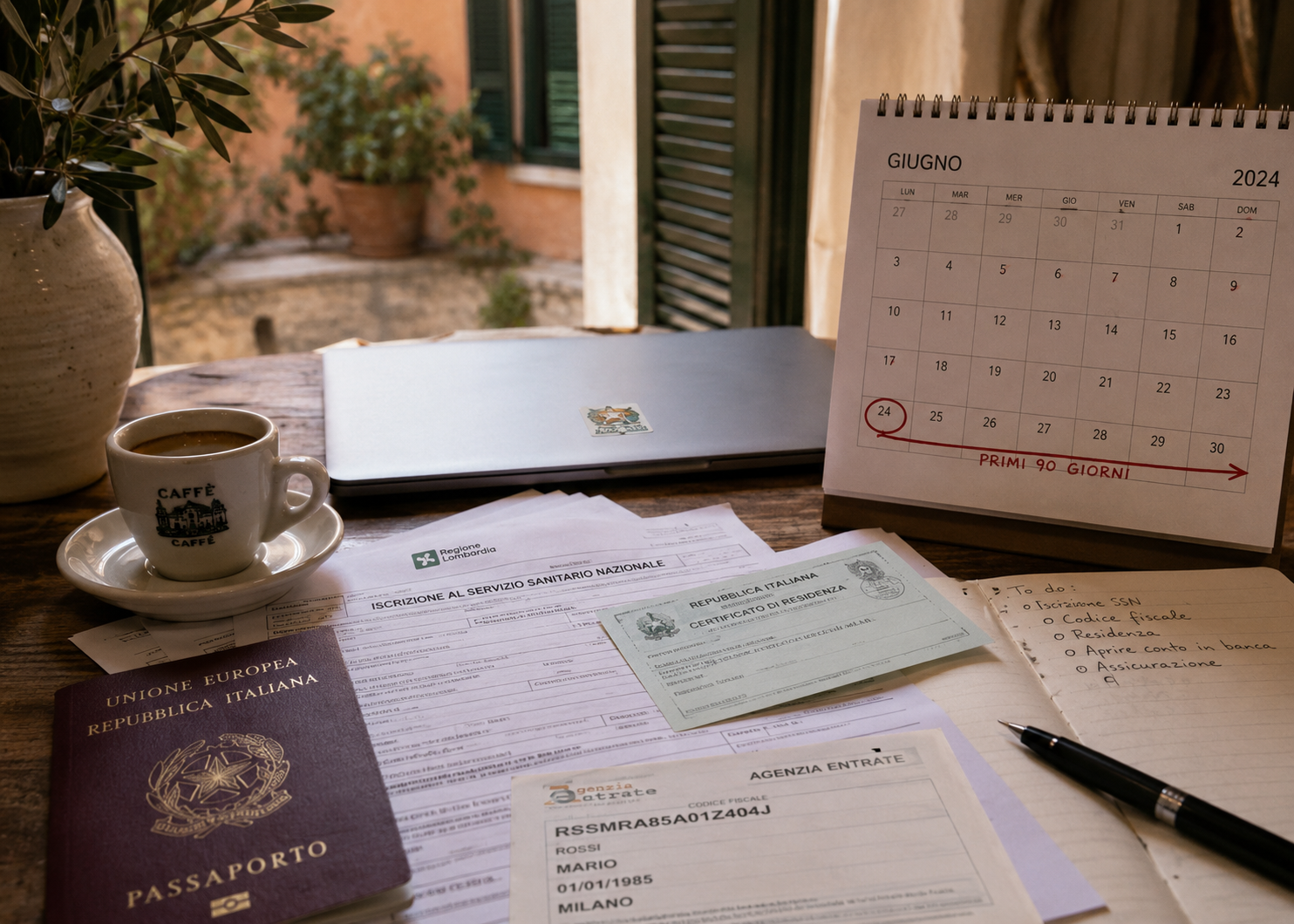
The single most damaging mistake involves the timing of voluntary enrollment, and it is the one that genuinely locks people out.
Voluntary enrollment in the SSN runs on the calendar year, from the first of January to the thirty-first of December, and this is the trap. The annual contribution buys coverage for the calendar year, and critically, it cannot be prorated and does not carry retroactive effect, which means the way you time your enrollment matters enormously. Enroll in January and your contribution covers the full year ahead. Enroll late in the year and you pay for coverage that runs only to the end of that same December, then must pay again for the next year, having effectively bought only a sliver of coverage for a full year’s fee. The calendar-year structure, rigid and non-negotiable, is the thing that catches people who assume enrollment simply runs for twelve months from whenever they sign up.
The deeper version of the trap is the gap it can create. A newcomer who delays voluntary enrollment, thinking they will get to it once they are settled, can find themselves uninsured in the public system for a stretch, and because the enrollment is tied to the calendar year rather than to a rolling twelve months, the timing of when they finally enroll determines how much coverage they get for their money. The fix is to understand the calendar-year structure from the start, to enroll promptly upon establishing residence rather than delaying, and to factor the timing into the decision, since enrolling early in the year gives the best value and enrolling late means paying a full or near-full contribution for only the months remaining. This is not a system that rewards procrastination, and the calendar is the part to plan around.
The Second Mistake, The Residence Permit Sequence

The second mistake is procedural, a misunderstanding of the order in which the documents must come, and it stalls people for weeks.
SSN enrollment depends on having the right residency documentation, and there is a sequence to it that newcomers frequently get tangled in. To enroll, you generally need a valid residence permit, the permesso di soggiorno, or at least the receipt proving you have applied for one, along with proof of your actual residence, your codice fiscale tax code, and the relevant forms. The trap is that the residence permit itself takes time to obtain after arrival, and the health enrollment is downstream of it, so a newcomer who has not yet sorted their permit cannot complete their SSN registration and can find themselves in a frustrating waiting period, technically in the country legally but not yet in the health system.
The system does provide for this gap, which is the part people miss. While the permit is being processed, enrollment can often be temporary or provisional, becoming permanent once the permit is issued, and the receipt of the permit application frequently suffices to begin the process rather than the finished permit itself. The mistake is not knowing this and assuming you must wait, fully uninsured, until the permit arrives, when in fact you can often begin enrollment on the strength of the application receipt and bridge the gap. The fix is to understand the document sequence in advance, to start the residency process immediately on arrival since everything downstream depends on it, and to ask the ASL specifically about provisional enrollment while the permit is pending rather than assuming you are simply stuck waiting.
The Third Mistake, Skipping Private Cover In The Gap
The third mistake compounds the first two, leaving a person genuinely exposed during the transition, and it is the one with real risk attached.
Many newcomers, particularly those on the elective residence route, are required to have private health insurance as a condition of their visa in the first place, and this private cover is meant to bridge exactly the period before SSN enrollment is complete. The mistake is treating that private insurance as a mere visa formality to be dropped the moment they arrive, rather than the genuine bridge it is meant to be, and then finding themselves in a gap with no coverage at all, the private policy abandoned and the public enrollment not yet finished. The visa rules generally require the private cover precisely because the authorities understand there will be a transition period, and a newcomer who treats it as a box-ticking exercise rather than real protection can end up exposed if something goes wrong in those early weeks.
The fix is to keep robust private health insurance in force until SSN enrollment is genuinely complete and the tessera sanitaria is in hand, treating the private cover as real protection during the transition rather than dropping it prematurely. The two should overlap, with the private policy carrying you through until the public coverage is unquestionably active, and only then should the private cover be reconsidered. Some newcomers choose to keep a private policy even after joining the SSN, for faster access to specialists or English-speaking doctors, but at a minimum the private cover should never be allowed to lapse before the public enrollment is finished, because the gap between the two is exactly where an uninsured medical emergency can turn a smooth move into a financial disaster.
What Enrollment Actually Costs

Because the cost of voluntary enrollment surprises people, it is worth being clear about the numbers, with the caveat that they change and vary.
For those who must enroll voluntarily rather than through work, the SSN is not free, but it is still remarkably cheap by American standards. The voluntary contribution is an annual lump sum, calculated based on income, with a minimum that under the reforms of recent years has risen to a figure in the low thousands of euros per year for many adults, less for students and certain other categories. The exact amount depends on declared income, both Italian and foreign, and rises for higher incomes up to a cap, which is why the enrollment requires documentation of your income to calculate the contribution. Even at the higher end, this is a fraction of what comprehensive American health coverage costs, and it buys access to the full public system on the same terms as Italian citizens.
The contribution is also, in many cases, tax-deductible on the Italian tax return, which softens the cost further for residents who file taxes in Italy, including retirees under the favorable flat-tax regimes that draw many of them to Italy in the first place. The point for a newcomer is to budget for the voluntary contribution as a real annual cost rather than assuming the famous Italian healthcare is simply free, and to understand that the figure depends on income and changes with policy, so the current amount should be confirmed at the local ASL rather than assumed from an old article. The healthcare is a bargain, but it is a bargain with a price tag, and knowing that price in advance prevents an unwelcome surprise.
How To Do It Right
Pulling the three mistakes together, the path through is straightforward once you know the shape of it, and it rewards doing things in the right order from the start.
Start the residency process the moment you arrive, since the residence permit is the document everything else depends on and it takes time, and do not let the early weeks slip by before beginning it. Keep your private health insurance fully in force from before you arrive until your SSN enrollment is genuinely complete, treating it as real bridging protection rather than a formality. Understand whether you fall into mandatory or voluntary enrollment, since the route determines the cost and the process. And if you are enrolling voluntarily, understand the calendar-year structure and time your enrollment to get the best value, enrolling promptly and early in the year where possible rather than delaying into a partial year. Do these four things in order and the enrollment, while bureaucratic, goes smoothly.
The deeper lesson is the one that applies to every part of moving to Italy, that the systems are good but they are procedural, and they reward the newcomer who learns the rules in advance over the one who improvises after arrival. The healthcare is one of the great prizes of an Italian move, genuinely excellent and genuinely affordable, but it is not automatic and it is not instant, and the gap between arriving and being fully enrolled is a real period that has to be managed with the right documents, the right timing, and continuous private cover as a bridge. Manage it well and you join one of the world’s better health systems for a modest annual fee. Manage it badly and you can find yourself locked out, uninsured, or paying for coverage you cannot yet use, which is an avoidable and unnecessary way to start a new life.
The Regional Variation Nobody Mentions

One feature of the Italian system surprises Americans more than almost anything, and it shapes the whole experience of care, which is that the SSN is not really one national system but twenty regional ones.
Healthcare in Italy is administered at the regional level, and the quality, the waiting times, the efficiency, and even some of the specific rules and costs vary considerably from one region to another. The northern regions are generally regarded as having the better-funded and better-run health services, with shorter waits and more resources, while some southern regions struggle with longer waits and tighter budgets, to the point that Italians themselves sometimes travel north for serious treatment. This regional reality means that the experience of the same national system can differ markedly depending on where in Italy a newcomer settles, and it is a genuine factor in choosing where to live, not just a bureaucratic footnote.
For a newcomer this cuts two ways. On one hand, it means the research has to be local, since the national reputation of Italian healthcare tells you less than the specific reputation of the health service in the actual region and town you are considering, and a retiree optimizing for healthcare should look at the regional system where they intend to live rather than at Italy in the abstract. On the other hand, it means that even a person who settles in a region with a weaker public service has options, the private system as a supplement, or the choice to travel within Italy for major care, and the modest cost of private cover makes that supplement genuinely affordable. The practical advice is to research the specific regional health service of any place you are seriously considering, to weight the larger cities and the north more favorably on healthcare grounds if that matters to you, and to understand that where you settle in Italy is also a decision about which version of the national health system you will actually be using.
None of this is legal or medical advice, and the rules, costs, and procedures for SSN enrollment change over time and vary significantly from region to region. Anyone planning a move to Italy should confirm the current requirements with their local ASL and with a qualified immigration or relocation professional rather than relying on general guidance, since the specific details that determine whether enrollment succeeds are exactly the ones most likely to differ by region and to change from year to year.

About the Author: Ruben, co-founder of Gamintraveler.com since 2014, is a seasoned traveler from Spain who has explored over 100 countries since 2009. Known for his extensive travel adventures across South America, Europe, the US, Australia, New Zealand, Asia, and Africa, Ruben combines his passion for adventurous yet sustainable living with his love for cycling, highlighted by his remarkable 5-month bicycle journey from Spain to Norway. He currently resides in Spain, where he continues sharing his travel experiences with his partner, Rachel, and their son, Han.