

At the end of May 2026, Europe ran a preview of its summer, and it arrived weeks early. A heat dome settled over the western half of the continent in the last days of the month and broke records that had stood for generations. France recorded its hottest May day in its history. The United Kingdom logged its hottest May day ever. Portugal became the first European country to pass 40 degrees this year. By the first days of June the worst of it had eased, but the message it left behind was clear enough for anyone with a summer trip booked.
From Madrid, where the heat is an old companion rather than a novelty, the American questions started arriving immediately. Should I cancel. Is it safe. Was this a freak event or a warning. The honest answer is that the late-May heat was both extraordinary and entirely consistent with where European summers have been heading, and that a smart traveler does not cancel but adjusts. Here are six things worth understanding before you commit to June and July.
The Heat Was Real, And It Was Early
Start with what actually happened, because the scale of it is the reason to pay attention rather than shrug.
In the final week of May, temperatures across western Europe ran 10 to 15 degrees Celsius above the seasonal normal, which is an enormous departure, the kind that turns a mild late-spring week into something resembling the middle of July. France saw monthly heat records fall at hundreds of weather stations, more than half the country setting at least one May record. The United Kingdom, a country not built for heat, saw its hottest May day on record by a margin of two full degrees. This was not a warm spell. It was a record-shattering event that climate scientists described as extraordinary even by the standards of a warming continent.
The detail that matters most for a traveler is the timing. This happened in May, weeks before summer officially began, which tells you something uncomfortable about what the actual peak of summer may hold. A continent that hits July temperatures in May has shifted its whole thermal calendar forward, and the practical implication is that the traditional shoulder season, the cooler edges of the travel year, can no longer be assumed to be cool. The early arrival is the warning inside the event.
This Is A Trend, Not A Freak
The second thing to understand is that this fits a pattern, which changes how you should weigh it.
Europe is warming at roughly twice the global average rate, faster than any other continent, and the heat waves of recent summers have been getting earlier, longer, and more intense in a way that is now well documented rather than speculative. The summer of 2025 brought its own punishing heat waves and a brutal wildfire season. The late-May 2026 event was not an isolated freak but the latest and earliest in a clear sequence, the continuation of a trend that shows no sign of reversing. Scientists were direct in saying this kind of event has been made both more likely and more severe by climate change.
For a traveler, the difference between a freak and a trend is the difference between bad luck and a planning assumption. You do not plan around bad luck, you simply hope to avoid it. You do plan around a trend, building your trip on the assumption that European summers now run hot and that heat events can arrive early and stay late. Treating the heat as a permanent feature of the summer travel landscape, rather than a one-off to be waited out, is the mindset that leads to good decisions.
The Cool Months Are Not Reliably Cool Anymore

The third point overturns a piece of advice that travel writers, including this one, have given for years.
The standard guidance has always been to travel Europe in the shoulder seasons, May, June, and September, to dodge the July and August peak. That advice rested on those months being reliably milder, and the late-May event has put a crack in it. If May can deliver July heat, then June and September can no longer be treated as safe cool harbors, and the traveler who booked June specifically to avoid the heat may find the heat booked the same dates. The shoulder season is still, on average, cooler and less crowded, and it remains the better choice. But the word reliably has quietly fallen out of the recommendation.
This does not mean abandon the shoulder season. It means hold it more loosely, with the understanding that any week of the European summer, early or late, can now bring a serious heat event. The practical response is not to chase a guaranteed-cool window that no longer exists, but to build a trip that can absorb a hot week whenever it lands. Flexibility, not the calendar, is now the real defense.
Where You Go Still Matters Enormously

The fourth point is the most useful for actual planning, because geography remains a powerful lever.
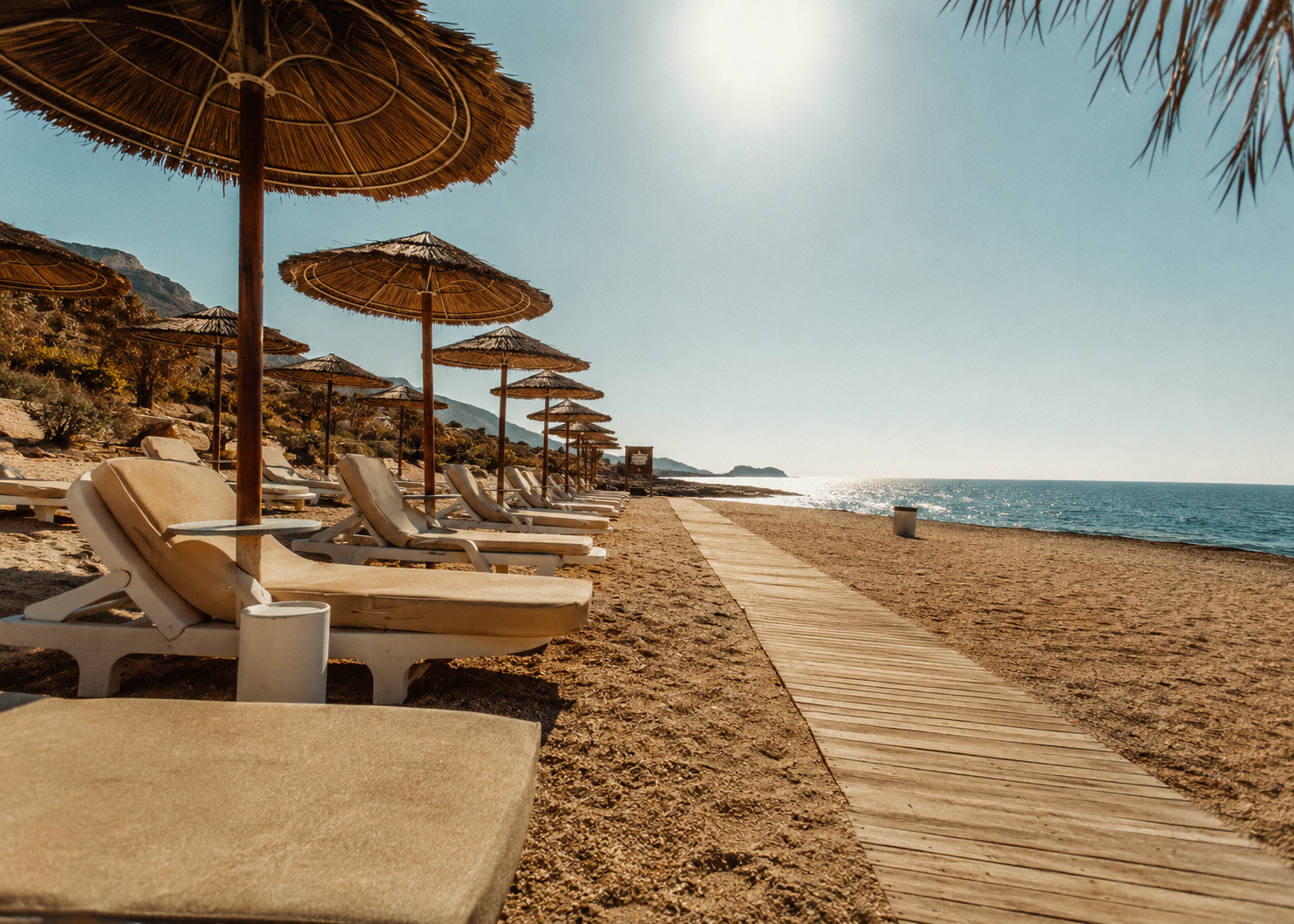
The heat is not uniform across Europe, and the difference between regions is large. The western and southern core, Spain, Portugal, southern France, Italy, takes the worst of it, while the cooler edges of the continent, the Atlantic coast, the mountains, Scandinavia, the northern countries, run substantially milder even during a heat dome. A traveler genuinely worried about heat has real options that do not involve canceling, simply by shifting the map rather than the calendar. The fjords of Norway, the Irish and Scottish coasts, the Alpine regions, the Baltic countries, all offer a European summer without the southern furnace.
Even within the hot countries, altitude and coast change everything. The interior of Spain bakes while the northern Galician coast stays cool and green. Inland Italian cities swelter while the mountain towns are pleasant. A trip planned with heat in mind can stay in the cooler pockets of even a hot country, choosing the coast over the inland city and the hills over the valley. Where you stand on the map, and how high, matters as much as when you travel.
Cities Are The Hard Part
The fifth point concerns the specific challenge of urban travel, which is where heat hurts a trip most.
A heat wave is far more punishing in a city than on a coast or in the countryside, because stone and concrete absorb and radiate heat, because air conditioning is far less common in European buildings than American visitors expect, and because the classic city trip involves walking for hours through exposed streets in the middle of the day. The great European city breaks, Paris, Rome, Madrid, Seville, are exactly the trips most vulnerable to a heat event, and a first-time visitor determined to see everything on foot in August can find the experience genuinely miserable and even dangerous.
This does not mean skip the cities. It means do the cities the way their own residents do in summer, which is the real lesson the locals can teach. Start early, see the sights in the cool of the morning, retreat indoors or to a shaded terrace through the worst afternoon hours, and come back out in the evening when the city revives. The Spanish and Italian habit of the long midday pause was built for exactly this, and the American instinct to power through from nine to five in the heat is the surest way to ruin a summer city trip. Adopt the local rhythm and the city stays open to you even in the heat.
What This Means For A Trip You Have Booked
The sixth point is the practical bottom line, the answer to the question everyone is actually asking.
If you have a European summer trip booked, the answer is almost certainly not to cancel, but to adapt. Build heat into the plan rather than hoping to avoid it. Favor accommodation with air conditioning and confirm it actually has it rather than assuming, since many European places do not. Plan the days around the heat, active in the cool hours and slow in the hot ones. Keep a flexible itinerary that can swap a brutal afternoon in a city for a cooler alternative. Carry water, respect the sun, and watch the forecast in the days before you travel so a heat event does not catch you unprepared. These adjustments turn a potentially miserable trip into a perfectly good one.
The travelers who struggle are the ones who plan an American-style summer trip, packed daytime schedules, long midday walks, no air conditioning, no flexibility, and then meet a European heat wave head-on. The travelers who do well are the ones who plan as a southern European does, around the heat rather than against it. The late-May event was a loud reminder that this is the new reality of European summer travel, and the trip that accounts for it is the trip that still works.
A Word On What The Heat Costs
It would be wrong to write about this purely as a travel-logistics problem, because the late-May heat carried a real human cost that deserves acknowledgment.
The event was linked to deaths across the affected countries, including in the United Kingdom and France, some of them children and young people who got into difficulty in open water while trying to cool off, and some of them vulnerable people for whom extreme heat is genuinely dangerous. Heat is not merely an inconvenience to be planned around. It is, for the old, the very young, and the unwell, a serious health threat, and the rising frequency of these events is a real cost that the continent and its visitors are only beginning to reckon with.
For a traveler the practical takeaway carries that weight. Take the heat seriously, watch out for the genuine warning signs of heat exhaustion in yourself and your traveling companions, be especially careful with elderly travelers and children, and never treat a heat warning as background noise. A summer trip to Europe remains entirely worth taking, and the vast majority of travelers will be fine with sensible precautions. But the heat is real, it is rising, and the respect it deserves is part of traveling well in the Europe that now exists rather than the cooler one of memory.
The Air Conditioning Gap Americans Underestimate
One specific point deserves expansion, because it surprises American travelers more than any other and shapes a summer trip more than they expect.
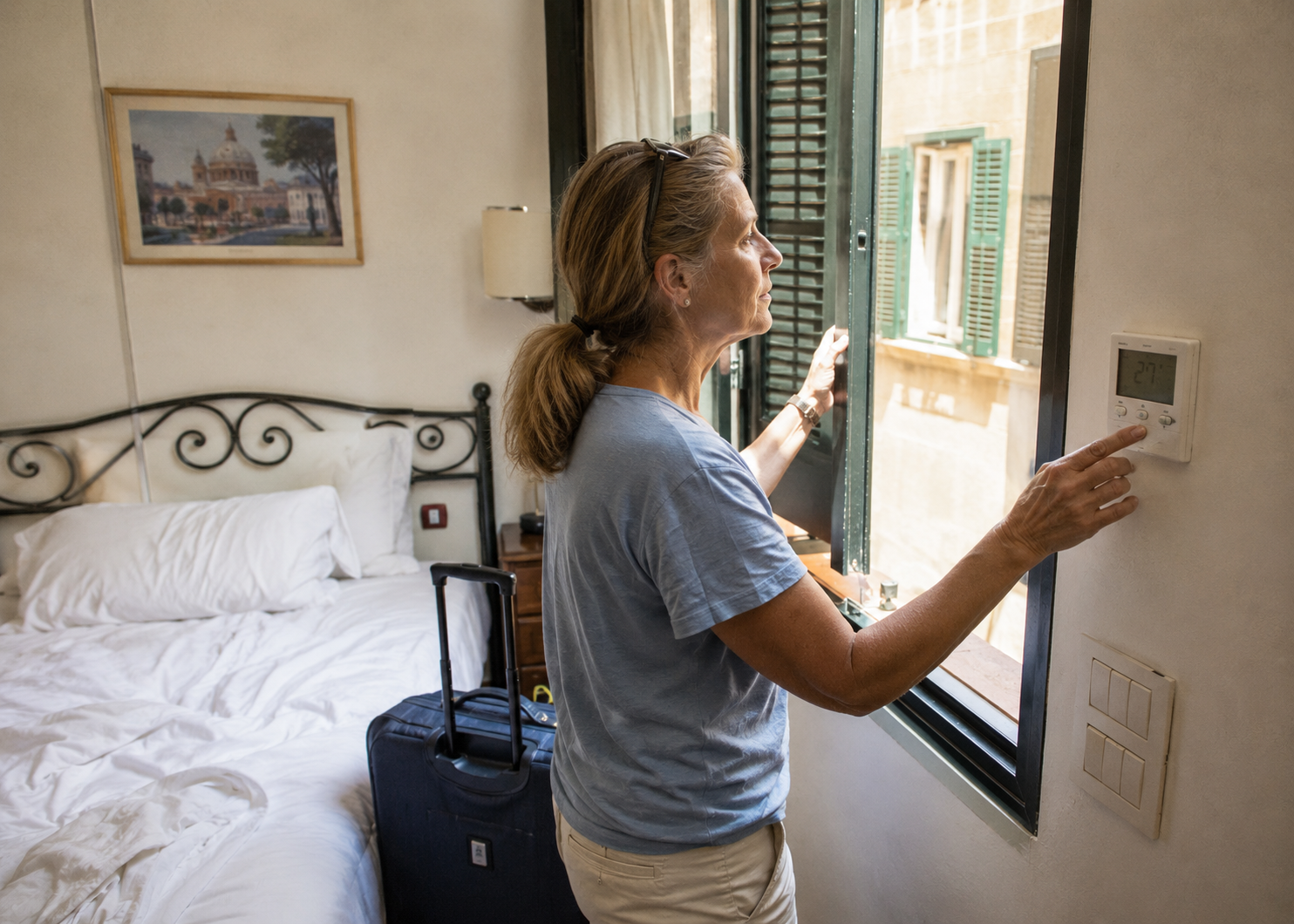
Air conditioning is far less common in Europe than in the United States, and this is the single thing American visitors most consistently get wrong. In much of southern Europe, air conditioning in homes, small hotels, guesthouses, and even some restaurants is the exception rather than the rule, a function of older buildings, higher energy costs, and a cultural tradition of coping with heat through architecture and habit rather than refrigeration. The thick walls, the shutters, the shaded courtyards, the midday pause, these were the historical air conditioning, and they work, but they do not deliver the chilled indoor air an American takes for granted.
For a traveler this means the booking details matter enormously in a way they would not at home. An accommodation listing that does not explicitly mention air conditioning very often does not have it, and assuming it does is how people end up sleepless in a hot room during a heat wave. Anyone traveling in a European summer who wants reliable cooling has to treat air conditioning as a specific feature to confirm in writing before booking, not a default to expect, and should be prepared to pay more for it where it exists. The cheaper and more charming the lodging, the less likely it is to have it, which is a real trade-off in a hot summer.
The deeper point is that even with confirmed air conditioning, the European version is often gentler than the American, cooling a room to comfortable rather than cold and frequently switched off by hosts mindful of the electricity bill. The traveler who needs serious cooling to sleep should weigh this honestly when choosing where to stay, favoring the kind of property, often a modern hotel rather than a characterful old apartment, where reliable air conditioning is genuinely part of the package. It is one of the clearest cases where the romantic choice and the comfortable choice diverge in a European summer.
How To Read The Forecast Before You Fly
The last practical skill worth having is knowing how to watch the weather in the days before departure, because a heat event is forecast well in advance and a prepared traveler is never caught entirely off guard.
European heat domes build over days and are visible in the forecast roughly a week out, which gives a traveler real lead time to adjust. In the run-up to a trip, watching the national weather services of the countries on the itinerary, and paying attention to the official heat-warning systems that France, Spain, Italy, and others operate, tells you whether you are walking into a heat event and lets you shift plans before you go rather than scrambling once you arrive. These warning systems use clear color-coded levels, and a red or orange alert is a genuine signal to change how you will spend those days, not a formality to ignore.
The traveler who checks the forecast in the final week and finds a heat wave building can do useful things with that knowledge. Rearrange the itinerary to put the indoor and cooler-region portions during the worst days. Move a planned long city walk to the start or end of the trip. Buy the fan, book the room with confirmed air conditioning, plan the early starts. None of this requires canceling, and all of it requires only paying attention to information that is freely available and reliably accurate several days out. The heat is increasingly part of European summer, but it is a predictable part, and the traveler who watches for it travels through it far more comfortably than the one who does not.

About the Author: Ruben, co-founder of Gamintraveler.com since 2014, is a seasoned traveler from Spain who has explored over 100 countries since 2009. Known for his extensive travel adventures across South America, Europe, the US, Australia, New Zealand, Asia, and Africa, Ruben combines his passion for adventurous yet sustainable living with his love for cycling, highlighted by his remarkable 5-month bicycle journey from Spain to Norway. He currently resides in Spain, where he continues sharing his travel experiences with his partner, Rachel, and their son, Han.