
The first time an American uses an Italian bathroom, something usually stops them. There is a second porcelain fixture next to the toilet, low and unfamiliar, and they have no idea what it does. By the end of a long stay in Italy, many of them have quietly become converts, and the bathroom they go home to suddenly looks unfinished in a way they cannot unsee.
From Spain, where the bathroom culture runs along similar Mediterranean lines, the gap between an Italian bathroom and a standard American one is easy to spot. It is not about money or luxury. It is about a set of small standards that Italian households simply take for granted, habits and fixtures that an American kitchen-and-bath showroom would call upgrades and an Italian nonna would call the bare minimum. Here are ten of them, and why the Italian version tends to win.
The Bidet Is Not Optional

Start with the fixture that confuses every first-time visitor, because it is the clearest single difference between the two bathroom cultures.
The bidet is standard in Italian bathrooms, so standard that it has been effectively required in new construction for decades, a fixture as expected as the sink. Italians regard washing with water as basic hygiene, and the idea of relying on dry paper alone strikes many of them as not quite clean, the way an American might feel about not washing their hands. It is not a luxury item or a European affectation. It is simply how a bathroom is supposed to be equipped.
The American bathroom, by contrast, almost never has one, and the American visitor’s journey usually runs from confusion to curiosity to conversion. Once someone has lived with a bidet, the absence of one feels like a gap, and the modern handheld and seat-mounted versions that have started appearing in American homes are really just the bidet idea arriving a century late. The Italian household never had to discover this. It was always there, low beside the toilet, waiting for the visitor to work out what it was for.
The Bathroom Is A Separate Room
The second standard is architectural, and it shapes how the whole space feels and functions.
In many Italian homes the toilet sits in its own small room, separate from the room with the bath or shower, a division that strikes Americans used to the single all-in-one bathroom as a small revelation. The logic is obvious once you live with it. One person can shower while another uses the toilet, the morning bottleneck of a family sharing a single room eases, and the wet zone of the bath stays separate from the rest. It is a more practical use of space, arrived at by households that have shared small apartments for generations.
The American standard, the one big room holding everything, works until more than one person needs it at once, at which point it becomes the family choke point. The Italian split, the toilet in its own compartment and the washing facilities in another, quietly solves a daily problem that Americans simply absorb as normal. It is the kind of standard you do not notice until you have had it, and then notice its absence every busy morning.
Tile Everywhere, Wall To Ceiling

The third standard is about surfaces, and it is one of the reasons Italian bathrooms feel built to last.
Italian bathrooms are typically tiled extensively, often floor to ceiling, in a way that American bathrooms with their painted drywall and a tiled shower surround are not. The tile is not just decorative, though Italians take real care with how it looks. It is practical, sealing the room against the moisture that a steamy bathroom generates, making every surface wipeable, and lasting for decades without the peeling paint and mildewed corners that plague a half-tiled room. A fully tiled bathroom is a bathroom that shrugs off water.
The American approach, paint above the tile line, treats the bathroom more like any other room that happens to get wet. The result over time is the familiar list of bathroom complaints, paint bubbling near the shower, mold creeping into the seam between tile and wall, surfaces that stain and cannot simply be wiped clean. The Italian wall-to-ceiling tile costs more up front and pays it back in a room that stays sound and clean for a generation, which is exactly the trade a household planning to stay put is happy to make.
Shutters And Real Ventilation
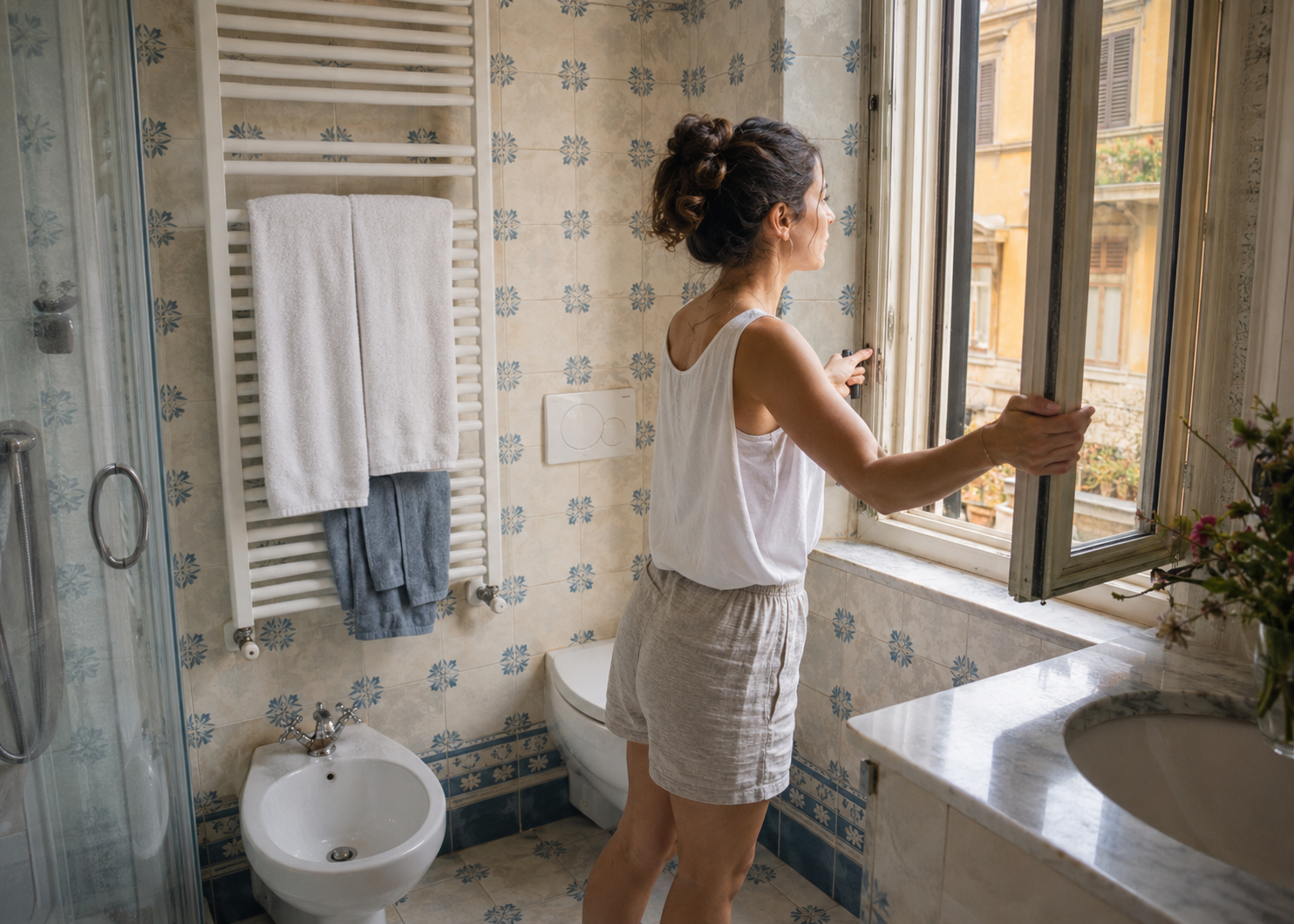
The fourth standard concerns air and light, and it reflects a Mediterranean obsession with keeping a home fresh.
Italian bathrooms are built around real ventilation, a window that opens, external shutters, a genuine exchange of air, rather than relying on an electric extractor fan as the American bathroom usually does. Italians open the window after a shower as a matter of habit, clearing the moisture before it can settle into mold, and the external shutters that feature on so many Italian buildings let a household control light and air with precision. Fresh air is treated as the natural antidote to a damp room.
The American bathroom often has no opening window at all, especially in newer construction and interior bathrooms, leaving a noisy fan as the only defense against moisture. The fan helps, but it is a poor substitute for actually exchanging the air, and the difference shows in how the two rooms smell and how they age. The Italian instinct, open the window and let the room breathe, is a small daily habit that does more for a bathroom’s longevity than any appliance.
The Heated Towel Rail
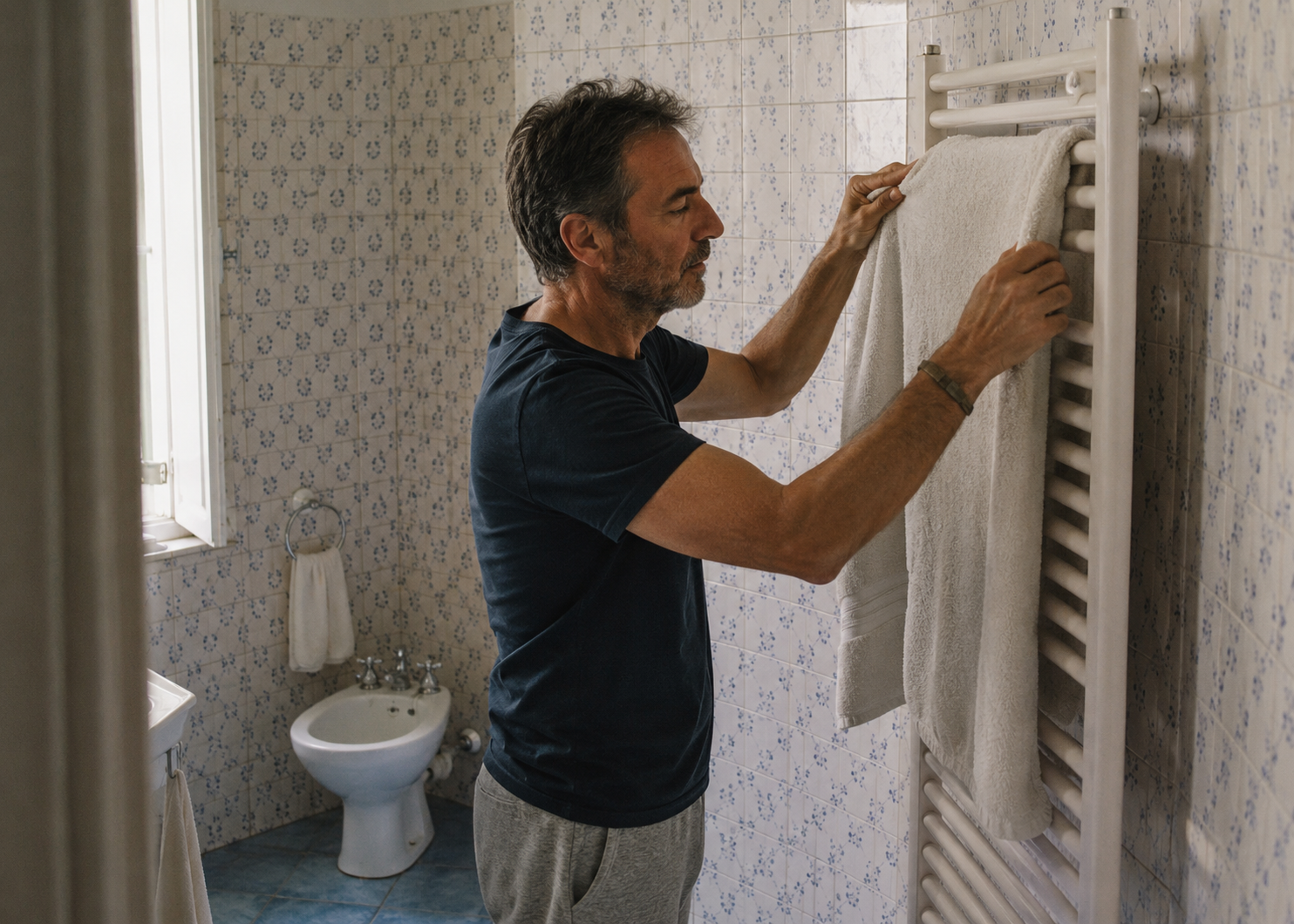
The fifth standard is a comfort the Americans tend to file under luxury and the Italians under sense.
The heated towel rail, the scaldasalviette, is a common fixture in Italian bathrooms, a radiator shaped to hold towels that keeps them warm and, crucially, dry. A warm towel after a shower is the obvious pleasure, but the real function is drying, since a damp towel left on a hook in a humid room never quite dries and starts to smell, while a towel on a heated rail is dry and fresh by the next use. In a climate with real winters, the rail doubles as the bathroom’s heat source.
Americans encounter the heated towel rail in hotels and think of it as a splurge, an indulgence reserved for nice places. The Italian household treats it as basic equipment, the solution to the perennial problem of the damp, faintly musty towel that an unheated bathroom produces. It is a small thing, but it is the kind of small thing that separates a bathroom that feels finished from one that feels merely functional.
Quality Fittings That Are Meant To Last
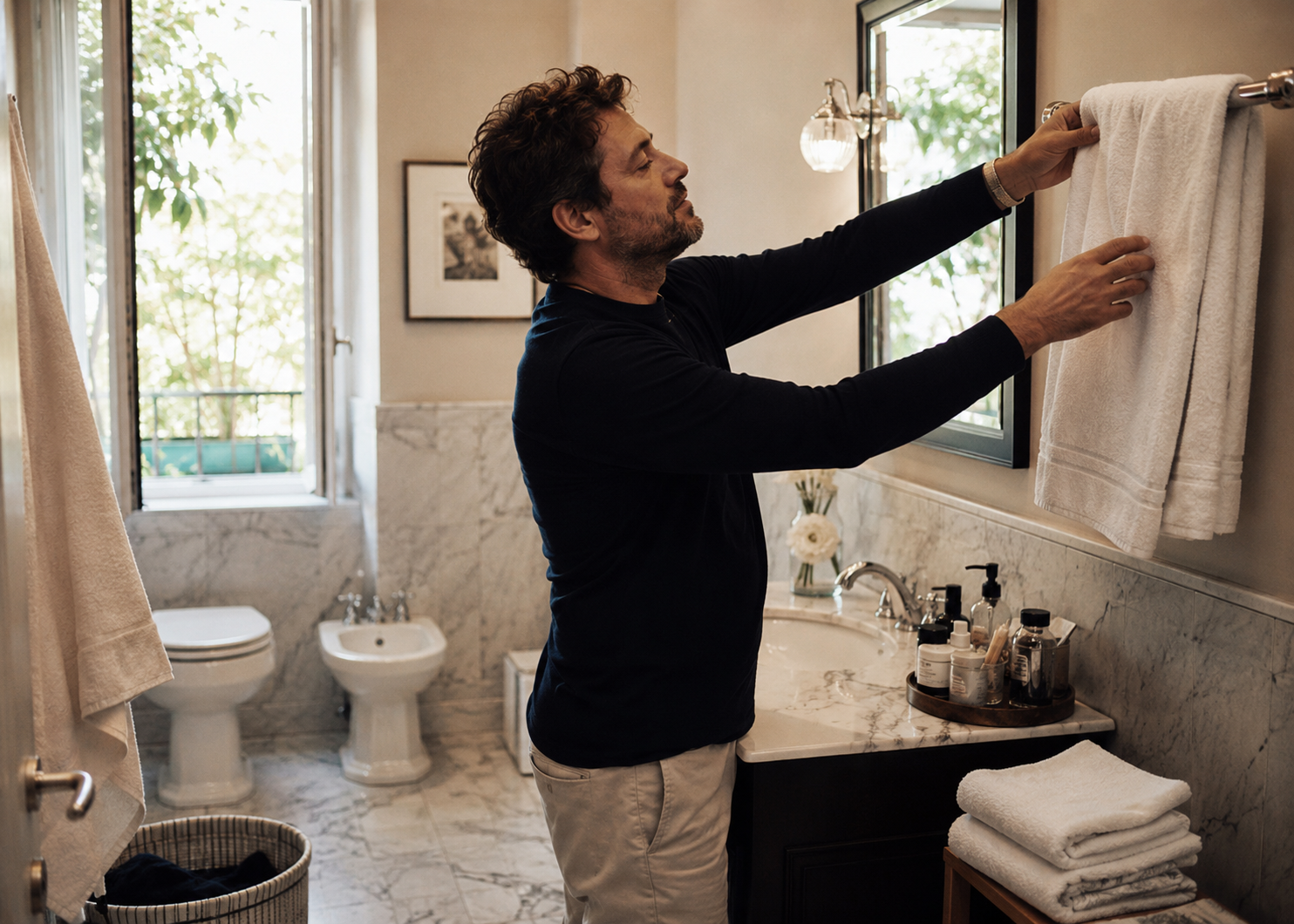
The sixth standard is about the hardware itself, and it reflects a broader Italian attitude toward buying things once.
Italian bathroom fittings, the taps, the fixtures, the hardware, tend toward solid, well-made pieces chosen to last for decades rather than the builder-grade fittings that fill many American bathrooms and get replaced every time they fail. Italy has a long tradition of design and manufacturing in exactly this category, and even ordinary households tend to choose fittings with a weight and a quality that reflect an expectation of permanence. You buy the good tap once.
The American market, with its enormous range of cheap fittings and its culture of renovation and replacement, often defaults to the affordable option that looks fine and lasts a few years. The Italian preference for the solid, lasting fitting is part of a wider Mediterranean habit of investing in the things you use every day, the difference between a bathroom assembled from the cheapest available parts and one built from pieces meant to outlast their owner.
Spotless As A Baseline
The seventh standard is about cleanliness, and it runs deeper than a cleaning schedule.
The Italian bathroom is kept clean to a standard that many visitors find striking, not occasionally deep-cleaned but maintained spotless as a matter of routine, the fully tiled surfaces wiped down, the fixtures kept gleaming. This is partly a function of the design, since a wall-to-ceiling tiled room with good ventilation is far easier to keep clean than a half-painted, poorly aired one, but it is also cultural, an expectation that a bathroom simply is clean, the way a kitchen is.
The point is that the Italian standard makes cleanliness easier rather than harder. The American bathroom, with its painted walls, its carpet in some older homes, its poor ventilation, fights against the person trying to keep it clean, accumulating the grime and mildew that the Italian design sheds. A bathroom built to be wiped down and aired out stays clean with less effort, which is the quiet genius of the whole Italian approach.
The Small Details That Add Up
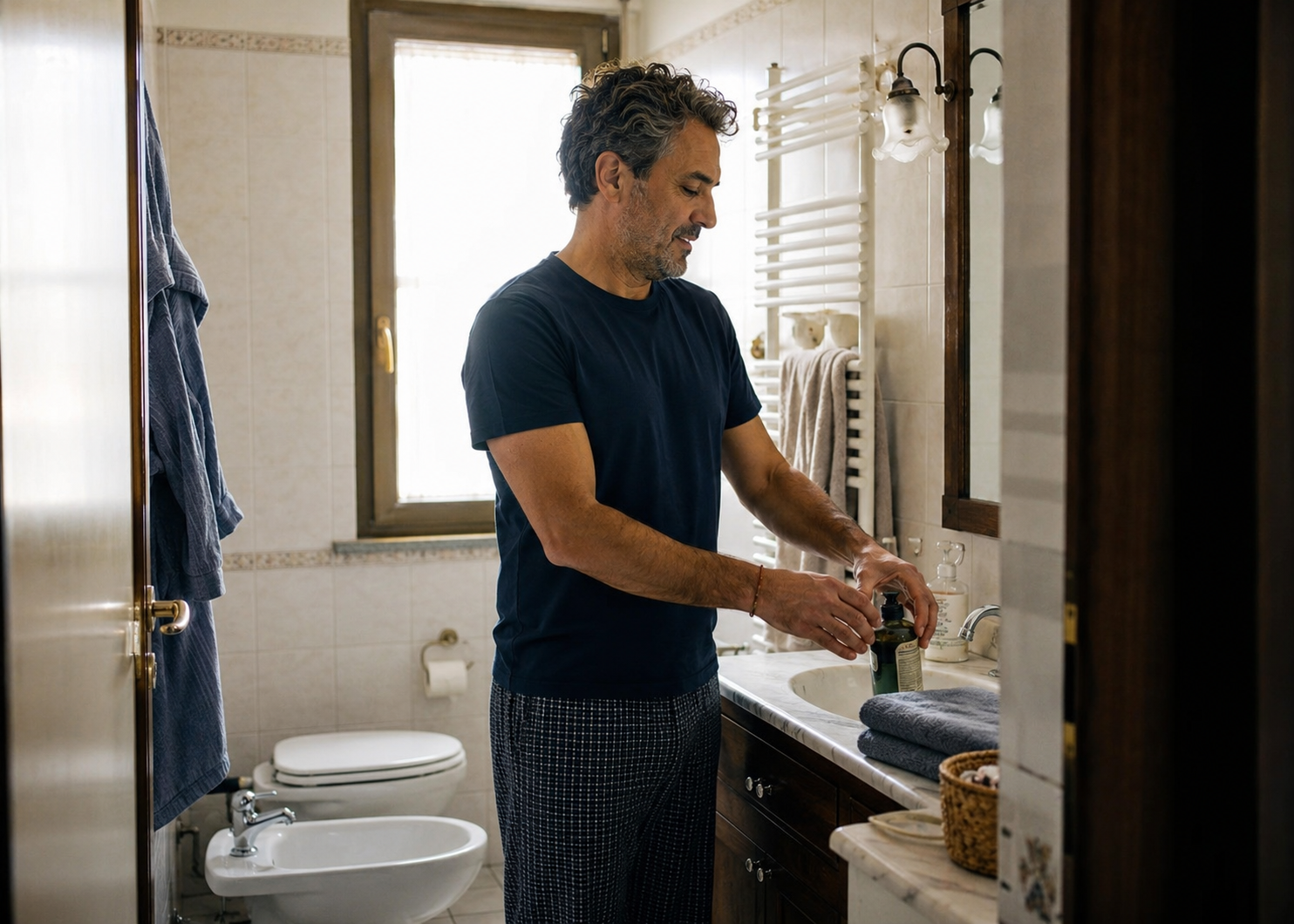
The remaining standards are smaller, but together they complete the picture of a bathroom built with more thought than the American default.
Italians tend to favor proper hand towels and quality soap over the disposable and the cheap, treating the bathroom as a room that deserves real textiles rather than the paper-towel-and-pump-bottle setup common in American homes. Storage is considered, with built-in cabinetry that keeps surfaces clear rather than the cluttered countertop of products that fills many American bathrooms. And the overall aesthetic runs toward a considered simplicity, a sense that the room was designed rather than merely assembled, even in modest homes.
None of these is dramatic on its own. A good towel, a clear surface, a room that looks thought-about. But they stack, and the cumulative effect is the thing the returning American notices, a bathroom that feels complete and cared for against one that feels like a collection of fixtures in a damp room. The Italian household did not set out to make a statement. It simply held a higher baseline for an ordinary room, and the baseline shows.
What Americans Actually Take Home
The interesting part is which of these standards Americans adopt once they have lived with them, because the conversions tell you which differences are real and which are merely cultural.
The bidet is the famous one, with handheld and seat versions spreading through American homes as returning travelers and curious converts decide they cannot go back. The heated towel rail follows close behind, an affordable upgrade that solves the damp-towel problem so completely that people wonder why they waited. The separate-toilet idea shows up in new American construction as the water closet, a quiet borrowing of the Italian split. And the wall-to-ceiling tile is increasingly the choice of Americans renovating a bathroom they intend to keep.
The deeper lesson is that the Italian bathroom is not more expensive so much as more considered, built by households that expected to stay, that valued the daily comfort of an ordinary room, and that held a standard the American market treats as optional. An American who has used these bathrooms comes home seeing the gaps, and the renovation that follows is usually just an attempt to reach the baseline an Italian nonna would have considered the obvious starting point all along.
Why The Mediterranean Got Here First

It is worth asking why the bathroom standards of Italy, and of Spain and the wider Mediterranean, diverged so sharply from the American ones, because the answer is not that one culture cared more than the other. It is that they solved different problems under different conditions.
European homes are older, smaller, and built to last in a way that shaped every room including the bathroom. A family in an apartment that has stood for a century and will stand for another, in a building they expect to pass down, invests differently than a household in newer housing built to a price and an expectation of moving on within a decade. The wall-to-ceiling tile, the solid fittings, the considered storage, these are the choices of people building for permanence in a space they cannot easily expand, where every fixture has to earn its place and last.
The climate played its part too. The Mediterranean’s warm, humid summers make ventilation and moisture control genuine necessities rather than refinements, which is why the opening window, the shutters, and the fully sealed tiled surfaces became standard. A bathroom that cannot breathe in that climate grows mold fast, so the culture learned to build rooms that air out and wipe down. The bidet, meanwhile, reflects a simple cultural conviction about water and cleanliness that runs across southern Europe and much of the world, and that the dry-paper Anglo-American tradition is actually the global outlier on.
The result is two bathroom cultures that each make sense in their own context, but only one of which a visitor tends to come home wanting to copy. Americans rarely visit Italy and decide their own bathrooms are superior. They come home and install the bidet attachment, the heated rail, the better tile, reaching piece by piece for a standard that an Italian household never had to assemble because it was simply the way a bathroom was always meant to be.
A Note For Anyone Renovating Or Moving
For the American actually planning a move to Italy or Spain, or simply renovating with these ideas in mind, a few of these standards are worth prioritizing over the others, because not all of them are equally easy to adopt.
The easiest wins are the ones that do not require tearing a room apart. A heated towel rail can replace an existing radiator or be added on, and it transforms the daily experience of the room for a modest cost. A bidet attachment or a washlet-style seat brings the single most missed Italian feature into an existing bathroom without plumbing a second fixture. Better towels and proper soap cost almost nothing and shift how the room feels immediately. These are the changes that deliver most of the Mediterranean bathroom experience for the least disruption.
The harder, more worthwhile changes are structural and belong to a real renovation. Full wall-to-ceiling tile, a genuinely opening window or a serious ventilation upgrade, and where the layout allows it, separating the toilet into its own compartment, are the choices that change a bathroom for its whole remaining life. Anyone gutting a bathroom anyway should treat these as the default rather than the upgrade, because the marginal cost during a renovation already underway is small and the payoff runs for decades. The Italian household never thought of these as optional, and the American renovating to that standard is simply catching up to a baseline that the rest of the Mediterranean settled on long ago.

About the Author: Ruben, co-founder of Gamintraveler.com since 2014, is a seasoned traveler from Spain who has explored over 100 countries since 2009. Known for his extensive travel adventures across South America, Europe, the US, Australia, New Zealand, Asia, and Africa, Ruben combines his passion for adventurous yet sustainable living with his love for cycling, highlighted by his remarkable 5-month bicycle journey from Spain to Norway. He currently resides in Spain, where he continues sharing his travel experiences with his partner, Rachel, and their son, Han.