
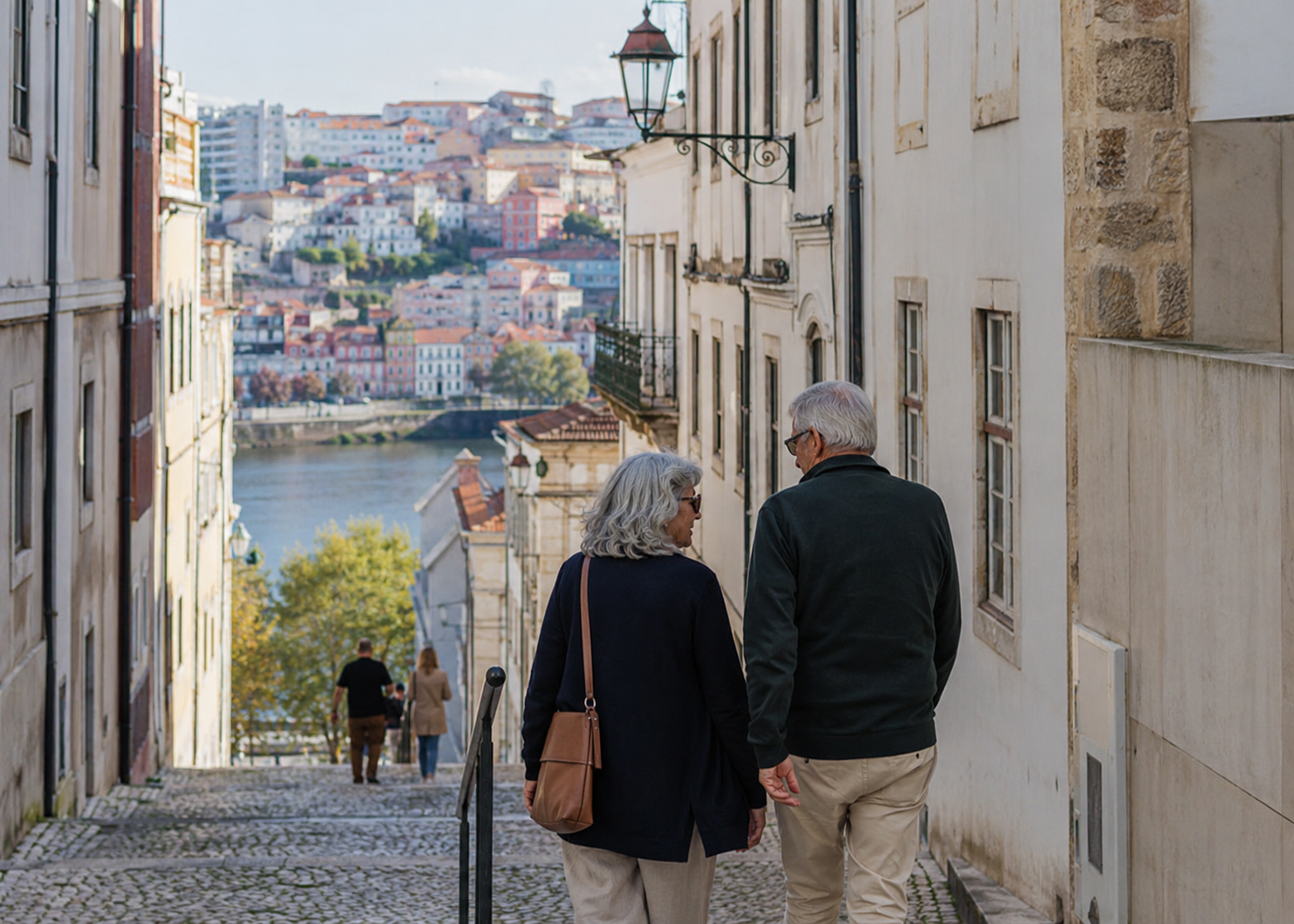
A retired nurse from Vermont arrived in Coimbra in March 2025 with $340,000 in retirement assets and a husband recovering from heart surgery. They had spent two years researching Portugal and had assumed they would end up in the Algarve, where most American retirees they knew had settled. They visited Lagos, Tavira, and Albufeira on the same trip. By day four they had crossed the Algarve off their list. The costs had climbed past what they could comfortably manage, the American expat presence was thicker than they had wanted, and the daily life felt more like a sunny suburb of an English-speaking community than the Portuguese life they had imagined. They rerouted to Coimbra on the recommendation of a Portuguese pharmacist they had met on the train.
Two years later they are still in Coimbra, in a central one-bedroom apartment for which they pay €720 monthly. Her husband is fully recovered, walks four miles daily through the historic center, and has built a small circle of Portuguese acquaintances at a cafe near the university. They have not seriously considered moving. What Coimbra delivered that the Algarve did not is the texture of actual Portuguese life at a price point that left their retirement assets intact rather than draining them.
This piece walks through what the smaller Portuguese towns actually offer, which specific places deserve American attention, what the trade-offs are honestly, and what American retirees considering Portugal beyond the Algarve and Lisbon should understand. The information is current for early 2026, with verified cost figures and an honest account of how the Portuguese landscape has shifted since the NHR closure.
What The Smaller Portuguese Towns Actually Offer

The Portuguese smaller towns share characteristics that distinguish them sharply from the Algarve and the Lisbon-Porto axis where most American retirement attention concentrates.
The costs are substantially lower. Central one-bedroom apartments in Coimbra and Braga run €600 to €800 monthly for good-quality units. In Évora, Viseu, and Aveiro, similar apartments run €500 to €700. In the truly interior cities (Bragança, Guarda, Castelo Branco, Beja, Portalegre), the same apartment often runs €350 to €500. The differential compared with central Lisbon, where equivalent apartments run €1,200 to €1,500, is substantial enough to reshape what retirement assets need to look like.
The walkability is genuine. These towns developed across centuries before automobiles. The retiree reaches the market, the pharmacy, the doctor, the bakery, the cafe, and the cathedral on foot. The Vermont nurse’s husband, who needed daily walking for his cardiac recovery, found in Coimbra a city that built the walking into ordinary errands rather than requiring deliberate exercise time. The walkability produces the cost savings and the daily physical activity in the same structure.
The community is intact. These towns have not been hollowed out by tourism the way parts of the Algarve and central Lisbon have been. The neighbors are Portuguese living their lives. The shopkeepers know their regulars. The cafes have communities of pensioners who arrive at the same hour each morning. The community fabric that the Algarve has substantially lost to international ownership and short-term rentals remains intact in the smaller towns.
The healthcare is competent and accessible. Portugal’s national health service operates throughout the country, and several of the smaller towns have hospitals attached to medical schools that provide higher-quality care than the town size would suggest. Coimbra in particular is home to one of Portugal’s best hospitals, the Hospital da Universidade de Coimbra, with English-speaking specialists available through the university hospital system. Braga has strong healthcare infrastructure. Évora has solid regional services. The Vermont couple chose Coimbra partly because the cardiology care for her husband was excellent and accessible.
The cultural depth is real. These towns have universities, medieval centers, cathedrals, museums, festivals. Coimbra’s university is among the oldest in Europe and shapes the city’s intellectual culture. Évora is a UNESCO World Heritage city. Braga has a long Catholic and academic history. The cultural offering is not the scale of Lisbon, but it is genuine and woven into daily life rather than presented as tourist experience.
The pace allows the retirement that the marketing promises. The Mediterranean rhythm of long lunches, afternoon rest, evening sociability operates in these towns more fully than in Lisbon, where the international pace has compressed it. The Vermont nurse describes her Coimbra weeks as the first time in her adult life she has felt unhurried, and she had not realized until she experienced it that unhurried was something she had been missing.
Which Specific Towns Deserve American Attention
Several smaller Portuguese towns deserve specific consideration. Each has its own character and trade-offs.
Coimbra, in central Portugal. A university city of approximately 100,000 in the central interior, with a historic center on the Mondego River. The university dating to 1290 is the cultural anchor. Central one-bedroom apartments run €600 to €800 monthly. Excellent hospital infrastructure. Train connections to Lisbon (just under two hours) and Porto (just over an hour). Best suited to retirees who want a real urban texture with intellectual life, walkable historic streets, and the medical infrastructure that demanding healthcare needs require. The trade-off is that Coimbra is a working Portuguese city, not a destination, and retirees who want a clear expat infrastructure will find less of it than in the Algarve.

Braga, in northern Portugal. A city of approximately 190,000 known as the religious capital of Portugal, with the country’s oldest cathedral. One-bedroom apartments in the center run €450 to €700, the lowest among Portugal’s major cities. The town has a young population and a tech sector that gives it more dynamism than its size suggests. The nearby UNESCO town of Guimarães offers even lower prices. Strong train connections to Porto. Best suited to retirees who want a more youthful urban energy with deep traditional culture and the lowest costs among Portugal’s substantial cities. The trade-off is that the climate is cooler and rainier than the south.
Évora, in the Alentejo. A small city of approximately 55,000 in southern interior Portugal, a UNESCO World Heritage site with Roman ruins, medieval walls, and a remarkable historic center. One-bedroom apartments run €500 to €700. The Alentejo plain stretches around it, producing the wine and cork and olive oil that anchor the regional economy. Lisbon is reachable in 90 minutes by car or train. Best suited to retirees who want a smaller scale, dramatic historic surroundings, and proximity to Lisbon without Lisbon prices. The trade-off is that Évora is genuinely small and quiet, with hot summers and limited specialized services.
Viseu, in central Portugal. A city of approximately 100,000 frequently ranked among Portugal’s most livable cities. One-bedroom apartments run around €600. Clean, organized, with strong infrastructure and a graceful historic center. The professional and retired population is solidly middle-class. Best suited to retirees who want a comfortable, well-functioning city with good services and reasonable cost. The trade-off is that Viseu has limited international connectivity and a smaller cultural offering than the larger cities.
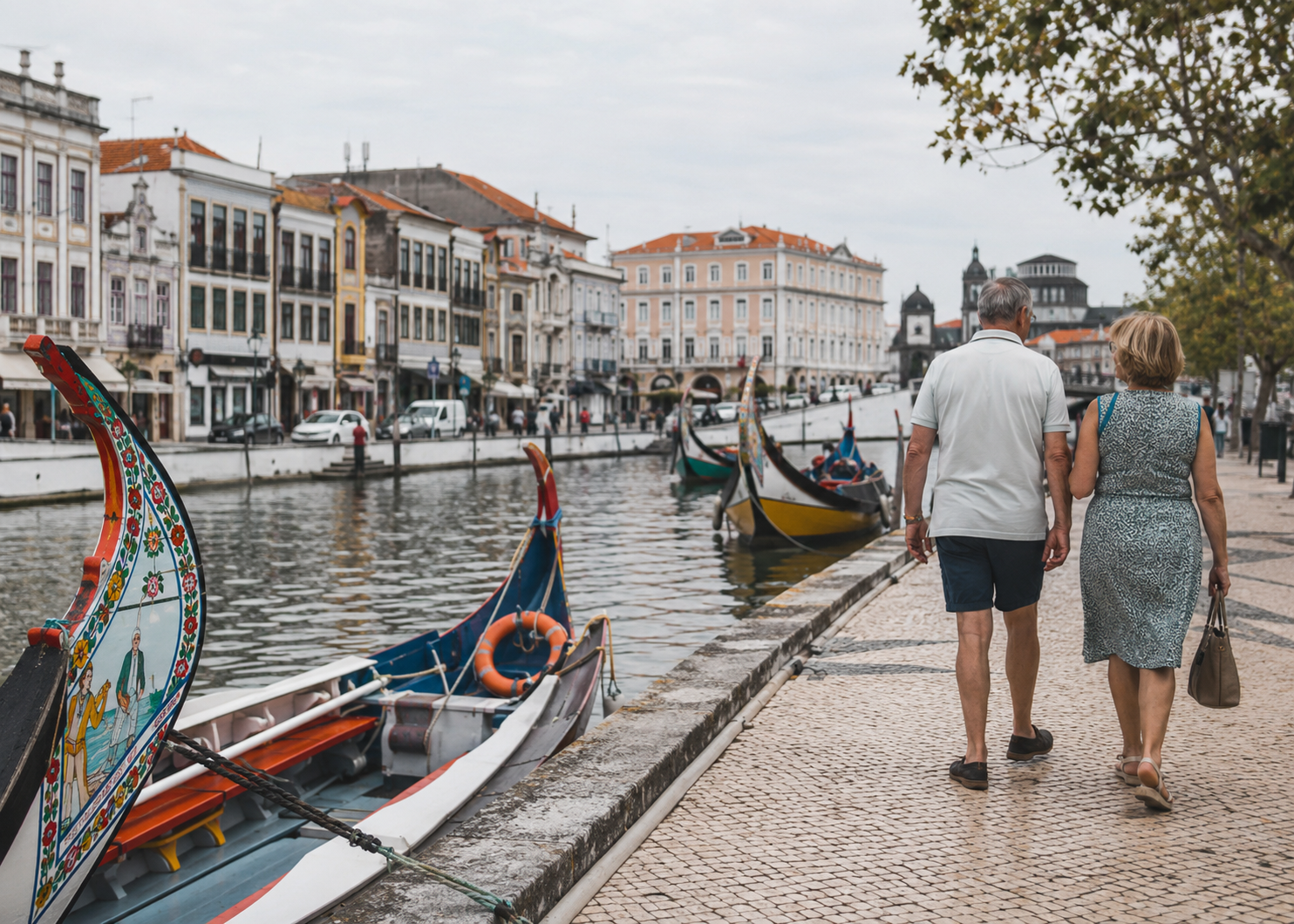
Aveiro, on the central coast. A city of approximately 80,000 sometimes called the Venice of Portugal for its canals and traditional boats. One-bedroom apartments run €600 to €800. Coastal location with reasonable beach access. University presence. Connected to Porto by frequent regional trains. Best suited to retirees who want a smaller coastal city with intact Portuguese character at substantially lower cost than the major coastal destinations. The trade-off is that Aveiro is becoming more discovered, and prices are rising faster than in the deeper interior.
Bragança, in the far northeast. A district capital of approximately 35,000 near the Spanish border, frequently cited as one of the most affordable cities in Portugal. One-bedroom apartments can be found for €350 to €500. Hospital, higher education institutions, and full everyday services despite the remote location. Best suited to retirees who prioritize cost minimization and accept genuine remoteness. The trade-off is the distance from major hubs (more than four hours by car to Lisbon) and the limited cultural offering.
Each of these towns delivers walkable historic centers, competent healthcare, cultural depth, and real Portuguese community at prices substantially below Lisbon and the Algarve. The choice among them depends on the size of city desired, climate preference, and how much remoteness the retiree is willing to accept.
What The Trade-Offs Honestly Are
The Portuguese smaller towns offer real value, but they come with trade-offs American retirees should understand before committing.
English is less commonly spoken than in the Algarve. The Algarve has extensive English-speaking infrastructure built around international tourism and the substantial British and American expat populations. The smaller Portuguese towns operate primarily in Portuguese. The retiree who does not learn functional Portuguese will struggle with daily life in ways that would be less acute in the Algarve. Portuguese is harder than Spanish for English speakers, and the European Portuguese pronunciation in particular requires real adjustment. This is a meaningful demand.
The expat community is thinner. Americans wanting substantial English-speaking community find more of it in the Algarve, in Cascais near Lisbon, or in the Lisbon city itself. The smaller towns have few other Americans. The Vermont nurse describes the absence of American expats in Coimbra as a feature rather than a problem, but she notes that retirees seeking a community of fellow Americans should be honest about that need before choosing a smaller town.
The post-NHR tax situation requires careful planning. Portugal closed the Non-Habitual Resident regime in January 2024, and the replacement IFICI regime explicitly excludes pension income. Most American retirees now pay standard Portuguese tax rates on their US-source retirement income, which runs progressive from 13 to 48 percent depending on income level. The Portugal that offered favorable tax treatment to retiring Americans across the 2010s has substantially closed that door. The math now needs honest calculation at current rates, not at the favorable rates that closed.
The Golden Visa real estate route is closed. Portugal eliminated the residential property investment pathway for the Golden Visa in October 2023. The Golden Visa now requires investment in funds, scientific research, or other narrower categories, not property purchase. American retirees who had planned around the property route need different residency planning, typically the D7 visa for retirees with passive income.
The citizenship timeline has lengthened. Portugal’s citizenship law changed in May 2026, extending the residency requirement from five to ten years. Americans planning Portuguese citizenship as the long-term endpoint of their move now face a meaningfully longer path. Those already in the system under the old rules retain their position; those just beginning face the new timeline.
The bureaucracy is real. Portuguese residency, healthcare registration, and tax matters require navigating a bureaucracy that operates at its own pace. The smaller towns have less English-language professional support than Lisbon or the Algarve, which means engaging Portuguese-speaking professionals or those few specialists who serve foreign clients in smaller towns. The Vermont couple worked with a Coimbra lawyer who specialized in foreign residents, and they describe the engagement as essential.
Winters in some are cold. Bragança, Guarda, and the interior northern towns have genuinely cold winters with snow. The sunny warm Portugal of the imagination is more the Algarve and coastal central Portugal than the interior. Retirees specifically seeking warmth should weight the coastal options and southern Alentejo (Évora) more heavily than the northern interior.
These trade-offs are real. For many American retirees, the trade-offs are acceptable in exchange for the costs, the walkability, and the community texture. For others, the trade-offs argue for the Algarve or Lisbon despite the higher costs. The honest evaluation comes from visiting and from running the actual financial math, not from the marketing.
What Practical Steps Look Like
For American retirees seriously considering Portuguese smaller towns, the practical path forward has specific shape.
Visit during the season you would actually live there. Most Americans visit Portugal in spring or autumn when conditions are best. The honest test is winter, particularly in interior towns where the climate is harshest. A week in Coimbra in February reveals what daily life in February actually feels like. A week in August reveals the heat. Both visits matter.
Stay long enough to test daily life. Two weeks is the minimum that produces real information. A month is better. The Vermont nurse and her husband spent three weeks in Coimbra before deciding to relocate, which gave them time to walk the neighborhoods, eat at the local cafes, meet the doctor they would use, and confirm that the apartment options matched the budget they had calculated.
Engage a Portuguese lawyer who handles foreign residents. The D7 visa, the residency permits, the tax registration, the healthcare enrollment. These require professional help. The cost is modest. The savings in time, stress, and avoided mistakes are substantial.
Run the actual Portuguese tax math. With NHR closed, the standard Portuguese tax system applies. Get a qualified cross-border tax advisor to calculate what your specific US-source retirement income would actually produce in Portuguese tax. The number is not catastrophic for most retirees, but it needs to be in the budget rather than discovered after arrival.
Plan for the longer citizenship timeline. Ten years rather than five. For some retirees this changes nothing, since they were never planning to seek citizenship. For others it changes the strategic calculation about Portugal versus other European options that still offer shorter paths.
Decide whether you can commit to Portuguese. The smaller towns require it. Be honest with yourself. The retiree who arrives expecting to operate in English in Bragança or Évora will struggle. The retiree who commits to six to twelve months of intensive Portuguese before the move arrives prepared for the actual situation.
Build local connections deliberately. The intact community in the smaller towns welcomes outsiders who make the effort. Join something specific: a hiking group, a language exchange, a cultural association, a parish if you are religious, a regular cafe. The Vermont couple joined a Saturday morning hiking group that walks in the hills around Coimbra. The hiking group became their primary social community within their first six months.
What The Coimbra Couple Has Learned
The Vermont nurse and her husband, two years into their Coimbra life, describe their financial trajectory in terms that match what the math would predict. Their monthly costs run approximately €2,200 in total, against a US Social Security income of $3,400 monthly. They have not had to draw from their portfolio. The Vermont house they retained when they moved generates another $1,400 monthly net, which they are reinvesting. Their retirement assets are growing rather than shrinking.
Her husband’s cardiology care has been excellent. He has a cardiologist at the university hospital who speaks English and has been managing his case competently across two years. The Portuguese public health system has covered most of his care; the small private supplemental insurance they maintain handles the rest. The catastrophic medical cost exposure that defined his American care has effectively disappeared.
Their Portuguese has progressed from minimal to functional. They handle ordinary daily life in Portuguese now. They are not fluent, but they are integrated enough that the daily friction has dissolved. The cafe regulars greet them by name. The shopkeepers ask after her husband’s health. The hiking group has become genuine friendship across two years.
They tell other Americans considering Portugal that the smaller towns deserve serious attention, that the Algarve and Lisbon are not the only options, and that the costs and the quality of life in towns like Coimbra produce a version of Portuguese retirement that the famous destinations cannot match at any reasonable price. They do not regret crossing the Algarve off their list on day four of their initial trip. They regret only that they did not know about Coimbra sooner.
For American retirees currently evaluating Portuguese options, the recognition is that the Algarve and Lisbon define one version of Portuguese retirement and the smaller towns define another. Both are real. Both work for different kinds of retirees. The smaller towns offer substantial savings, deeper community, more walkability, and more authentic Portuguese daily life at the cost of less English-speaking infrastructure and thinner expat community. The retiree willing to accept those trade-offs finds in towns like Coimbra, Braga, Évora, and Viseu a version of Portugal that the marketing has largely missed and that delivers what the retirement marketing promised more fully than the famous destinations now do.

About the Author: Ruben, co-founder of Gamintraveler.com since 2014, is a seasoned traveler from Spain who has explored over 100 countries since 2009. Known for his extensive travel adventures across South America, Europe, the US, Australia, New Zealand, Asia, and Africa, Ruben combines his passion for adventurous yet sustainable living with his love for cycling, highlighted by his remarkable 5-month bicycle journey from Spain to Norway. He currently resides in Spain, where he continues sharing his travel experiences with his partner, Rachel, and their son, Han.