
A French shopper in a Carrefour in Lyon picks up a box of cereal. She turns it over and reads the ingredient list. Eight ingredients. Whole wheat, sugar, salt, malt extract, natural flavoring, and three vitamins.
The same brand on an American supermarket shelf in Houston has nineteen ingredients on the back of the box. The first twelve match. The remaining seven include two synthetic preservatives, two artificial colors, an emulsifier, an anti-caking agent, and a flour treatment that has been prohibited in EU food for nearly twenty years.
The cereals are not the same product. They have the same name on the box, the same logo, and the same advertising. The contents have been reformulated for the European market because the European market does not permit the additives the American product contains.
This piece walks through the specific ingredients that France and the broader EU have restricted or banned, what they do in cereal, why they were banned, and what American shoppers can do with this information.

Why The EU Acted Twenty Years Ago
The regulatory trajectory that produced the current divergence began in 2002.
The EU General Food Law of January 2002 established the precautionary principle in European food regulation. The precautionary principle holds that ingredients with insufficient safety evidence can be restricted or banned even when conclusive human harm has not been proven. The American system operates on a different principle: ingredients are generally permitted unless conclusive harm is established.
The 2002 framework produced a series of specific actions over the following decade. Regulation 1333/2008 consolidated EU food additive law and established the current list of permitted additives in Annex II. Anything not on the list is not permitted. This is the opposite of the American approach, which permits anything not specifically prohibited.
Propylparaben was banned in EU food in 2006. Azodicarbonamide was prohibited in 2005. Synthetic dyes including Red 40, Yellow 5, and Yellow 6 received mandatory warning labels in 2010 (the warnings specifically about effects on children’s behavior). BHT restrictions tightened in 2022 due to endocrine disruption concerns. BHA has been classified as a possible carcinogen by the International Agency for Research on Cancer for over thirty years and is heavily restricted in EU food, including a complete ban in infant food.
The cumulative effect is that the EU regulatory regime has progressively eliminated or restricted exactly the categories of additives that American breakfast cereals rely on most heavily. The American cereal industry could have reformulated their products to meet EU standards globally. They chose to reformulate for the European market and keep the original formulations in America.
The Specific Ingredients Affected
The ingredients most commonly removed from American cereals when they are sold in France fall into a few categories.
BHA (butylated hydroxyanisole). A synthetic antioxidant used to prevent the fats and oils in cereal from going rancid. Extends shelf life from weeks to months or years. Classified as possibly carcinogenic to humans by the IARC. Banned in EU infant food and heavily restricted elsewhere. Still listed as Generally Recognized As Safe (GRAS) by the FDA, though the FDA opened a new safety review of BHA in February 2026.
Common American cereals containing BHA include several Kellogg’s products in their American formulations. The same cereals sold in France use natural antioxidants (tocopherols, rosemary extract) instead.
BHT (butylated hydroxytoluene). Similar to BHA but with stronger endocrine disruption concerns. Used for the same shelf-life purpose. Restricted in EU food since 2022. The FDA opened a postmarket safety assessment of BHT in August 2025.
Found in many American cereal products, granola bars, and crackers. The European versions of the same products substitute natural antioxidants or accept shorter shelf life.
TBHQ (tert-butylhydroquinone). Petroleum-derived preservative. Banned for food use in Japan. Restricted in the EU. The FDA permits up to 0.02 percent in fats and oils. Associated with neurological effects in animal studies at higher doses.
Used in some American cereals, snack crackers, and microwave popcorn. Not found in European versions of the same products.
Synthetic dyes (Red 40, Yellow 5, Yellow 6, Blue 1, Blue 2). Petroleum-derived food colorings. Required warning labels in EU products since 2010 specifically warning that the dyes “may have an adverse effect on activity and attention in children.” Many European manufacturers reformulated rather than use the warning label.
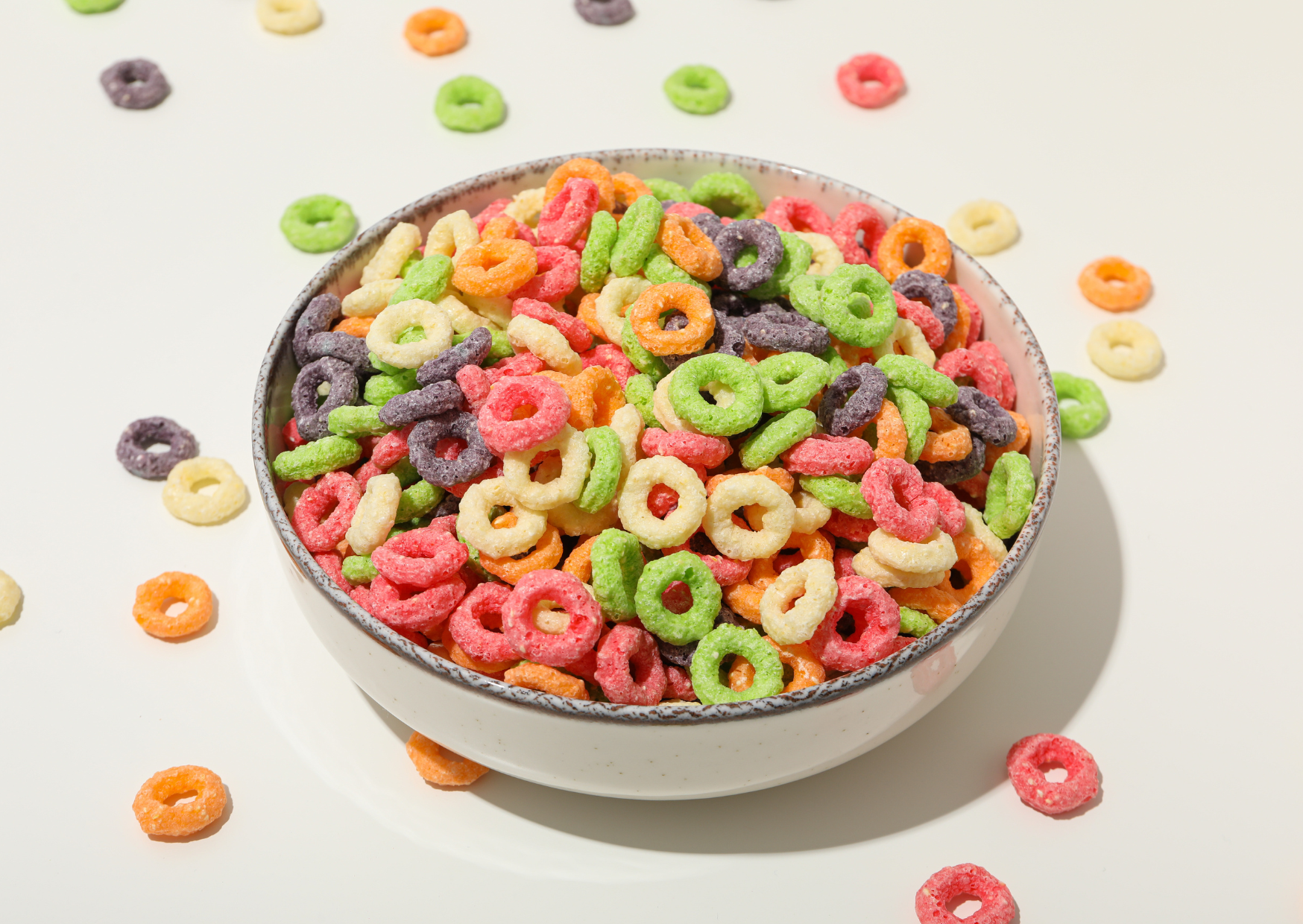
Common in American children’s cereals (Froot Loops, Lucky Charms, Trix, Apple Jacks, and similar). The European versions of Froot Loops and similar cereals use beet juice, turmeric, paprika extract, and other natural colorings. The reformulation produces visibly less vivid colors but otherwise identical products.
Azodicarbonamide (ADA). Flour treatment agent. Used to whiten flour and condition dough. Banned in EU food. Classified as a possible carcinogen by the World Health Organization based on its breakdown products during baking.
Found in some American cereal-related products including the flour used in cereal bars and certain crackers. Banned across all EU food applications since 2005.
Potassium bromate. Flour oxidizer. Used to strengthen dough and improve baking quality. Banned in the EU, UK, Canada, Japan, Brazil, and many other jurisdictions. Classified as possibly carcinogenic to humans.
Found in some American baked goods including some cereal products. California banned potassium bromate from food sold in the state starting 2027.
BVO (brominated vegetable oil). Used in some cereal-adjacent beverages. Contains bromine compounds that accumulate in body tissue. Banned in EU food. The FDA finally revoked the GRAS status for BVO in 2024 after decades of restriction internationally.
The full list extends further. Propylparaben, certain artificial flavorings, certain emulsifiers, and other additives have similar regulatory differences between the EU and US.
What These Ingredients Do In Cereal
Each ingredient serves a specific manufacturing or commercial purpose. Understanding what they do explains why American manufacturers use them and why European manufacturers have found alternatives.
Shelf life extension. BHA, BHT, and TBHQ all prevent the fats in cereal from oxidizing. American cereal can sit on a supermarket shelf for 12 to 18 months without rancidity developing. European cereal without these preservatives has a shelf life of 4 to 8 months. The shorter shelf life requires more frequent restocking and tighter supply chain management. European cereal manufacturers have built their distribution to accommodate this.
Visual appeal. Synthetic dyes produce the saturated colors that American children’s cereals are famous for. The pink, the bright green, the electric blue. European cereals using natural colorings produce muted versions of the same shapes. A European Froot Loop is dustier in color than an American one. The cereal still works as cereal. The visual difference is significant.
Texture and uniformity. Anti-caking agents, emulsifiers, and flour treatments produce uniform texture and pourability. The European alternatives produce slightly less uniform textures that some consumers initially find less appealing. The functional difference is minimal once the consumer adapts.
Cost reduction. Most of these synthetic ingredients are cheaper than the natural alternatives. BHA and BHT cost a fraction of what rosemary extract costs at industrial scale. Synthetic dyes cost less than natural colorings. The American cereal industry uses these ingredients largely because they reduce production costs, not because they produce a better product.
Vitamin stability. Some additives protect added vitamins from degradation during the cereal’s shelf life. This is the legitimate health-related function of certain preservatives. European manufacturers handle this through different processing methods and shorter shelf life rather than through synthetic preservatives.
The combined effect is that American cereal exists as it does largely because the regulatory and consumer environment permits and encourages low-cost industrial formulations. European cereal exists differently because the regulatory environment requires different formulations.
The Cardiovascular Angle Most Discussion Misses
The conversation about banned ingredients in American cereals usually focuses on cancer risk and behavioral effects in children. A separate angle that gets less attention is cardiovascular.
The ingredients themselves are not the main cardiovascular issue. The bigger issue is what the ingredients enable. Synthetic preservatives, dyes, and texturizers permit the manufacture of cereals that are dramatically higher in sugar, refined flour, and seed oils than traditional cereals could be while remaining shelf-stable and visually appealing.
The American cereal aisle contains hundreds of products in which sugar is the first or second ingredient by weight. Many American children’s cereals are 35 to 50 percent sugar. The same products in their European reformulations often have lower sugar content because European consumer preferences and regulatory pressure on children’s marketing have pushed manufacturers to reduce sweetness.
The refined flour content is high in many American cereals. The glycemic load of a typical American breakfast cereal is comparable to that of a soft drink. Daily consumption of high-glycemic breakfast cereals has been associated in research with adverse changes in lipid profiles including elevated LDL cholesterol, lowered HDL cholesterol, and elevated triglycerides.
Seed oils used as ingredients or as the substrate for added flavors and colors contribute to the overall composition. Many American cereals contain palm oil, soybean oil, or canola oil in amounts that are not nutritionally meaningful but that contribute to the inflammatory profile of the overall food matrix.
The 30-day observation pattern that some American consumers run when they switch to ingredient-clean cereals (European cereals, organic American cereals, or homemade alternatives) involves multiple simultaneous changes: lower sugar, less refined flour, fewer seed oils, no synthetic preservatives, no synthetic dyes. The cardiovascular markers that improve in such observations are responding to the combined change, not to any single ingredient elimination.
Published research on dietary patterns including the Mediterranean diet pattern and the Portfolio diet pattern has consistently shown that elimination of ultra-processed foods produces measurable improvements in LDL cholesterol, blood pressure, and inflammatory markers over 30 to 90 days. Breakfast cereals as commonly consumed in America are categorized as ultra-processed foods by the NOVA classification system used in nutritional research.
For readers currently managing cholesterol, blood pressure, or cardiovascular risk factors, the cereal aisle is one specific location where ingredient changes can produce measurable effects. Discussions with a physician about whether to adjust medication based on dietary changes should happen with the physician, not based on blog content. Statins and other cardiovascular medications are prescribed based on individual risk profiles that cannot be addressed in general writing.
What 30 Days Of Elimination Often Produces
The pattern observed when American adults eliminate ultra-processed American breakfast cereals for 30 days, replacing them with either European-formulation alternatives or with simpler whole-grain alternatives, is consistent enough to describe.
Weight loss of 2 to 6 pounds is commonly observed, attributable to lower caloric density and lower glycemic load producing better satiety. The effect is not dramatic but is measurable.
Improved morning energy stability. The post-breakfast blood sugar peak and crash that high-glycemic American cereals produce is replaced by steadier energy across the morning. Many consumers report this is the most noticeable subjective effect.
Reduction in mid-morning hunger and snacking. The European-style breakfast with whole grains, less sugar, and natural fats produces satiety that lasts to lunch. The American sugar-cereal pattern often produces hunger by 10:30am.
Modest improvements in lipid profile markers. Published research on similar dietary changes shows average LDL cholesterol reductions of 8 to 18 mg/dL over 30 to 90 days, depending on the specific changes made. The cereal change alone is a subset of this. Combined with other dietary improvements, the cholesterol effect can be meaningful.
Modest improvements in fasting blood glucose. Reductions of 5 to 15 mg/dL are commonly observed when high-glycemic morning cereals are eliminated.
Changes in skin appearance. Some consumers report clearer skin within 30 days. The mechanism likely involves reduced inflammation from the dietary changes overall.
Changes in children’s behavior. Parents who switch children from synthetic-dye-containing cereals to dye-free alternatives sometimes observe modest improvements in attention and behavior. The effect is most pronounced in children who showed adverse reactions to dyes previously.
These patterns are observations of what often happens, not guarantees of what will happen for any individual. Individual responses to dietary changes vary substantially. People with specific medical conditions, on specific medications, or with specific genetic profiles may respond differently than the general pattern suggests.
What This Means For American Cereal Buyers

For American consumers wanting to align their breakfast cereal choices with EU standards, several practical steps work.
Read the ingredient list. Look for BHA, BHT, TBHQ, synthetic dyes (Red 40, Yellow 5, Yellow 6, Blue 1, Blue 2), and azodicarbonamide. Any cereal containing these would be reformulated or banned in the EU.
Choose American cereals that already meet EU standards. Some American manufacturers produce clean-ingredient cereal lines. Cascadian Farm, Nature’s Path, Bob’s Red Mill, and similar brands typically use natural preservatives and natural colorings. These cereals are widely available at standard American supermarkets and cost only modestly more than the synthetic-additive alternatives.
European cereals available in American stores. Some European brands import to the US. Weetabix, certain Sainsbury’s products, certain German muesli brands. These maintain their EU formulations. The cost is higher but the ingredient lists are cleaner.
Whole grain alternatives. Plain oatmeal, plain bran cereal, plain whole grain wheat cereal without added flavors or colors contain none of the affected ingredients. The cost is dramatically lower than branded cereals and the nutritional profile is meaningfully better.
Homemade granola. Made with whole oats, real nuts, real seeds, real dried fruit, and a small amount of real honey or maple syrup. The ingredient list is whatever you choose to put in it. Cost runs about $4 to $7 per pound of homemade granola versus $5 to $9 per pound for clean-ingredient store-bought.
Consider what breakfast actually needs to be. The American expectation that breakfast comes from a box of cereal is itself an industrial product of the early 20th century. European breakfast often consists of bread with butter and jam, eggs with vegetables, yogurt with fruit, or muesli with milk. None of these require a box of cereal. The cereal aisle can be skipped entirely.
A Note On Acting On This Information
Anyone considering changes to their diet specifically for cardiovascular risk management, cholesterol management, or other medical purposes should discuss the changes with their physician. The information in this piece describes patterns observed in research and in consumer experiences. It is not medical advice for any individual reader.
Changes to prescribed medications, including statins and other cardiovascular medications, should never be made without medical supervision. Patients who stop these medications based on dietary changes alone can face serious cardiovascular consequences. The medication and the dietary change can work together but the decision-making belongs to the patient and the physician, not to the blog.
For readers without specific medical conditions who simply want cleaner ingredients in their breakfast, the information here is straightforward. The cereal aisle is one specific location where American shoppers can make different choices that align with European standards. The choices are available. The cost differential is modest. The information is sufficient for the shopper to act on without further guidance.
What The Lyon Shopper Recognizes

The French shopper turning over the cereal box in the Carrefour aisle is operating in a regulatory environment that has progressively narrowed the additives permitted in her food over the past two decades. She does not need to be vigilant about specific ingredients because the regulatory system has been vigilant on her behalf. The default in her supermarket is closer to what American consumers have to actively seek out.
The American shopper in Houston is operating in a different regulatory environment. The defaults in her supermarket include ingredients that the EU has restricted or banned. She has to be vigilant about specific ingredients to achieve what is automatic in the French supermarket.
Neither system is necessarily better in absolute terms. The American system permits more innovation, more variety, and lower prices on basic products. The European system permits less variety and higher prices but provides cleaner default ingredient profiles. The cardiovascular outcomes in the two populations differ in ways that have multiple causes, of which cereal ingredients are one small contributor.
For Americans who want to bring their breakfast cereal choices closer to European norms, the path is clear. Read the labels. Avoid the specific additives the EU has restricted. Choose alternatives that already meet EU standards. The choice does not require moving to France. It requires reading the back of the box and choosing differently in the cereal aisle.
The 30-day pattern that many consumers run produces visible effects often enough to be worth trying. The cereal change alone is a small change. Combined with broader dietary improvements, it becomes part of a meaningful pattern. The Lyon shopper is not doing anything special. She is buying breakfast. The fact that her breakfast contains fewer industrial additives than the same brand sold in America is the regulatory environment working as it was designed to work, twenty years after the relevant decisions were made.

About the Author: Ruben, co-founder of Gamintraveler.com since 2014, is a seasoned traveler from Spain who has explored over 100 countries since 2009. Known for his extensive travel adventures across South America, Europe, the US, Australia, New Zealand, Asia, and Africa, Ruben combines his passion for adventurous yet sustainable living with his love for cycling, highlighted by his remarkable 5-month bicycle journey from Spain to Norway. He currently resides in Spain, where he continues sharing his travel experiences with his partner, Rachel, and their son, Han.