
When Americans dream of retiring to Europe on a modest income, they almost always think of the same handful of places: Portugal, Spain, maybe Italy. They rarely think of Budapest. And yet the Hungarian capital quietly offers something those sunnier favorites increasingly do not: a genuinely grand European city, full of thermal baths and riverside grandeur and cafe culture, at a cost of living low enough that a careful couple can live there well on around nineteen hundred dollars a month.
That figure, nineteen hundred dollars for two people, sounds almost too low for a European capital, and it comes with real caveats we will get to honestly. But in Budapest it genuinely works, and it buys a life that would be impossible on the same money in Lisbon or Madrid, let alone back home. The city is one of the last real bargains among Europe’s great capitals, and most American retirees have never seriously looked at it.
Here is what retiring to Budapest on roughly nineteen hundred dollars a month actually looks like, where that money goes, why the city is so overlooked, and the genuine tradeoffs, the forint, the clunky residency, the cold winters, that you have to weigh before you fall in love with the idea. None of this is financial or legal advice; it is an honest look at an underrated option.
The Couple, and the Honesty About Them

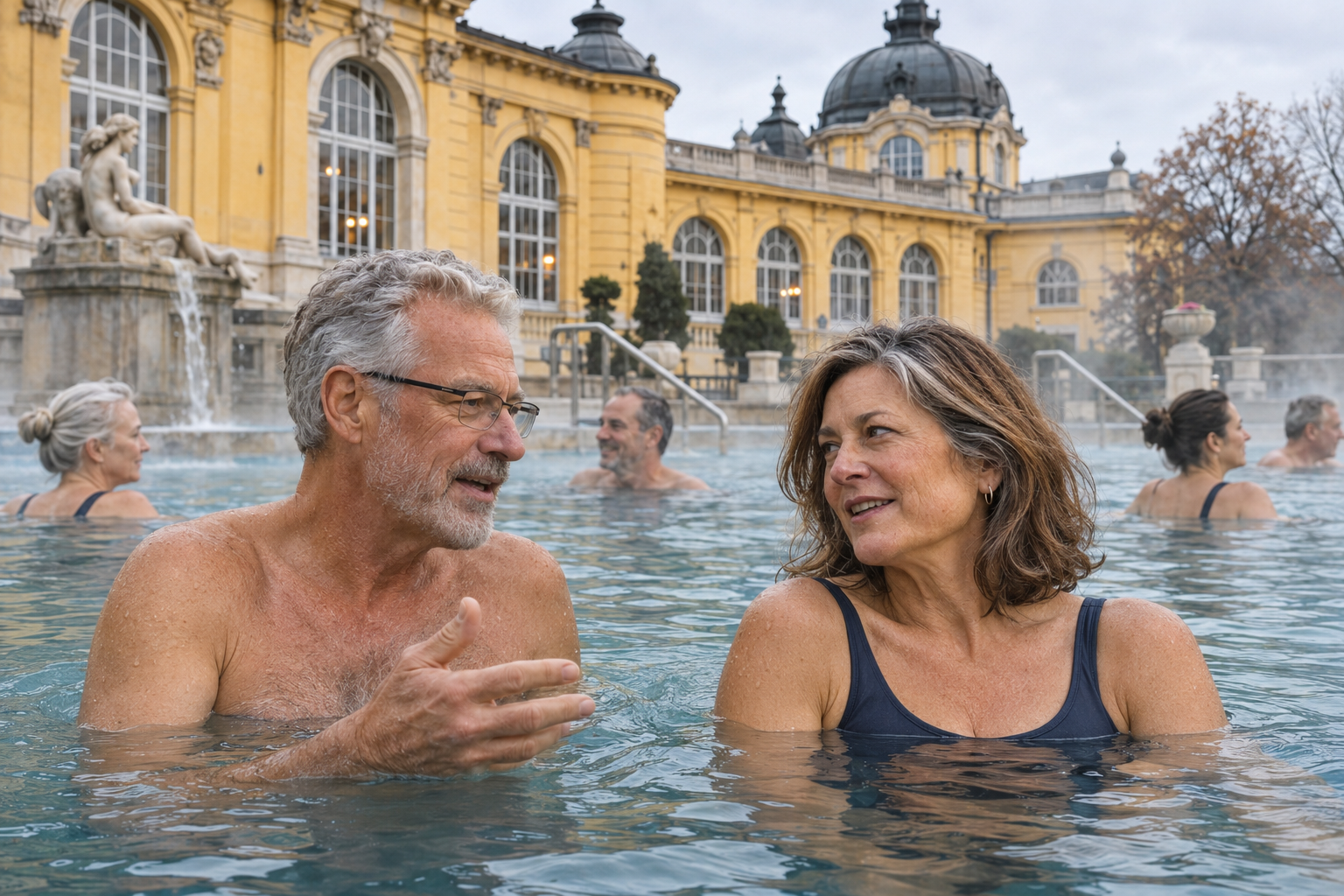
Before going further, a necessary bit of honesty about the couple in the title. They are a composite, an illustrative example built from real Budapest cost-of-living data rather than a specific real pair of people, used to show what a nineteen-hundred-dollar-a-month retirement in the city realistically looks like. There is no first-person diary here, no single true story being sold as typical; there is a representative budget and a representative life, grounded in actual numbers.
This matters because retirement-abroad writing is full of suspiciously perfect personal tales that gloss over the hard parts, and the point here is the opposite: to show, plainly and with the real figures, what a modest income does and does not stretch to in Budapest. The composite couple lets us do that honestly, pricing out a genuine life, two retired Americans living carefully but comfortably in the Hungarian capital, without pretending every reader’s experience will match.
So treat the nineteen-hundred-dollar couple as a worked example rather than a testimonial. What follows is the actual math of their month, drawn from current costs, and an honest account of the life it supports and the compromises it requires. That, rather than a rosy story, is what will actually help you judge whether Budapest could work for you.
Where the $1,900 Goes

So where does the money actually go? The single biggest reason the budget works is housing, which in Budapest is remarkably cheap by European-capital standards. A comfortable one or two bedroom apartment in a pleasant central or near-central district rents for somewhere in the region of six to eight hundred dollars a month, a fraction of what the equivalent would cost in Lisbon, Madrid, or any Western European capital, and far less than most American cities.
From there, the rest of a careful couple’s budget falls into place. Groceries are inexpensive, with the city’s markets and discount supermarkets keeping a couple’s food bill modest, and eating out remains affordable by Western standards. Utilities are notably low, helped by Hungary’s regulated energy prices, and public transport is both excellent and astonishingly cheap, with a monthly pass costing only around thirty dollars for a superb network of metro, trams, and buses that makes a car entirely unnecessary. The one line item Americans must not forget is health insurance: as non-EU residents, the couple needs private health coverage, which adds perhaps a couple of hundred dollars a month, but even with that included, the numbers add up to a real, livable life within the nineteen hundred dollars.
The honest texture of that life is comfortable but careful rather than lavish. Nineteen hundred dollars a month in Budapest supports a good apartment, good food, full use of a world-class city, and regular small pleasures, cafes, baths, concerts, the occasional dinner out, without strain, but it is a modest-comfortable budget, not a luxurious one. A couple wanting a large flat in the most prestigious central district, frequent fine dining, and constant travel would need more. For a life of genuine comfort and daily enjoyment in a magnificent city, though, nineteen hundred dollars genuinely delivers, which is exactly what makes Budapest so striking.
Why Budapest, Not Lisbon

The natural question is why, if Budapest is this good a value, almost nobody talks about it, while Lisbon and the Spanish costas are overrun with American retirees. Part of the answer is simply habit and marketing: the sunny south of Europe has been sold to retirees for decades, while Budapest has never been on the standard list, so people do not think of it.
But the value case for Budapest is genuinely strong, and in some ways it beats the usual favorites. It is meaningfully cheaper than Lisbon or Madrid, both of which have grown expensive and crowded as expat destinations, so the same money stretches considerably further. And it is not as though you are trading down for the savings: Budapest is one of the most beautiful and culturally rich capitals in Europe, a city of grand Habsburg architecture, the sweeping Danube, world-famous thermal baths, a deep cafe and music culture, and an astonishing concentration of things to see and do, all served by that cheap, excellent transport and a central location with the rest of Europe on the doorstep. You give up the beach and the guaranteed sunshine, and you gain a magnificent, affordable, grand old European city that most of your compatriots have never considered.
For the right retiree, that is an exceptional trade. The person who cares more about culture, architecture, cafe life, and value than about a Mediterranean beach, and who is willing to look past the obvious destinations, finds in Budapest a capital that offers the grandeur of Vienna or Paris at a fraction of the price. It is overlooked not because it falls short but because it is off the well-worn American retirement track, which, for the independent-minded, is part of the appeal. The bargain exists precisely because the crowds have not found it.
The Forint Is the Catch

Now the honesty begins in earnest, because Budapest’s great advantage comes bundled with a real and specific risk that retirees must understand: the currency. Hungary does not use the euro, and it certainly does not use the dollar; it uses its own currency, the forint, and that single fact introduces a complication absent from somewhere like dollarized Ecuador.
Here is why it matters. When you live on a dollar income in a forint country, your real cost of living depends on the exchange rate between the two, which moves, sometimes considerably. A favorable rate makes Budapest feel almost unbelievably cheap, which is a good part of why the city is such a bargain right now; but an unfavorable swing can quietly raise your effective costs, and the forint has historically been a more volatile currency than the euro. The low prices that make nineteen hundred dollars go so far are partly a function of a relatively weak forint, and currencies cut both ways, so a retiree here is exposed to exchange-rate risk in a way they would not be in a euro country or a dollarized one.
This does not mean Budapest is a bad bet, but it means a retiree must go in with open eyes and a cushion. You should not budget to the last dollar on the assumption that today’s favorable rate will hold forever, and you should keep a financial buffer against the possibility that the forint strengthens or your dollar weakens, raising your costs. The currency is the price of admission to Budapest’s bargain: the same forint that makes the city so cheap also makes your budget less predictable, and a sensible retiree plans for that volatility rather than ignoring it. It is a manageable risk, but a real one, and it is the first thing the glossy value case tends to leave out.
The Residency Is Clunkier Than You Think
The second honest caveat is about actually being allowed to stay, because here Budapest is less welcoming than the destinations built around retirees. Hungary does not offer a simple, turnkey retirement visa of the kind Portugal and Spain have marketed to the world, and the path to living there as a non-EU retiree is genuinely clunkier.
The realistic route for most retirees is an income-based national residence permit, which generally requires proving a stable passive income, roughly in the region of a thousand to twelve hundred euros a month from pensions or investments, along with valid private health insurance and the usual paperwork. This is achievable for many retirees, but it is a more bureaucratic, less streamlined process than the dedicated retirement visas elsewhere, it is handled through Hungarian immigration channels that are not built for the retiree market, and it very often requires the help of a local immigration lawyer to navigate. There is also a Guest Investor golden visa, but that demands a substantial investment and is a different proposition entirely, aimed at the wealthy rather than the modest-income retiree.
So the residency is a real hurdle to plan for, not a formality. Anyone serious about Budapest needs to research the current permit requirements carefully, budget for private health insurance as a non-EU resident, probably engage a local immigration lawyer, and accept that the process will be more effortful than the smooth retirement-visa pipelines of Portugal or Spain. None of this is disqualifying, and plenty of non-EU retirees do establish themselves in Hungary, but it is a genuine piece of friction that the pure cost-of-living comparison hides. Budapest makes you work a little harder for the privilege of its bargain, on the way in as well as on the exchange rate.
The Honest Tradeoffs
Beyond the currency and the paperwork, a few more honest tradeoffs round out the real picture, because Budapest is a genuine city with genuine drawbacks, not a flawless postcard. Weighing these is part of making a clear-eyed decision rather than a romantic one.
Consider the realities. Hungarian is a famously difficult language, unrelated to the Romance and Germanic languages most Americans have any grounding in, so while English is reasonably widely spoken in Budapest and you can get by, truly integrating is hard, and daily life involves more of a language barrier than in, say, Spain.
The winters are cold, grey, and long, a world away from the Mediterranean sun that draws retirees south, so if year-round warmth is what you are after, Budapest is the wrong city. The country’s political climate is its own consideration to research and weigh for yourself. And it bears repeating that nineteen hundred dollars buys a modest-comfortable life, tighter in the most prestigious central districts and easier in the pleasant outer ones, rather than a grand one.
None of these is a reason to dismiss Budapest, but together they sketch an honest portrait: a magnificent, affordable, culturally rich capital that is also cold in winter, linguistically challenging, bureaucratically clunky to settle in, and priced in a volatile currency. That is a real place with real tradeoffs, which is exactly what a retiree needs to weigh rather than a marketing fantasy. The value is genuine, and so are the compromises, and the right decision depends entirely on how a particular person balances the two.
Is Budapest Your $1,900 City?
So who is Budapest actually for? It suits the retiree, or retired couple, with a modest but steady income, in the region of nineteen hundred dollars a month for two, who prizes culture, architecture, history, and value over beaches and sunshine, who is drawn to a grand old European capital rather than a resort, and who can handle the real tradeoffs: the forint’s volatility, the clunkier residency, the hard language, and the cold winters. For that person, Budapest offers something genuinely rare, the grandeur of a great European capital at a price that a modest pension can actually meet.
For others, the calculation will land differently, and that is fine. A retiree set on warmth, ease of residency, and a well-worn expat infrastructure will be happier in Portugal or Spain and should go there with a clear conscience; one who cannot tolerate exchange-rate uncertainty or long grey winters should look elsewhere. Budapest is not the easy, sunny, turnkey retirement that the usual destinations sell, and it does not pretend to be. It is a more interesting, more affordable, and more demanding option, a bargain with conditions attached, best suited to the independent-minded retiree willing to trade a little comfort and ease for a lot of value and grandeur.
If it does appeal, the next steps are the sensible ones for any such move: visit first, ideally for an extended stay and in winter as well as summer, run your own numbers against current costs and a realistic exchange-rate cushion, and consult qualified professionals on the residency permit and the tax and currency implications before committing. Budapest is one of Europe’s last great capital-city bargains, and a modest pension really can buy a rich life there, but only for the retiree who goes in with open eyes, a financial buffer, and a clear sense of the tradeoffs. For that person, the overlooked city on the Danube may be the smartest retirement bargain in Europe.

About the Author: Ruben, co-founder of Gamintraveler.com since 2014, is a seasoned traveler from Spain who has explored over 100 countries since 2009. Known for his extensive travel adventures across South America, Europe, the US, Australia, New Zealand, Asia, and Africa, Ruben combines his passion for adventurous yet sustainable living with his love for cycling, highlighted by his remarkable 5-month bicycle journey from Spain to Norway. He currently resides in Spain, where he continues sharing his travel experiences with his partner, Rachel, and their son, Han.