
Every travel guide, every packing list, every well-meaning friend who has been to Europe tells American women the same thing: wear flat, comfortable shoes, because the cobblestones will destroy you and heels are out of the question. So American women dutifully pack their sneakers and their sensible flats, and set off expecting to spend their trip in the most comfortable, least elegant footwear they own.
And then they get to Europe, and they watch, baffled, as European women stride across those same treacherous cobblestones in heels, confidently, elegantly, all day long, looking effortless while the visitor shuffles along in her walking shoes. How on earth, the American wonders, are they doing that? The cobbles that the guidebooks swore would be impossible in heels seem to pose no problem at all to the locals.
The answer is that the flat-shoe guides, for all their good intentions, are getting something important wrong. They are not entirely mistaken, but they have missed the real rule, which is not about heels versus flats at all. Here is what the European women actually know, what the guides get wrong, and the walkable, elegant middle path that nobody told you about.
The Advice Everyone Gives

Let us start by being fair to the standard advice, because it comes from a real place and it is not simply wrong. The near-universal guidance to American women heading to Europe is to prioritize comfortable, flat, supportive shoes, on the reasoning that European cities are walked rather than driven, that the days are long and the distances real, and that the old cobblestone streets are genuinely uneven and hard on the feet.
All of that is true. You really do walk enormous distances as a tourist in Europe, far more than you would in a typical American day, and the historic centers really are paved with uneven cobbles that can turn an ankle or exhaust a foot unaccustomed to them. Comfortable shoes genuinely matter, and a visitor who spends twelve hours a day on her feet on cobblestones in the wrong footwear will suffer for it. The advice to choose comfort is sensible as far as it goes, and anyone dismissing it entirely would be setting travelers up for blisters and misery.
The trouble is not that the advice values comfort; it is that it presents the choice far too narrowly, as if the only options were ugly-but-comfortable flats and sneakers on one side, and beautiful-but-impossible heels on the other. Faced with that stark either-or, American women reasonably choose comfort and resign themselves to sneakers, and they end up looking unmistakably like tourists while the local women float past them looking chic. The advice is not wrong about comfort; it is wrong about the options, and that is the gap the European women quietly occupy.
And Yet, the Heels
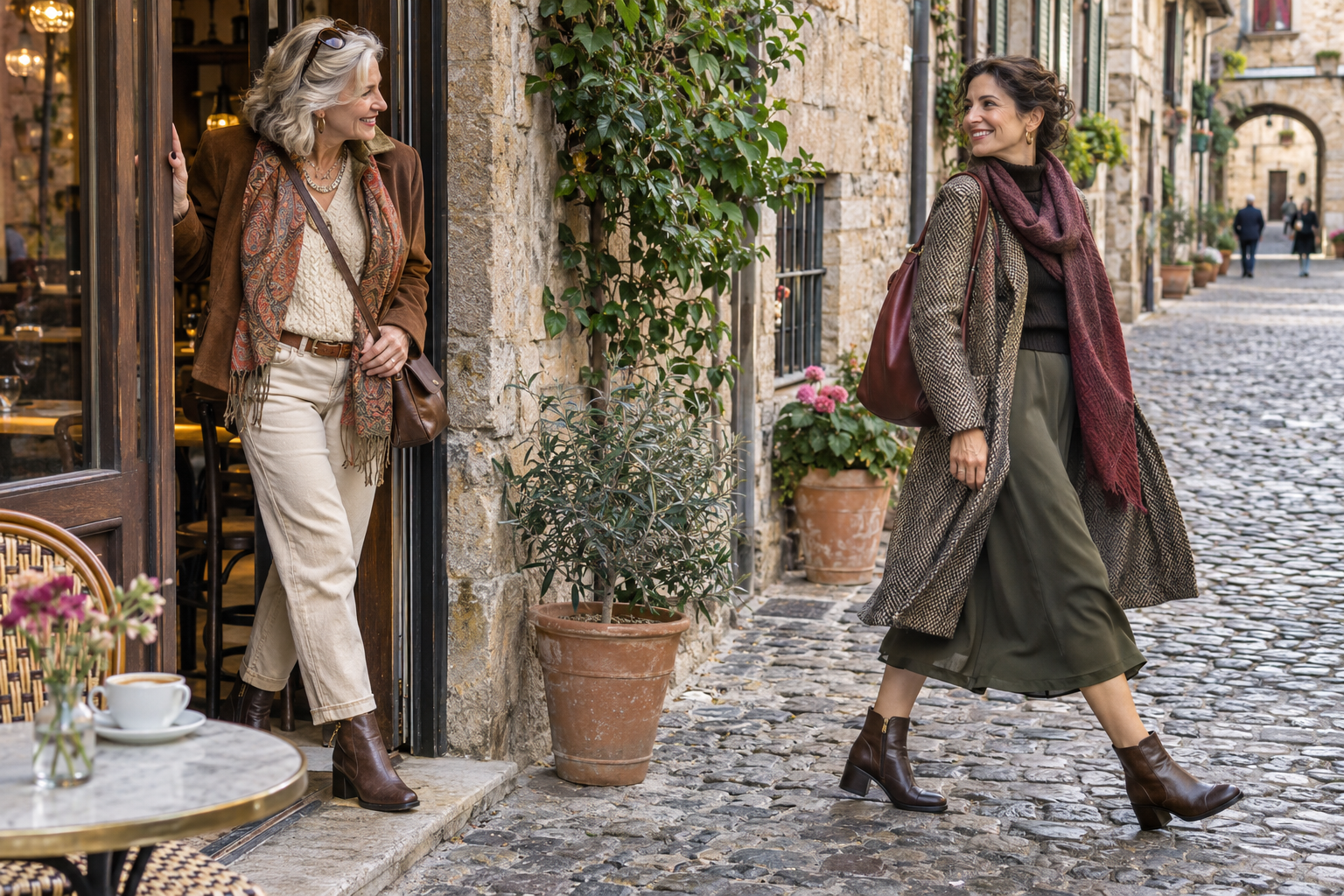
Because the striking thing, the thing that puzzles every sneaker-clad American visitor, is that the European women are manifestly not suffering in their heels. They walk the same cobbled streets the guidebooks warned you about, in heels, all day, and they do it with an ease and an elegance that seems to defy everything you were told.
This is genuinely confusing if you have internalized the guidebook binary. You were promised that heels on cobblestones were a recipe for turned ankles and ruined feet, a vanity you would pay for painfully, and yet here are women of all ages, including plenty over fifty, crossing those very cobbles in heeled shoes and boots without the slightest difficulty, chatting and striding and looking wonderful. They are not wincing, not teetering, not picking their way gingerly; they are simply walking, as naturally as you would in your sneakers. It looks, to the baffled American, like a kind of magic, or at least a skill she was never taught.
It is neither magic nor some innate European talent for balance. The local women can do it because they understand something about heels and cobblestones that the flat-shoe advice never explains, a set of practical truths that transform heels from the impossibility the guides describe into the entirely manageable, everyday footwear the Europeans treat them as. Once you know what they know, the mystery dissolves, and the stark choice between sneakers and suffering turns out to have been false all along. Here is what they know.
It Is the Kind of Heel
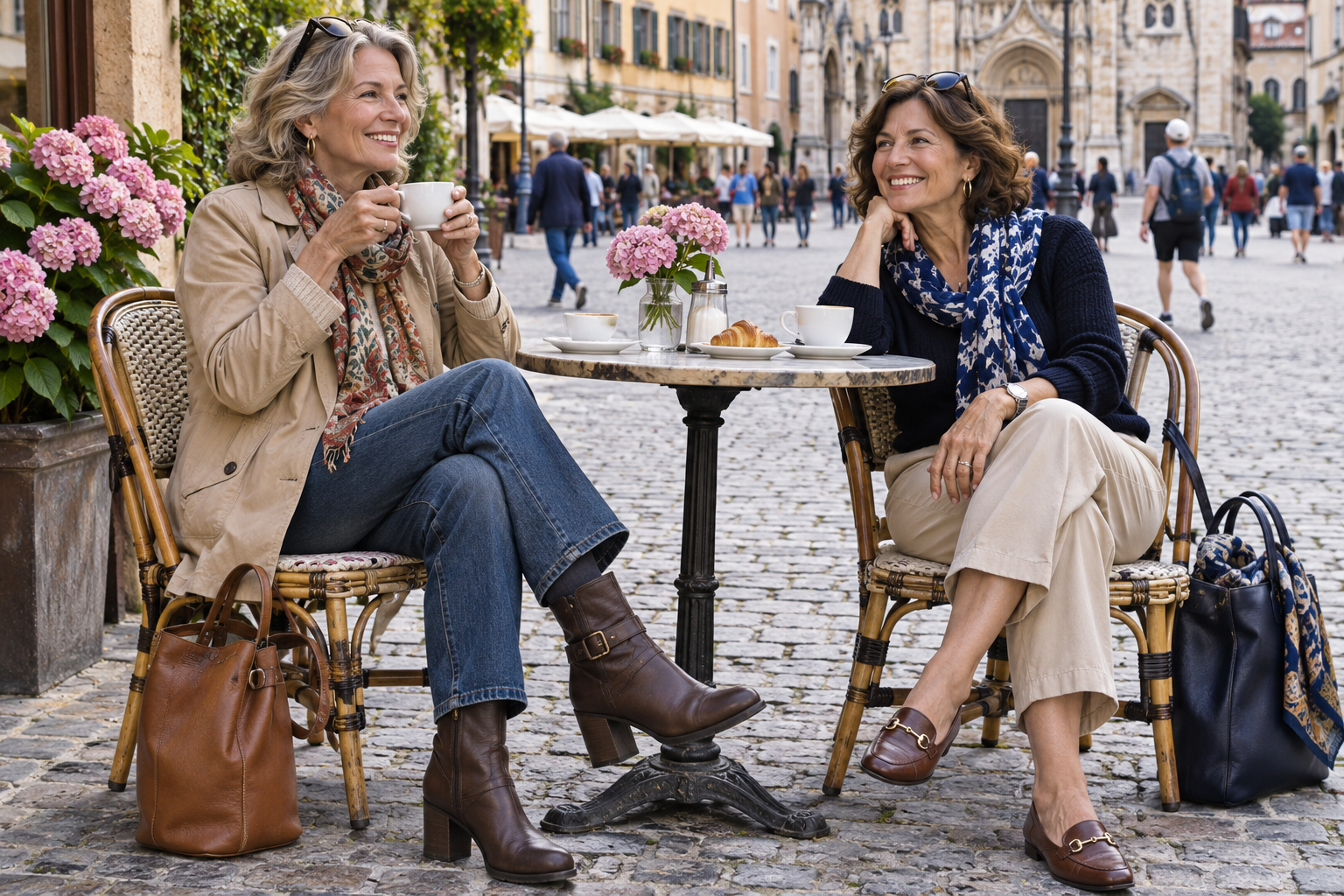
The first and most important secret is about the heel itself, and it is the thing the guidebooks almost never specify: not all heels are the same, and the European women are, for the most part, not wearing the kind you are picturing. When the guides warn against heels, they are imagining stilettos, those thin, high, spiky heels that really are a disaster on uneven ground, and they are right that those are a terrible idea on cobbles.
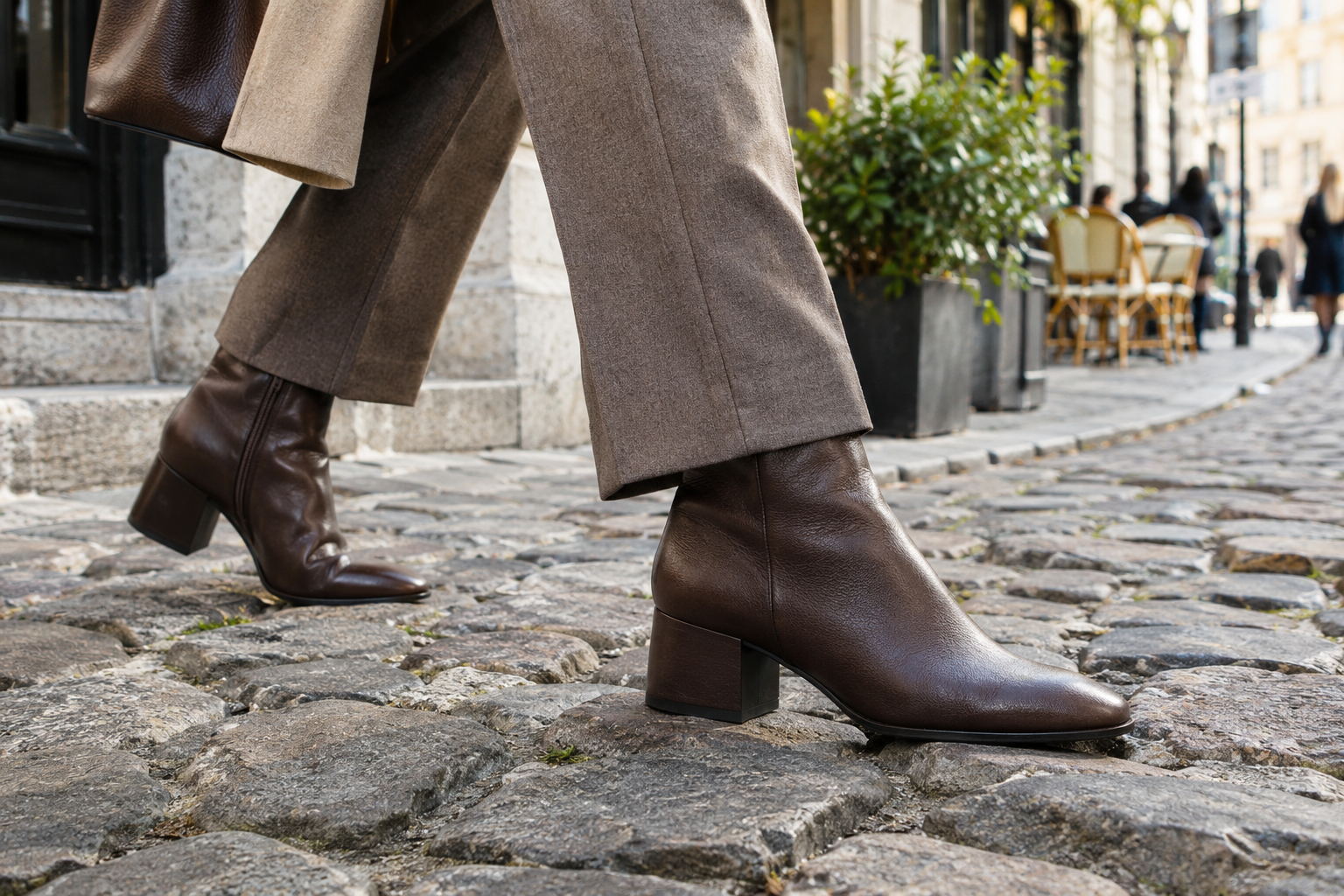
But that is not what the European women are wearing. The everyday European heel, the one that crosses cobblestones with such ease, is a block heel, a wedge, or a low, sturdy heel, often on an ankle boot, a chunky, stable heel with a broad base rather than a thin spike.
The difference is everything. A thin stiletto heel sinks between the cobbles, catches in the gaps, and tips you off balance, which is exactly the catastrophe the guides warn about; a broad block heel or a solid wedge sits securely across the uneven stones, giving you a stable, planted base that handles cobbles with no drama at all. The European women are not performing a feat of balance in stilettos; they are walking comfortably in stable, sensible heels that happen also to be stylish.
This single distinction resolves most of the mystery, and it is precisely what the flat-shoe advice fails to make. The guides lump all heels together and warn against the whole category, when the real rule is that the type of heel is what matters: thin spiky heels are indeed impossible on cobbles, but broad, stable, lower heels are perfectly walkable and have been the European solution all along. The choice was never heels versus flats; it was the right kind of heel versus the wrong kind, and the Europeans simply know which is which.
It Is How They Walk
The second secret is about technique, because walking well on cobblestones is a genuine skill, and the European women have it where the visitor does not. They have been walking on these surfaces their whole lives, in all kinds of shoes, and that lifetime of practice shows in how they move.
The differences are subtle but real. A local woman on cobblestones tends to take slightly shorter, more deliberate steps, to place her feet with an unconscious awareness of the surface, to carry herself with a relaxed confidence that keeps her balanced, and generally to move as someone entirely at home on uneven ground. The tourist, by contrast, is often tentative and stiff, watching her feet, taking uncertain steps, tensing up in a way that actually makes her less stable, not more. The European is not concentrating on the cobbles at all; she has walked on them since childhood, and her body handles them automatically, which frees her to stride along in heels while the visitor picks her anxious way in flats.
This is good news for the traveler, because technique can be learned, or at least approximated, with a little awareness. You will never match a lifetime of practice in a two-week trip, but you can walk more like a local simply by relaxing, taking slightly shorter and more deliberate steps, placing your whole foot with intention, and carrying yourself with confidence rather than creeping along watching the ground. A good deal of the European ease on cobblestones is just comfort and practice, and while you cannot fully fake the practice, you can drop the tense, tentative shuffle that makes the surface harder than it needs to be. Walk like you belong there, and the cobbles grow kinder.
And They Are Not Marching Twelve Hours
The third secret is the one nobody likes to admit, but it is important for an honest comparison: the European women are not doing what you are doing. A local woman in heels is going about her ordinary day, which involves a reasonable amount of walking punctuated by sitting, not the punishing tourist marathon of ten or twelve hours continuously on her feet.
This changes the whole comfort equation. The European woman walks from home to the metro, from the metro to work, out to lunch, to a few errands, perhaps to dinner, with plenty of sitting in between at her desk, in cafes, on the train.
Her feet get real rest throughout the day, so stylish heels that are perfectly comfortable for that pattern of use would be a different matter over a relentless twelve-hour sightseeing slog. The tourist, by contrast, is on her feet almost continuously, covering far greater distances than any local would, with few real breaks, which genuinely is harder on the feet and does call for more forgiving footwear. The local is not tougher than you; she is simply having a different, gentler day.
Recognizing this is liberating, because it means the sneaker advice is really advice for the tourist marathon, not for European walking as such. On a day when you truly will be on your feet for twelve hours straight covering miles of ground, comfortable shoes are genuinely the right call, and you should not feel you have failed some style test by wearing them. But on an ordinary day, or an evening out, when your walking looks more like the local woman’s, with sitting and cafes and reasonable distances, you have far more latitude than the guidebooks suggest, and the stylish stable heel the Europeans favor becomes entirely viable for you too. Match your shoes to your actual day, not to the worst-case marathon.
What the Flat-Shoe Guides Get Wrong
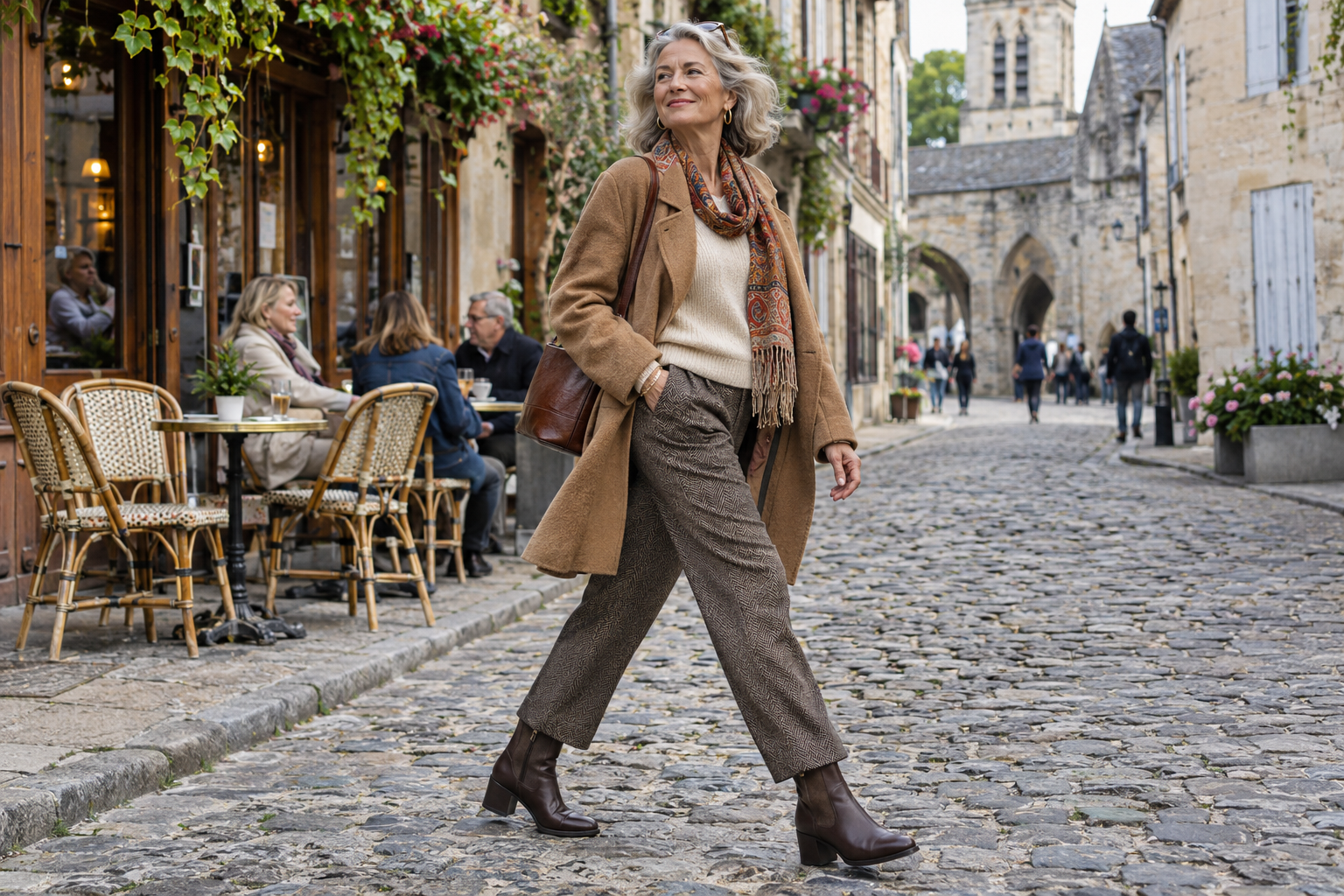
Put the three secrets together and you can see exactly where the flat-shoe advice goes wrong, which is worth stating plainly because the error is so widespread. The guides are not wrong that comfort matters, that cobbles are real, or that stilettos are a disaster; on all of that they are correct. What they get wrong is the framing, the presentation of the whole thing as a brutal choice between comfortable ugliness and elegant pain.
That binary is false, and it is false because it ignores the entire middle of the range, which is precisely where the European women live. Between the sneakers the guides push and the stilettos they warn against lies a wide territory of footwear that is both genuinely walkable and genuinely stylish: the block-heeled ankle boot, the sturdy low heel, the wedge, the elegant flat that is not a sneaker. The guides, imagining only the two extremes, never mention this middle ground, and so they send American women to one pole, comfortable but frumpy, while the Europeans occupy the sensible, chic center the whole time. The advice is not so much wrong as incomplete, and the incompleteness is exactly the part that matters.
So the real shoe rule, the one the European women follow and the guides fail to teach, is this: you do not have to choose between comfort and style, because the right kind of heel, or a proper stylish flat, gives you both. The flat-shoe guides, by presenting only sneakers-or-suffering, have been quietly telling American women that looking good in Europe requires either misery or risk, when the locals have known forever that a stable, lower heel sidesteps both. Correcting that single misframing is the whole of the lesson, and it opens up a far better set of options than the guidebooks ever offered.
The Walkable Middle
So here is the practical takeaway, the European shoe rule for anyone who would rather not spend her whole trip in sneakers but also has no wish to suffer. Aim for the walkable middle: skip both the athletic sneakers and the thin stilettos, and choose the shoes the European women actually wear.
In concrete terms, that means a block-heeled ankle boot, a sturdy low or mid heel with a broad stable base, a wedge, or a genuinely stylish flat that reads as a real shoe rather than a trainer, all of which are comfortable enough for a reasonable amount of real walking and chic enough to look thoroughly European. Pair them with the technique, relaxed, deliberate steps and a confident carriage, and with a realistic sense of your day, and you can cross the cobblestones looking like a local rather than shuffling across them looking like a tourist. Keep the actual sneakers in reserve for the genuine twelve-hour marathon days, where comfort rightly wins, but do not assume every day requires them. A good pair of block-heeled boots can carry you through an ordinary day of sightseeing more happily than you would believe, as long as you have chosen the heel well and are not trying to cover fifteen miles in them.
The deeper point is simply that you were sold a false choice, and you can stop making it. European women are not suffering for their elegance, and they are not performing impossible feats of balance; they are wearing sensible, stable, stylish heels, walking with practiced ease, and living a gentler daily rhythm than the tourist grind.
Any of that you can borrow. Choose the right kind of heel, walk with a little confidence, match your shoes to your real day, and you can have both the comfort and the chic the guidebooks swore you had to choose between. The cobblestones were never the enemy; the false binary was.

About the Author: Ruben, co-founder of Gamintraveler.com since 2014, is a seasoned traveler from Spain who has explored over 100 countries since 2009. Known for his extensive travel adventures across South America, Europe, the US, Australia, New Zealand, Asia, and Africa, Ruben combines his passion for adventurous yet sustainable living with his love for cycling, highlighted by his remarkable 5-month bicycle journey from Spain to Norway. He currently resides in Spain, where he continues sharing his travel experiences with his partner, Rachel, and their son, Han.